Published on
June 22, 2023


Most FedEx Ground routes sell for $300,000 to $1.5 million, priced as a multiple of cash flow rather than a flat fee. Single-route deals sit at the low end; multi-truck contracted service areas (CSAs) trade at 2.5x to 4x seller's discretionary earnings (SDE) [1]. Other sources put the typical deal between $500,000 and $1.5 million, with about 75% of the purchase price financed [5]. Some smaller single-route businesses can be found closer to $100,000, though that figure is an average across a wide range of route sizes and shouldn't be your planning number for a multi-route CSA [3].
Whatever the sticker price, plan on putting up real cash. Buyers typically need $200,000 to $1 million or more in equity, with SBA financing covering the rest [1]. If a lender is involved, expect a 20% down payment as the norm rather than the exception [2]. That's the practical answer to the "FedEx franchise cost" question people search for - it isn't a franchise fee at all, it's a business purchase price plus a down payment.
A FedEx route business is a company that has signed an Independent Service Provider (ISP) agreement with FedEx Ground to handle pickup and delivery in a set territory, using its own trucks and employees. You're not buying a route directly from FedEx - you're buying the operating company that holds that agreement, and FedEx has to approve you as the incoming contractor before the sale closes [1].
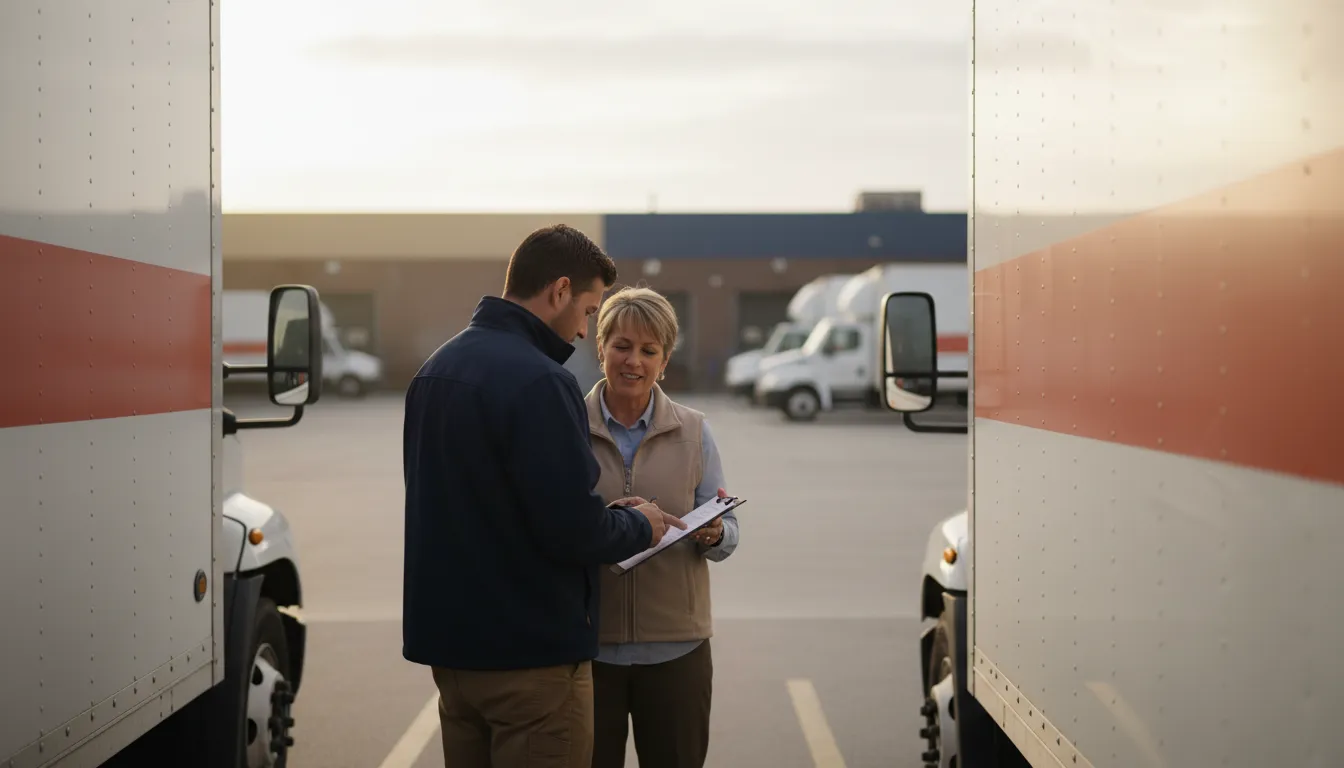
This is a real operating business, not a licensed brand name. There's no franchise fee to become eligible, and FedEx stays largely out of your day-to-day staffing and equipment decisions [1]. What you are buying is a contract, typically written for a 2 to 3 year term and renewable, that grants exclusive service rights in a defined area [6]. FedEx Ground is a meaningful piece of the parent company's business too - it brings in around 30% of FedEx's total revenue, which is part of why the ISP model has stayed stable for decades [6].
Because you own the operating company, you also own its obligations: payroll, insurance, vehicle maintenance, and compliance. FedEx sets service standards and safety requirements, but you run the business. That distinction matters when you're comparing this to a traditional franchise, where the franchisor controls far more of your operations.
FedEx P&D stands for pickup and delivery - daytime routes moving packages between businesses, homes, and FedEx facilities within a local territory. Linehaul routes are the opposite: overnight, interstate runs between FedEx hubs using tractor-trailers and CDL-licensed drivers. Most first-time buyers start with P&D because it's simpler to run and cheaper to enter.

Neither type is automatically the "better" buy - it depends on your risk tolerance, driving background, and how much you want to be hands-on. If you've never run a trucking or delivery operation, I'd start with P&D. You'll learn the FedEx compliance and reporting rhythm on a smaller scale before you take on the extra regulatory weight of linehaul.
Buying a FedEx route follows six steps: find available routes, confirm your eligibility, do due diligence on the financials and equipment, line up financing, sign a purchase agreement, and get FedEx's approval to take over the ISP contract. Each step gates the next - FedEx approval comes last, after the deal is otherwise done.
FedEx routes are valued as a multiple of earnings, most often SDE or EBITDA, not by a fixed formula per stop or per truck. Current market pricing runs 2.5x to 4x SDE for most Ground/Home Delivery territories, and 3.5x to 5x EBITDA on the higher end for larger, multi-truck operations [1][2].

Picture a founder named Marcus looking at a five-route CSA generating $900,000 in annual SDE. At a 3x multiple, that route prices out around $2.7 million. If a bank will finance 75% of that through SBA debt, Marcus still needs roughly $675,000 in cash equity plus working capital for the transition period - a very different number than the sticker price alone suggests. This is exactly why buyers get burned when they anchor to the "average $100,000 route" figure without checking whether that average applies to a business their size [3].
A real appraisal also weighs route density, contract term remaining, driver retention, and vehicle age. Two routes with identical revenue can be worth very different amounts if one has three years left on its contract and the other is up for renewal in six months.
Buying a FedEx route can be a solid investment if you value stable, contracted revenue and are prepared to actively manage people and vehicles - it is not a passive income play. The upside is real: consistent demand, fast payment from FedEx, and no marketing spend to find customers. The downside is a large upfront capital requirement and full operational responsibility for staff, equipment, and compliance.
| Pros | Cons |
|---|---|
| Brand recognition and built-in customer base | Large upfront investment, often $300K-$1.5M [1] |
| Reliable, contracted revenue | Financing lenders for this niche are limited |
| Fast payment from FedEx vs. 30+ day terms elsewhere | Full responsibility for hiring, training, and managing drivers |
| Low marketing spend, no sales function needed | Peak-season and holiday work is mandatory |
| Operational flexibility as owner | Regulatory and safety compliance sits entirely on you |
Profit margins typically run 10% to 25% of revenue, translating to about $30,000 to $40,000 in annual profit per route [3]. A contractor running five routes at the high end of that range is looking at roughly $150,000-$200,000 in annual profit before accounting for debt service on the purchase. Run that math against your specific deal before you decide it's a good investment - the average margin tells you very little about your route.
Most FedEx route purchases are financed with a mix of buyer equity, an SBA 7(a) loan, and sometimes seller financing for a portion of the price. SBA loans are the dominant path because conventional banks are cautious about lending against a contract-based business with no hard real estate collateral.
| Option | Typical down payment | Typical term | Notes |
|---|---|---|---|
| SBA 7(a) loan | ~20% down | 10-year term [2] | Max loan amount is $5 million [4] |
| Conventional bank term loan | Higher, deal-specific | 5-7 years [2] | Stricter credit and collateral requirements |
| Seller financing | Negotiated | Negotiated | Often paired with SBA debt to close a gap |
An SBA 7(a) loan's 10-year amortization versus a conventional loan's 5-7 years matters more than people realize - it's the difference between debt service eating 60% of your route's cash flow versus 35%. That gap is often the deciding factor in whether a route can support its own purchase price. Ask any lender you talk to to run both scenarios before you commit.
One more practical note on staffing costs, since they're your biggest recurring expense after debt service: the median wage for light truck drivers was $44,860 in 2025, and demand for these roles is projected to grow 7% through 2035 [7]. Build your driver pay assumptions around current market wages, not whatever the seller happened to be paying two years ago.
Buying a FedEx route is a real business purchase, priced on earnings multiples, gated by FedEx's own approval process, and financed mostly through SBA debt. The people who do well with it treat it like buying any operating company: verify the financials, size the debt to the actual cash flow, and understand exactly what FedEx will and won't let you change. If you'd rather not build the financial model by hand, Phoenix Strategy Group can help you pressure-test a route's numbers before you sign anything.
No. FedEx Ground does not sell territories directly to the public. You buy the operating company that holds the Independent Service Provider (ISP) agreement from its current owner, and FedEx must approve you as the incoming contractor before the sale closes [1].
It can be, if you're prepared to actively manage staff, vehicles, and compliance rather than sit back passively. Profit margins typically run 10%-25% of revenue, or about $30,000-$40,000 per route annually, so the investment case depends heavily on how many routes you run and how you finance the purchase [3].
P&D stands for pickup and delivery - daytime routes that move packages between businesses, homes, and FedEx facilities within a local territory. It's distinct from linehaul routes, which run overnight between FedEx hubs and require a CDL.
You own a FedEx route by buying an operating company with an existing ISP agreement (or building one from scratch), structured as a corporation, able to handle employer responsibilities, and meeting FedEx's minimum route requirements of at least five routes or 500 stops per day [3].

About the author
Partner, Phoenix Strategy Group
Ethan Lu is a Partner at Phoenix Strategy Group, where he works as a fractional CFO helping founder-led companies maximize their exit value. He currently oversees more than $200M in client enterprise value and has been part of multiple eight-figure exits. Before PSG he was an asset manager and investor for a San Diego family office, where he sat on the investment committee for more than $1B in assets. A data scientist by training, he holds a B.S. in Mathematics with a minor in Accounting from UC San Diego.
Talk to a PSG CFO about your numbers
Phoenix Strategy Group does CFO work for growth-stage companies.
Schedule a call