Published on
August 9, 2026


If I need to run a SaaS business day to day, I look at MRR. If I need to show scale over a year, I look at ARR.
Here’s the short version:
A simple example:
That sounds simple. But mistakes happen when teams mix in non-recurring revenue or use only one metric.
What I’d keep in mind:
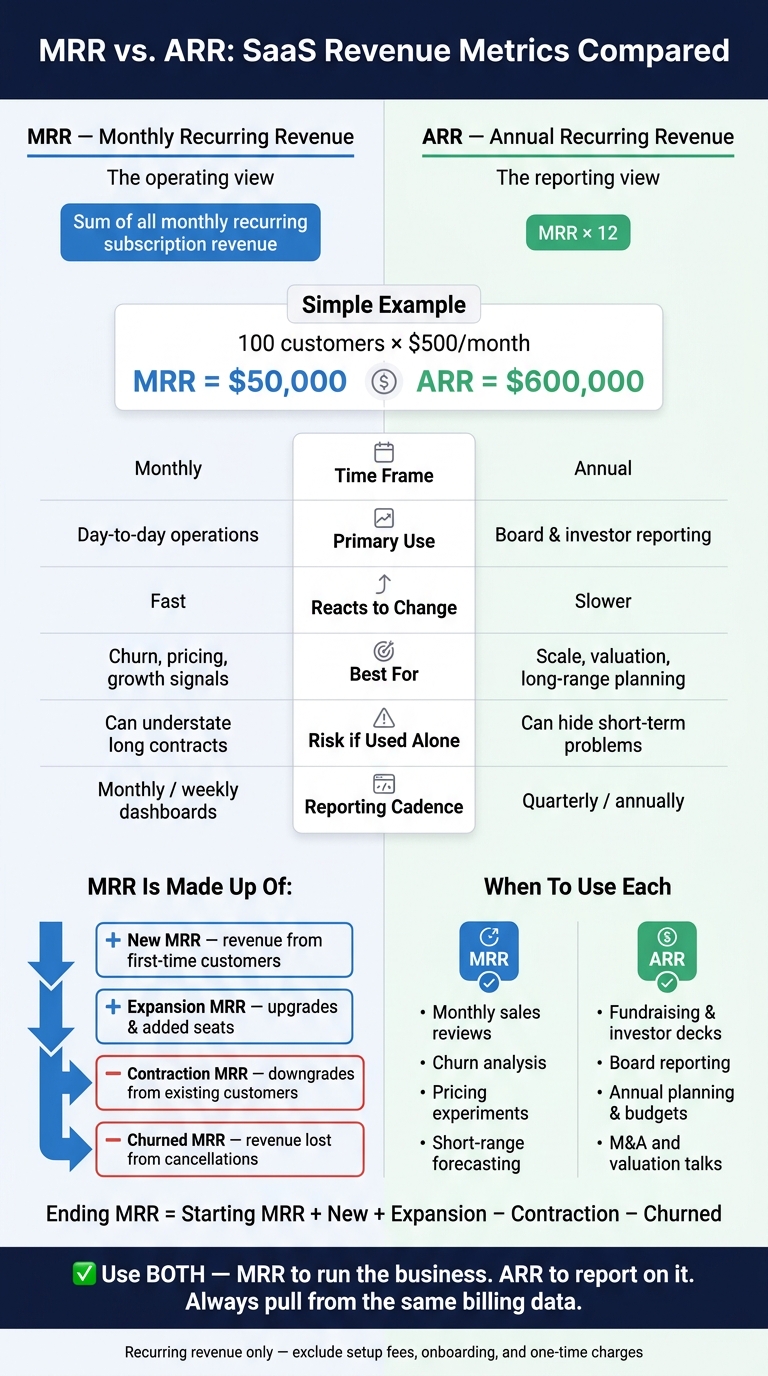
MRR vs. ARR: SaaS Revenue Metrics Compared
| Criteria | MRR | ARR |
|---|---|---|
| Time frame | Monthly | Annual |
| Main use | Month-to-month decisions | Yearly reporting |
| Formula | Sum of monthly recurring revenue | MRR × 12 |
| Best for | Churn, pricing, growth changes | Scale, planning, investor view |
| Reacts to change | Fast | Slower |
| Risk if used alone | Can understate long contracts | Can hide short-term problems |
Bottom line: I’d use both. MRR tells me what is happening now. ARR shows what that revenue base looks like over 12 months.
MRR is the normalized monthly value of recurring subscription revenue from active contracts, converted to a monthly equivalent. It is not cash, billings, or GAAP revenue. It shows the recurring revenue you have in force right now.
That matters because MRR can move fast. New sales push it up. Churn pulls it down. Expansions and downgrades can shift it from one month to the next. So if you want the best near-term operating metric for a SaaS business, MRR is usually the one to watch.
The rule is simple: include only revenue you expect to recur next month under the current contract.
Monthly subscription fees from active plans belong in MRR. Recurring add-ons count too, like per-seat charges or premium support billed each month. Annual and multi-year contracts count as well, but only on a monthly basis. So if a customer signs a $12,000/year contract, that customer adds $1,000 to MRR, not $12,000.[2][3][4]
Some items stay out of MRR on purpose:
Why leave those out? Because putting them into MRR makes the number look bigger than it is. It can also hide churn and throw off the rest of your reporting.
To understand what changed during the month, track MRR as a bridge. Each month, total MRR moves through four core parts:
| MRR Component | What It Captures | Example |
|---|---|---|
| New MRR | Revenue from first-time customers | 5 new customers at $3,000/month = +$15,000 |
| Expansion MRR | Upgrades or added seats from existing customers | Customer grows from $2,000 to $3,500/month = +$1,500 |
| Contraction MRR | Downgrades from existing customers who stay | Customer drops from $1,000 to $700/month = −$300 |
| Churned MRR | Revenue lost from full cancellations | 3 customers at $500/month cancel = −$1,500 |
The formula is straightforward: Ending MRR = Starting MRR + New MRR + Expansion MRR − Contraction MRR − Churned MRR.
Finance teams use this monthly bridge to catch churn, expansion, and pricing problems early. It turns a headline number into a story of what happened.
Here’s a concrete example. A company starts January with $333,000 MRR. During the month, it adds $48,000 in new customer MRR, gains $12,000 in expansion, loses $6,000 to contraction, and loses $11,000 to churn. That leaves the business with $376,000 MRR at month-end.[5]
That bridge shows, in plain terms, how sales, retention, and pricing shifted during the month. ARR uses that same revenue base and converts it into an annual view.
Next, convert the same monthly base into ARR for the annual view.
Annual Recurring Revenue (ARR) is the annualized value of contracted recurring subscription revenue, expressed as a 12-month run rate. In plain English, it shows what your recurring revenue would look like over the next year if today's run rate stayed the same and there were no new sales or churn.
ARR is simply the yearly view of the same recurring base that MRR tracks month by month. That’s why ARR is the metric teams lean on for annual planning and investor reporting.
In a simple recurring subscription model, ARR = MRR × 12. So if a company has $50,000 in MRR, its run-rate ARR is $600,000.
If the business has a mix of monthly, annual, and multi-year contracts, the math changes a bit. You annualize each active recurring contract, then add everything together.
The inclusion rule should match MRR. Count only recurring subscription revenue and contractual add-ons. Leave out setup fees, onboarding, implementation, professional services, and one-time usage spikes or overages.
Finance teams also use ARR waterfalls to map churn, expansion, and new ARR for budgets and hiring plans.
ARR is the headline metric for boards, investors, and acquirers because it gives a quick read on scale, durability, and valuation. Valuations are often discussed in ARR multiples, and board or investor conversations usually use ARR as the frame of reference.
ARR also helps with retention and cohort analysis. It shows whether the recurring revenue base is growing, staying flat, or shrinking over time.
Next, compare ARR and MRR side by side to see where each metric is strongest.
MRR and ARR follow the same recurring-revenue logic. The main difference is the time frame. But that one shift changes how teams report performance, make calls, and spot risk. Here's where each metric does its best work.
| Dimension | MRR | ARR |
|---|---|---|
| Time horizon | Monthly | Annualized |
| Primary use | Operating decisions and short-term forecasting | Fundraising, valuation, board reporting, long-range planning |
| Reporting cadence | Monthly, often weekly in dashboards | Quarterly or annually; board-level |
| Sensitivity to churn | High - changes appear quickly | Lower - short-term churn can be masked |
| Sensitivity to seasonality | High | Lower; smoother view of the business |
| Best fit | Monthly-billed, product-led, or fast-changing revenue bases | Annual or multi-year contracts, investor reporting |
| Common decision | Sales quota this quarter, pricing experiment results | When to raise, what valuation to target, when to hire a CRO |
For growth-stage SaaS founders, the rule of thumb is pretty simple: use MRR to run the business week to week, and use ARR to talk about the business with investors and the board. That's why many SaaS teams need both, not just one.
ARR can hide problems that are already happening. Because it smooths short-term swings, ARR can cover up churn, soft sales stretches, and seasonality.[8][9]
MRR runs into the reverse issue. If annual or multi-year contracts make up most of the business, MRR can make contracted scale look smaller than it is and can hide renewal cliffs.[6][7][9]
One rule applies to both: don't mix in one-time revenue. Setup, onboarding, implementation, and services revenue can bloat these metrics during busy stretches and then make later periods look weaker than they are.[10][11][12]
That's what shapes when founders should lean on MRR, ARR, or both.
Once the definitions are set, the next step is simple: pick the metric that fits the decision you're making.
MRR is the metric for month-to-month operating calls. It changes fast with new sales, churn, pricing shifts, and tests. That makes it the best signal when you're managing the business in the near term.
Early-stage SaaS teams usually watch MRR most closely because it shows churn and expansion fast. It's the right metric for monthly sales reviews, churn analysis, and short-range forecasting. That includes things like quota-setting, marketing spend, and hiring plans in customer support and customer success.
For external reporting and long-range planning, ARR is the better fit.
Use ARR for fundraising, board reporting, and annual planning. It's the cleaner metric for outside audiences because investors, lenders, and acquirers often benchmark SaaS value on ARR.[13][14][1][15][16][17]
ARR also helps frame bigger goals. It sets targets, points to the investments needed to hit them, and gives buyers and lenders a clean number to use for multiples in M&A or debt talks.
When you present ARR externally, be clear about what's included: recurring subscription revenue only, with one-time fees left out. Also break out the mix of monthly and annual contracts. That kind of clarity makes due diligence move with less friction and helps avoid later reclassification that can shrink perceived scale.[14][1][15][16]
The best approach is to use both metrics from the same source data. Strong SaaS reporting ties MRR and ARR back to the same records, so monthly bridges and annual waterfalls reconcile cleanly.
MRR and ARR aren't competing metrics. They answer different business questions.
MRR is the operating view. ARR is the reporting view.
In plain English, they reflect the same recurring revenue base at two different time horizons. MRR helps you run the business month by month. ARR helps you present that same business to investors and boards in a yearly frame.
For growth-stage SaaS teams, the best move is simple: report both.
Just make sure both metrics come from the same billing and contract data so they reconcile cleanly. When MRR and ARR pull from the same data set, you get one view for operating decisions and one view for reporting. That's the line between merely tracking revenue and actually managing it.
For annual contracts, first convert each contract’s total value into MRR by dividing by 12.
Then add the MRR from all active, recurring subscriptions.
To get ARR, multiply that total MRR by 12.
This gives you a standardized run-rate view of recurring revenue, not cash bookings or GAAP-recognized revenue.
MRR includes only the predictable, normalized revenue from active subscription customers.
To calculate it, add up the monthly subscription fees from active users. Leave out one-time charges like setup or implementation fees, along with non-recurring usage charges.
Early-stage SaaS teams should usually track MRR first. It shows monthly momentum and gives the short-term view you need to spot where revenue is growing or slipping.
ARR - usually MRR × 12 - still matters. It helps with long-range planning, investor reporting, and valuations. As the business grows, teams can start tracking other metrics too, like churn, CAC payback, and net revenue retention.