Published on
September 13, 2026


If I want the short answer: a corporate buyer often means more cash at close, while a PE buyer often means less cash now and more upside later.
That choice shapes almost every part of the sale:
So if you want a clean exit, I’d lean toward a corporate buyer. If you want partial liquidity, want to stay involved, and are willing to bet on a second sale, I’d look harder at PE.
Before going to market, I’d compare the deal on three things, not one:
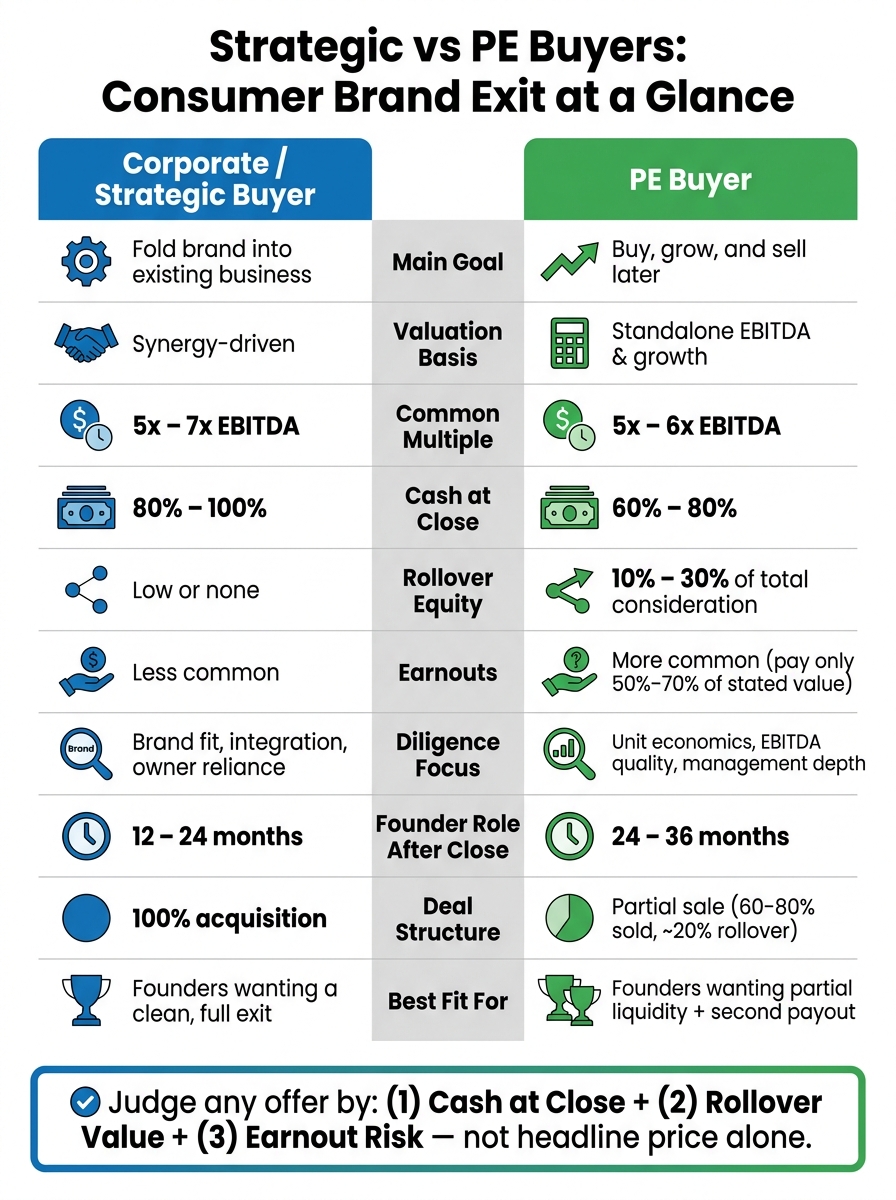
Strategic vs PE Buyers: Consumer Brand Exit Comparison
| Criteria | Corporate Buyer | PE Buyer |
|---|---|---|
| Main goal | Add the brand to an existing business | Buy, grow, and sell later |
| Valuation focus | Synergies plus current earnings | Standalone EBITDA and growth |
| Common multiple | 5x to 7x EBITDA | 5x to 6x EBITDA |
| Cash at close | 80% to 100% | 60% to 80% |
| Rollover equity | Usually lower or none | Often 10% to 30% |
| Earnouts | Less common | More common |
| Diligence focus | Fit, owner reliance, system handoff | Unit economics, working capital, reporting, team depth |
| Founder role after close | Often shorter | Often longer |
| Best fit for | Founders who want a near-full exit | Founders who want a second shot at value |
One more point: the highest headline price is not always the best deal. I’d judge the offer by what lands in my bank account, how hard the post-close targets are, and how much control I keep after signing.
Strategic acquirers buy consumer brands to strengthen what they already own. The play is usually simple: move into a nearby category, cut costs through synergies, or run the brand through sales and distribution channels that are already in place. They buy to fold the business in, not to hold it as a stand-alone asset. And that shows up right away in pricing.
Strategic buyers don't look only at your current EBITDA. If your brand helps them open new channels or reach more customers, that synergy can push the offer higher. In practice, strategic buyers often pay 5x to 7x EBITDA [1], and they also tend to offer 80% to 100% cash at close [1].
That extra price isn't automatic, though. The buyer has to believe they can actually get the synergy. So before you take the deal to market, spell out the value story in plain English. Show where the brand fits, what it adds, and why the fit makes sense.
Once that case is on the table, diligence turns into a different conversation: can this business be folded in without a mess?
Strategic diligence centers on synergy capture and fit. Buyers want to know how well the business will slot into their current setup. That includes owner dependency, process documentation, and whether the company can run without too much tribal knowledge stuck in one person's head.
Earnouts are less common in strategic deals. When they do show up, they usually tie back to integration goals or revenue milestones. Buyers also like to see standardized software and documented SOPs in place 12 to 24 months before a sale. That makes integration smoother and can make the business more appealing.
Compared with private equity deals, strategic transactions are often cleaner purchases, with rollover equity showing up less often [2].
If the buyer sees a clear path to integration, deal terms usually get cleaner as well.
After closing, things can move fast. Back-office functions, often managed by fractional CFO services, are consolidated early, and the founder usually has less room to steer day-to-day decisions.
"The advantage [of a strategic sale] is maximum cash and a clean break. The risk is that your product might eventually get absorbed or sunset if it doesn't fit perfectly with their strategy." - Axial [2]
Most founders leave within 12 to 24 months. They get scale and liquidity, but they give up control. That's the trade-off in plain terms. You may get the highest cash outcome up front, but the brand's identity can shift, and the product line may even be discontinued if it no longer fits the acquirer's plans.
Private equity buyers look at the same brand through a different lens: less synergy, more structure.
Unlike strategic buyers, PE firms look at the brand as a standalone business, not something to fold into a bigger company. That changes the whole deal.
Most PE firms hold consumer brands for 3 to 7 years and try to grow value through a platform or add-on acquisition play before selling again. For founders, that usually means partial liquidity now and a longer road to full liquidity later. You’ll often keep more day-to-day control than you would in a strategic sale, but there’s a tradeoff: more reporting, more board involvement, and more eyes on performance.
PE firms usually price consumer brands based on EBITDA because they’re looking at how much better the business can run on its own, not what synergies they can pull from a merger. In many cases, multiples fall in the 5x to 6x EBITDA range [1].
Leadership depth matters too. A strong second-in-command can lift your multiple by 1x to 1.5x by itself [1]. That makes sense. If the business can run without the founder driving every key decision, the buyer sees less risk.
Cash at close also tends to look different in PE deals. These transactions often pay 60% to 80% cash at close, versus 80% to 100% with strategic buyers [1]. The rest usually comes through rollover equity.
Because PE buyers care about standalone performance, diligence tends to go deeper. They’ll spend more time on unit economics, working capital, management depth, and the quality of your reporting. In a perfect setup, those systems are already in place 12 to 24 months before sale.
PE deal terms often include rollover equity, usually 10% to 30% of total consideration [1]. That piece gives founders a shot at a second payout when the PE firm exits later.
Earnouts are common too, often tied to EBITDA or cash flow goals. But there’s a catch: they often pay only 50% to 70% of stated value [1]. On paper, the number can look great. In practice, getting paid is a different story.
Tip: When reviewing rollover terms, don't focus only on the percentage. The definitive agreement's preferred returns, catch-up provisions, and tag-along/drag-along rights matter just as much - sometimes more [1].
After closing, founders often stay involved for 24 to 36 months under PE ownership. The role usually comes with more board oversight, tighter reporting, and clear operating targets. So while there’s often more continuity and more upside than in a strategic sale, there’s also less freedom and more governance.
The choice comes down to one plain trade-off: full exit now or shared upside later. You see that most clearly in valuation, diligence, and what life looks like after closing.
Strategic buyers pay for synergy. PE buyers pay for stand-alone cash flow and growth.
The deal structure changes a lot too. Strategic deals are often a 100% acquisition, followed by a transition period and then a full exit. PE deals are more often partial-sale deals, where the firm buys 60% to 80% and the founder rolls over about 20% equity [2]. That rollover can lead to a second payout if the next sale goes well.
Here’s the simplest side-by-side view:
| Feature | Strategic Buyer | PE Buyer |
|---|---|---|
| Valuation basis | Synergy-driven | Cash flow and growth efficiency |
| Common structure | 100% acquisition | Partial-sale deal (60–80% sale) [2] |
| Rollover equity | 10–20% of proceeds (if any) [2] | About 20% [2] |
| Earnout purpose | Confirm revenue stability and integration | Bridge valuation gaps |
One practical point on earnouts: no matter who the buyer is, push for proportional payouts. If you hit 90% of a target, you should get 90% of the earnout, not zero [2]. All-or-nothing setups are common, but they can be negotiated.
Once the structure is outlined, diligence becomes the part that puts pressure on the deal.
Strategic buyers spend much of their time on fit. They want to know how your brand, team, and systems will slot into what they already own. The core question is: will this work inside our company? PE buyers come at it from another angle: can this business perform and scale on its own? That usually means a deeper look at unit economics, EBITDA quality, management depth, working capital, and data quality.
| Dimension | Strategic Buyer | PE Buyer |
|---|---|---|
| Diligence focus | Brand fit, integration, customer overlap | Unit economics, EBITDA quality, management depth |
| Process complexity | Moderate | High |
| Key closing risks | Integration planning, transition services agreement terms, cultural fit | Working capital adjustments, management gaps, data quality, customer concentration |
After closing, buyer type can matter just as much as price.
Strategic buyers often fold the brand into a larger company. PE buyers more often keep it running as a stand-alone platform. Under PE ownership, the founder may stay on as CEO or in another senior role, with growth targets still in place and major decisions shared.
If you want maximum liquidity and a clean break, a strategic buyer often fits better. If you want to keep ownership, stay involved, and take a shot at another exit, PE is usually the better match.
Before either buyer can put a solid value on the business, your numbers need to be clean. That work looks almost the same no matter who you plan to sell to, and it should start well before you go to market.
It starts with clean accrual financials and a reliable monthly close. After that, both buyer types will dig into channel margins, SKU-level profitability, and cash flow forecasts. They’ll also want to see repeat purchase rates and customer concentration.
That last one can become a problem fast. If one customer makes up more than 10% of total revenue, expect PE buyers in particular to flag it or cut their offer [2].
Phoenix Strategy Group helps growth-stage consumer brands clean up financials and get ready for M&A.
Once the data room is ready, the main choice shifts from prep work to buyer type.
After the financial cleanup, the decision usually comes down to control versus upside.
Choose a strategic buyer when synergy value is driving the premium and you want a clean break. The trade-off is that your brand and team may need to fit into a more integrated setup after close.
Choose a PE buyer if you want partial liquidity now, plan to stay in a leadership role, and like the idea of a second payout later. PE buyers usually keep founders invested so everyone stays pointed at growth. That 20% rollover equity can turn into a second liquidity event if the PE firm executes well [2].
Look closely at diligence, deal structure, and post-close control. That’s usually where the gap between buyer types becomes most clear.
Start by getting clear on your personal and financial goals. Think about what you want life to look like after the deal, how involved you want to be, and what kind of structure works for you.
Strategic buyers often make sense if you want a clean exit and more cash upfront. Private equity buyers can be a better match if you want to stay involved or keep some upside through rollover equity. In most cases, it’s smart not to rule out either buyer type too early.
Rollover equity can be appealing because it gives you potential upside. If the company grows after the acquisition, you may get a second payout when the buyer sells the business later.
But there’s a catch. You’re still a minority shareholder, which usually means limited control over big decisions. And your return depends on the buyer’s plan, how well they run the company, and whether they can sell it at a good price - often four to six years after closing.
Start getting ready 6 to 12 months before you go to market. One of the biggest ways to lower buyer concern is to spread revenue across more customers, so no single client makes up more than 20% to 25% of total revenue.
Document every financial add-back clearly, keep GAAP-compliant financials, and normalize working capital. When diligence starts, share clean, reconciled records through a virtual data room so buyers can review everything without friction.
If an earnout is part of the deal, lock down the terms early. That includes the accounting policies, overhead caps, and milestones tied to metrics you can actually control.