Published on
September 15, 2026


Convertible notes can help you close a seed round fast, but they can also put your company on a clock. If I were weighing a note, I’d focus on four things right away: interest, maturity date, valuation cap, and dilution math.
Here’s the short version: a note is debt, not just a promise to convert later. That means interest can stack up, maturity can create repayment pressure, and caps or discounts can expand dilution more than many founders expect. The article’s main point is simple: a note works best as a short bridge to a near-term priced round, not as a fix for weak cash flow or an unclear fundraise plan.
If I wanted a clean way to judge the risk, I’d check these items first:
A few numbers from the article show why this matters:
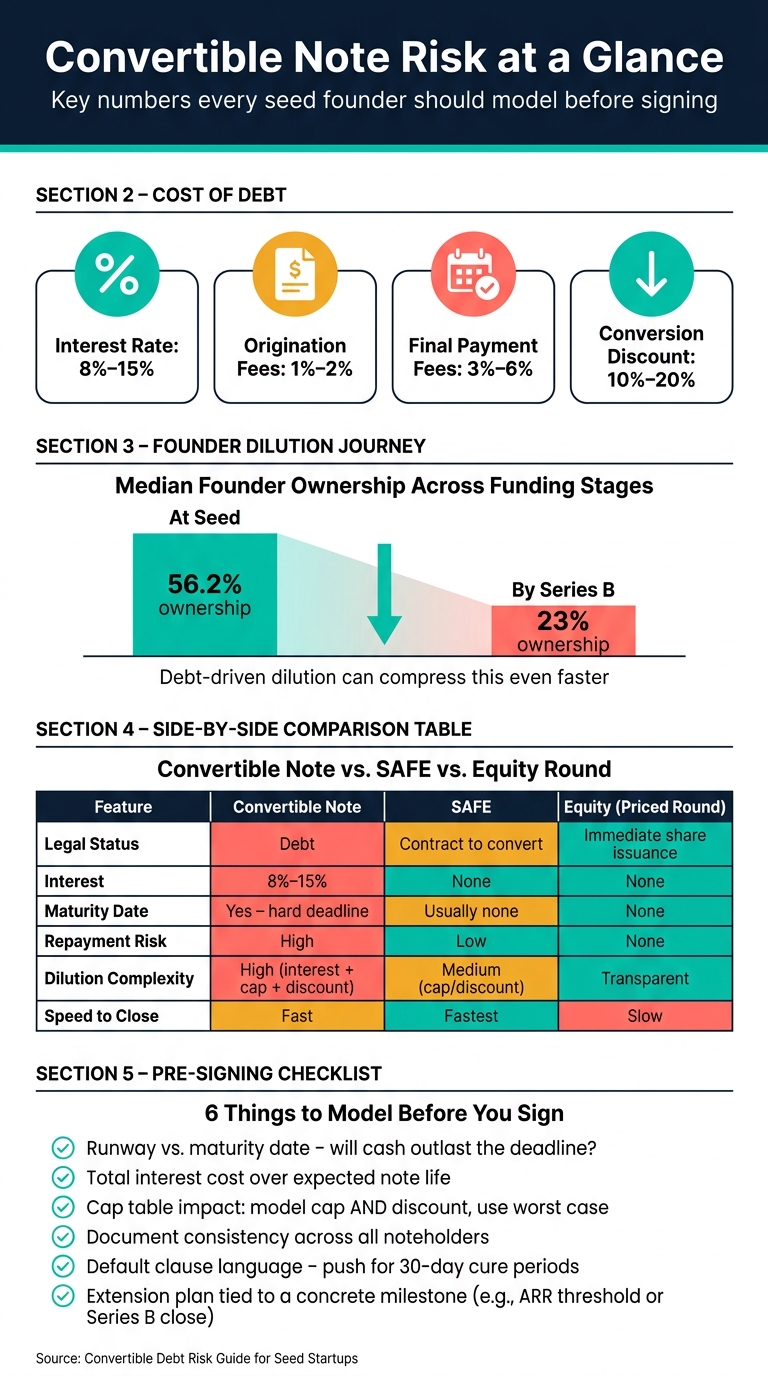
Convertible Note vs. SAFE vs. Equity: Seed Startup Risk Comparison
| Topic | Convertible Note | SAFE |
|---|---|---|
| Legal status | Debt | Contract to convert later |
| Interest | Usually 2% to 8%+ or more, article notes 8% to 15% seed debt | Usually none |
| Maturity date | Yes | Usually no |
| Repayment pressure | High | Low |
| Dilution risk | Driven by interest, cap, discount, and timing | Driven mostly by cap/discount terms |
| Next round friction | Can increase if terms differ across investors | Often lower, but stacked SAFEs can still cause cap table issues |
Bottom line: if I couldn’t model the note’s cost, conversion, and cap table impact on one spreadsheet before signing, I wouldn’t sign it. The article that follows breaks down when notes fit, when they backfire, and how to keep a future priced round from turning into a mess.
Notes work when timing, traction, and investor expectations line up.
A convertible note makes sense when a follow-on priced round is already within reach and speed matters more than valuation certainty. If you're adding a small extension to hit one more milestone before pricing the round, a note can help you close fast and push the valuation discussion a bit later.
The big swing factor is investor alignment on timing. Notes tend to work when both sides share a clear, realistic view of when the priced round will happen. If they don't, the maturity date stops feeling flexible and starts feeling like a countdown clock.
That’s why a note should act as a bridge, not a fallback.
Notes only work if there’s a believable path to follow-on equity. They don’t fix weak fundamentals. If your metrics are sliding or the market is soft, debt just adds a repayment deadline without solving the core problem. And if the path to the next equity round is more guesswork than plan, the default risk at maturity becomes very real [1].
The same issue shows up when companies stack multiple notes or SAFEs with different valuation caps and discounts. That can turn a simple financing into a messy puzzle. Each instrument adds conversion complexity and can create dilution surprises [2]. In a down round, those caps and discounts can speed up dilution even more [2].
When the setup makes sense, the next thing to watch is the terms.
Convertible note costs can run 8% to 15% [1]. The tradeoff is pretty direct: notes move faster, but they push risk into maturity and conversion.
| Feature | Convertible Note / Debt | Equity (Priced Round) |
|---|---|---|
| Speed | Faster; avoids immediate valuation negotiation | Slower; requires full legal due diligence |
| Maturity Pressure | High; must be repaid or converted by a specific date | None; no repayment obligation |
| Interest Accrual | Yes; increases the total amount to be converted | No interest accrual |
| Repayment Risk | High; can lead to insolvency if not refinanced | None |
| Cap Table Impact | Complex; depends on future round pricing | Transparent; immediate share issuance |
Median founding team ownership usually falls from 56.2% at seed to 23% by Series B [2]. Debt-driven dilution can compress that even faster if the interest rate and conversion terms are harsh. So yes, a note can be a useful tool, but only when the next equity round is a near-term probability, not a distant hope.
Once the note makes strategic sense, the terms decide how much debt and dilution risk you’re actually taking on.
The main risk isn't the note itself. It's the fine print.
Once a note fits the plan, the terms decide how much pressure it can put on the business. Interest and maturity are the two big ones. Interest builds on the principal over the life of the note - usually 8% to 15% - and that larger balance converts into equity in the next round. That means dilution comes from more than the original amount borrowed. It also comes from the interest that piled up along the way.
Then there's the maturity date. That's the hard stop. If a priced round hasn't closed by then, noteholders may be able to ask for repayment or come back to the table and push for new terms. Put those two pieces together, and even a small note can turn into real pressure by the time conversion happens. [1]
The two terms that shape dilution most are the valuation cap and the conversion discount.
A valuation cap sets the highest price at which the note can convert into equity. So if your priced round lands above that cap, noteholders convert at the lower capped price. Lower price means more shares for them, compared with later investors paying the full round price.
A discount does almost the same thing from a different angle. It lets noteholders convert below the priced round's per-share price, often at a 10% to 20% discount. Sounds small on paper. On the cap table, it can add up fast.
When several notes are in play, each with different caps and discounts, the math can get messy in a hurry. And if the company has a strong up-round, founder dilution can climb more than expected. [2]
Some clauses can trip you up even if the business is doing fine. Vague MAC clauses can make default easier to trigger. Minimum cash covenants can create technical defaults even when day-to-day operations are solid.
If you want the next round to go more smoothly, try to push for:
Those terms shape both runway planning and what happens to the cap table next.
Model the note in a spreadsheet before you sign. Then pressure-test the basics: runway, dilution, and investor timing. If those three don’t line up, the note can get painful fast.
Ask one direct question: if the priced round gets delayed, does your cash last beyond maturity?
Map the note proceeds against monthly burn, planned hires, and expected revenue. Runway needs to outlast maturity. A note leans on a successful next round, not just day-to-day survival. [1]
As the maturity date gets closer without a closed priced round, the balance of power shifts toward the noteholder. That’s why extension terms are best negotiated from a stronger spot, right after an equity round closes. [1]
Before signing, build a conversion model. Add the principal, layer in accrued interest over the expected time to conversion, and model both the cap and the discount. Then use the case that creates more dilution.
Things get messier when you have more than one note outstanding. Different notes may convert at different prices, and founder ownership can shrink faster than it first appears. New investors will study that cap table closely before they wire funds.
Track cash weekly and update your forecast early. An integrated financial model that ties burn to milestones and gives you clear KPI visibility helps you spot runway trouble before maturity turns into a fire drill.
Founders who raise with months of runway left usually get better terms than those trying to raise with a maturity deadline hanging over them.
If you want added room, tie any extension to a milestone like closing the next institutional round or hitting an ARR threshold. [1] Keep covenant language narrow. Broad minimum cash or revenue floors can create problems during a raise, while springing covenants are more founder-friendly. [1]
Phoenix Strategy Group supports this work with bookkeeping, fractional CFO, FP&A, data engineering, and fundraising support. If the round slips, update the forecast and extension plan before maturity becomes urgent.
Once the dilution math works, lock the paperwork down so conversion stays mechanical. One of the biggest sources of legal friction in a priced round is messy note docs. If terms differ from one investor to another, conversion math stops being a calculation and starts becoming a negotiation.
Keep terms consistent across every noteholder:
Spell out any financing threshold with precision so there’s no argument about when conversion should happen. Keep the cap table current, and standardize the note stack so diligence stays simple.
If your documents include default or adverse-change language, make default triggers objective and add a 30-day cure period [1].
If conversion terms are clean but the round gets pushed back, move to extension planning right away. Start those talks before cash gets tight. Tie any extension to a concrete milestone, such as maturity extending 6 months upon closing a Series B or reaching a specific ARR threshold [1]. That keeps the note tied to growth instead of turning maturity into a hard stop.
If burn is the core issue, cut costs before taking on more debt. A bridge should cover a short gap to a near-term milestone, not patch a long cash problem [1].
Most of the risk gets set when you sign, so pay close attention to document consistency, clear conversion language, maturity timing, and covenant design. Model the total cost before signing: interest, origination fees (typically 1% to 2%), final payment fees (3% to 6%), and any warrant value if the deal includes warrants [1].
Avoid stacking multiple notes with different terms. It may seem manageable in the moment, but later it can slow diligence and make conversion much harder to unwind.
A clean cap table and current records make diligence and conversion move faster. Phoenix Strategy Group can help keep your model, cap table, and fundraising materials current.
A seed-stage startup should use a convertible note when it needs cash now but wants to put off a hard valuation conversation until later.
A convertible note is a short-term loan that turns into equity during a future funding round. That makes it a practical stopgap for startups that don't yet have a formal valuation.
For founders, this can buy time to keep building. It may help them hold onto more control in the near term, stretch runway, or hit key milestones before doing a priced round.
That said, convertible notes need careful handling. If the terms stack up the wrong way, they can lead to more dilution later than the team expected.
There isn’t a fixed numeric formula or standard range for dilution tied to a valuation cap or discount on convertible notes or SAFEs.
That said, these terms can change dilution in a meaningful way. The practical move is to model the cap table impact across a few scenarios, such as pre-seed, post-seed, and post-Series A, so you can see the effect in actual numbers.
If a convertible note matures before your next priced round, the startup is usually in default unless investors agree to extend the maturity date.
At that point, the lender can ask for repayment of the principal plus accrued interest. For an early-stage company, that can trigger a serious cash flow crunch and, in some cases, push the business toward bankruptcy.
To lower this risk, keep a close eye on your runway and start talking with investors about an extension well before the deadline.