Published on
August 21, 2026


If your SaaS company has uneven cash flow, equity is often the safer starting point. If your revenue is steady, debt can help you keep more ownership.
I’d boil the choice down to this:
A few numbers frame the tradeoff fast:
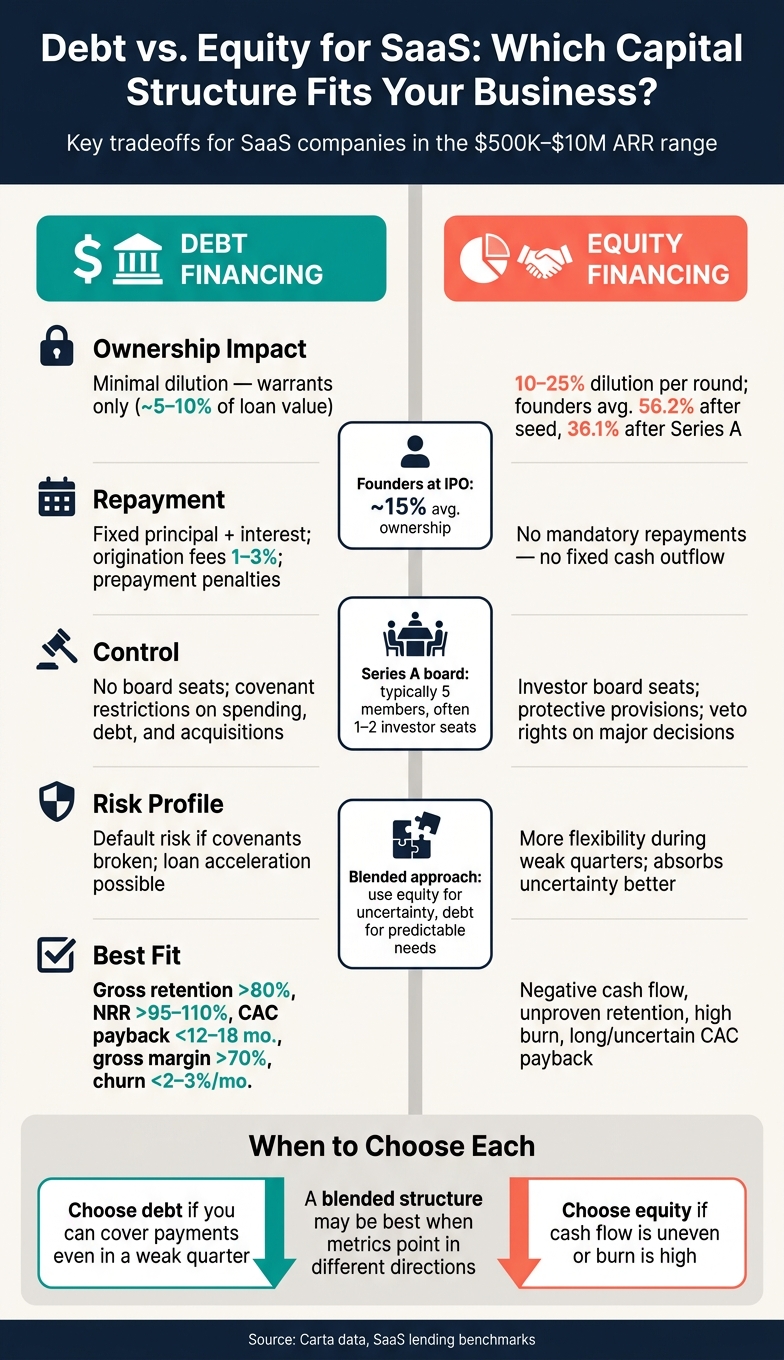
Debt vs Equity for SaaS: Key Metrics & Tradeoffs at a Glance
| Factor | Debt | Equity |
|---|---|---|
| Ownership | Keeps dilution low | Reduces founder and employee ownership |
| Cash flow | Requires payments | No fixed repayment |
| Control | Few board rights, but lender limits | Board seats and investor veto rights |
| Risk if performance drops | Default risk and covenant trouble | More room to absorb weak periods |
| Best fit | Predictable revenue and clear path to break-even | High burn, uneven growth, or uncertain payback |
My simple view: if you can cover payments even in a weak quarter, debt may work. If not, equity usually gives you more room to operate. In some cases, a mix of both is the better answer. Working with fractional CFO services can help you model these scenarios and determine the right balance.
Equity financing means selling part of your company - usually common or preferred stock - to venture capital or growth equity investors in exchange for cash. There are no fixed principal or interest payments, which is why this route often fits SaaS companies with negative cash flow and long payback periods.
Each new share cuts the percentage owned by current shareholders. And that effect stacks from round to round.
Based on Carta data from U.S. software startups, median founder ownership falls to about 56.2% after seed, 36.1% after Series A, 23% after Series B, and 10.3% after Series D.[13][15]
Option pools chip away at ownership too. In many cases, investors want the pool set up before their ownership is calculated, so the dilution lands on founders instead of the new investors.[3][5]
That’s the part many teams feel only after a few rounds. The cash helps, but the ownership math keeps moving in one direction. And dilution isn’t the whole story - equity also shifts control.
Equity investors don’t just buy shares. They buy a seat at the table.
A typical Series A in the U.S. resets the board to about five members: one lead investor seat, one or two founder seats, and one independent director chosen jointly by founder and investor representatives.[3][4][9] By Series B or C, it’s common to see two or three investor-appointed seats, one or two founder seats, and one or more independents. At that point, founders can end up as a minority on their own board.[7][8]
Then there are protective provisions. These give preferred stockholders veto rights over certain decisions. That usually includes:
On paper, those rights may sound narrow. In practice, they can slow or block financings, exits, and other major moves. For a SaaS company, that can mean slower hiring, slower product expansion, and less room to maneuver in later raises.
Those control terms hit hardest when a company needs speed, room to pivot, and access to more capital.
Equity tends to make sense when the business can’t carry fixed repayments - or when the amount of cash needed is far beyond what a lender would offer. That often includes negative cash flow stages, long or uncertain CAC payback periods, weak or unproven retention, and growth plans that require more headcount, entry into new verticals, or tripling sales capacity.[6][11][12]
The long-term cost is high because investors want big returns in exchange for taking that risk.[14] That’s why expert guidance usually treats equity as a tool for growth capital, not as a way to patch short-term cash gaps.[11]
Debt preserves ownership, but it adds repayment pressure and covenant limits.
Debt lets founders keep more ownership. But SaaS lenders don’t hand out money on hope. They look hard at the quality of your recurring revenue: ARR, retention, gross margin, and how steady your cash collections are.[19][1][22] Those numbers shape two things at once: how much you can borrow and how much room you’ll have to run the business your way.
For U.S.-based SaaS companies, the main debt options are venture debt, recurring-revenue credit facilities, revenue-based financing, and term loans. Each one comes with its own repayment schedule and its own level of lender control. So the best choice comes down to one thing: how predictable your recurring revenue is when things get messy, not just when the dashboard looks good.
The interest rate is only one piece of the bill. Once you add interest, amortization, origination fees, and, in the case of venture debt, warrant coverage, a loan that looked light on paper can start eating into runway fast.
Origination fees usually land in the 1%–3% range of the total loan amount. Prepayment penalties often drop over the first few years. Venture debt also often includes warrant coverage, which gives the lender the right to buy equity worth about 5%–10% of the loan amount at your current round’s valuation.[16] That still means some dilution, but it’s usually much smaller than going out and doing a full equity round.
The harder part of debt usually isn’t the payment itself. It’s the restrictions attached to it.
Most SaaS lenders put three kinds of limits in place:
If you break one of those terms, the fallout can be rough: default fees, a higher rate, or even loan acceleration.[23] For a startup that’s still burning cash, that’s not a small paperwork issue. It can turn into a full-blown cash crunch.
Debt tends to work best when revenue is steady enough to cover fixed payments and cash flow is easy to see ahead of time. In plain English: lenders want proof that the business isn’t wobbling.
They usually look for:
Monthly churn above 2%–3% is a warning sign for many lenders.[20]
If your ARR is spread across many customers, your contracts lean toward annual prepayments, and you can point to a believable path to break-even before heavy amortization kicks in, debt can buy more runway without giving up as much ownership as another equity round.
That leads straight into the trade-off with equity: dilution and board control on one side, repayment and covenant risk on the other.
Equity cuts into ownership for good. Debt lets founders keep more of the cap table, but it brings fixed payment risk. That’s the heart of the choice.
Equity rounds often dilute existing shareholders by 10–25% per round. By the time a SaaS company gets to IPO, founders often hold about 15% ownership.[2][25] Debt flips the pressure from ownership to cash flow. Monthly payments don’t shrink just because a quarter comes in light. If payments are missed, the fallout can include default fees, faster repayment demands, or tighter lender control. So debt only makes sense when the business can still make payments during a slowdown.
Debt and equity both come with strings attached. They just pull from different directions.
With debt, the limits are written into the loan agreement. That can mean minimum cash balances, ARR floors, or limits on taking on new debt or making acquisitions. Break a covenant, and the lender can act right away.
With equity, the pressure usually comes through governance. Investors may want board seats, protective provisions, and approval rights over major decisions such as new financings, M&A, or budget changes. If lender guardrails feel acceptable, debt may fit better. If investor input and oversight are worth it, equity may be the better call.
The best way to compare debt and equity is to look at the tradeoffs side by side, not just the labels.
| Factor | Debt | Equity | Typical SaaS implication |
|---|---|---|---|
| Dilution | Minimal, usually limited to warrants | High, increases with each round | Debt looks appealing once ARR is stable and founders want to protect ownership |
| Repayment risk | Fixed principal and interest payments; missed payments can trigger default | No mandatory repayments | Early-stage SaaS with uneven ARR is often a better fit for equity |
| Covenant limits | Financial and operating covenants can restrict spending and major moves | Few explicit covenants | Sharp product pivots or test-heavy burn can run into covenant limits |
| Cost of capital | Explicit interest, fees, and warrant value; lower cash cost if growth holds | Implicit cost through dilution; more expensive at large exits | High-upside companies may give up more through equity but can reach outcomes debt alone may not fund |
| Board control | Typically no board seat; limited governance impact unless default occurs | Investor board seats and protective provisions; strategic oversight | Founders swap some control for capital; debt keeps governance cleaner but adds contract risk |
The next step is to test which structure lines up with your ARR, retention, burn, and payback.
Once you understand the tradeoffs, the next step is simple in theory and hard in practice: pick the structure your business can actually support.
Look at ARR growth, NRR, gross margin, burn, CAC payback, and runway together. No single metric should make the call.
If ARR is strong, retention is solid, margins are healthy, and CAC payback is short enough, debt can work well. The reason is pretty straightforward: your revenue is predictable enough to handle fixed payments.
If ARR is choppy, retention is weak, or burn is high, equity is usually the safer path. In that case, locking yourself into repayment can add pressure at the exact moment you need breathing room.
Sometimes the numbers point in different directions. Maybe growth looks good, but burn is still high. Or retention is solid, but runway is tight. In those cases, a blended structure often makes more sense than going all-in on debt or all-in on equity.
A blended structure tends to fit SaaS companies that can carry some debt but still need equity to cover uncertainty.
A practical way to think about it: use equity for the parts of the plan that are less certain, and use debt for needs that are more predictable and shorter in duration. That split helps spread risk between dilution and repayment pressure instead of putting all of it in one bucket.
Before you make the call, test the structure in a downside model.
Build a 3-statement, monthly cash flow model that includes a debt service schedule, covenant tests, and dilution scenarios across different fundraising outcomes. If the downside case breaks covenants or leaves you short on cash, walk away from the debt structure.
Phoenix Strategy Group can help build the forecast and scenario model to compare debt, equity, and blended options with a scenario model.
It depends on your growth stage, how predictable your revenue is, and how steady your cash flow looks. A common benchmark is total debt of 0.5x to 1.0x ARR.
Lenders also often want a DSCR of at least 1.25x. To give yourself some breathing room, keep cash reserves that can cover 3 to 4 months of debt payments and keep a close eye on leverage ratios during uneven revenue periods.
A blended debt-and-equity strategy often makes sense when your SaaS is moving from uncertain to more predictable.
Early on, when cash flow is still shaky, equity usually gives you more room to breathe. You’re not locked into fixed monthly payments, which matters when revenue can swing and growth plans are still taking shape.
Later, once recurring revenue is steady enough to handle repayments, debt can start to make more sense. At that point, it can help fund specific growth initiatives without giving up as much ownership.
This approach also appeals to founders who want to cut dilution and keep more control of the business. A lot of teams start looking at debt when recurring revenue can comfortably cover repayments and still leave enough cash flow cushion for covenants and day-to-day operations.
Model cash flow stability and repayment capacity, including worst-case scenarios like a revenue drop, to see if you can keep covering fixed payments. Then do the same for dilution tolerance across multiple rounds, so you know how much ownership you can give up before the math starts to hurt.
Stress-test covenant limits and timing mismatches by laying out your debt schedule next to subscription revenue timing and your required cash buffer. That means mapping principal, interest, covenants, and maturity against when cash actually comes in. In the same set of scenarios, track DSCR and interest coverage. If revenue slips or collections slow down, those two numbers will tell you pretty fast whether the plan still holds up or starts to crack.