Published on
July 27, 2026


A deferred tax liability can change deal value on day one, even though no cash leaves at closing. In many U.S. stock deals, book value steps up to fair value under ASC 805 while tax basis stays put. That gap creates a future tax cost, cuts net identifiable assets, and pushes more of the purchase price into goodwill.
If I had to boil this article down fast, I’d focus on these 7 drivers:
A simple example shows the point: if an asset gets a $4,000 book step-up and the tax rate is 21%, the opening DTL is $840. That $840 cuts identifiable net assets and shifts the same amount into goodwill.
What I’d watch first:
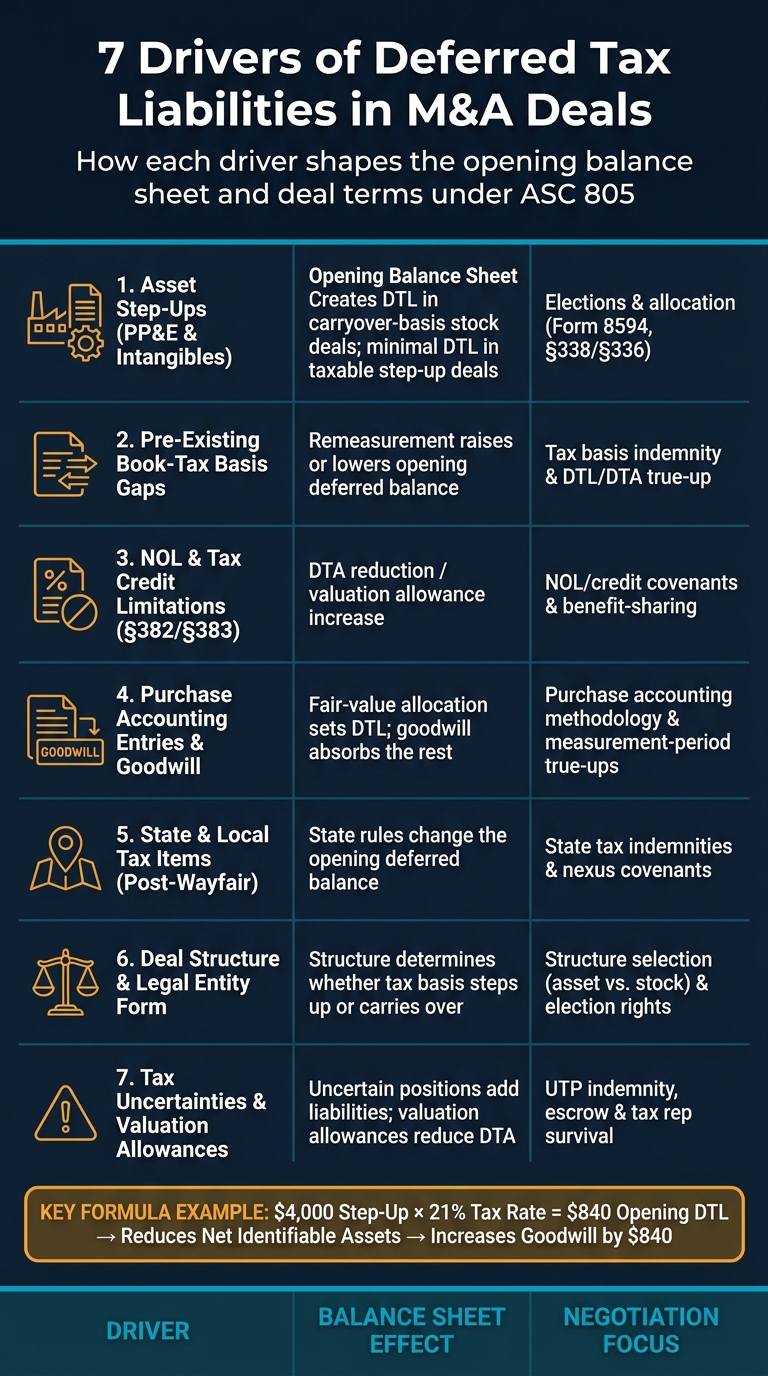
7 Drivers of Deferred Tax Liabilities in M&A Deals
| Driver | Main effect at closing | What it can change |
|---|---|---|
| Asset step-ups | Creates DTL in many stock deals | Goodwill, future tax deductions |
| Pre-existing basis gaps | Remeasures old deferred taxes | Goodwill, post-close cash taxes |
| NOL/credit limits | Cuts DTA value | Tax shield, free cash flow |
| Purchase accounting | Adds fair-value-based DTLs | Opening balance sheet, goodwill |
| State and local tax | Adds state exposure or deferred tax effects | Price cuts, escrows, cash taxes |
| Deal structure/entity form | Decides whether basis resets | DTL size, tax shield |
| Tax uncertainties/valuation allowances | Adds liabilities or trims DTAs | Goodwill, indemnities, escrow |
Bottom line: if you’re pricing a deal, building the model, or drafting the purchase agreement, these seven items shape the opening balance sheet and the buyer’s future tax bill.
Three levers tend to drive the conversation here: purchase accounting, tax rates, and closing mechanics.
Under ASC 805, DTLs booked at closing reduce net identifiable assets and increase goodwill. It’s a direct tradeoff. If the DTL gets bigger, net identifiable assets go down dollar-for-dollar, and more of the purchase price shifts into goodwill. That matters because goodwill is tested for impairment under ASC 350, so a bigger goodwill balance can leave the buyer with more write-down risk later on.[3][5][7]
Tax rates can also move value more than people expect. DTLs are measured using blended federal and state tax rates, and even small rate changes can affect the math. Buyers usually use a blended federal-state rate. If that blended rate goes up, the DTL goes up too, net identifiable assets fall, and goodwill rises. In a live deal, that swing can change bid value.[3]
The same rate sensitivity shows up after closing when the DTL reverses. As those reversals happen, cash taxes rise above book tax expense. If a model misses that timing, free cash flow can look better on paper than it will in practice.[3]
That cash impact is one reason buyers deal with DTLs head-on in the purchase agreement. In stock deals, buyers and sellers often negotiate whether DTL changes between signing and closing belong in the net working capital true-up or stay out of it. In many cases, timing-difference DTLs are excluded from net working capital and handled on their own in the agreement. But unusual DTLs tied to aggressive tax positions or accelerated depreciation schemes may be treated more like debt-like liabilities, which can lead to price cuts or specific indemnities.[3]
Closing structure also plays a big role, because entity design can change how the DTL is measured at signing. Post-closing entity structure, state nexus, and planned restructurings can all shift the opening DTL balance. So if the structure changes after signing, the opening DTL can move away from what the diligence model showed.[6][3]
The first, and often biggest, driver is the purchase-price step-up on acquired assets.
In a non-taxable stock deal without a §338 election, book value steps up to fair value, but tax basis stays at its historical amount. That gap creates a temporary difference and, in turn, a DTL.[11][5]
The math is simple: DTL = step-up × tax rate. So if there’s a $4,000 intangible step-up and the tax rate is 21%, the opening DTL is $840. That lowers identifiable net assets and pushes more value into goodwill.[14]
Intangible assets often drive the biggest DTLs because they can receive large fair-value marks while having little or no tax basis.[11][5] Common examples include customer relationships, developed technology, and trademarks. When the DTL gets bigger, identifiable net assets go down and goodwill goes up.[8][9][5]
In taxable asset deals and §338(h)(10) elections, book and tax basis usually step up together. So the step-up by itself usually does not create a DTL.[12]
Once the step-up is measured, diligence turns to the support behind it: fair value and tax basis for each asset class.
Start with a by-asset schedule that compares fair value with tax basis. In practice, that means pulling:
From there, map the reversal pattern so the buyer can see the after-tax cash flow effect.[9][11][3]
Tax and accounting teams need to work from the same asset classes and the same deduction assumptions. This is where deals can get messy. A common mistake is using mismatched asset classes or tax deductions that lack support. Even a small allocation error can move goodwill, skew deferred taxes, and set up post-close surprises.
Deal documents usually deal with step-up DTLs through allocation provisions, tax election covenants, and reps about asset basis.[2][12] If a §338(h)(10) election is in play, the parties need to work out who bears the seller’s added tax cost and how the buyer’s step-up benefit shows up in the purchase price.
Some deals also split the tax benefit tied to post-closing amortization deductions. If that’s part of the bargain, the agreement should state exactly how those deductions are divided.
Step-up DTLs are just one source of opening balance-sheet tax differences. The next piece is basis differences that were already there before the deal closed.
Pre-existing book-tax gaps are legacy differences that were already sitting on the target's books before the deal closed. At closing, the buyer remeasures those balances. The big issue isn't just whether a gap exists. It's how much of that gap will reverse after close.
PP&E is the most common source. A target may use straight-line depreciation for book purposes while taking accelerated MACRS deductions for tax. That leaves tax basis below book value and creates a DTL that reverses over time as book depreciation catches up. Other common sources include capitalized software or R&D, prior acquisition fair-value adjustments, and timing differences tied to accruals and reserves.
The core formula is simple: temporary difference × applicable tax rate = DTL. Say machinery has a book value of $5,000,000 and a tax basis of $3,500,000. That creates a $1,500,000 gap. At a 25% blended tax rate, the result is a $375,000 DTL.[15][16]
That timing matters. The buyer is paying for a balance sheet today that can turn into future tax cash outflows later.
These gaps flow straight into purchase accounting. They reduce net identifiable assets, increase goodwill, and then unwind through higher cash taxes after closing.
Buyers usually start with the target's ASC 740 provision workpapers, with close attention to the deferred tax rollforward by category, such as:
They also review filed federal and state tax returns, fixed asset ledgers, intangible asset ledgers, and prior provision-to-return reconciliations. The goal is to confirm that deferred tax balances tie back to the filed tax positions. That rollback schedule can shape both purchase price and post-close cash tax costs.
Buyers often push for tax reps stating that deferred tax balances are complete, accurate, and in line with the returns. If diligence turns up large gaps or weak support, buyers may ask for specific tax indemnities, escrows, or holdbacks tied to pre-closing exposure. Deal documents should also spell out whether the DTL is excluded from working capital and included in net debt.[3][2][1]
Next, NOL and tax credit limits can change how much of a deferred tax position the buyer can actually use.
Net operating loss (NOL) carryforwards and tax credit carryforwards can look like real assets on paper. But in a U.S. deal, the buyer often can't use them as fast as the headline numbers suggest. That gap matters. It cuts down the deferred tax assets the buyer can record and pushes more value into goodwill.
With NOLs and credits, the problem usually isn't a basis step-up. It's use. More specifically, it's how much of the tax benefit the buyer can use after closing.
The buyer may not be able to use the full NOL or credit balance. Section 382 limits annual NOL use after an ownership change based on the value of the loss corporation multiplied by the long-term tax-exempt rate. Section 383 applies similar limits to tax credits, including R&D credits. And post-2017 NOLs can generally offset only 80% of taxable income in a given year.
So the amount the buyer can use is often much smaller than the total carryforward balance. That's where the temporary difference starts to show up.
The buyer records a deferred tax asset only for the portion it expects to use. The rest doesn't disappear, but it also doesn't get booked as a tax asset in the same way. Instead, that amount flows into goodwill in the purchase accounting entry.
That can increase the goodwill balance and, with it, the impairment risk under ASC 350.
It also affects the first stretch after closing in ways buyers care about right away:
This is one of those areas where a tax item quietly changes the economics of the deal.
Buyers should zero in on the items that help them value what the NOLs and credits are actually worth:
Buyers often ask for reps and warranties confirming that the NOL and credit schedules are accurate, including any known Section 382 limits. Pre-closing covenants also tend to restrict equity issuances or redemptions that could trigger another ownership change before closing.
If diligence shows that usable NOLs or credits are much lower than represented, buyers may push for specific indemnities tied to the shortfall. In some deals, the fix comes through purchase price adjustments, earnouts tied to realized tax benefits, or tax benefit sharing clauses. The goal is simple: line up the economics with what the buyer can actually use over time.
Those limits feed straight into purchase accounting and the opening balance sheet.
Next, purchase accounting itself can create or magnify deferred tax liabilities through fair-value entries and goodwill.
Purchase accounting can increase DTLs right at closing. Under ASC 805, the buyer remeasures acquired assets and liabilities to fair value, but the tax basis usually does not change. That mismatch creates deferred tax liabilities.
The biggest DTLs often come from large step-ups in intangible assets and PP&E.[4][1]
Higher DTLs lower net identifiable assets. And when net identifiable assets go down, goodwill goes up.
That matters because a bigger goodwill balance can bring more impairment risk later under ASC 350. Goodwill is not amortized, so the balance stays on the books unless it is impaired.[4][20]
There is one key exception here: non-deductible goodwill does not create a DTL. The reason is simple. The book-tax difference is permanent, not temporary.[13][19][10]
To check the tax basis by asset class, buyers should gather a few core documents:
From there, use the PPA model to line up fair value against tax basis for each asset class. Then apply the blended tax rate to estimate the DTL.[18][4]
This is why buyers often negotiate Section 338 election covenants. If the election works in the deal structure, it can reduce DTLs.[4][1]
Buyers may also push for purchase price adjustments or indemnities when large intangible step-ups are on the table, especially if there are specific pre-close tax exposures that could change deferred tax balances after closing.
State and local tax rules can make these balances larger or smaller, which is the next driver.
State tax gaps can cause trouble in M&A because they don't always disappear at closing. In many cases, they stick around, land on the buyer's opening balance sheet, and change the liability picture on day one. After Wayfair, nexus rules got broader, which made SALT a much bigger diligence issue. And just like book-tax basis gaps, state-level tax exposure can add to the opening liability stack and force the buyer to book larger reserves at closing.
Post-Wayfair, broader nexus rules have increased the chance that a target has old SALT exposure it never dealt with. When diligence brings those gaps to light, the impact can show up fast: purchase price haircuts, escrows, or indemnities. One of the most common sources of unrecorded SALT liability is missing or incomplete sales tax exemption certificates.
Buyers should zero in on a short list of SALT records:
A pre-signing sell-side SALT review can stop exposure estimates from ballooning and helps keep the buyer from using vague, unmeasured risk as a reason to cut price.
Voluntary Disclosure Agreements (VDAs) are the main tool for dealing with old SALT exposure before closing because they can reduce the lookback period and eliminate penalties. [21] Sellers that fix SALT issues before signing usually negotiate from a stronger position. If the filings wait until after close, the buyer is left holding the exposure. That allocation then feeds into the legal entity form and closing structure.
Once you’ve mapped SALT exposure, the next thing that matters is deal structure. This is the piece that often decides how much tax liability shows up on the opening balance sheet.
Deal structure drives whether tax basis gets reset or simply carries over. That one choice can make the opening DTL much smaller or much larger.
In a stock purchase of a C corporation, the target’s tax basis in the acquired assets usually stays at its old carryover amount. Book basis, though, steps up to fair value. That gap creates a temporary difference, and that temporary difference creates a DTL on the opening balance sheet.[4][17][2]
An asset purchase usually works differently. In that setup, tax basis often steps up along with book basis, so opening DTLs tied to basis gaps are often smaller. Certain elections can push a stock deal closer to that tax result. A §338(h)(10) election for S corporations and a §336(e) election for certain subsidiaries let the parties treat a stock acquisition as if it were an asset sale for tax purposes, which can reduce the DTL by bringing tax basis closer to book basis.[22]
That said, the gap doesn’t always disappear. Differences can still show up if book and tax allocations don’t match, or if an asset is amortizable for tax but not for book, or the other way around.
Legal entity form matters just as much. If the buyer acquires the equity of a single-member LLC that is disregarded for tax purposes, the transaction is treated as an asset acquisition for tax purposes, even if it looks like a stock deal from a legal standpoint.[22] Partnerships and multi-member LLCs add another layer. A §754 election can create a partner-specific basis step-up, but that step-up is tied to the entity and needs separate basis tracking.
These structure-driven DTLs don’t just sit in the tax footnotes. They flow straight into goodwill.
Under ASC 805, DTLs reduce net identifiable assets. When net identifiable assets go down, goodwill goes up dollar for dollar. So the size of goodwill can turn on a pretty basic deal question: does the structure produce carryover basis, or do you get a new tax basis?[17]
The main diligence task here is simple in concept, even if the work can get messy: build a book-versus-tax basis summary by legal entity and asset category.
That usually means reviewing:
Each entity type can change where the DTL is recorded and how the temporary difference should be modeled. If you miss the entity form, you can miss the tax result. And that’s where deals start to get expensive.
If a §338(h)(10) or §336(e) election is being considered, the purchase agreement needs to say so clearly. It should cover the election itself, the allocation of deemed sale proceeds across asset classes, and a cooperation covenant that requires both sides to file the election forms on time. Agreements also often include gross-up terms or price adjustments when one party ends up carrying added tax cost.[22]
When entity classification is unclear, or there’s a risk that an election may not hold up, buyers usually push for strong representations and warranties. Those are often backed by R&W insurance. The reason is pretty direct: misclassification or an invalid election can create DTLs or DTAs that no one expected.[22]
When structure doesn’t explain the gap, the next step is to look at whether the tax positions themselves are uncertain.
Not every tax item comes from timing. UTPs are uncertain tax liabilities tied to audit risk, while valuation allowances cut down deferred tax assets when realizing those assets looks doubtful.
That gives buyers two separate diligence problems to sort through: possible tax liabilities on one side, and whether tax assets are usable on the other.
Common UTPs include R&D credit claims and transfer pricing arrangements. In a stock deal, the buyer inherits those exposures. If diligence turns up a UTP, the buyer records a liability that works a lot like a deferred tax liability because it points to a future tax cost.
A valuation allowance lowers the carrying value of a deferred tax asset when it is more likely than not that some part of it will not be realized. If the target has large NOLs or capitalized R&D costs but not much expected taxable income, that allowance offsets those DTAs. If the acquirer has stronger projected income, the allowance may be released after closing, which can increase the net value of the acquired tax attributes.
UTPs reduce net identifiable assets and usually increase goodwill. Valuation allowances reduce DTAs. If one is released during the measurement period, it can lower goodwill.
Use the Section 382 result to test whether the related DTA still supports a valuation allowance. Buyers should also review:
The goal is simple: confirm that the recorded balances match a realistic view of realizability.
Those findings should flow straight into the purchase agreement and any closing escrow.
In stock deals, unresolved UTPs should be flagged early and covered with reps, indemnities, or escrows.
In diligence, the seven drivers show up as support requests, model inputs, and deal points. Buyers usually ask for fixed asset, intangible, NOL, state, and ASC 740 support. Each request ties back to items already found in the deal: asset step-ups, basis gaps, NOL limits, SALT matters, and tax uncertainties.
Once that support is in hand, buyers build two linked schedules: the deferred tax rollforward and the cash tax schedule.
The deferred tax rollforward starts with opening DTA and DTL balances. From there, it adds new balances tied to purchase accounting step-ups and maps out reversals based on asset lives and NOL use patterns. The cash tax schedule starts with pre-tax book income, converts that into taxable income, layers in Section 382 NOL caps, and applies a blended federal and state rate based on post-closing apportionment assumptions. These schedules can't live in isolation. The rollforward needs to tie back to the cash tax schedule and the three-statement model.
State apportionment sits as its own model input because it can change both the blended rate and the worth of state tax attributes. A buyer may fold the target into a much larger footprint after closing. When that happens, the blended state rate can move in a meaningful way, which changes the value of state NOLs and credits already sitting on the balance sheet. Buyers also look closely at states where the target may have nexus but hasn't filed returns. That's the kind of issue that can sit quietly for years and then show up at the worst time.
On deal terms, DTAs and DTLs usually sit outside the working capital definition and get handled on a separate track. Working capital stays centered on operating items, such as:
Current income taxes payable are often treated as debt-like items or handled through a tax indemnity. And when a target has a meaningful DTA tied to NOLs, the parties often negotiate a separate price adjustment for usable tax attributes instead of rolling that amount into the working capital true-up. That split should flow into the driver summary table.
These items should be grouped by balance sheet effect and negotiation focus.
After diligence and model inputs are in place, this table shows how each driver changes the opening balance sheet and the deal terms. It gives you a quick way to scan the opening balance-sheet effect and the main source of deal-term leverage for each driver. It also helps you line up the deferred-tax rollforward with the cash-tax schedule.
| Driver | Opening Deferred Balance Effect | Goodwill / Cash Tax Effect | Negotiation Focus |
|---|---|---|---|
| Asset step-ups (tangible & intangible) | Primarily DTL in carryover-basis deals; little or no initial DTL in taxable step-up deals | DTL can increase goodwill; tax basis step-up creates future deductions | Elections & allocation (Form 8594, §338/§336) |
| Pre-existing book-tax basis gaps | Remeasurement can raise or lower the opening deferred balance | Can shift goodwill up or down; mostly affects the timing of cash taxes | Tax basis indemnity & DTL/DTA true-up |
| NOL and tax credit limitations | DTA reduction / valuation allowance increase under §382 and §383 | Reduces expected tax shield; raises future cash taxes | NOL/credit covenants & benefit-sharing |
| Purchase accounting entries & goodwill | Fair-value allocation sets the DTL; goodwill absorbs the rest | Net DTL raises goodwill; tax-deductible goodwill can improve future cash taxes | Purchase accounting methodology & measurement-period true-ups |
| State and local tax items | State rules change the opening deferred balance | Can increase cash tax burden and state tax exposure | State tax indemnities & nexus covenants |
| Deal structure and legal entity form | Structure determines whether tax basis steps up or carries over | Asset deals often produce cash tax shields; stock deals without elections often create DTLs | Structure selection (asset vs. stock) & election rights |
| Tax uncertainties and valuation allowances | Uncertain positions add liabilities; valuation allowances reduce DTA | Raises risk of future cash taxes, IRS disputes, and interest/penalties | UTP indemnity, escrow, and tax rep survival |
The point of the columns is simple: one side shows the balance-sheet hit, and the other shows where you may have room to negotiate. That makes it easier to connect diligence findings to the purchase agreement and the cash-tax model.
A practical way to use it:
This summary ties the seven drivers back to price, indemnities, and the closing structure.
Each of the seven drivers comes back to one thing: a timing gap between what tax rules recognize and what GAAP records. Put together, those gaps affect the opening balance sheet, cash taxes, and the way deal terms get negotiated.
Once you understand those drivers, diligence gets a lot more focused. You can zero in on the schedules, elections, and entity structures that change the numbers. That's the practical test in any deal.
If you're getting a company ready for exit or looking at an acquisition target, Phoenix Strategy Group offers M&A support and fractional CFO expertise to help price tax effects, diligence the drivers, and assign tax risk with a clear view.
Deferred tax liabilities (DTLs) can drag down a company’s net value. Because of that, they often show up in purchase price talks and shape the final deal terms.
From a buyer’s side, the concern is pretty simple: a DTL can turn into future cash taxes. And that can make the deal less attractive on day one. So buyers may ask for:
That said, the picture isn’t always one-sided. Tax benefits like basis step-ups can offset part of the hit. In some deals, that softens the buyer’s concern and changes how hard they push on price.
Deal structure matters too. In a stock sale, buyers often lean harder on price because they’re taking on the target’s existing tax profile. Put plainly, they may want a discount to account for the tax burden already sitting in the business.
In a standard stock deal, a deferred tax liability can show up when there’s a meaningful gap between the book value and tax basis of the target’s assets.
Stock purchases don’t usually create an automatic basis step-up. But a Section 338(h)(10) election can make the deal look like an asset sale for tax purposes, which creates a new tax basis.
Other items can add to the picture too, including purchase accounting, inherited tax attributes, and state tax items.
Prioritize three to five years of federal and state tax returns. That review helps surface hidden liabilities, open disputes, and back-tax exposure that might not show up at first glance.
You should also gather state nexus studies, apportionment methods, tax credit support, NOL schedules, and Section 382 studies. Add asset valuation reports and transaction records such as Form 8594 to confirm purchase price allocation and IRS compliance.