Published on
September 6, 2026


If some owners want cash and others want a 1031 exchange, the deal can go off track fast. In most cases, the tax result turns on two things: who the taxpayer is and whether each step looks separate or preplanned.
Here’s the short version:
If I were sizing this up, I’d focus on three questions right away:
| Issue | Drop-and-Swap | Swap-and-Drop |
|---|---|---|
| Exchanger | Individual owners after a TIC distribution | Partnership or LLC |
| Order | Drop first, swap second | Swap first, drop second |
| Main tax pressure point | Time between distribution and exchange | Time between exchange and later distribution |
| IRS concern | Preplanned sale or weak investment intent | Preplanned distribution or weak investment intent |
| Deal friction | Title changes before closing can slow the sale | Closing often stays simpler at the entity level |
| Common use case | Owners want different paths, including cash or different replacement property | Owners stay together through the exchange, then split later |
Bottom line: the label does not control the tax result. I’d match the structure to the facts, test the holding period, and compare the 1031 path against simply paying tax now and investing the net proceeds.
A partnership can't act as the exchanger in this setup. So in a drop-and-swap, the partnership first distributes the property to the partners. That way, each owner can try to qualify for the exchange on their own.
The partnership distributes undivided tenant-in-common (TIC) interests in the relinquished property to its partners under Section 731. Each partner then exchanges that TIC interest individually, usually through a qualified intermediary.
On paper, the flow is pretty simple. First comes the drop. Then comes the swap.
But this only works if the drop isn't treated as part of a planned sale. That's where things start to get risky. If the drop happens too close to the sale, IRS scrutiny tends to go up.
The key issue is timing: how long the partners hold the TIC interests before the exchange closes.
This is the mirror image of drop-and-swap: the exchange happens first, and the distribution comes later.
In a swap-and-drop, the partnership completes the 1031 exchange first and uses a qualified intermediary so it doesn't run into constructive receipt. Once the replacement property has been acquired, the partnership then distributes that property to the partners.
At that point, the IRS looks closely at the later distribution and asks a simple but loaded question: Was this distribution separate from the exchange, or was it part of a preplanned exit?
That timing is what puts the deal under the microscope. If the later drop looks prearranged, IRS scrutiny goes up fast.
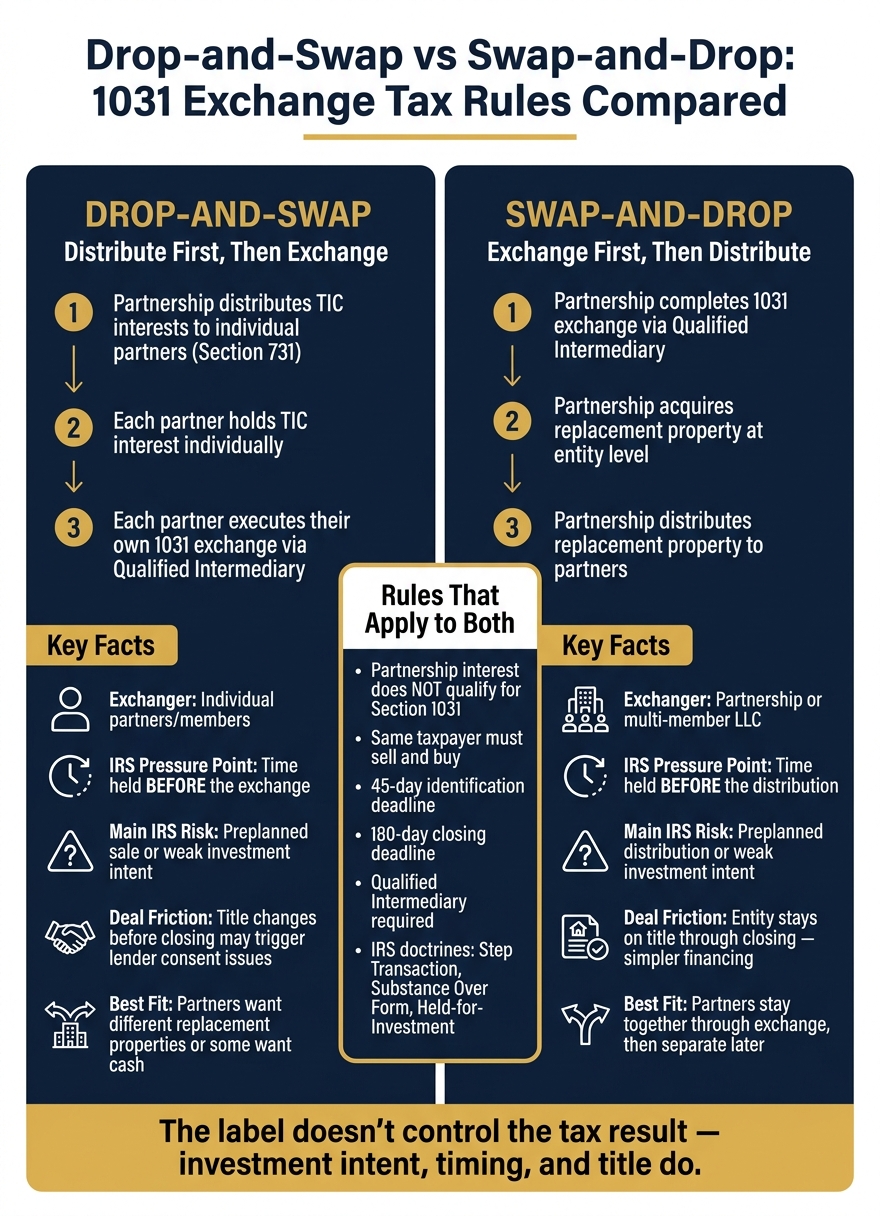
Drop-and-Swap vs Swap-and-Drop: 1031 Exchange Tax Rules Compared
These two setups differ in a few big ways: who does the exchange, when title shifts, and whether the later move was mapped out in advance. That’s where most of the tax risk and deal friction show up.
| Issue | Drop-and-Swap | Swap-and-Drop |
|---|---|---|
| Exchanger identity | Individual partners or members after receiving distributed TIC interests | The partnership or multi-member LLC itself |
| Transaction sequence | Distribution first → each owner sells or exchanges their TIC interest | Entity-level exchange first → replacement property distributed later |
| Main IRS arguments | Whether the later step was preplanned and whether the property was truly held for investment | Whether the later step was preplanned and whether the property was truly held for investment |
| Holding-period pressure point | Time held before the exchange | Time held before the distribution |
| Financing and closing | Pre-closing title changes can trigger lender consent, TIC conversion, and closing delays | Entity-level closing generally preserves existing financing, management continuity, and deal control |
| Typical fit | Partners want different replacement properties, or some want cash | Partners complete one exchange, then separate later |
Financing can end up steering the whole deal. If a partnership shifts to TIC ownership before closing, the lender may push back, ask for loan changes, or require new guaranties. That can slow things down fast.
A swap-and-drop can ease some of that pressure because the entity stays on title through closing, and the split happens later. Put simply, deal mechanics matter just as much as the tax rules.
Three doctrines sit at the center of the analysis: step transaction, substance over form, and the rule that property must be held for productive use in a trade or business or for investment.
The step-transaction doctrine lets the IRS combine separate steps - distribution, exchange, and sale - into one taxable event if those steps depend on each other or were set up to reach one end result. Substance over form works much the same way. Even if the documents look neat, a court may look past the paper trail and focus on what actually happened.
Cases in this area often come down to one basic point: are the exchange and distribution separate in substance, or just separate on paper? The holding-period issue matters too. And some authorities do not treat the partnership’s holding period as the partner’s holding period after a drop.
Neither setup is safe by default. Calling a deal a "drop-and-swap" or a "swap-and-drop" doesn’t shield it from IRS review. The IRS looks at what the parties did, in what order, and why.
The better path depends on what the owners actually plan to do. If the partners have different reinvestment goals - one wants a Delaware Statutory Trust, another wants a different property, another wants cash - a drop-and-swap may line up with that split. But each owner should be able to show a separate investment call tied to the distributed TIC interest, not just follow a prearranged script.
If the group wants to stay together through closing and sort things out later, a swap-and-drop may be easier to defend, as long as the entity in fact holds the replacement property for investment before any distribution takes place.
The key test is simple: Can each step stand on its own as a real investment move? That’s the point that drives the choice, and it sets up the after-tax comparison in the conclusion.
Once you weigh IRS risk and the holding-period facts, the decision becomes economic as much as legal. Both structures aim to solve the same exit problem: partners often want different tax results and different reinvestment paths. The label on the deal doesn't control the tax result. What matters most is investment intent, timing, and who holds title.
That leads to the main test: do the facts support the added complexity? The cleanest way to judge that is to compare each structure with the other option - paying tax now and investing the net proceeds. The right path is the one that holds up under scrutiny and still leaves you with more net proceeds.
In some deals, fees eat up most of the deferral upside. That's why partner-level proceeds modeling matters. It shows the net result before closing, not after the fact.
Phoenix Strategy Group can help model after-tax proceeds, cash flow, and partner-level outcomes before closing.
For 2026 or 2027 exits, the call should come down to three things: cost, coordination, and net proceeds.
In most cases, you need to hold a property for more than one year to get long-term capital gains tax rates. Those rates are usually lower than ordinary income tax rates.
Sell in less than a year, and the gain is taxed as ordinary income - as high as 37%.
Some tax breaks have a much longer clock. For example, the QSBS exclusion calls for a minimum holding period of five years.
That’s why exit planning shouldn’t wait until the last minute. It’s best to start two to three years before the sale so you have time to line things up and avoid expensive surprises.
Yes. Partners with different goals may be able to do this by restructuring the entity before the sale.
Here’s the key point: Section 1031 requires the same entity that sells the original property to buy the replacement property. So if the group wants to split paths, that restructuring has to happen before the exchange starts.
Once that step is done, some partners can cash out, while others move forward with a 1031 exchange into qualifying like-kind property.
The IRS tends to challenge these deals when they look built mainly to cut taxes, not to serve a real business purpose.
One of the biggest trouble spots is constructive receipt. That happens when the seller still has control over the proceeds, or can get to the assets while the deal is still in motion.
IRS scrutiny also tends to go up when the deal involves related parties, a trustee who doesn’t seem independent, thin documentation, weak continuity of interest, vague holding periods, or circular cash flows that suggest the seller never actually gave up control.