Published on
July 21, 2026

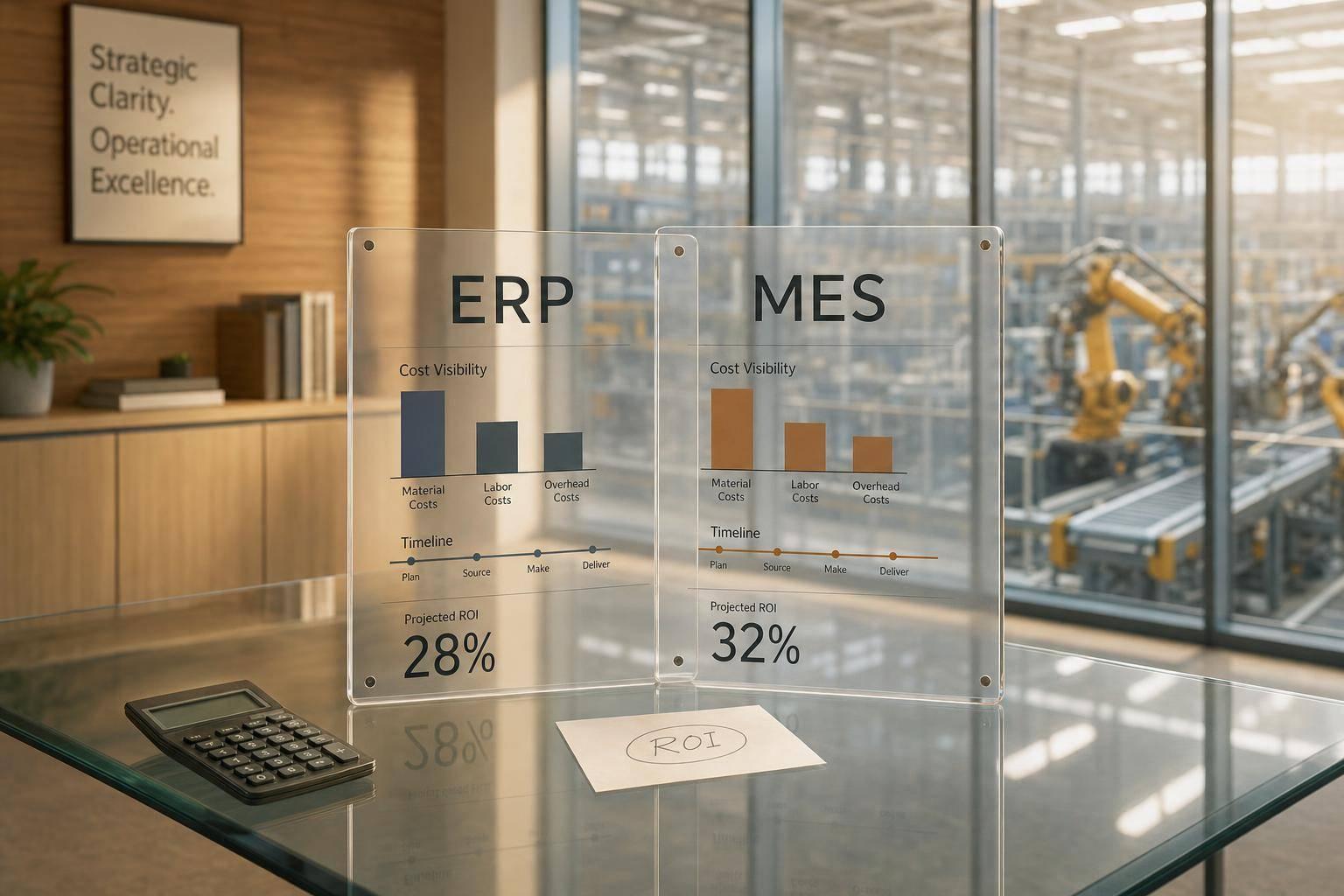
If I have to pick one first, I start with the biggest cash leak. ERP usually comes first when close, costing, and inventory are weak. MES usually comes first when scrap, downtime, and labor loss are eating margin.
Here’s the short version:
What matters to me is simple: ERP explains the financial result. MES explains what caused it. If I want better inventory control, cleaner costing, and a faster close, I lean ERP. If I want to cut scrap, reduce downtime, and get more output from current assets, I lean MES.
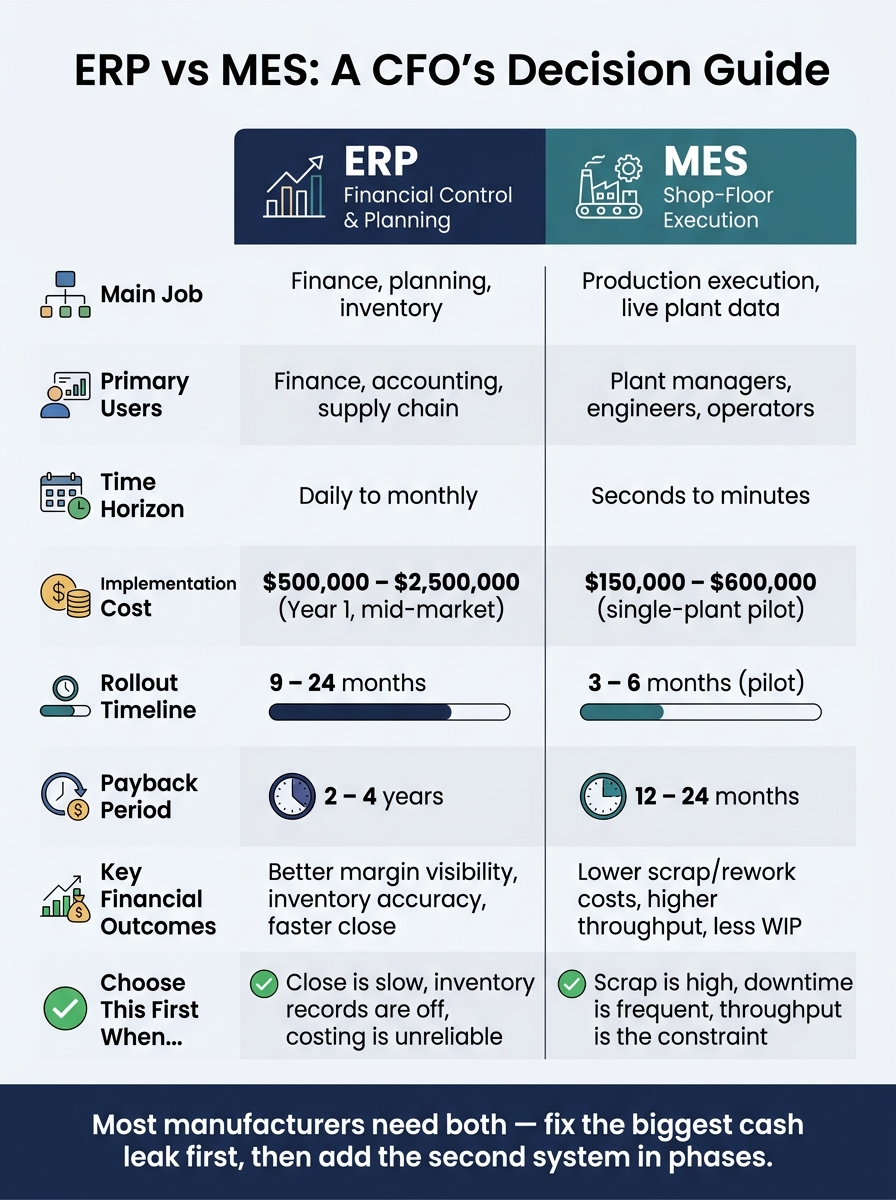
ERP vs MES: Cost, Timeline & ROI Comparison for Manufacturers
| Criteria | ERP | MES |
|---|---|---|
| Main job | Finance, planning, inventory | Production execution, live plant data |
| Main users | Finance, accounting, supply chain | Plant managers, engineers, operators |
| Time view | Daily to monthly | Seconds to minutes |
| Best for | Close, costing, purchasing, inventory | Scrap, downtime, WIP, traceability |
| Common first-year cost | $500,000–$2,500,000 | $150,000–$600,000 for a pilot |
| Common timeline | 9–24 months | 3–6 months for a pilot |
| Payback range | 2–4 years | 12–24 months |
| Main financial effect | Better control of margin, inventory, cash | Lower losses, more throughput, less rework |
My takeaway: most manufacturers need both. But I would not fund both at once unless the team, data, and budget can handle it. In many mid-market cases, the safer path is to fix the biggest problem first, prove value, and then add the second system in phases.
From a CFO’s view, ERP explains the numbers. MES explains what happened on the shop floor to produce them.
ERP gives finance control over margin, inventory valuation, and standard cost across plants and warehouses. Its core modules - general ledger, AP/AR, purchasing, item masters, BOMs, MRP, and standard costing - create a shared system of record for financial reporting, inventory valuation, and cost control.[6][8]
At month-end, this is what a CFO leans on. ERP answers the big money questions: What is our gross margin by product line? How much inventory are we carrying, and what is it worth? Are receivables coming in and vendors getting paid on schedule? It answers those through daily postings, period-end rollups, and variance reports - not through line-level production events happening minute by minute.[6][8]
ERP shows total inventory by location, total labor cost by period, and material usage variances against standard. What it can’t show is who or what caused a scrap spike on the floor. It won’t point to the exact machine, shift, or operator behind the issue. That’s the blind spot MES covers.
MES handles the part of production ERP doesn’t track. It manages work order execution, routing, labor tracking, WIP status, scrap, downtime, quality checks, traceability, and machine and sensor data - all in real time, down to individual batches, shifts, and production lines.[3][4][5][7]
The rhythm is completely different. ERP looks at posted transactions. MES watches production as it happens. A supervisor can check live WIP status, react to an unplanned downtime event in the middle of a shift, or trace a quality problem back to a specific operator and machine.[5][7] That level of detail matters because it shows where production losses start eating into margin.
MES turns downtime, scrap, and throughput losses into usable financial signals.
| ERP | MES | |
|---|---|---|
| Primary users | Finance, accounting, supply chain, executive leadership | Plant managers, engineers, quality teams, operators |
| Time horizon | Daily, weekly, monthly | Seconds to minutes |
| Data granularity | Aggregated transactions, period-end postings | Event-level data: machine states, per-batch scrap, cycle times, operator actions |
| Reporting focus | P&L, balance sheet, inventory valuation, standard cost variances | OEE, yield, downtime, WIP status, scrap by line/shift/SKU |
| Plant use cases | Inventory control, purchasing, production order creation, financial close | Work order execution, downtime tracking, quality enforcement, traceability |
| Common financial outcomes | Improved costing accuracy, better margin visibility, stronger cash management | Reduced scrap and rework costs, higher throughput, lower WIP, improved labor efficiency |
For a CFO, the big issue isn’t just what each system does. It’s which one pays back faster. That’s what leads to the next set of questions: cost, rollout time, and how deep the reporting needs to go.
For most CFOs, the issue is simple: which system shows measurable results sooner, with risk the business can live with and a budget that makes sense.
ERP comes with a much bigger upfront commitment. MES usually starts smaller, often with a pilot at one plant or one line.
For U.S. mid-market manufacturers, total first-year ERP costs - including software, implementation services, data migration, integrations, training, and internal staff time - usually land between $500,000 and $2,500,000.[2][11] Services, migration, and change management can add 1.5x to 3x the software fee.[10] Rollouts usually take 9–24 months, and multi-site programs tend to sit at the long end of that range.[2][11][14]
A cloud-based MES pilot at a single line or plant is usually much lighter, at $150,000–$600,000. In many cases, pilot value starts showing up within 3–6 months.[16][17]
The risk profile is different too. ERP risk spreads across the business. MES risk stays more contained.
ERP projects most often go over budget because of scope creep, poor master data, and change-management gaps across finance and operations. One benchmark found that 83% of data migration projects run over budget or timeline, with an average 30% overrun.[9]
MES has its own trouble spots, but they tend to stay closer to the plant floor. The main issues are OT-IT coordination failures, machine-connectivity delays, and operator-adoption gaps. A focused start helps a lot here. If the team begins with a single bottleneck line and brings in operations and controls engineers early, that exposure drops in a meaningful way.[13][16]
Payback timing also tends to split cleanly:
Reporting only matters if it helps finance make better decisions faster. That’s the heart of it.
Finance needs close-ready statements. Operations needs live production data.
ERP reporting is built for the financial close. It produces the P&L, balance sheet, cash flow statement, inventory valuation, and variance analysis that CFOs, auditors, and lenders depend on. It also standardizes revenue, COGS, and overhead allocation across plants and business units. On top of that, it gives finance structured variance reports - material, labor, and overhead - by SKU or work center.
But ERP has a blind spot: it usually shows production after the fact.
It might show that labor variance at a plant was $250,000 unfavorable in a quarter. What it usually can’t do is show which machine, shift, or changeover caused the problem. So finance ends up leaning on plant leadership for explanations. That slows corrective action, and root causes can stick around longer than they should.[15]
MES reporting handles that missing layer. It tracks OEE, downtime by cause code, scrap by line or shift, yield, first-pass quality, and operator adherence in real time.
For a CFO, those aren’t just shop-floor metrics. They turn into dollars fast.
A scrap-rate issue on one SKU might equal $400,000 per year in wasted material. Chronic changeover-related downtime on a constrained asset might point to recoverable contribution margin without new CapEx.[5] In fact, downtime reduction by itself usually makes up 60%–70% of MES ROI.[5]
When ERP and MES data connect, variance analysis stops being just a report. It starts pointing to action, linking operating fixes to EBITDA impact.
Those tradeoffs hit the numbers that matter most: margin, inventory, and cash flow.
Here is the CFO summary of cost, speed, and reporting depth.
| Factor | ERP | MES |
|---|---|---|
| Implementation cost | $500,000–$2,500,000 (mid-market)[2][11] | $150,000–$600,000 for a single-plant pilot[16] |
| Rollout timeline | 9–24 months[2][11][14] | 3–6 months for a cloud pilot; 6–18 months for full deployment[16][17] |
| Internal resource needs | Heavy cross-functional demand: finance, IT, operations, supply chain; SMEs often consume 20%–30% of the timeline[10][12] | Concentrated in operations, OT/IT, and CI teams; plant supervisors and controls engineers are critical[16][17] |
| Disruption risk | Higher and broad-based; weak master data and scope creep are the main drivers[9][1][10] | More localized; machine-connectivity delays and operator-adoption gaps are the primary risks[13][16] |
| Payback profile | 2–4 years; driven by costing accuracy, inventory efficiency, and process control[1][10] | 12–24 months when targeting scrap, downtime, and throughput losses[5][13][16] |
| Reporting depth | Finance close and audit trail | Real-time production root-cause data |
The next question isn't about reporting detail. It's about which system moves margin, inventory, and cash first.
ERP and MES affect margin in different ways.
ERP improves margin visibility through standard cost and variance control. If a buyer purchases off-contract or overhead absorption falls, ERP brings that issue to light. Purchase approval workflows and preferred supplier lists also help stop margin leakage before it shows up in the P&L[22][24][27].
MES shows scrap, rework, and downtime at the line level. If a plant cuts scrap from 4% to 2% on a key input, gross margin can improve by 1–2 percentage points[19][23].
When the two systems share data, the view gets much clearer. ERP may show that a high-volume SKU is margin-negative. MES can then show the reason - maybe a chronic micro-stop issue on one filler line or higher defect rates on Night Shift. Fix the shop-floor problem, and ERP can confirm the margin recovery. That's the loop that makes integration pay off[21][22][24].
Margin improvement matters, but only if it also helps working capital.
ERP has the stronger direct effect on inventory. It enforces reorder points, min/max stock levels, and MRP-driven purchase plans. That shifts procurement away from gut feel and toward data. The result is fewer excess buys, better inventory turns, and less cash sitting on shelves[18][20][21][26]. It also keeps inventory valuation consistent for finance and audit[24][25].
MES helps in a different way, but the impact can still be meaningful. By improving schedule adherence and giving supervisors real-time order status, it cuts queue time between work centers and reduces WIP days. It also catches defects earlier, before they turn into large batch write-offs. A plant that cuts quality-related write-offs by 30%–40% through MES-driven statistical process control and alarms is freeing cash that would have been lost to scrap and rework[19][23].
Both systems need upfront cash. The main issue is what comes back, and how soon.
ERP's cash impact builds over time. Better inventory control lowers annual carrying costs such as interest, storage, insurance, and shrinkage. ERP can also shorten the order-to-cash cycle by linking shipping to billing and automating invoicing. That can reduce days sales outstanding (DSO) by several days and speed up cash collection[21][24][25].
MES frees cash mainly through higher throughput. If MES lifts available capacity by 10%–15% on current assets, and demand is there to absorb the output, the added contribution margin flows into operating cash flow without new CapEx[19][23]. Lower scrap and rework also reduce material spend per unit of revenue, which cuts cash outflows relative to sales.
The decision signals are pretty clear:
These tradeoffs lead straight to the next choice: ERP first, MES first, or both in phases.
After cost, rollout time, and reporting, the last issue is sequence.
Start with the biggest cash leak. If your monthly close takes 10+ days, inventory in the system doesn't match what's on the floor, or product-line margin numbers feel shaky, ERP should come first.
This tends to be the case for manufacturers in the $10M–$150M revenue range that scaled fast and still run core work across QuickBooks, spreadsheets, and disconnected tools. The same thing shows up in larger multi-site businesses when each location uses a different chart of accounts or item master. Research shows ERP implementation can move inventory accuracy from 85% to 96% and shorten monthly close from 10 days to about 4 days.[29][30]
The rule of thumb is simple: when the control problem is financial, start with ERP. When it's on the plant side, start with MES.
If ERP is already in place and the financial side is in good shape, but plant losses keep eating into margin, MES is usually the next step. ERP can tell you that a loss exists. MES tells you why it happened.
Here's the difference in plain English: if ERP can measure scrap, overtime, or downtime but can't tie it back to a certain shift, machine, or work order, the missing piece is execution data, not financial visibility.
A focused MES pilot on one bottleneck line can show results in 4–12 weeks.[32][34] MESA International reports 22.5% lower unit cost and 19.4% higher net margin from MES.[31] That's a strong case when ERP already gives you the financial structure needed to record and confirm those gains.
Start with the system that fixes the biggest cash leak first, then add the other in phases. Most manufacturers end up needing both. Once the first system steadies reporting or shop-floor execution, the second fills the gap. ERP and MES work best together, with MES sending actual production data back into ERP's standard costs, pricing decisions, and working capital.[28][33]
Phoenix Strategy Group helps CFOs model ERP and MES ROI, cash flow, and rollout sequencing.
Static spreadsheets can only tell you so much. When you connect real-time data from your ERP and MES, you get a much clearer view of where cash is slipping away.
Manual work and siloed data often hide the biggest margin leaks, including production waste, excess inventory, and labor inefficiency. Those problems don’t always stand out in a spreadsheet. They tend to stay buried until the damage is already done.
With dashboards that pull live material, labor, and energy data, you can sort variances by driver:
That makes it easier to separate outside pressure from issues inside your operation. And once you can see that clearly, you can pinpoint which leak is doing the most harm to margins.
Yes. When ERP and MES are connected the right way, they can share data well by linking financial records with live shop-floor data.
That means inventory changes, production downtime, and actual material or labor usage can move into financial reports much faster. The payoff is simple: less manual reconciliation, better forecast accuracy, and real-time variance analysis that reflects what’s happening in production.
A successful pilot starts with clear, measurable goals linked to specific business outcomes. That means deciding up front what success looks like, not in vague terms, but in numbers you can track.
It should also review current systems, map how data moves between them, and set a performance baseline. A financial health check matters here too, because it gives you a clean starting point for comparing results later.
Bring in IT, finance, and operations early. That early input can save a lot of back-and-forth once the pilot is live. It also helps to plan for things that might go wrong, validate the data, and test the key integrations before anything touches day-to-day work.
The goal is simple: track production variances and financial metrics without disrupting core operations.