Published on
September 9, 2026


Founder ownership usually drops faster than expected because dilution comes from multiple terms at once, not just the investor’s percentage. If I only look at valuation, I miss what actually cuts my stake: round size, pre-money option pools, SAFE or note conversion terms, and later down rounds.
Here’s the short version:
A simple example shows the issue. If I bring in $5,000,000 at a $20,000,000 pre-money valuation, the basic math says the new investor gets 20% and founders keep 80%. But if the deal also adds a 10%–15% pre-money option pool, founder ownership falls below that headline number right away.
Another example: bringing in $10,000,000 at a $40,000,000 pre-money valuation gives investors 20%. At $60,000,000 pre-money, that drops to 14.3%. On a $500,000,000 exit, that gap can mean about $28,500,000 more for founders.
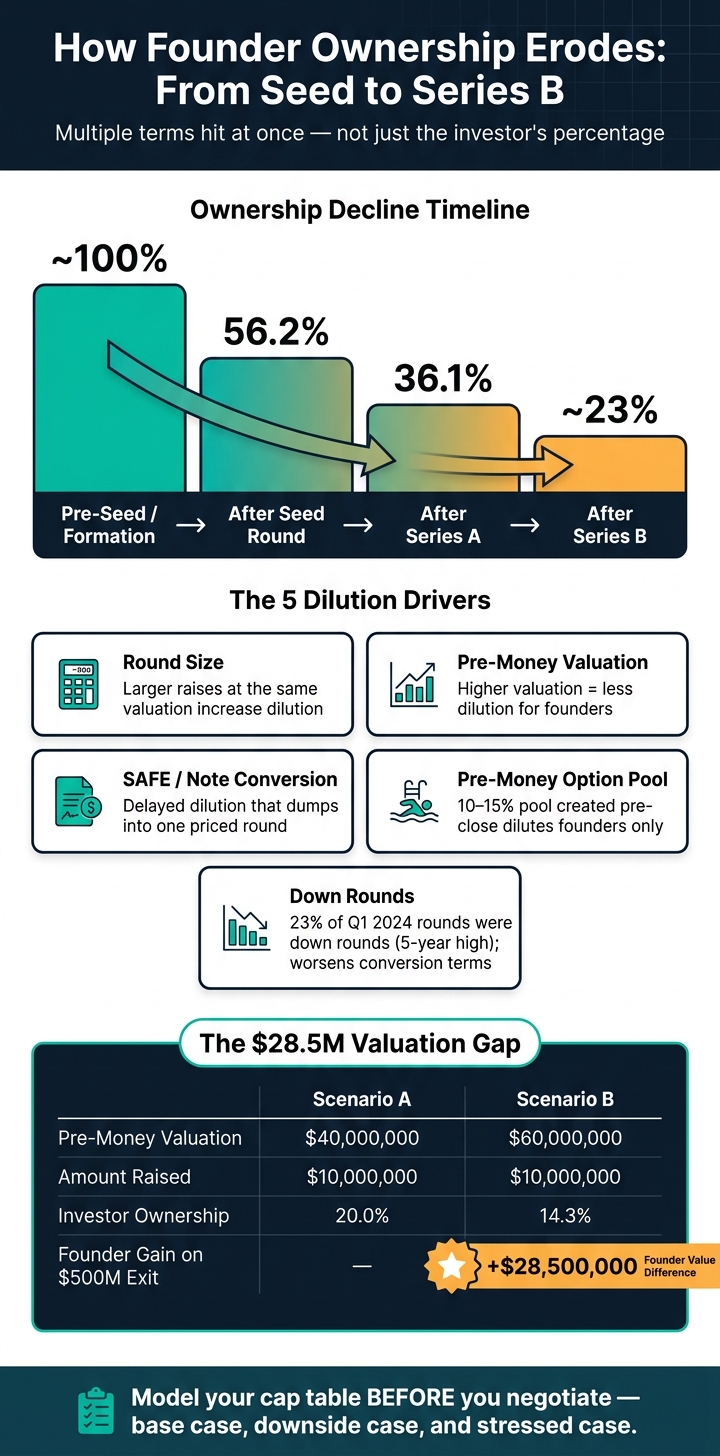
How Founder Ownership Dilutes from Seed to Series B
| Dilution driver | What it does to founder ownership |
|---|---|
| Round size | More money in at the same valuation usually means a lower founder stake |
| Valuation | A higher pre-money valuation usually means less dilution |
| SAFE/note conversion | Can add delayed dilution when the priced round closes |
| Pre-money option pool | Shifts dilution to founders before investor money goes in |
| Down round | Can increase dilution and make conversion terms hit harder |
If I want to protect ownership, I need to model the cap table before I sign anything. That means running a base case, a downside case, and a stressed case so I can see the effect of each term before it becomes permanent.
Dilution is simple on paper: when a company issues new shares, every current holder owns a smaller slice. Where founders get tripped up is when several things hit at once - round size, option pool timing, and SAFE conversions.
Most founders know how many common shares they own. Fewer keep a close eye on fully diluted ownership, which is usually where the surprise shows up.
Fully diluted ownership includes every share that exists or could exist: common shares, investor preferred shares, the employee option pool, warrants, and convertible instruments like SAFEs or notes. If you look only at issued common shares, your ownership can look higher than it is.
Here’s a simple example. Your company has 10,000,000 shares outstanding before a round. You raise $5,000,000 at a $20,000,000 pre-money valuation. That gives you a share price of $2.00 ($20M ÷ 10M). To bring in $5M at $2.00 per share, the company issues 2,500,000 new shares. After the round, total shares rise to 12,500,000. Your stake drops to 80%.
| Metric | Calculation | Result |
|---|---|---|
| Pre-Money Valuation | Agreed value | $20,000,000 |
| New Investment | Cash injected | $5,000,000 |
| Post-Money Valuation | $20M + $5M | $25,000,000 |
| New Investor Ownership | $5M ÷ $25M | 20% |
| Founder Ownership (basic) | $20M ÷ $25M | 80% |
That headline number looks neat. But if the deal also requires a pre-money option pool, founder ownership drops below that basic 80% math.
A high valuation doesn’t always mean you keep as much of the company as you think.
The clearest case is the pre-money option pool. Investors often ask for a 10%–15% option pool to be set up before their cash comes in. Because that pool is created pre-money, the dilution lands entirely on the founder side - not on the new investor. On a $40,000,000 pre-money valuation with a 15% pool requirement, your effective valuation is closer to $34,000,000 [1]. The investor still gets to price the round off the $40M headline, but your ownership takes the hit.
Convertible instruments can do the same thing. If a priced round comes in below a SAFE cap, SAFE holders convert at the lower price and get more shares. More shares means your percentage shrinks again.
The next section walks through how oversized rounds, low valuations, stacked SAFEs, and pool increases can make that drop happen fast.
Founders know dilution is part of the deal. What often slips past them is how fast it piles up once multiple terms start working together.
Round size and valuation work together to set dilution. The headline number can look fine, but the cap table tells the real story.
Raise $10,000,000 at a $40,000,000 pre-money valuation, and investors get 20% of the company. Raise that same $10,000,000 at a $60,000,000 pre-money valuation, and the investor stake falls to 14.3% [1]. On a $500,000,000 exit, that difference is $28,500,000 [1].
The same issue shows up when founders take a bigger round without getting a better valuation. If you move from $10,000,000 to $15,000,000 at the same $40,000,000 pre-money valuation, investor ownership climbs to 27.3% [1]. Nothing changed except the amount raised, yet founder ownership drops more.
| Scenario | Pre-Money Valuation | Amount Raised | Investor Ownership |
|---|---|---|---|
| Base case | $40,000,000 | $10,000,000 | 20.0% |
| Higher valuation | $60,000,000 | $10,000,000 | 14.3% |
| Oversized round | $40,000,000 | $15,000,000 | 27.3% |
That’s why the math belongs in the cap table model, not in the headline valuation.
SAFEs are now the main pre-seed instrument, which means more companies carry hidden dilution into their first priced round [3]. On paper, these instruments can seem light and easy. In practice, they often push dilution into the future, then dump it into one closing.
The conversion math is where things can sting. If a priced round lands below a SAFE’s valuation cap, the SAFE holder converts at the lower price and gets more shares than the cap may have led the founder to expect. Add bridge rounds between major financings, and the stack gets even heavier because those instruments also convert later, often at the same time as the rest. As of Q1 2024, 23% of all new venture rounds were down rounds, the highest rate in more than five years [2].
Put those conversion cases into the cap table before you look at the term sheet. If you wait until the round closes, the surprise is already baked in.
This is one of the easiest ways founder ownership gets trimmed without much attention.
A 10%–15% pre-money pool comes out of the current owners, not the investor. Those shares are created before the financing closes, so the dilution falls on founders instead of the new investor [1]. That’s why founders often push for post-money pool creation instead [1].
Pool timing sounds like a small drafting point. It isn’t. Treat it like a term-sheet item from day one, not something to sort out after signing.
Once you know what drives dilution, put it into a model before you negotiate. Start with your fully diluted share count. The point is simple: see the ownership hit before the term sheet locks in.
Run three cases: base, downside, and stressed.
A base case uses your target valuation and planned round size. A downside case assumes a lower valuation. A stressed case models a down round where SAFEs convert at their caps.
Each case should include founder shares, current investor ownership, outstanding SAFEs or notes, and the proposed round size. What you want to see is your post-close ownership in each scenario.
| Scenario | What Changes | What to Watch |
|---|---|---|
| Base case | Target valuation and planned round size | Expected dilution at your intended terms |
| Downside case | Lower valuation | Higher founder dilution |
| Stressed case | Down round, SAFE cap conversion | Accelerated dilution at closing |
A lot of founders look at the total dilution figure and miss the part that matters most: what's causing it. Build a simple table that shows how founder ownership shifts when you change one input at a time: round size, valuation, SAFE conversion, and pool expansion [2]. That makes each driver easy to spot.
| Dilution Driver | Typical Effect |
|---|---|
| Round size | Larger raises usually increase dilution |
| Pre-money valuation | Higher valuation reduces dilution |
| SAFE conversion | Caps and discounts can create delayed dilution |
| Option pool expansion | A pre-money pool dilutes founders only |
When you break it out this way, the negotiation gets a lot more concrete. You're talking through specific numbers, not tossing around vague terms.
A model is only as good as the numbers behind it. Before you open a term sheet, confirm your fully diluted share count, all board-approved option grants, every outstanding SAFE's cap and discount rate, and any convertible note terms.
If a SAFE, note, or option grant is missing, your dilution math will come out too low. Reconcile every instrument before reviewing the term sheet. Those outputs show you which terms are worth pushing on.
Once your model shows where dilution is coming from, start there. Don’t negotiate in the abstract. Use the cap table model to decide which terms matter most.
A lot of founders fixate on valuation and treat round size and option pool timing like side issues. That’s where things can slip. These three terms move together, and when one changes, the others usually do too.
A smaller round at a higher valuation can leave founders with more ownership without changing the plan.
Set the pool based on the hiring plan, not some off-the-shelf percentage. Show the math line by line - for example, a VP of Engineering at 0.75% and six engineers at 1.5% total - and use that to support an 8% pool tied to actual roles [1]. An 18-month hiring plan also gives you a clear reason for asking for the smallest pool that still works.
If the option pool is doing most of the dilution work, move next to SAFE and note terms.
Before signing anything, put every SAFE and note term in writing: cap, discount, MFN, and whether the instrument is pre-money or post-money [2].
This sounds basic, but it matters. Small wording differences here can change ownership more than founders expect.
Also, push for broad-based weighted-average anti-dilution instead of full ratchet [2] [1].
Two term sheets can have the same headline price and still lead to very different outcomes.
That’s because structure matters. A participating preferred deal lets investors first take back their money and then take their pro-rata share of what’s left. In a moderate exit, that can eat up 50–70% of proceeds before founders see a dollar [1].
The market norm is 1x non-participating preferred [1]. And in 2024, 97% of non-participating preferred shares used a 1x multiple [2].
| Term | Market Standard | Red Flag |
|---|---|---|
| Liquidation preference | 1x non-participating | Participating or >1x multiple |
| Anti-dilution | Broad-based weighted average | Full ratchet |
| Option pool | 10–15% post-money | Pre-money only, or >20% |
Look past headline economics and compare the structure itself. That’s often where founder ownership shifts the most.
The cap table usually tells the story before the term sheet does. Founder ownership rarely vanishes in one big hit. It gets chipped away by a few small terms working together: a bigger round, a lower valuation, stacked SAFEs, and a pre-money pool increase.
The median founding team owns 56.2% after a seed round and ends up at about 23% by Series B [2]. That’s why it helps to model your cap table before you sit down with an investor. Run a base case, a downside case, and a stressed case so you can see where ownership starts to slip.
Then use that model to keep the negotiation on the terms that actually move the needle. A 5.7-point dilution gap between a $40 million and $60 million pre-money valuation on a $10 million raise can mean $28.5 million more founder value in a $500 million exit [1]. And that gap doesn’t stay put. It carries into every round that comes after.
Focus on the terms that change ownership:
SAFEs can increase dilution because they push valuation to a later date and then convert into equity using preset terms like valuation caps and discounts, not the share price set in the next round.
That can lead to ownership loss that feels bigger than expected. The risk often shows up in a down round, when SAFE holders may get more shares than founders planned for. Cap table modeling helps founders spot those outcomes before a priced round.
A pre-money option pool matters because it shifts dilution to existing shareholders - mostly the founders - instead of splitting that dilution with new investors.
Here’s the plain-English version: when the pool is set up before the investment price is locked in, it lowers the company’s effective valuation for current owners. At the same time, it helps protect the investor’s ownership percentage.
A post-money pool works differently. It spreads dilution more evenly across both current owners and new investors, which tends to make the outcome feel more balanced. It also does a better job of tying the pool size to actual hiring needs instead of inflating it up front.
Before you sign any term sheet, build your cap table out through at least three future rounds.
That means looking past today’s deal and asking a simple question: What does this company look like after more dilution, new investors, and a tougher market? Model founder ownership, valuation shifts, possible down rounds, and increases to the employee option pool.
Don’t stop at ownership. You also need to map control terms.
Test how 50 percent ownership lines up with actual decision-making power. Look at drag-along triggers, class-vote rules, hidden veto rights, Major Investor cutoffs, and any approval choke points that could slow or block key moves later on.
If debt is part of the deal, pressure-test that too. Run cash flow and repayment models using worst-case revenue scenarios, not just the upside case shown in a pitch deck.
A term sheet can look fine on the surface and still create problems a round or two later. That’s why this modeling work matters: it shows where ownership gets squeezed, where control can shift, and where the business could get boxed in if things don’t go to plan.