Published on
September 11, 2026


If your QSBS works, you may exclude up to $10,000,000 of gain per issuer - or more under the 10x basis rule. For many founders, that can mean up to $2,380,000 in federal tax saved on a $10,000,000 gain at the 23.8% top federal capital gains + NIIT rate.
Here’s the short version: I need to check four things before any exit:
A few points matter fast. Low-basis founder stock often leans on the flat dollar cap, not the 10x rule. Options, RSUs, LLC conversions, secondaries, and deal structure can shift the result. And if I miss things like an 83(b) election, clean issuance records, or holding-period dates, I can lose part - or all - of the tax break.
Bottom line: before I think about a sale, I want to confirm eligibility, map my holding periods, model both exclusion limits, and keep one clean file with stock records, tax filings, and company financials.
| Topic | What I need to know |
|---|---|
| Company status | Must be a domestic C corporation |
| Gross assets test | Must be within the limit when stock is issued |
| Share type | Usually must be original issuance shares |
| Main exclusion limit | Greater of $10,000,000 or 10x basis |
| Holding period | Often more than 5 years for full exclusion |
| Common trouble spots | LLC conversions, options, RSUs, secondaries, asset sales |
This guide helps me see where the QSBS tax break is strong, where it can fail, and what to review before a deal gets close.
QSBS has two gates: the company has to qualify, and the shares have to qualify. Start with the company tests. Then look at the stock.
The issuing company must be a domestic C corporation when the stock is issued and for substantially all of the shareholder’s holding period.[10][14]
It also has to pass the gross assets test. The corporation’s aggregate gross assets - cash plus the tax basis of other assets - must not exceed $50 million for stock issued on or before July 4, 2025.[5][7][13] This is a snapshot test, which means the company must be under that limit at the time of issuance.[18][13][9]
There’s also the active business test. At least 80% of the company’s assets by value must be used in the active conduct of one or more qualified trades or businesses during substantially all of the holding period.[11][14][15][16]
Some business types often run into trouble here. That includes financial services, banking, insurance, farming, hospitality, and many professional service practices, such as law, health, consulting, and accounting.[11][12][17] If a company starts leaning too heavily into consulting work, it can miss the active-business test. Mixed-model companies sit in a gray area, so this is usually where a tax attorney earns their fee.[11][12][17]
Even if the company checks every box, the shares still have their own rules.
The stock must be acquired at original issuance straight from the corporation. In plain English, that means not bought from another shareholder in a secondary sale.[11][12][8][10] The shares also must be acquired in exchange for cash, property other than stock, or services rendered to the company.[11][8][7][10]
For founders, direct issuance is usually the cleanest setup. If you buy shares from a co-founder or an early investor, even at a bargain price, that purchase usually does not create QSBS treatment for the buyer.
That paperwork matters more than people think. During M&A due diligence, buyers and their advisors will look closely at stock purchase agreements, subscription documents, board resolutions, and cap table records. Keeping those records clean from day one can save a lot of pain later.[12][8][14]
This is where many founders get tripped up.
Pre-conversion LLC or partnership interests do not qualify as QSBS, even if those interests are later exchanged for C corporation stock in a tax-free reorganization.[2][12][14] If an LLC converts to a C corporation, only stock issued after the conversion can even potentially qualify. And the holding period clock starts at the conversion date, not when the LLC was first formed.[24][25][26]
That timing point is a big deal. If the business waits too long to convert and gross assets climb too high, the QSBS window can narrow fast. That’s why founders often talk through conversion timing with a fractional CFO or tax advisor well before a financing or major growth push.
Options and RSUs add another layer. They’re often where QSBS mistakes show up.
| Equity Instrument | Likely QSBS Treatment | Holding Period Starts |
|---|---|---|
| Direct stock purchase from company | Eligible if all tests are met[13][11][19] | Date of original issuance |
| Stock issued after LLC-to-C-corp conversion | May qualify if issued after conversion and all tests are met[24][25][26] | Date of C corporation issuance |
| Option exercise | Eligible if the company qualifies at exercise date[21][22][23][25] | Date of exercise, not grant |
| RSU settlement / vesting | Eligible if the company qualifies at settlement[20][21][22][23] | Date of settlement or delivery |
| Secondary-market purchase | Generally not eligible[13][19] | N/A |
Direct stock is usually the strongest fact pattern. Options and RSUs can work, but only if the company still meets the QSBS tests when the shares are actually issued. Early exercise can start the QSBS holding period sooner.
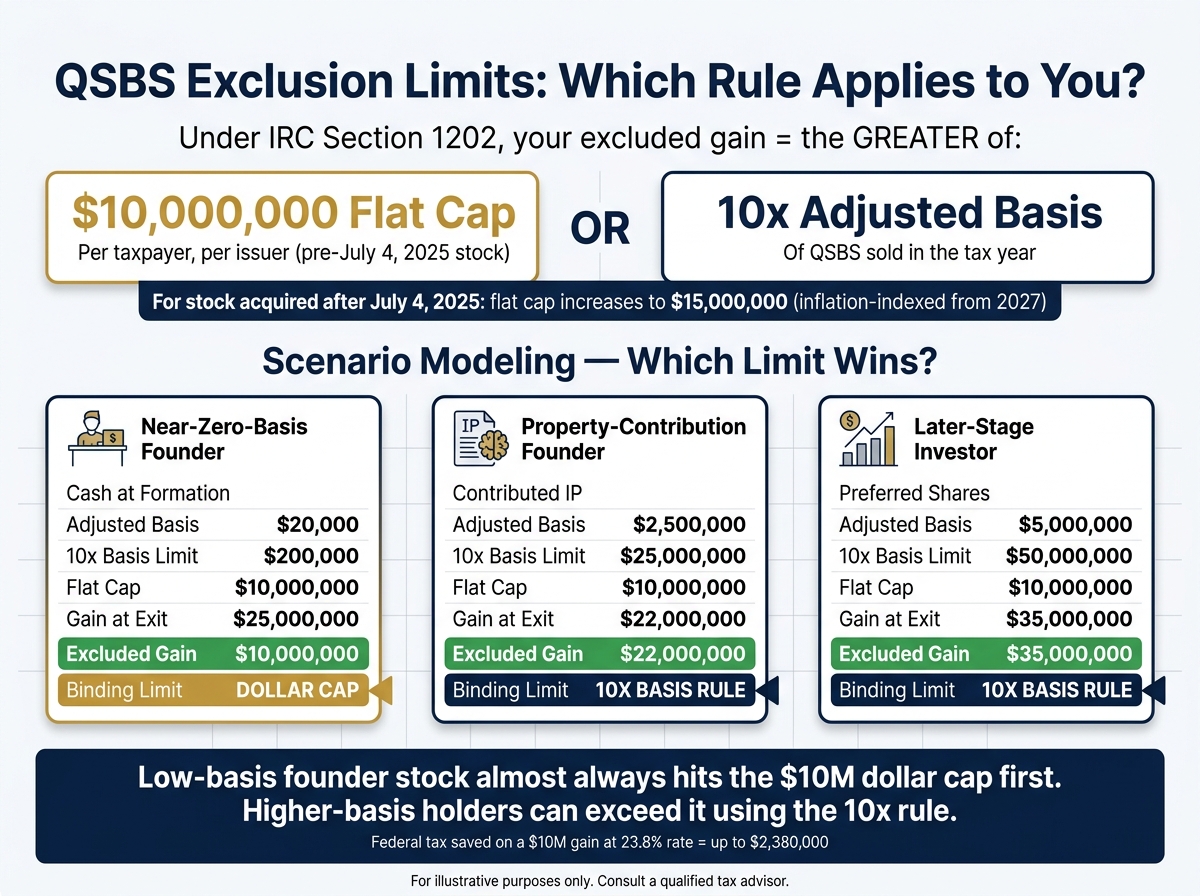
QSBS $10M Cap vs 10x Basis Rule: Which Exclusion Applies to You?
Once QSBS status is in place, the next step is figuring out how much gain can be excluded.
Under IRC Section 1202, eligible QSBS gain is generally excluded up to the greater of the lifetime $10,000,000 per-issuer cap, reduced by prior excluded gain from that issuer, or 10 times the aggregate adjusted basis of that issuer's QSBS sold during the tax year. For QSBS acquired after July 4, 2025, the flat cap goes up to $15,000,000, with inflation indexing starting in 2027.[8][5]
This limit applies per taxpayer, per issuer. Each shareholder gets a separate cap for each company whose QSBS they own, so a sale of QSBS in one corporation does not shrink the exclusion tied to another.[29][27] But within one issuer, all QSBS blocks share a single cap, and any gain already excluded from that same issuer cuts into what remains.[8][30] So if you already excluded $4,000,000 from Company A, you have $6,000,000 left under the dollar cap for that issuer.
Adjusted basis usually starts with what you paid for the shares, plus capitalized costs. For service shares, basis is the taxable compensation recognized when the shares became taxable.[4] For many founders, that number is so low that the $10,000,000 cap comes into play first.
Here’s the plain-English version. If you bought 10,000,000 shares at formation for $1,000, your basis is $1,000. Under the 10x rule, your limit would be only $10,000. Compared with a $10,000,000 cap, that barely moves the needle.
The same thing often happens with sweat equity. Shares received for services usually take a basis equal to the compensation income recognized at the time. In an early-stage startup, that amount is often close to zero.[4][28] In both setups, the $10,000,000 cap is usually the rule that matters.
There’s also one detail people miss: for the 10x calculation, basis is measured as of the original issuance date and generally ignores later additions to basis after issuance.[5][8] In other words, putting more money into the company later usually does not increase the 10x limit.
That’s why founders with cheap common stock often run into the dollar cap long before the 10x rule becomes useful.
The 10x rule starts to matter when basis gets high enough to beat the $10,000,000 cap. That can happen with founders who contributed property with a higher basis, or with later-stage investors who paid much more for their shares.
| Scenario | Adjusted Basis | 10x Basis Limit | Flat Cap | Gain at Exit | Excluded Gain | Binding Limit |
|---|---|---|---|---|---|---|
| Near-zero-basis founder (cash at formation) | $20,000 | $200,000 | $10,000,000 | $25,000,000 | $10,000,000 | Dollar cap |
| Property-contribution founder (contributed IP) | $2,500,000 | $25,000,000 | $10,000,000 | $22,000,000 | $22,000,000 | 10x basis |
| Later-stage investor (preferred shares) | $5,000,000 | $50,000,000 | $10,000,000 | $35,000,000 | $35,000,000 | 10x basis |
Low-basis founders usually max out at the $10,000,000 cap. Higher-basis holders can go past it through the 10x rule.[3][6]
That said, a high-basis contribution is not a simple tax hack. The company still has to meet the QSBS rules, including the active business test and gross asset test. And if contributed property has built-in gain, or the valuation is off, the tax result can get messy fast. This is the kind of planning that needs tax counsel and a finance team that can model the exit math before anything is done.
Next, holding period and deal structure determine whether this exclusion survives the exit.
Once you know the exclusion cap, the next issue is simple: can you use it when the deal closes? That comes down to structure and timing.
The QSBS clock starts when you own the stock, not when you get an option or hold convertible debt.[35][43] For founder common stock issued at formation, the holding period starts on the issuance date. For options, it starts when you exercise. For restricted stock without a timely Section 83(b) election, the clock usually starts on each vesting date.[38][37][43]
A timely Section 83(b) election can make a huge difference. If you file it within 30 days of grant or early exercise, the QSBS clock starts right away.[31][32][37] That gives you the earliest possible start date. Miss that 30-day deadline, and there’s no do-over.
For stock issued before July 4, 2025, a 100% exclusion generally needs more than five years.[34][42] For stock under the post-July 4, 2025 tiered regime, the schedule is more flexible:
That’s why you want to check holding periods before the LOI. The closing date controls the exclusion tier.[33][41] A deal that closes a little too early can leave money on the table.
The exit structure can decide whether QSBS exclusion applies at closing.[1][42][44]
| Exit Structure | QSBS Impact | Holding-Period Issues | Key Planning Considerations |
|---|---|---|---|
| Stock sale | Direct exclusion is available if Section 1202 rules and the holding period are met. | Track the issuance date for each block of stock. Post-July 4, 2025 stock may fall into the 50% / 75% / 100% exclusion tiers based on holding period. | Time the closing to hit the target tier, model per-issuer cap use, and line up trust planning. |
| Asset sale | QSBS exclusion usually does not apply directly at the corporate level. Shareholders may get access only if they receive a liquidation or redemption of their stock. | Shareholders still need to satisfy the holding period when the liquidation or redemption happens. | Model corporate-level tax and possible double taxation with tax counsel. |
| Stock-for-stock reorganization | QSBS treatment on built-in gain at closing may carry over, but future appreciation in the replacement stock usually turns into regular capital gain. | Original issuance dates and tacked holding periods need close tracking. | You need detailed transaction tax analysis to confirm whether QSBS attributes carry over. |
| Founder secondary sale | A secondary sale can use part of the per-issuer exclusion cap if the holding period is met. If shares were held for more than 6 months but not long enough for full exclusion, Section 1045 rollover may help preserve future QSBS treatment. | Identify which stock blocks are being sold and the start date for each one. | Work with trust and tax advisors on cap use before the main exit. |
Asset sales bring their own corporate-level tax issues, and reorganizations need close review to confirm whether QSBS attributes survive the transaction.[1][43][44]
Three planning tools show up again and again before an exit. Each one can help, but each comes with trade-offs.
Partial secondary sales give founders a way to take some liquidity before a full exit. If the holding period is already met, that sale uses part of the per-issuer exclusion cap. In plain English, every dollar you exclude early is a dollar you can’t exclude later at the final exit.[1][39] That’s why stock selection matters. Basis, holding period, and remaining cap all shape which blocks make the most sense to sell.
Trust and multi-owner structures can multiply the exclusion by spreading QSBS ownership across multiple taxpayers, each with a separate per-taxpayer, per-issuer cap.[39] You’ll often hear this called QSBS stacking. The shares have to be transferred while they still qualify as QSBS, and the trust design can get technical fast, with grantor versus non-grantor status, gift tax issues, and state-law rules all in play.[40] One bad move can knock the shares out of QSBS treatment, so this isn’t something to piece together on your own.
Section 1045 rollover comes into play when a founder sells QSBS held for more than 6 months but not long enough for the full exclusion. If the proceeds go into new qualifying QSBS within 60 days, the gain can be deferred, and the holding period can effectively continue in the replacement stock.[40][45] That said, the replacement stock also has to satisfy Section 1202, and the recordkeeping can be a grind.
These calls usually need joint modeling by legal, tax, and finance teams.
Once the exit path is set, document every fact that supports the QSBS position.
QSBS records protect the exclusion that can shape your net exit value. Keep this material in one indexed file, not spread across random folders. The goal is simple: each document should back up a specific QSBS test.
| Document | QSBS Test It Supports |
|---|---|
| Certificate of incorporation, amended and restated charters | C corporation status at issuance and throughout the holding period |
| Corporate records and tax filings | No S corporation election while QSBS was held |
| Stock purchase agreements, cap table, stock ledger | Original issuance, share count, issuance date, holder identity |
| Wire confirmations, canceled checks, payroll records | Acquired for money, property, or services at original issuance |
| Balance sheets and trial balances near issuance dates | Aggregate gross assets at the time of issuance |
| Financial statements, payroll records, business activity narratives | Active business operations and use of assets |
| 83(b) election filings and IRS acknowledgments | Holding period start date for restricted stock |
| Option grant notices, exercise notices, payment confirmations | When options converted to stock; QSBS eligibility of resulting shares |
| Redemption records, board minutes on repurchases | Proof that redemptions did not trigger disqualification |
Tax advisors recommend keeping these records for at least seven years after filing the returns that claim the exclusion, so you have support if the IRS asks questions later.[46]
Once the file is in order, do a pre-close review of the facts that drive exclusion eligibility.
Start this review 12–24 months before your expected exit. That may sound early, but it gives you time to deal with missing records, messy cap table issues, or stock history questions before they show up in diligence.
Focus on the items that matter most:
If anything is incomplete, fix it before the LOI, not in the middle of a deal sprint.
QSBS results are usually locked in long before closing. Confirm eligibility early, file 83(b) elections on time, model the $10 million cap against the 10x basis rule, and keep a complete file that can support the exclusion during diligence and audit.
Your shares may qualify as QSBS if they were issued directly by a domestic C corporation and not bought on the secondary market.
There’s also an asset cap at the time the shares were issued. The company’s gross assets must have been no more than $50 million at issuance, or $75 million for shares issued on or after July 4, 2025.
The business itself has to meet another test too. For most of your holding period, at least 80% of the company’s assets must be used in a qualified active business. Some industries are excluded, so those companies won’t qualify.
This is one of those areas where paperwork matters. Keep records that support eligibility.
The 10x basis rule lets you claim a bigger exclusion when 10 times your original basis is higher than the standard cap.
Here’s how that cap works:
That means the 10x basis rule becomes the larger number if your initial basis is more than $1,000,000 for shares issued before July 4, 2025, or more than $1,500,000 for shares issued on or after that date.
Not on their own. Options, RSUs, and LLCs are not automatically QSBS.
With options and RSUs, the holding period usually starts only when you exercise the option or when the RSU converts into actual stock. Until then, you don't hold the stock itself.
With an LLC, the rule is different. The company needs to be a domestic C corporation, and in most cases, only stock issued after that conversion can qualify.