Published on
July 21, 2026


Investors often decide on the team before they decide on the product. In this piece, I’d boil team diligence down to five checks: who does what, who owns what, who gets hired next, how the company tracks progress, and who can back up the story.
Here’s the short version:
One stat sets the tone: 95% of VC firms say the founding team is the top factor in whether they pursue a deal. That means small mismatches can hurt more than most founders think.
A simple way to think about it: if I open the deck, model, data room, and LinkedIn pages, I should see the same team story in every place.
| Area | What I should have ready | What investors look for |
|---|---|---|
| Team roles | Founder bios, role map, org chart | Clear ownership and no major gaps |
| Equity | Fully diluted cap table, SAFEs, notes, option records | Clean ownership and no missing approvals |
| Hiring | Next 1–2 hires, salary, equity, start dates | Clear path to the next milestone |
| Performance | Monthly financials, forecast, KPI sheet | Clean reporting and steady tracking |
| References | Founders, managers, peers, customers, past investors | Proof that the story holds up |
If I get these basics in order before outreach, diligence usually moves with fewer delays and fewer hard questions.
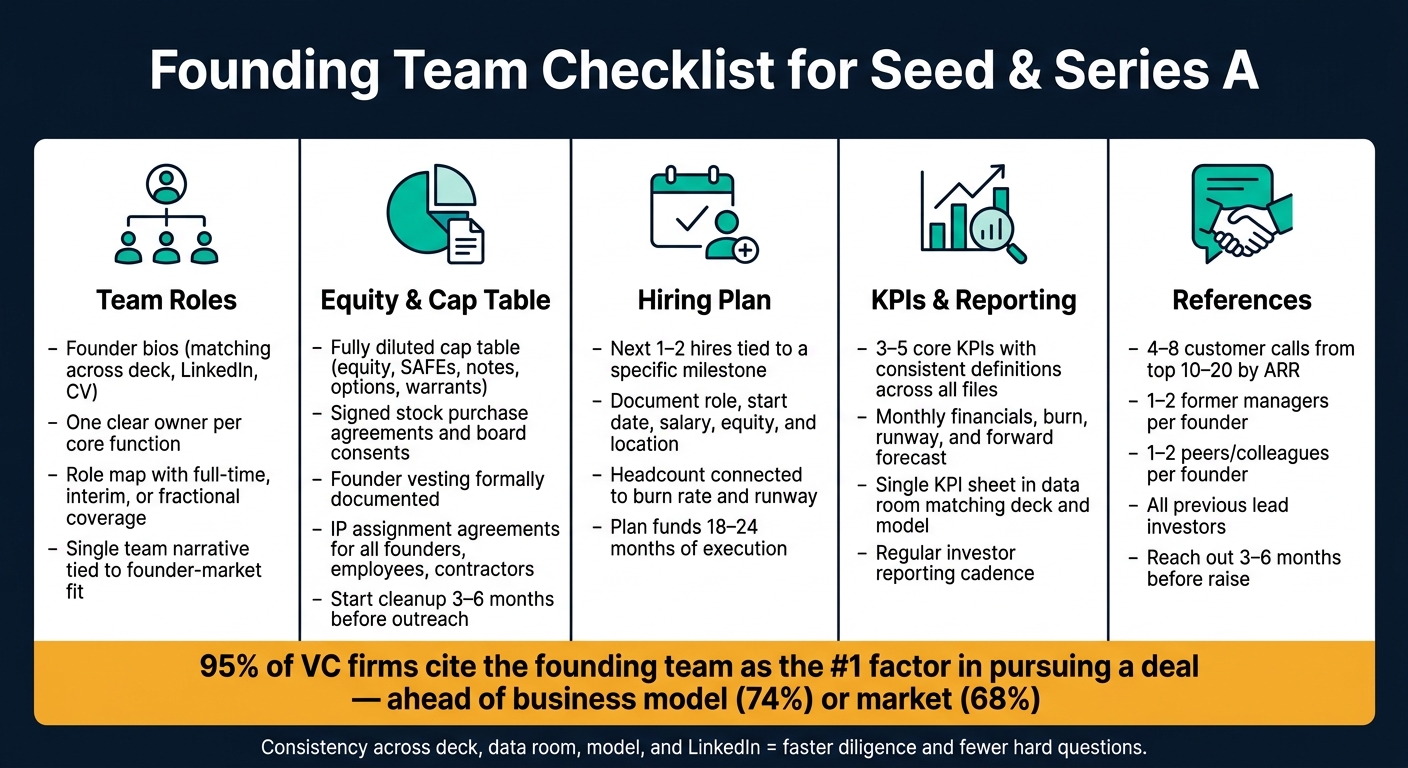
Founding Team Checklist: 5 Key Areas Investors Evaluate at Seed & Series A
Every founder bio in a data room or pitch deck should answer one thing, plain and simple: why is this person the right one to solve this exact problem? A good bio links prior roles, domain know-how, startup wins, and verifiable credentials straight to the market you’re targeting.
Use the same titles, dates, and outcomes across the bio, LinkedIn, and CV[1]. Keep each founder bio in line with the deck, LinkedIn, and CV, and stick to roles, outcomes, and credentials that can be checked.
Once the bios line up, connect each person to the functions investors will review in diligence.
Use a function-by-function ownership table to make coverage gaps easy to spot. Assign each core function to one owner, and show whether that coverage is full-time, interim, or fractional[1].
| Function | Owner | Coverage |
|---|---|---|
| Product | Named founder or hire | Full-time or interim |
| Engineering | Named founder or hire | Full-time or interim |
| GTM | Named founder or hire | Full-time or interim |
| Finance | Named founder or fractional | Full-time or fractional |
| Ops | Named founder or fractional | Full-time or fractional |
Gaps are fine if they’re explained[1]. If a function doesn’t have a dedicated owner yet, say how it’s being handled for now, such as fractional CFO support for financial modeling and reporting.
That ownership map should feed into one clear team story, not five separate ones.
Write one short team thesis that shows why these founders fit this market. Boil the bios down to a single sentence that ties founder background to the customer pain point and product insight. The narrative should match the pitch deck and what founders say in meetings[1][2] - that kind of consistency helps build trust around founder-market fit and execution during diligence.
A messy cap table can stall a deal fast. In some cases, it can end the conversation altogether. Investors want a fully diluted cap table that covers equity, SAFEs, notes, options, and warrants, with signed stock purchase agreements, option grants, SAFEs, convertible notes, board consents, and stock plan documents behind it [1].
For U.S.-based companies, get the Certificate of Incorporation, Bylaws, board minutes, and written consents for past equity grants in order before diligence begins [1]. Investors aren’t just skimming these files. They’re checking whether ownership is clear, approvals were handled the right way, and the company has control of its core IP.
| Diligence Category | Key Documents Required | What Investors Are Verifying |
|---|---|---|
| Cap Table | Fully diluted table, SAFE/note agreements, option plan | Ownership clarity and no unresolved equity claims |
| Legal | Bylaws, board minutes, incorporation certificate, IP assignment agreements | Proper corporate governance, share authorization, and that the company owns its core technology |
| Team | Vesting schedules, background checks, employment/IP assignment agreements | Long-term incentive alignment and founder commitment |
The issues investors flag most often are pretty consistent: missing board consents, incomplete SAFE records, and unsigned IP assignment clauses. Those problems are much easier to fix before outreach than in the middle of diligence, when every loose end feels bigger than it is.
Start this cleanup 3–6 months before outreach [1].
Once the paperwork is in shape, the next thing investors look at is how the round will shift ownership.
Founder vesting needs to be formally documented. If any vesting terms are missing or unsigned, fix that before investor meetings start [1].
Then go a step further. Make sure equity splits, voting control, and decision rights are fully settled. Voting agreements, investor rights agreements, and right of first refusal (ROFR) documents from past rounds will all come up in diligence [1]. If decision rights are fuzzy, that will come out. It’s far better to sort it out with your co-founders now than to explain confusion in a live deal.
IP assignment is just as strict. Every founder, employee, and contractor who worked on the codebase or product should have a signed IP assignment agreement on file [1]. Pay extra attention to code or IP built by founders before the company was formally incorporated. That’s one of the most common gaps auditors find [1].
Before meetings begin, build an internal pro forma that shows what investors will review in diligence across three scenarios: Pre-Seed, Post-Seed, and Post-Series A. Include founder dilution, new investor ownership, and option-pool expansion tied to the hiring plan.
This helps you avoid ownership surprises during diligence.
It also gives you a clearer view of how to size the option pool and plan the next hires.
Investors look at the hiring plan to see one thing: can this team hit the next milestone with the money being raised? That’s why each hire needs a direct link to an outcome.
Use the role map to choose the next 1–2 hires that fill the biggest coverage gaps. Then tie each one to a clear result, like shipping a product release, adding sales capacity, or reaching a revenue target.
Specificity matters here. If a hire is supposed to help launch a feature in Q3 or help the company reach $1,000,000 in ARR, say that plainly. The tighter the link between the role and the milestone, the easier it is for investors to judge the plan.
Once that’s set, spell out each role so investors can see how team coverage turns into day-to-day execution.
Keep a headcount table that lines up with burn-rate assumptions.
| Component | What to Include |
|---|---|
| Role & Seniority | Title and level (e.g., Senior, Director, VP) |
| Start Date | Expected date in MM/DD/YYYY format |
| Annual Salary | Compensation in USD |
| Equity Grant | Specific grant size and vesting schedule |
| Location | Base location |
| Milestone | Expected impact by quarter |
That role plan should map straight to compensation, timing, and location.
A current org chart that shows the team structure and key open roles is a standard diligence item for Series A [1]. Also, make sure every new hire signs an employment agreement with IP assignment and invention assignment clauses as soon as they start. Missing paperwork here is a common reason deals slow down or fall apart during diligence [1].
The hiring plan should flow straight into the P&L and cash flow forecast so investors can see how the raise funds 18 to 24 months of execution [1]. In plain terms, headcount assumptions shouldn’t sit in a separate doc by themselves. They need to show up in the model, where salary, timing, and cash impact are easy to trace.
If the company plans to hire over several quarters, that timing should also show when burn steps up and how much runway remains. This is how investors check whether the plan is grounded in the numbers, not just the story.
Once headcount is set, investors want to see two things: does the team track progress in a clean way, and do outside references back up the founder story? After roles, ownership, and hiring are locked in, they look for proof that the team can carry out the plan already laid out in the hiring section.
Choose 3–5 core KPIs and stick to one definition for each across the deck, model, data room, and monthly reports. No swapping formulas. No slightly different versions from file to file.
Keep a single KPI sheet in the data room, and make sure it matches the deck, model, and reports exactly. That kind of consistency sounds small, but it matters. If an investor sees one number defined three different ways, trust starts to slip.
Include monthly financials, burn, runway, and a forward forecast with assumptions. Keep the package easy to follow, and update it on a set cadence so investors always see current numbers.
Use the same team narrative here that you used in your founder bios. If the bios say the team is disciplined and data-driven, the reporting package should show that on the page.
Reference checks can make or break the deal. According to research, 95% of venture capital firms cite the founding team as the most important factor in pursuing a deal - well ahead of the business model (74%) or the market (68%)[2]. Investors use references to verify what founders claim, and any contradiction - even a small one about employment dates or role scope - can quietly end a deal[2].
References should back up the same founder-market fit story already shown in the bios.
Prepare references from former managers, peers or colleagues, and previous investors before the raise begins. Investors usually select 4–8 customers from your top 10–20 by ARR. Give those customers a heads-up before investors call.
Use customer calls to confirm product value and expansion potential.
| Reference Type | Quantity Needed | What investors check |
|---|---|---|
| Customers | 4–8 calls from a 10–20 customer list | Product works as described, "must-have" status, expansion potential [1] |
| Former Managers | 1–2 per founder | Leadership, coachability, and past execution [1] |
| Peers/Colleagues | 1–2 per founder | Collaboration, technical/domain expertise, and work ethic [1] |
| Former Investors | All previous leads | Integrity, transparency, and ability to handle stress [1][2] |
Reach out to references 3–6 months before the raise and align on the story they will tell[1][2]. Even small discrepancies can signal a lack of integrity to investors, including when they were unintentional.
Keep these files ready before outreach so diligence can move fast.
Once you finish the checklist above, every investor-facing file should tell the same story. Even one small mismatch can slow the deal down.
In that folder, keep founder bios, the org chart, a headcount sheet, and equity documents together in one team folder. Name files with an MM/DD/YYYY date stamp, and mark every currency figure in USD so investors aren't left guessing.
Before you send anything, do one last cross-check. Make sure revenue, headcount, and KPI definitions match across the deck, model, and reporting package. A complete data room can shorten closing by at least a week.
If keeping those files up to date is tough, Phoenix Strategy Group can help growth-stage companies keep financial and KPI systems investor-ready.
An investor should be able to open the data room, move through it fast, and come away with no unanswered questions.
First, tighten your operational and financial discipline. Clean up your cap table, make sure your financials are GAAP-compliant, and confirm your data is consistent and easy to verify.
Then set up an organized data room, document traction with key metrics like MRR, churn, and CAC, and aim for 6 to 12 months of cash runway so you’re not forced into rushed decisions.
For a Seed or Series A round, your hiring plan should be granular and tied straight to your growth strategy.
That means modeling headcount costs line by line. Show when each person will join, what they’ll cost, and how that role helps drive revenue or supports the company as it grows.
Investors look for this level of detail because it shows how you’ll use the money to hit growth milestones. It also signals that the leadership team is ready to scale the business as day-to-day ownership starts to move beyond the founders.
Common red flags include:
Investors also get uneasy when leadership’s story doesn’t line up with the data or with what team members say. That gap can point to poor alignment, limited transparency, and higher execution risk.