Published on
September 12, 2026


If you run a company between $500,000 and $10 million in annual revenue, recurring spend can quietly drain margin and runway. I’d fix that with a fractional CFO system: define recurring costs, require approval based on total contract value, track every vendor in one register, review spend every month and quarter, and tie each cost back to margin and CAC payback.
Here’s the short version:
A few numbers stand out:
In plain English: I want every recurring charge to have an owner, a renewal date, a reason to exist, and a place in the forecast. That’s how I keep spending from turning into a slow leak.
A spend policy should be short, direct, and easy to use without pulling finance into every small decision.
A solid recurring expense policy should spell out the basics: approved expense categories, who can sign contracts, spending caps by role, reimbursement rules, receipt requirements, and how corporate cards can be used. It should also require pre-approval for annual SaaS contracts, multi-month retainers, and any auto-renewing commitment. And here's the part that matters most: approval thresholds should be based on total contract value, not the monthly fee, so a small monthly charge doesn't slip past review.[1]
The policy also needs to draw a hard line between personal and business spending. Personal subscriptions on company cards are not allowed. Every recurring charge should have a clear business purpose and a named owner.
Tiered approvals help keep recurring commitments under control, especially because these charges tend to fade into the background over time. Finance sets the rules. Managers handle routine spending.
| Monthly Recurring Cost | Annualized Value | Approval Required |
|---|---|---|
| Under $500/month | Under $6,000/year | Department manager |
| $500–$2,000/month | $6,000–$24,000/year | Department head or finance |
| Above $2,000/month | Above $24,000/year | CFO or CEO |
If a contract includes cancellation penalties or multi-year terms, move it up one approval level no matter the size.
Each department should own its recurring spend inside an approved budget. One person should be accountable for renewals and vendor relationships. That way, ownership is clear, and renewals don't turn into a game of "Who approved this?"
As the company grows, these rules need to grow with it. What starts as a few spending thresholds should turn into department-level budgets and renewal tracking.
The right controls shift as recurring spend spreads across the business.
At $500,000 in revenue, start simple: a short policy, approval thresholds, and an approved-vendor list. That's usually enough to stop most silent spend from piling up.
At $10 million, recurring spend touches more teams, so the framework needs to protect runway without bogging people down. At that point, controls should cover more points across the business, including:
The average company deals with about 247 SaaS renewals a year, which makes pre-renewal approval workflows a must.[2]
The principle stays the same at every stage: make the default "no commitment without review," instead of trying to clean up unauthorized spend after the fact.
Once the rules are set, build a single register to track every recurring charge.
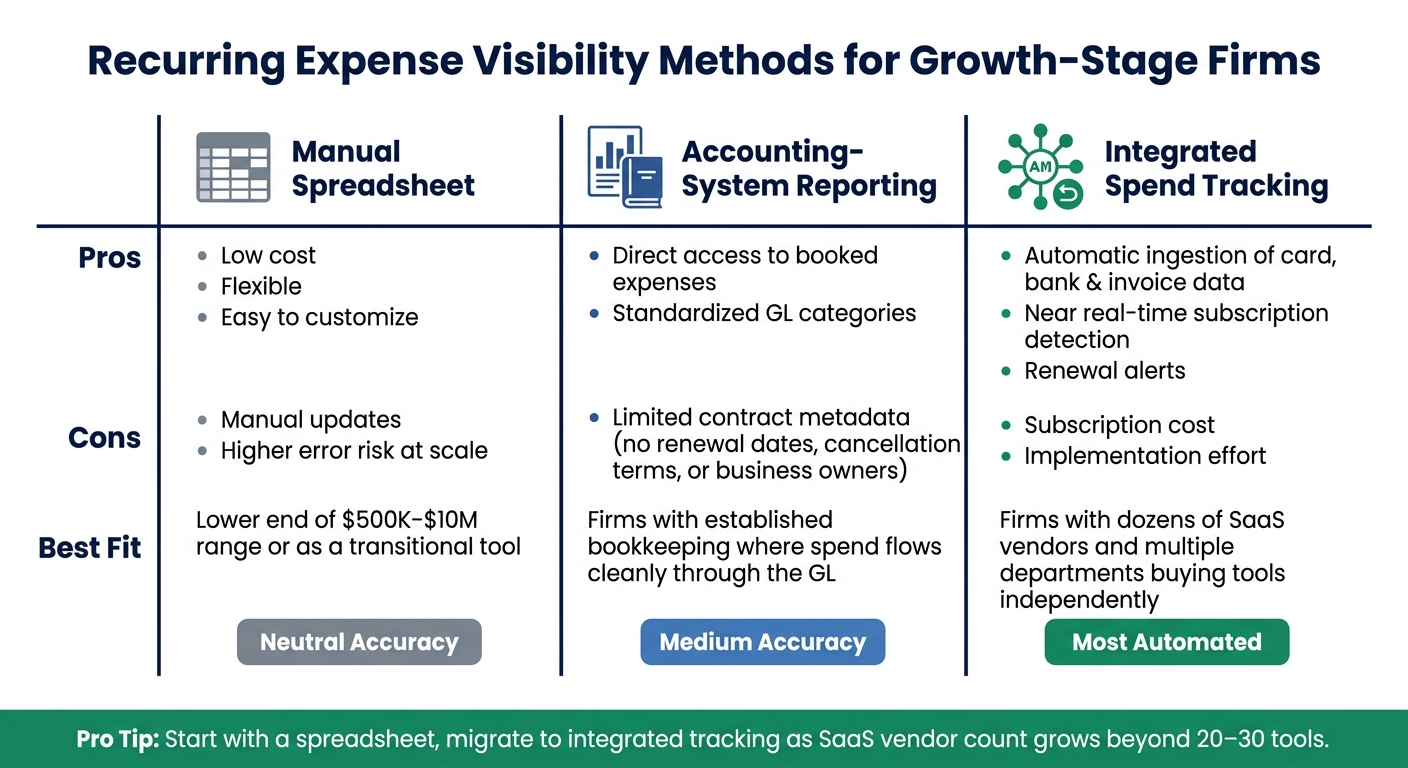
Recurring Expense Visibility Methods: Manual vs. Accounting vs. Integrated
A policy means very little if recurring costs are scattered across inboxes, card statements, and old contracts. To see what you're actually committed to, you need one live register that holds every recurring charge in one place.
Use one spreadsheet or database to track every recurring commitment. Each row should represent a vendor or recurring charge. Each column should hold the details finance needs to track it, forecast it, and make a call when renewal time comes around.
Track the vendor, service, owner, monthly equivalent (USD), billing frequency, next bill date, renewal date, payment method, GL category, term, auto-renewal, cancellation notice, and contract link. These fields aren't busywork. Each one supports a clear next step. The owner creates accountability at renewal. The renewal date sets up pre-approval. The cancellation notice tells finance how much time it has to act before the contract rolls over.
Convert annual and quarterly charges into a monthly equivalent so total recurring spend adds up cleanly without hiding the actual billing rhythm. It also helps when you want one clear monthly view instead of mentally juggling a mix of annual, quarterly, and monthly payments.
Add a status field too - Active, Under Review, or Terminate at renewal. That one column shifts the register from a static record into something you can use to make decisions.
Start with exports from your bank, card, and reimbursement systems for the last 6–12 months. Save the data to CSV, group charges by merchant, and clean up name variants so the same vendor doesn't show up three different ways. That's how finance spots duplicates, renewals, and spend that slipped past the approval process.
After grouping the data, look for three issues:
Then reconcile what you find against the vendor list in your accounting system. This matters because some payments go out by ACH or check, which means they won't appear on card statements.
Employee-paid spend can be easy to miss. If someone bought a tool on a personal card and filed an expense report, that charge is sitting in reimbursement data, not your bank feed. Pull that data too. If you find a vendor no one recognizes, add it to the register with a status like Unapproved or Discovery.
| Visibility Method | Pros | Cons | Best Fit |
|---|---|---|---|
| Manual spreadsheet | Low cost, flexible, and easy to customize | Manual updates and higher error risk as the company scales | Lower end of the $500K–$10M range or as a transitional tool |
| Accounting-system reporting | Direct access to booked expenses and standardized GL categories | Limited contract metadata such as renewal dates, cancellation terms, or business owners | Firms with established bookkeeping where most spend flows cleanly through the GL |
| Integrated spend tracking | Automatic ingestion of card, bank, and sometimes invoice data; near real-time detection of new subscriptions; renewal alerts | Subscription cost and implementation effort | Firms with dozens of SaaS vendors and multiple departments buying tools independently |
Once the register exists, you have to keep it alive. Without a review schedule, it goes stale fast.
Monthly reviews should be led by finance and should compare actual recurring spend against what's in the register. Flag any vendor that comes in more than 10% above forecast. Assign an owner to each new recurring charge. Review low-use tools that cost more than $500 per month. That's the kind of drift that quietly eats budget.
Quarterly audits should go deeper. Group vendors into four buckets - software/SaaS, marketing services, payroll-related costs, and insurance - and review each one based on usage, ROI, and upcoming renewal terms.
For SaaS, map each tool to a business capability and look for overlap. Two teams may be paying for tools that do almost the same job. For marketing retainers, connect fees to performance metrics like CAC and lead volume. For insurance, benchmark policies before renewal to make sure coverage still matches the company's current revenue and risk profile.
Each vendor review should end with one action: consolidate, renegotiate, expand, or exit. That action list should feed into a renewal calendar that gives finance 60–90 days of lead time before any major contract auto-renews.
That cadence keeps the register current and ready for forecasting. Use the register as the input to your expense forecast.
Turn your expense register into a forecast people can actually use. The point isn't just to log spend. It's to build a plan the board, lenders, and investors can lean on for renewal calls, hiring timing, and runway decisions. From there, you can map committed spend into a month-by-month operating plan.
Not every expense line should be forecasted the same way. Some costs barely move. Others follow contracts. And some rise and fall with volume.
| Forecasting Method | Typical Accuracy | Effort | Best Use |
|---|---|---|---|
| Historical run-rate | Medium - works well for stable costs, poor for step changes | Low | Fixed, low-volatility lines |
| Contract-based | High - when contracts are current and modeled precisely | Medium | Leases, enterprise SaaS, outsourced services |
| Revenue-linked | High when the revenue forecast is reliable | Medium to high | Costs that scale with volume |
Historical run-rate forecasting fits fixed, low-volatility lines like core SaaS subscriptions, insurance, and routine services. Use the last 3–6 months of actual spend, adjust for known contract changes, and roll it forward.
Contract-based forecasting makes more sense for contract-driven costs. Think of an office lease with annual escalators, a three-year SaaS deal with tiered user pricing, or a data platform with usage minimums. In those cases, model from the contract, not from past averages.
Revenue-linked forecasting works for costs tied to volume, such as payment processing fees, usage-based cloud infrastructure, commissions, and marketing programs where spend is set as a percent of expected revenue or per-unit activity.
For example, if you forecast payment processor fees at 2.9% + $0.30 per transaction against projected gross revenue, that cost will move with volume instead of sitting flat on the page.
Use the right method for each line, then roll it all into one operating expense schedule.
The goal is a monthly operating expense schedule where every recurring cost gets its own row and each line is tagged as COGS, recurring operating expenses, non-recurring, or non-operating.
Set the classification once, then build the schedule around it. Hosting costs tied directly to product delivery belong in COGS. Salaries, rent, SaaS tools, and G&A services belong in recurring OpEx. Interest expense and one-time transaction costs sit below the line.
From there, build rows for payroll by department, benefits and employer payroll taxes, occupancy, software split out by key tools, sales and marketing programs, R&D, and G&A. Benefits and payroll taxes in the U.S. often add about 15–30% on top of base salary [4][5].
Then layer in timing. A new hire starting in April shouldn't hit January. A lease step-up in July should show up in July. If marketing is front-loaded in Q1 and Q3 around major campaigns, the schedule should show that too. Annual totals alone won't cut it.
At close, record accruals for expenses incurred but not yet paid, like a quarterly SaaS invoice or a marketing campaign that crosses month-end. That keeps each month's numbers right for margin analysis, not just cash tracking.
This turns recurring spend into a monthly baseline you can manage, not just a backward-looking list of bills.
Once the schedule is in place, the next step is to test whether the cost base supports healthy margins and payback.
After the schedule is built, the main question is simple: is recurring spend helping scalable growth, or is it eating margin? Two metrics get you there fast: contribution margin and CAC payback period.
Contribution margin is revenue minus direct variable costs per customer or unit. Say a SaaS firm pays 3% of revenue in processing fees, 10% in hosting, 5% in support, and 2% in onboarding. That's a 20% variable cost rate and an 80% contribution margin. Recurring costs like executive salaries, fixed rent, and G&A tools stay below that line because they don't change with each added customer.
CAC payback is just:
CAC ÷ monthly contribution margin per customer
Include all recurring acquisition costs - ad spend, salaries, software, and outsourced support - so payback shows the full cost of growth.
Here's the math. If a firm spends $60,000 on ads, $40,000 on sales and marketing salaries, and $10,000 on marketing software each month, then acquires 100 new customers, fully loaded CAC is $1,100. If monthly contribution margin per customer is $150, payback is about 7.3 months. That falls inside the 6–12 month range often seen as strong for B2B SaaS [6][7][8][9].
Once payback stretches past 18–24 months, acquisition efficiency starts to look weak.
Use these outputs to spot renewals to revisit, vendors to renegotiate, and tools or programs that may need to go before the next review cycle.
Once your forecast is set, vendor reviews help you go straight to the costs putting the most pressure on margin. The big tradeoff here is speed vs. staying power. Quick cuts can trim spend fast, but they also tend to break core workflows. A structured review takes a better route: renegotiate pricing, combine overlapping tools, and remove excess spend without damaging the systems the company runs on. Start with vendors that drag down contribution margin or CAC payback.
Before each review, match the register against the last 3–6 months of card, bank, and GL spend. Then, for every vendor above $1,000 per month, check usage, business impact, and contract risk. From there, make a call: renegotiate the price, remove unused seats, combine tools that do the same job, or end the contract. Keep the review centered on the fields that lead to action:
Set contract calendar alerts for 270, 180, and 90 days before each renewal [10][11][12]. That gives you room to negotiate because you have options, not because the deadline is breathing down your neck. Say a CRM vendor charges $6,000 per month on a month-to-month plan. That same vendor may agree to $4,500 per month in exchange for a 12–24 month commitment with annual prepayment. That cuts annual spend from $72,000 to $54,000 while keeping the same function in place.
The same logic works with seat counts. If a team is paying for 100 SaaS seats at $40 per user per month but only 62 users are active, trimming to 70 seats saves $14,400 per year with little day-to-day disruption.
Benchmarks show that organizations without formal SaaS governance waste 45–60% of their SaaS budget [3].
These records also make diligence move a lot faster. Investors and acquirers don't stop at revenue. They want to know whether the cost base is real, documented, and easy to defend. During a Quality of Earnings (QoE) review, recurring operating expenses usually can't be added back as one-time adjustments [13][15][17][19]. And when add-backs aren't well supported, buyers dig in. Trust slips, multiples tighten, and the deal can pick up friction in the form of escrows, holdbacks, or earnouts [14][16][18].
A current register with contracts, owners, and renewal dates makes it easier for diligence teams to verify each expense. It also shows a clean line between must-have infrastructure costs and tools the business could trim if needed. That sends a simple message: management knows where the money goes and knows how to act if conditions change.
Buyers usually ask for 3–5 years of accurate financial statements and contract documentation [14][16][18]. Companies that already have those records in order tend to get through diligence with less back-and-forth and fewer surprises.
For a growth-stage SaaS company, a disciplined recurring expense profile matters. Documented contracts, normalized EBITDA, and clear unit economics can lower perceived operating risk and support a higher ARR or EBITDA multiple. Phoenix Strategy Group supports growth-stage firms with bookkeeping, fractional CFO services, FP&A, data engineering, and M&A preparation for teams working toward that standard.
The system itself is pretty simple. Define what counts as a recurring expense. Enforce a spend policy with approval workflows that don't depend on the founder. Keep the expense register current. Forecast each line with the method that fits that cost type. Review vendors on a set cadence. Then tie every spending call back to contribution margin, CAC payback, and exit readiness.
That loop is what protects margin, runway, and exit value.
Recurring expenses are the bills your business pays again and again on a set schedule. They make up your monthly burn floor and often include office leases, salaries and benefits, debt service, and locked-in software or infrastructure contracts.
Because these costs don’t move with revenue, they set the base amount of cash your business needs every month. Managing them well starts with finding every recurring charge on the books, including easy-to-miss subscriptions and tools that do the same job.
Move past spreadsheets once manual work starts masking key cost details, creating version mix-ups, or eating into time that should go toward higher-level planning.
As hiring, software use, and paid spend increase, spreadsheets often bring more errors, more wasted effort, and less visibility into what’s happening right now. At that point, a centralized system stops feeling like a nice-to-have and starts feeling like the only sane option. It gives you automated updates, scenario planning, and one reliable source of truth.
Review recurring vendors on a risk-based schedule. Run formal reviews quarterly, led by finance, and do lighter check-ins between those review points.
Check higher-risk vendors more often. Review lower-risk vendors less often unless something changes. This helps teams spot SLA issues, performance problems, and cash impact early instead of waiting for the next quarterly review.