Published on
July 23, 2026


If you sell a business and reinvest without a tax plan, you can lose more than 30% of your gain to federal, NIIT, and state taxes. I’d start by splitting the proceeds into basis, capital gain, and ordinary income - because each piece follows different tax rules.
Here’s the short version:
If I had to boil the article down to one idea, it’s this: liquidity comes first, then after-tax return, then risk control. That means I would not treat every sale dollar the same way, and I would not lock up money I may need soon.
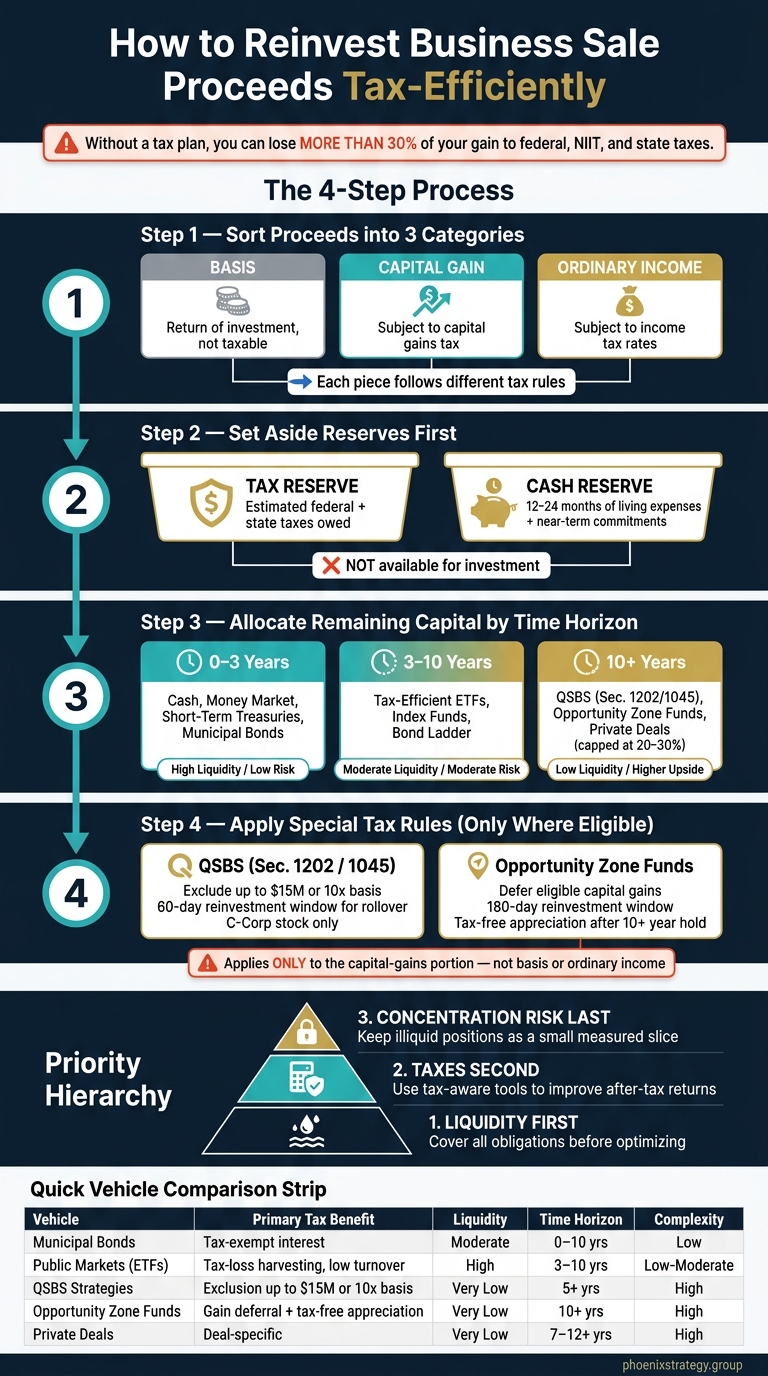
How to Reinvest Business Sale Proceeds Tax-Efficiently: 4-Step Framework

| Bucket or Tool | Best Use | Liquidity | Tax Angle | Main Watchout |
|---|---|---|---|---|
| Cash / Money Market / Short-Term Treasuries | Taxes, living costs, near-term plans | High | Low tax edge | Low growth |
| Municipal Bonds | Taxable income and capital stability | Moderate to high | Federal tax-free interest, sometimes state tax-free | Rate risk, credit selection |
| Public Index Funds / ETFs | Long-term liquid growth | High | Lower turnover, tax-loss harvesting | Market swings |
| QSBS (Sec. 1202 / 1045) | Eligible business-sale gains | Very low | Exclusion or deferral for qualifying stock | Tight rules and deadlines |
| Opportunity Zone Funds | Deferral of eligible gains | Very low | Gain deferral and possible tax-free fund appreciation after 10 years | Long lockup and project risk |
| Private Deals | Small long-term side allocation | Low | Case-by-case | K-1s, concentration, illiquidity |
I’d use this framework to make each dollar do the right job: reserve cash for obligations, keep mid-term money liquid, and put long-term capital into tax-aware growth assets.
After you set aside money for taxes and near-term cash needs, sort what's left based on when you'll use it. Only reinvest the capital-gains portion. Keep tax reserves and ordinary-income proceeds in their own lanes.
A simple way to think about reinvestable proceeds: split them into three time buckets. Then, if there's room, add a small opportunistic sleeve after the core buckets are covered.
The 0–3 year bucket is for near-term obligations. That includes estimated federal and state taxes from the sale, deal-related liabilities or escrow exposure, at least 1–2 years of living expenses, and any planned home purchase, tuition payment, debt payoff, or sabbatical. This bucket should stay mostly in cash, money market funds, or short-term Treasuries.[2][3][4]
The 3–10 year bucket is for goals that matter, but don't need funding right away. Think supplementing living expenses, backing a second venture, or keeping flexibility for future moves. A balanced mix of bonds and equities makes sense here.[1]
The 10+ year bucket is where long-term compounding does its work. Money in this bucket has time to ride through market cycles, so an equity-heavy mix usually fits best.[1] This is also where tax-efficient compounding matters most. If you want private deals, treat them like a small sidecar inside this long-term sleeve. Fund that piece only after the first three buckets are covered, and keep it capped. Illiquid positions are hard to rebalance when life changes fast.
Risk tolerance isn't one fixed score for your entire portfolio. It changes based on when the money will be needed. Short-term capital should see little price movement. Mid-range capital can handle some drawdowns. Long-term capital can take on more equity risk.
Tax profile matters too. The same asset can work well in one bucket and poorly in another.
| Asset Type | Time Horizon | Liquidity | Volatility |
|---|---|---|---|
| Cash and money market funds | 0–3 years | Very high | Very low |
| Short-duration municipal bonds | 0–3 years | High | Low |
| Investment-grade bond ladder | 3–10 years | Moderate–high | Low–moderate |
| Diversified index funds (equities) | 10+ years | High | Higher |
| Private deals / co-investments | 10+ years | Low | High |
For example, a high-turnover active fund that throws off a lot of ordinary income is a bad match for a taxable short-term bucket. On the flip side, a broad equity index fund with low turnover is still a bad place for money you'll need in the next year or two. The point is simple: match the asset to the bucket based on both time horizon and tax profile. That's what turns this from a nice idea into something you can use.
Once the buckets are set, Step 2 lines them up with the right vehicles: municipal bonds, public markets, and private deals.
The goal here is simple: put each type of money in the vehicle that gives you the best mix of tax treatment, access to cash, and downside control.
For money that needs to stay available but still produce after-tax income, municipal bonds are usually the first place to look. Interest on most municipal bonds is exempt from federal income tax. And if the bond comes from your home state, it may also be exempt from state and local taxes.[8][9] That tends to matter most for founders in high tax brackets.
Here’s the key math:
TEY = muni yield ÷ (1 − marginal tax rate). For a 4.8% muni yield and a 35% bracket, TEY is 7.38%.[7]
That’s why a muni yield that looks modest at first glance can end up beating a taxable bond on an after-tax basis.
Munis have also shown lower default rates than similar-rated corporate bonds. Between 2020 and 2024, high-yield munis defaulted at a rate of 0.9% versus 2.4% for high-yield corporates.[5][6] If your job is to protect capital in a taxable account, that gap matters.
| Municipal Bonds | Taxable Corporate Bonds | |
|---|---|---|
| Tax treatment | Federal tax-exempt; often state and local tax-exempt for in-state residents | Fully taxable at federal and usually state levels |
| Tax-equivalent yield | Can be higher for investors in high brackets | Lower after-tax yield for high-bracket investors |
| Credit risk | Lower historical default rates for higher-quality issues | Higher default rates, especially in high-yield segments |
| Liquidity | Good for larger issues; thinner for smaller or bespoke bonds | Generally better liquidity in large investment-grade names |
| Best use case | Taxable accounts, short- to intermediate-term income and preservation needs | Tax-advantaged accounts where interest is sheltered |
One practical point: munis usually belong in taxable accounts. Putting them inside an IRA or 401(k) gives up the main reason to own them in the first place, because those accounts already shield income from current tax.
For money that needs more growth and simpler rebalancing, shift from bonds to public markets. After a concentrated business exit, broad index funds and ETFs can become the core of the portfolio. They spread your money across thousands of companies right away, which helps fix the concentration you just left behind.
Low-turnover index funds and ETFs also help on taxes because they tend to distribute fewer gains. ETFs can add another tax edge through in-kind redemptions.
Two moves can improve after-tax results even more:
This is less about chasing returns and more about keeping more of what the portfolio earns.
Once the liquid core is in place, you can set aside a small slice for illiquid upside. Angel investments, private equity, private credit, direct real estate, and co-investments usually fit in the 10+ year bucket.
These deals can offer more upside, but the trade-off is steep: multi-year lockups, limited access to cash, and messier tax reporting, including K-1s and state filings. That’s why private deals should be capped at 20–30% of net investable assets.
That cap helps keep most of your wealth in liquid, diversified public holdings. In plain English, you want enough accessible capital to cover taxes, lifestyle needs, and new opportunities without being forced to sell something at the wrong moment.
| Public Markets | Private Deals | |
|---|---|---|
| Liquidity | High; can sell any trading day | Low; multi-year lockups or limited secondary markets |
| Transparency | Continuous market pricing | Periodic, model-based valuations |
| Minimums | Low; accessible via ETFs | Often $250,000–$1,000,000+ per fund or deal |
| Tax reporting | Simple 1099 forms | Complex K-1s, potential multi-state filings |
| Best time horizon | Core for the 3–10 and 10+ year buckets | 10+ years only |
| Concentration risk | Low with broad index exposure | High if over-allocated |
Once the liquid core is set, Step 3 covers the tax rules that apply only to qualifying gains.
Two tax rules can cut the tax bill on an eligible business-sale gain: Qualified Small Business Stock (QSBS) and Opportunity Zone funds. But there’s a catch. They apply only to the capital-gains portion of the sale.
That means they do not apply to basis recovery or ordinary income. So don’t treat them as a substitute for the bucket framework. First split the proceeds into basis, capital gain, and ordinary income. Then apply these rules only to the gain piece.

Section 1202 allows eligible shareholders to exclude qualifying gain from the sale of QSBS. For QSBS issued after July 4, 2025, the exclusion is tiered: 50% after 3 years, 75% after 4 years, and 100% after 5 years.[11][14][16][21]
The exclusion cap for post-July 4, 2025 stock is the greater of $15 million or 10 times your basis, with inflation indexing starting in 2027.[10][12][13][14][17] For stock acquired earlier, the cap is $10 million or 10x basis.[12][13][14][16]
QSBS has strict entry rules. The shares must be issued at original issuance by a domestic C corporation. The company also needs to be an active qualified trade or business, and it must satisfy the asset test. For post-July 4, 2025 stock, gross assets cannot exceed $75 million at issuance. Earlier stock used a $50 million test before and right after issuance.[10][11][15][17]
Section 1045 works differently. It does not erase gain. It pushes the gain forward.
If you sell eligible QSBS held for more than 6 months and reinvest the proceeds into replacement QSBS within 60 days, you can defer recognition of the gain.[18][19][20][21][22] That deferred gain reduces your basis in the replacement stock, and the holding period may tack on. In plain English: the window is short, so the replacement QSBS usually needs to be identified before the sale closes.
| Section 1202 | Section 1045 | |
|---|---|---|
| Tax benefit | Permanent gain exclusion | Gain deferral into replacement QSBS |
| Holding period | 5+ years (tiered exclusions at 3 and 4 years for post-July 4, 2025 stock) | Original QSBS held 6+ months |
| Timing requirement | No post-sale window; eligibility is built into the stock's history | Replacement QSBS must be purchased within 60 days of sale |
| Cap | Greater of $15M or 10x basis (post-July 4, 2025); $10M or 10x basis (earlier stock) | No separate cap; gain rolls into new QSBS basis |
If QSBS doesn’t fit, Opportunity Zones offer a different deferral route for eligible capital gains.

Opportunity Zone funds let you defer eligible capital gains by reinvesting them into a Qualified Opportunity Fund (QOF) within 180 days of the gain event.[19] Again, only capital gains count. Ordinary income from the sale is out.
If you hold the QOF long enough - usually 10+ years - you may qualify for a basis step-up on the fund’s appreciation.
That tax angle can look attractive, but the investment side needs just as much attention. Many QOFs are tied to a narrow set of real estate projects or operating businesses in designated zones. That can mean construction risk, leasing risk, execution risk, and rule-related risk, all packed into a less diversified structure. QOFs also have to satisfy ongoing asset tests, and missing those tests can put the tax result at risk.
| Opportunity Zone Fund | Conventional Private Real Estate / Private Fund | |
|---|---|---|
| Liquidity | Very low; designed for long holds | Low, but varies by structure |
| Holding period | 10+ years for maximum tax benefit | Deal-specific |
| Tax treatment | Deferral of eligible capital gains; potential basis step-up on appreciation[19] | Standard capital gains treatment |
| Risk profile | Development and project-specific risk with OZ compliance overlay | Deal-specific risk without OZ constraints |
A good way to think about Opportunity Zone exposure: it’s a small satellite sleeve inside the after-tax plan, not the core of it. Keep it inside the long-term bucket, and size it only to money you can leave alone for a decade.
Use these rules as narrow add-ons within the bigger reinvestment plan - Step 4 shows how to pull the full allocation together.
Once you know what’s left, turn it into an after-tax plan.
Start with the money that is not available for risk. Set aside taxes and living reserves first. Then invest what remains based on when you’ll need it. That simple split matters: cash you may need soon should not be treated the same way as long-term capital.
Work with a CPA to estimate total tax due, then park that money in cash or short-term Treasuries. On top of that, keep 12–24 months of living expenses plus any near-term commitments in reserve.
After those reserves are in place, divide the investable balance into three time buckets:
That structure helps you separate safety money from growth money. It also makes it easier to avoid a common mistake after a big exit: putting too much capital into long-lockup ideas before your short-term needs are covered.
Review the plan each quarter, and sit down with your CPA once a year. Track realized gains and losses, check that your liquidity coverage still holds, and watch for drift outside your target ranges.
Your annual review should also look at:
Then rebalance only when a bucket moves outside its target range. No need to tinker just to feel busy.
Phoenix Strategy Group can model post-exit cash flow, scenario-test allocation mixes, and map proceeds into monthly buckets.
Liquidity first, taxes second, concentration risk last.
Cover your obligations before you optimize anything else. Use tax-aware tools because they improve after-tax returns - not because they sound fancy. And keep illiquid, concentrated positions as a measured slice of the total portfolio, not the center of it.
The table below shows how the five main vehicles stack up across the factors that tend to matter most after an exit:
| Vehicle | Primary Tax Benefit | Liquidity | Time Horizon | Risk Level | Implementation Complexity |
|---|---|---|---|---|---|
| Municipal Bonds | Federal and often state tax-exempt interest[23][24] | Moderate | 0–10 years | Low | Low |
| QSBS Strategies | Gain exclusion (up to $15 million or 10x basis) or deferral via rollover[28][27] | Very low | 5+ years | High | High |
| Opportunity Zone Funds | Gain deferral; potential tax-free appreciation after a 10-year hold[25][26] | Very low | 10+ years | High | High |
| Public Markets (Tax-Aware) | Tax-loss harvesting, asset location, low-turnover ETFs | High | 3–10 years | Moderate | Low to moderate |
| Private Deals | Deal-specific tax treatment | Very low | 7–12+ years | High | High |
For most founders, the right setup is a coordinated mix, not a single vehicle. Liquid reserves and tax-aware public markets usually make up the core. Municipal bonds can support the income and capital-preservation layer. QSBS strategies, Opportunity Zones, and private deals belong in a smaller supporting role, sized only to capital you can afford to lock up for 10 years or more.
It comes down to balancing near-term cash needs with long-term goals and the taxes tied to each move. Since investment options vary in how easy they are to access and how they're taxed, think about how much money you may need on hand and how each path could affect your tax bill.
A bit of planning goes a long way here. It can help you handle capital gains, earnout payments, and investment income while keeping enough flexibility and avoiding missed exclusions.
With QSBS under Section 1045, you can roll proceeds from the sale of existing QSBS into new qualifying small business stock within 60 days. Do that, and you can defer the capital gains.
With a Qualified Opportunity Fund, the rule is a bit broader. You can reinvest the capital gains part of your proceeds - including short-term, long-term, and Section 1231 gains - within 180 days of the sale to defer tax recognition.
There’s no one-size-fits-all percentage here. How much you put into private deals should match your financial goals, liquidity needs, and risk tolerance, while also taking tax-efficient options and your need for ready cash into account.
Private deals can tie up your money for a long time, so your time horizon matters. It also helps to look at how these investments fit with your portfolio’s tax treatment and cash-flow needs. Because this can get complicated, working with financial professionals can help you set an allocation that lines up with your long-term wealth preservation goals.