Published on
August 3, 2026


If I want to use Reg CF, I need to treat it like a securities offering, not an online promo. The big rules are simple: I can sell through one SEC- and FINRA-registered portal or broker-dealer, I must file Form C before taking any commitments, I have to stay within the $5,000,000 limit over 12 months, and I need to keep disclosures and investor updates in line from start to finish.
From 2016 through 2024, companies reported about $1.3 billion across roughly 3,869 Reg CF offerings. That shows people use this path. But it also comes with clear filing duties, investor-cap rules handled by the platform, and post-close reporting and recordkeeping that do not stop when the money comes in.
If I were boiling this down for a founder, I’d focus on these points first:
Here’s the short version: pick the intermediary early, lock the security terms and use of proceeds, file on time, and keep every public statement aligned with what’s on file. That’s the core of staying within the rules.
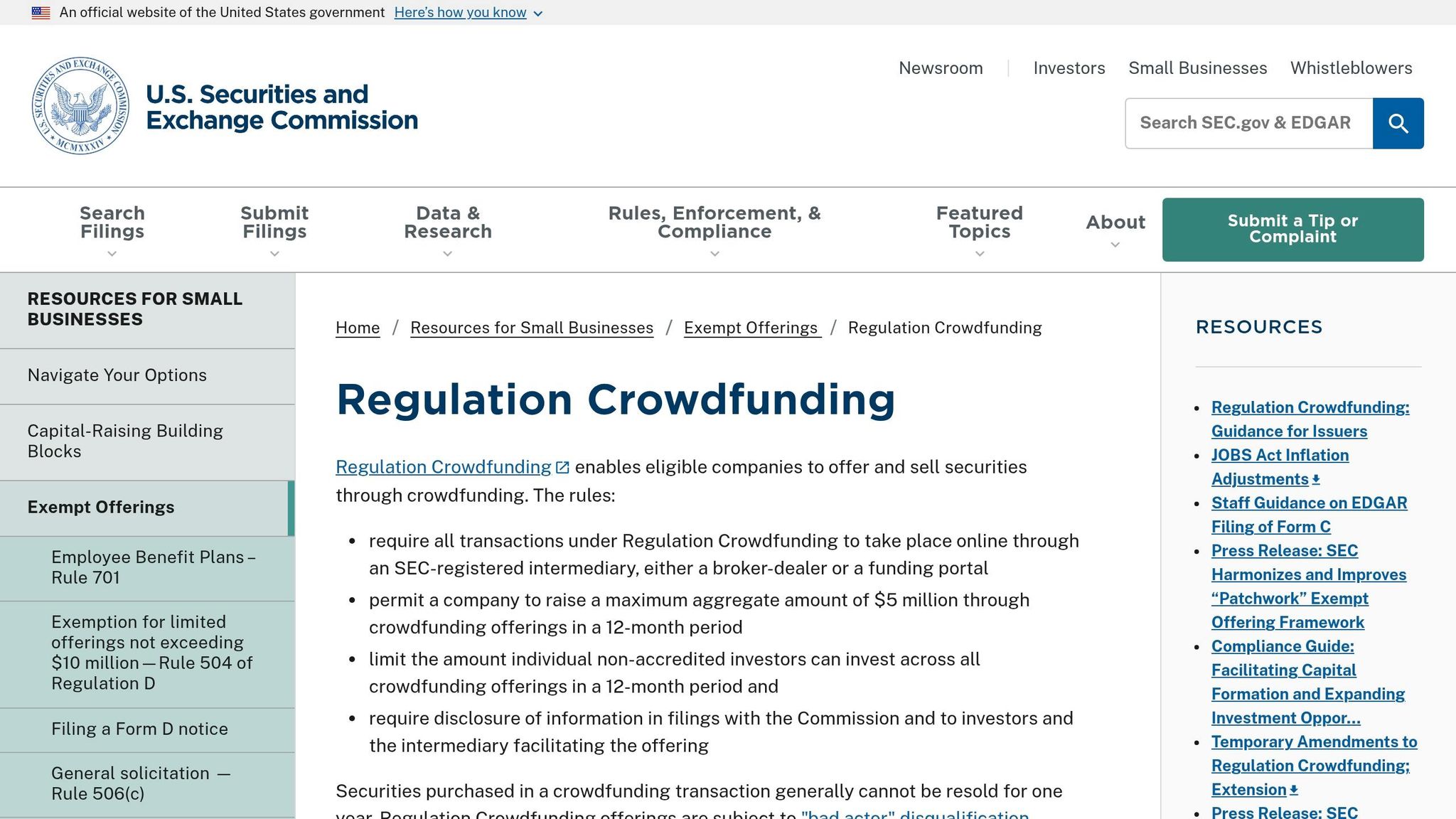
Reg CF is open to U.S. entities that meet the SEC’s eligibility rules, as long as the issuer is not an SEC-registered investment company.[1] Founders should check this first, before writing offering materials or picking an intermediary.
| Issuer Type | Eligible Under Reg CF? |
|---|---|
| U.S. entity that is not an SEC-registered investment company | Yes |
| SEC-registered investment company | No |
Once eligibility is clear, the intermediary becomes the center of the raise. Every Reg CF deal must run through one SEC-registered and FINRA-registered intermediary, either a funding portal or a broker-dealer.[1] Investors can’t make commitments outside that intermediary’s platform.[1]
Before Form C is filed, founders can use testing-the-waters communications if they include the required legend. But no one can accept commitments at that stage. That only starts once the filing is live, and even then, commitments can come in only through the intermediary’s platform.[1]
After filing, founders can point investors to the platform and share factual, non-promotional information. That includes offering terms, planned use of proceeds, and progress toward the funding goal.[1]
In plain English, this is the gatekeeping layer. It’s where investor status gets checked and investment caps are applied.
Before filing Form C, founders need to lock in the security type and target raise amount. Those two choices drive the disclosures in Form C and the investor-limit math.[1]
Founders also need a short, factual explanation of how the proceeds will be used. That description must appear in Form C and in any allowed advertising materials.[1]
These aren’t throwaway setup details. They shape what you disclose and how the offering rules apply from the start.
Every Reg CF raise goes through one intermediary, so that intermediary handles investor status, not the founder. In Reg CF, the intermediary checks investor information and applies the investment caps. Founders do not verify investor status on their own.
The platform manages all investment commitments and applies the caps for non-accredited investors. That means founders should focus on accurate disclosures, not manual investor screening. Use the platform for all investor communication and commitments.
Founders should send all investor-status questions and offering updates through the intermediary and keep every message in line with the platform's terms [1]. Those investor classifications feed straight into Form C disclosures and any updates during the offering.

Reg CF Offering Process: Key Steps, Filings & Deadlines for Founders
With investor eligibility and intermediary rules in place, the next step is filing and updating Form C.
Before you accept any investment commitments, you need to file Form C with the SEC [1]. This filing lays out the key facts investors need to see: your business, leadership team, ownership, offering terms, planned use of proceeds, risk factors, financial statements, and any required Rule 206 or Rule 241 materials [1].
If you used any test-the-waters communications before filing, those materials also need to be attached as exhibits to Form C [1].
Filing Form C isn’t a one-and-done step. Once the offering is live, you may need to file Form C/A amendments and Form C-U progress updates.
A Form C/A is required when there’s a material change in the offering or in your disclosures. That could mean a change in the offering price, a new target amount, or a material change in the business. You must file it promptly after the change happens [1].
A Form C-U is required when you hit 50% and 100% of your funding target. It must be filed within 5 business days of each milestone [1].
Investor status data and fundraising progress feed directly into these updates. From launch through close, these are the main filings founders need to stay on top of:
| Filing | Trigger | Required Content | Timing |
|---|---|---|---|
| Form C | Before accepting any commitments | Business description, officers/directors, ownership, terms, use of proceeds, risk factors, financial statements, and any Rule 206/241 materials that apply [1] | Before the offering goes live |
| Form C/A | Material change in the offering or disclosures | Description of the material change [1] | Promptly after the change occurs |
| Form C-U | Reaching 50% or 100% of funding target | Total commitments received to date [1] | Within 5 business days of each milestone |
These filings should match what investors see on the funding platform. If the platform says one thing and your SEC filing says another, that’s where problems start.
Accurate disclosure starts with clean financial records. If your books are messy, Form C financials and later amendments can turn into a scramble.
Phoenix Strategy Group works with growth-stage founders to set up the finance systems needed to keep disclosures current and compliant during an open offering.
Closing a Reg CF offering doesn't end your compliance work. It just changes shape. After the close, you move from deal execution to recordkeeping, controlled communication, and any required annual reporting until that duty ends.
Once the round closes, stop thinking only about filings and start thinking about proof. Keep complete records of every offering communication, including pre-filing test-the-waters materials, and store them with the Form C file.
These post-close records matter for a simple reason: they show what investors were told. They also help show that the offering stayed in line with the filing. If questions come up later, this is the paper trail that shows investor communications matched the Form C disclosures.
The same guardrails you used during the raise should stay in place after it. Public comments can still create problems if they drift from what was filed. Your internal controls should make sure any public statements stay factual and consistent with Form C [1].
A short checklist helps:
Founders who keep disciplined records and tight communication controls are in a better spot to stay compliant after the raise.
Yes. Before filing Form C, Reg CF lets you use “test-the-waters” communications.
But there’s a catch: those messages must clearly state that:
You also need to file those materials as an exhibit to Form C.
After Form C is filed, you must follow Reg CF rules for advertising and communications.
A material change under Reg CF means a major update to the information in your original offering statement. That can include a change to the target offering amount, the campaign deadline, or the offering terms.
When that happens, you must file a Form C/A amendment with the SEC. Investors then need to reconfirm their commitments within five business days, because they rely on current disclosures.
Your annual Regulation Crowdfunding reporting duties stop only when you file Form C-TR with the SEC.
You can file it if: