Published on
July 29, 2026


Post-closing claims usually turn on one thing: who keeps the pre-closing risk. In private company sales, the same issue can lead to a very different result in a stock deal than in an asset deal. And the claim types that most often drive fights are contract breaches, tax issues, legal disputes, employee matters, and compliance gaps.
Here’s the short version:
If I were screening seller exposure fast, I’d focus on these points first:
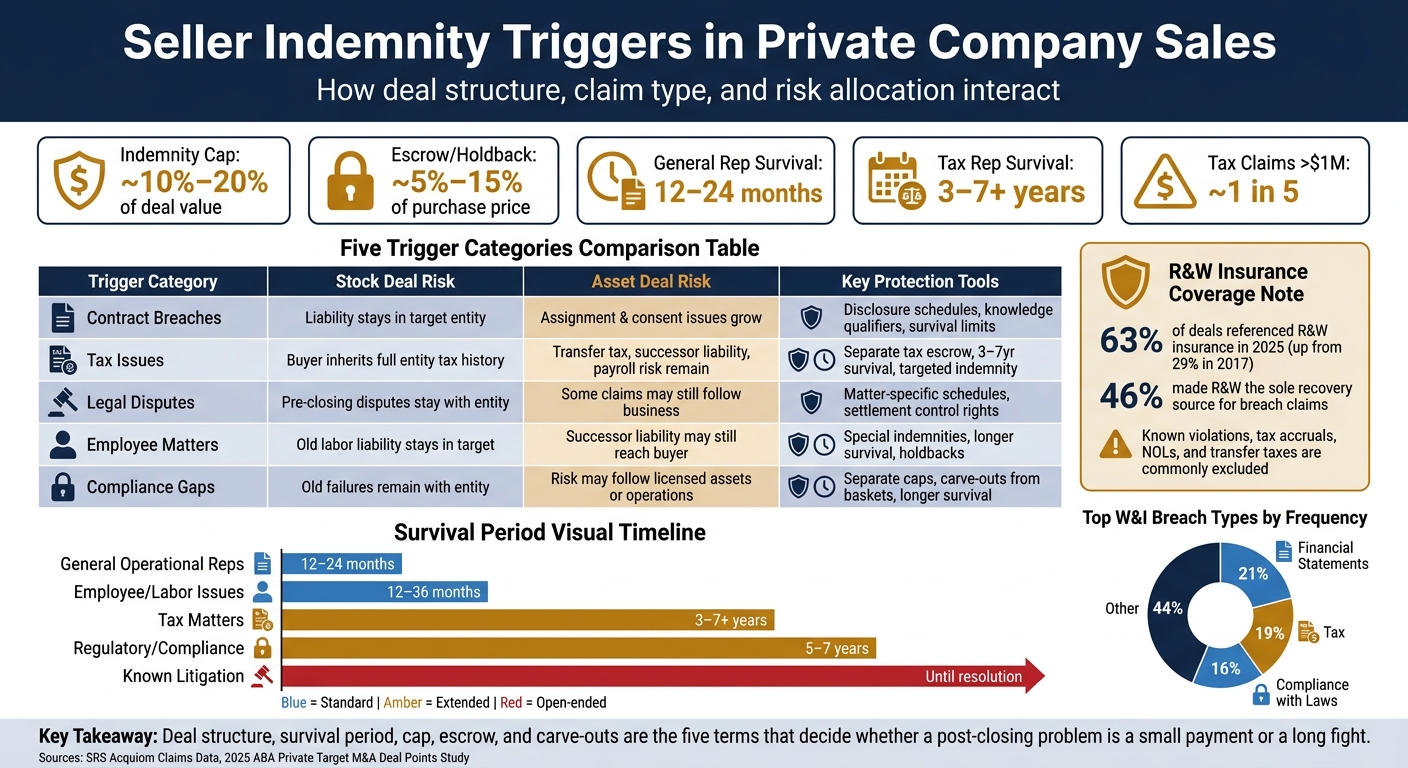
Seller Indemnity Triggers in Private Company Sales: Stock vs. Asset Deal Risk Breakdown
| Trigger | What usually starts the claim | Stock deal effect | Asset deal effect | Common seller pressure points |
|---|---|---|---|---|
| Contract breaches | Missed reps, undisclosed consents, IP gaps | Liability stays in target | Assignment and consent issues often grow | Schedules, knowledge qualifiers, survival limits |
| Tax issues | Audits, old filings, payroll or sales tax | Buyer inherits entity tax history | Some old tax risk may stay behind, but successor and transfer tax risk can remain | Tax escrow, separate cap, long survival |
| Legal disputes | Undisclosed claims or weak records | Pre-closing disputes stay with entity | Some claims may stay behind, but not all risk disappears | Matter-specific schedules, settlement control |
| Employee matters | Wage errors, misclassification, benefit issues | Old labor liability stays in target | Successor liability may still hit buyer | Special indemnities, longer survival, holdbacks |
| Compliance gaps | Privacy, licensing, cyber, labor, anti-corruption issues | Old failures remain with entity | Risk may follow the business or licensed assets | Separate indemnities, carve-outs from baskets |
Bottom line: if I’m looking at seller indemnity triggers, I’d treat deal structure, survival period, cap, escrow, and carve-outs as the five terms that matter most. They decide whether a post-closing problem is a small payment issue or a long fight.
Contract breaches are often the most straightforward indemnity claims because they tend to tie back to a specific representation or a line item in the disclosure schedules.
Most contract-breach claims come from missed contract reps, undisclosed consents, change-of-control clauses, and IP assignment gaps. For tech companies, IP ownership paperwork is a common trouble spot. Missing assignments from early developers or contractors show up a lot, and they can have a big effect on the deal [6].
Loss exposure depends on which rep was breached. Fundamental reps tied to authority and title usually survive through the statute of limitations and are often uncapped. General reps, by contrast, usually expire within 12 to 24 months [5].
Deal structure can shift where this risk lands. In a stock sale or merger, change-of-control clauses in existing leases and licenses are more likely to get triggered. In an asset sale, contract assignments usually call for far more third-party consents [8].
That’s why the exact same contract issue can be small in one deal and expensive in another.
Two tools do a lot of the work here:
Tax claims turn less on contract wording and more on pre-closing filings and timing.
Tax claims tend to come from old compliance problems, and they often show up months or even years after closing. That delay is what makes them tougher to catch than a plain contract breach. A state audit, amended filing, or voluntary disclosure agreement can surface long after the deal is done, even when the root problem goes back to the seller’s pre-closing operations.
This is one of the main reasons tax claims are so tricky: the issue may sit quietly for a long time before anyone sees it. According to SRS Acquiom claims data, sales and use tax and payroll tax are among the most frequent sources of post-closing tax claims, often triggered by state audits or voluntary disclosure agreements after closing [16][17]. As state and local revenue agencies have become more aggressive, buyers are more likely to get hit with assessments tied to periods the seller controlled.
The dollar amounts can add up fast. Nearly 1 in 5 tax claims exceeds $1 million [16]. One problem - like unregistered sales tax nexus across multiple states - can pile up over several years of unpaid tax, plus penalties and interest. That’s the hard part: tax exposure doesn’t always arrive as a single clean event. It can build period after period before anyone spots it.
Deal structure matters a lot here. In a stock sale, the buyer acquires the entity along with its historical tax liabilities, so pre-closing tax exposure becomes a core indemnity issue and tax reps get heavy negotiation [9][10]. In an asset sale, the buyer can sometimes avoid entity-level historical liabilities, but tax trouble can still come from sales tax on transferred assets, transfer taxes, successor liability, and payroll obligations tied to the transition [19].
Put simply:
Because of that, buyers often push for separate tax escrows when diligence turns up material risk. Survival periods for tax reps also tend to run much longer than general reps - typically 4 to 7 years, tied to the IRS statute of limitations, versus the 12 to 24 months often seen for general reps [18][11][12][13].
R&W insurance can help, but it doesn’t solve everything. Buyers should read tax exclusions closely, since many policies exclude accrued taxes, net operating losses (NOLs), and transfer taxes [14][15]. If tax exposure is a major issue, the usual answer is not insurance alone. Buyers often need both a tax-specific escrow and a targeted tax indemnity.
Legal disputes raise a different problem: third-party claims can start late, run long, and settle unpredictably.
Legal disputes often turn into indemnity claims when pending, threatened, or older matters weren't fully disclosed before closing. After the buyer takes over the business, those same disputes can land as post-closing indemnity claims.
Undisclosed litigation is one of the most common triggers [5][6]. That can include pre-closing slip-and-fall incidents, employment disputes, and undisclosed IP disputes that don't come to light until a buyer tries to enforce the company's rights.
Why do these claims show up so often? In many cases, the dispute wasn't listed on the schedules, wasn't reserved for, or wasn't carved out at signing. So when it surfaces later, the buyer treats it as a breach.
The bigger problem isn't just frequency. It's the price tag.
How serious the loss becomes depends on what the dispute affects. In a software company, for example, an undisclosed IP dispute can put a main revenue source - or even the company's core IP - at risk. And if the records are messy, things get worse fast.
Poor documentation can make a bad situation harder to fight. Common trouble spots include:
Each of those can widen exposure for post-closing claims [6].
Deal structure matters a lot here. In a stock deal, pre-closing disputes stay inside the acquired entity. In an asset deal, some liabilities can be boxed off, but buyers often need more assignment consents.
One common tool is the use of knowledge-qualified reps, which can limit exposure to matters outside the seller's actual knowledge [5]. Buyers may also use representation and warranty insurance to move some breach risk to an insurer [6].
Employee matters can lead to similar post-closing fights, though those cases usually come down to wages, benefits, and worker classification.
Employee claims are easy to miss at signing. They usually don't show up cleanly in the financials, and they often come to light only after closing, once someone digs into payroll files and HR records. Unlike contract breaches, these issues tend to stay hidden in day-to-day admin work. And a small payroll mistake can turn into a big problem fast if it touched a large group of employees.
The usual triggers are unpaid or miscalculated wages, including overtime; worker misclassification; missed benefits or PTO accruals; and pre-closing claims such as discrimination, harassment, and wrongful termination. These issues often surface 12–24 months after closing, once payroll and HR records get a closer review. Misclassification shows up a lot in tech and services businesses that rely heavily on contractors or hourly workers.
Employee matters can lead to some of the biggest indemnity claims in a deal. One wrongful-termination claim may be manageable. A wage-and-hour class or collective action is a different story.
The top 10 wage-and-hour settlements in 2024 totaled $614.55 million[25]. Under the FLSA, back pay can reach three years for willful violations, and some state wage laws allow an even longer look-back period[20][21]. For labor-heavy businesses like staffing, logistics, and hospitality, system-wide overtime or misclassification problems can lead to seven- or eight-figure claims that come close to, or even pass, indemnity caps.
Deal structure matters here because employment liabilities can stick to the business even when the purchase agreement says they should not. In stock deals, pre-closing employment liabilities remain with the target. In asset deals, non-assumption language can help, but successor-liability rules may still reach the buyer if the business and workforce stay largely the same.
Multiple U.S. federal circuits, including the Third, Sixth, Seventh, and Ninth, have applied federal common law successor liability to hold asset buyers responsible for pre-closing employment violations when there was continuity of business and workforce - even when the purchase agreement said otherwise[22][23][24].
Buyers often ask for specific indemnities and escrows for known wage, classification, or benefits issues. Escrow holdbacks are also common when employment risk is high. Sellers usually push back with knowledge qualifiers, materiality thresholds, and survival periods tied to the longest wage-law look-back. In plain English, employment diligence is as much about records as it is about legal review.
Compliance gaps often turn into indemnity claims after closing. That’s what makes them tricky. Unlike a plain contract breach, these problems can stay hidden during diligence and show up later during integration, audits, or government investigations.
A target may look clean on paper while still falling short on data privacy, cybersecurity, environmental, licensing, anti-corruption, or labor rules. The issue isn’t always visible at signing. Sometimes it only comes to light once the buyer is deep into the business.
Compliance-related claims show up again and again in indemnity disputes. One analysis of representation and warranty insurance claims found that compliance with laws reps made up about 16% of all W&I breach types, which put them in the top three along with financial statements (21%) and tax (19%) [30].
That ranking says a lot. These claims aren’t edge cases. They’re a regular part of post-closing fights, and smaller deals are often more exposed because weak controls can slip past diligence.
The cost can swing a lot depending on the industry and the issue. But the upside risk is high.
For example, data privacy violations under the California Consumer Privacy Act (CCPA) can lead to penalties of up to $7,500 per intentional violation, $2,500 per unintentional violation, and statutory damages of up to $750 per consumer per incident [27].
And privacy is only one lane. Environmental and healthcare issues can bring investigations, cleanup or remediation costs, and third-party claims. In some deals, that can eat up a big share of the escrow or a special indemnity basket.
Compliance claims also have a habit of spilling past the usual deal limits. They can be more likely than ordinary warranty breaches to blow through standard caps, especially when the problem involves willful misconduct or continuing obligations that were hard to price at signing.
Deal structure matters here.
In a stock deal, old compliance failures usually stay with the entity. In an asset deal, a buyer may be able to leave some liabilities behind. But that doesn’t always solve the problem. If the obligation is tied to operations, licenses, or regulated assets, it may still stick to the business after closing [26] [28].
That’s why deals with meaningful regulatory exposure often come with longer survival periods for compliance reps. Buyers know these issues may take time to surface.
That is why buyers often negotiate separate protection for compliance issues.
In regulated sectors, buyers often push for specific indemnities for known compliance issues found in diligence. Those indemnities may come with:
RWI may help, but it isn’t always a full backstop. If diligence is thin, insurers often exclude these areas or put lower limits on them. So a buyer can’t just assume the policy will pick up the tab.
Sellers usually push back by adding materiality and knowledge qualifiers to broad compliance-with-laws reps. They also try to narrow any special indemnity so it doesn’t turn into an open-ended risk.
Because compliance exposure is broad and hard to price, it often drives special indemnities and longer survival periods.
The key issue isn't whether a claim exists. It's how the purchase agreement assigns that claim. The exact same problem can lead to very different indemnity results based on deal structure and the depth of diligence.
In a stock deal, the buyer usually takes on the company's past liabilities. In an asset deal, some liabilities can be fenced off, but employment and regulatory risks may still stay with the business and follow the buyer.[2][4][41]
R&W insurance shows up in a lot more deals now. But it doesn't solve everything. Known violations, along with some tax and employment risks, still tend to need special indemnities. The 2025 ABA Private Target M&A Deal Points Study found that 63% of deals referred to R&W insurance, up from 29% in 2017. It also found that 46% of those agreements made the policy the only recovery source for breach claims.[3]
That's why one issue may be a small point in one deal and a major seller burden in another.
Buyers usually ask for issue-specific indemnities when diligence finds a concrete risk they can measure, and general reps plus baskets don't give enough cover. Common examples include tax liabilities, open litigation, labor classification issues, and regulatory violations with known enforcement risk.
For tax, buyers often negotiate a separate pre-closing tax indemnity that lasts until the statute of limitations runs out - often three to seven years - rather than relying on the general 12–18 month survival period.[40][42] For known litigation, buyers usually want each matter listed on a schedule, with seller obligations lasting until final resolution and a separate escrow sized to the expected loss.[33][34]
The table below shows the usual protection by claim type.
| Category | Typical Survival Period | Separate Escrow? | Cap Treatment | R&W Insurance Coverage |
|---|---|---|---|---|
| General operational reps | 12–24 months[31][32][35][39] | Yes, in non-insured deals | ~10–20% of purchase price[31][11][34][35][12] | Commonly covered[34][37][12] |
| Tax matters | Statute of limitations + 30–90 days; often 3–7+ years[40][42] | Often yes for known exposure | Higher or separate cap; sometimes uncapped[31][11][36] | Often excluded or limited for pre-closing tax issues[36][37][12] |
| Known litigation | Until resolution or negotiated long-stop date[33][34] | Often yes | Frequently separate from the general cap[33][34] | Known claims typically excluded[37][12] |
| Employee / labor issues | Often follows general rep survival; extended if material risk is identified[31][38] | Sometimes, for wage-and-hour or benefit plan risk | Material issues may get separate caps[34][38] | Routine reps may be covered; known violations often excluded or sublimited[37][12] |
| Regulatory / compliance | Often 5–7 years for environmental; varies by issue[31][17] | Yes when remediation or fines are expected | Often higher or uncapped for severe issues[31][17][33] | Many specific risks are excluded or narrowed[37][12] |
Diligence often decides whether a risk stays in the general bucket or turns into a special indemnity. Better diligence turns unknowns into priced exceptions. That can shrink caps, escrows, and survival periods.
When diligence is thin, buyers usually react by asking for broader protection: longer survival periods, higher caps, larger escrows, and wider special indemnities to guard against what they couldn't see.[34][35] That can increase seller exposure and delay post-closing distributions.
Clean books, orderly tax records, and documented controls can cut down surprise claims and reduce the push for special indemnities.
Each trigger changes indemnity exposure in its own way. It also shifts who has more leverage if a claim shows up later.
From the buyer’s side, tax claims are usually the easiest to price. They tie back to filings, tax periods, and assessments, so the loss is often easier to track.
Contract breaches give buyers a broad backstop. That can help a lot because one clause can cover many rep failures. The downside is obvious too: broad wording can pull in routine business disputes that were never meant to become indemnity fights.
Known disputes are often workable if they’re disclosed well. But even then, there’s still plenty of uncertainty. Timing can slip, defense costs can climb, and the final outcome may be hard to call at signing.
Employee matters and compliance gaps are usually the toughest for buyers to recover on. The facts are often scattered, records may be thin, and liability can hinge on disputed legal or policy readings. In plain English, these claims can get messy fast.
From the seller’s side, these same categories matter less as upside questions and more as risk-control questions. The main goal is to keep the exposure boxed in as tightly as possible.
For tax, sellers usually push for survival periods tied to the statute of limitations, along with clear pre-closing and post-closing allocation. That gives them a cleaner line around what they still own and what they don’t.
For legal disputes, sellers usually want tight schedules and control over settlement. That makes sense. If a matter is known, they want it described with care and don’t want the buyer settling too freely and sending over the bill.
Employee matters and compliance gaps are the hardest areas to ring-fence. They’re often underdocumented, spread across multiple jurisdictions, and broader than the seller first expects. That’s where deals can start to feel less like drafting and more like trying to nail Jell-O to the wall.
These differences show up most clearly in the amount of room each category leaves for scope, timing, and settlement control.
| Trigger Category | Buyer Advantages | Buyer Drawbacks | Seller Advantages | Seller Drawbacks |
|---|---|---|---|---|
| Contract breaches | Broad coverage across many rep failures; flexible backstop | Broad language can sweep in routine disputes; harder to isolate specific losses | Predictable with caps, baskets, and survival limits | Open-ended scope increases risk of unexpected claims |
| Tax issues | Measurable losses tied to filings and assessments; supports special indemnity | Longer survival periods mean extended exposure risk | Exposure can be ring-fenced to defined pre-closing periods | Long survival periods and, in some deals, higher or uncapped caps |
| Legal disputes | Known risks can be quantified and scheduled | Disputes over disclosure completeness, materiality, and settlement control | Narrower covered-matter definitions limit scope | Hard to fully disclose; defense cost uncertainty lingers |
| Employee matters | Covers a wide range of statutory and contractual liabilities | Facts often incomplete; state-by-state variation complicates recovery | Specific reps can limit scope to disclosed issues | Underdocumented issues surface post-closing; broad liability potential |
| Compliance gaps | Captures regulatory, privacy, and licensing failures that diligence may miss | Difficult to price; broad language can sweep in routine disputes | Sellers can push for narrow, disclosed-risk-only coverage | Scope is wide; line between technical defect and material violation is often contested |
The hardest negotiations tend to gather around categories with long-tail risk and fuzzy boundaries. Tax, legal disputes, and compliance gaps usually create the most friction because they call for longer survival periods, tighter disclosure, and narrower settlement control.
In private company sales, the main issue usually isn’t if a claim shows up. It’s which risks the buyer can push back onto the seller.
That’s why deal terms need to line up with the actual risk. Routine reps often call for a shorter survival period. Tax matters and known disputes may need longer protection, or their own separate treatment. And for regulatory or labor issues, targeted indemnities often make more sense than broad, one-size-fits-all language.
In practice, strong seller protection starts before signing, not after closing. Sellers who fix known gaps and fully disclose exceptions early leave buyers with less room to bring post-closing claims.
In private company sales, baskets set a minimum dollar amount for indemnification claims. In plain English, the buyer usually can't recover from the seller unless its losses go over that threshold.
That gives sellers some protection against small, immaterial breaches. It also makes post-closing issues easier to handle, since the parties don't have to fight over every minor claim. Baskets often appear in purchase agreements alongside other risk-allocation tools, such as escrow holdbacks.
Buyers ask for special indemnities when there’s a known, specific liability that general reps and warranties don’t fully cover.
This tends to come up when due diligence turns up higher-risk issues. Common examples include unresolved legal disputes, tax compliance gaps, environmental problems, or liabilities that can’t be fixed before closing.
R&W insurance usually covers unknown breaches of the seller’s representations and warranties.
Put simply: it’s meant for problems that no one spotted before the deal closed.
What it doesn’t usually cover are known risks or liabilities found during due diligence. If the buyer already knows about an issue, that issue is typically carved out of the policy.
In those cases, buyers often look to other options, such as:
Those tools help address deal concerns tied to known issues without trying to force them into R&W coverage.