Published on
August 27, 2026

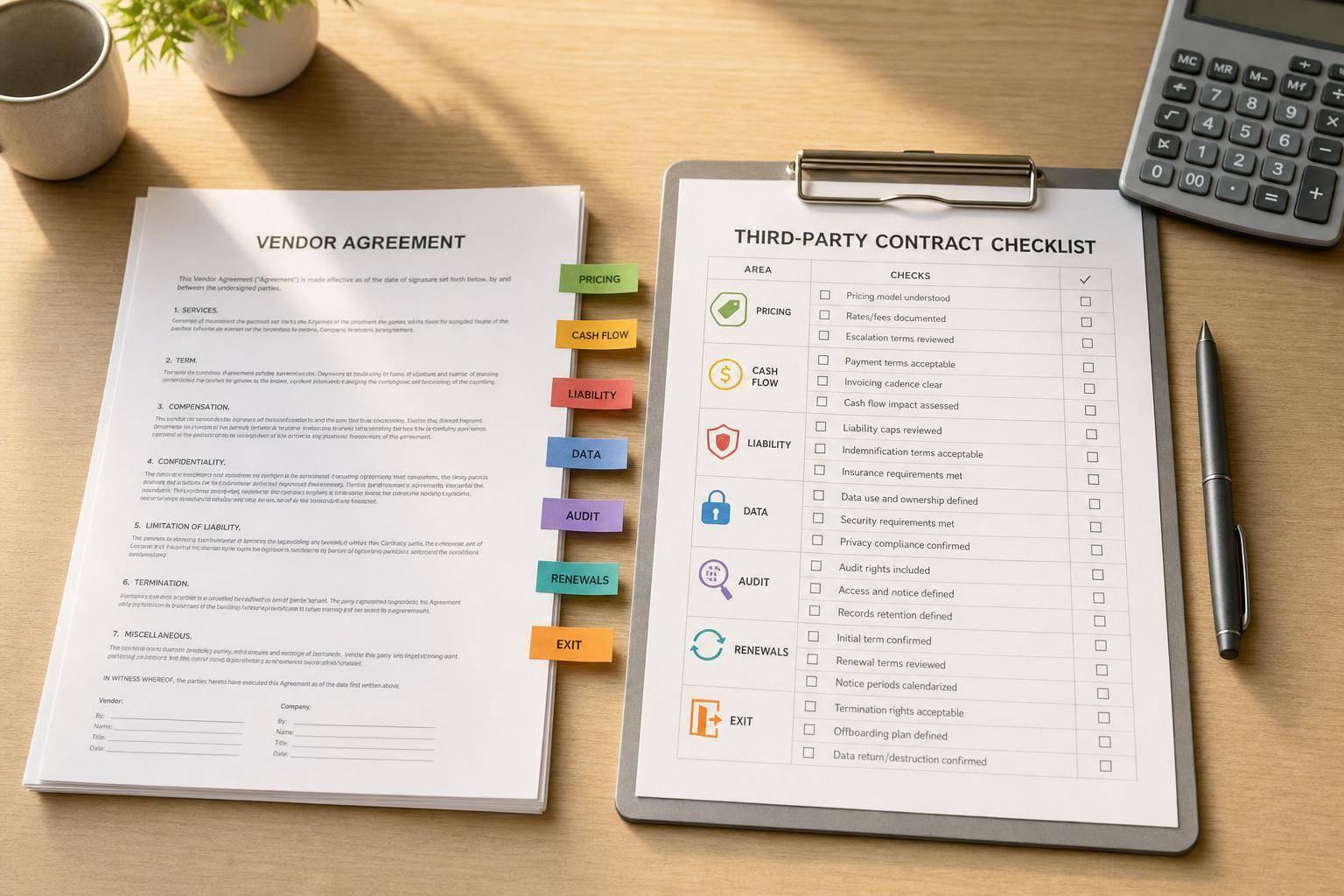
Poor contract control can cost a company 8.6% to 9.2% of annual revenue. As a fractional CFO on a finance team, I want a simple pre-signing checklist that flags cash risk, legal exposure, data issues, and exit problems before the contract is signed.
Here’s the short version: I review pricing, payment timing, liability caps, indemnities, insurance, data rights, audit access, renewals, and termination terms. I also make sure each contract has a named owner, budget approval, calendar reminders, and a clear record of who reviewed what.
What I check first:
A few numbers matter right away. Late interest often runs 1% to 1.5% per month. Cyber coverage for data-heavy vendors may need $2,000,000 to $10,000,000. And if a contract ends on 08/31/2027 with 60 days’ notice, I need to act by 07/02/2027 - not on the end date.
| Area | What I’m trying to avoid |
|---|---|
| Payment terms | Cash strain and billing surprises |
| Liability and insurance | Large out-of-pocket loss |
| Data and audit rights | Loss of control and weak oversight |
| Renewals and termination | Auto-renew spend and costly exits |
If I use this checklist before signature, I cut down on missed clauses, weak approvals, and bad surprises later.
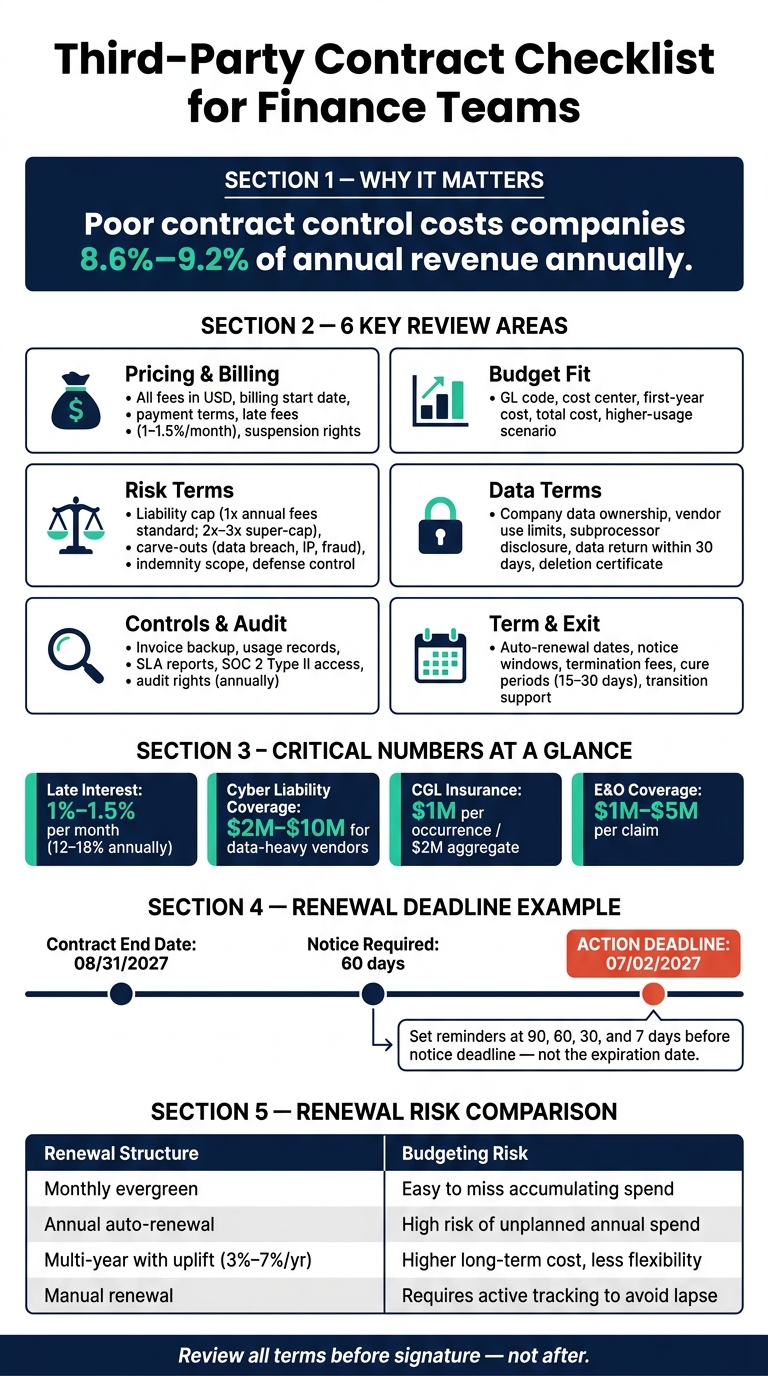
Third-Party Contract Checklist: Key Risk Areas & Financial Thresholds
Start with spend controls. Pricing, billing start date, and payment terms shape the cash impact from day one.
Different pricing models change cash flow in different ways. A fixed-fee deal is usually easier to forecast. Per-user and usage-based pricing can climb as headcount grows or usage increases. Annual prepaid, tiered, and minimum-commitment plans can also change how much cash leaves the business and when.
Before signing, make sure all fees are quoted in U.S. dollars (USD). Ask the vendor to break out every charge, including:
Also pin down when billing starts, what the payment terms are, which payment methods they accept, any late fees, and whether they can suspend service for nonpayment. Market-standard late interest runs 1–1.5% per month (12–18% annually).[2][3]
Check the fine print on discounts and credits. Confirm when a discount expires, what renewal pricing looks like, whether credits are issued automatically, and whether those credits are the exclusive remedy.
It also helps to ask a simple question: How does the credit actually show up? It may be applied as an offset on the next invoice, issued as a future service credit, or paid as a cash rebate. Service credits that expire before you can use them don't offer much protection.
Before signature, map the contract to a GL code, cost center, and internal owner. That sounds basic, but it saves a lot of confusion later.
FP&A should check that committed spend, expected usage, billing start date, and any renewal escalators are built into the cash flow forecast and runway model. Require sign-off on:
Get budget-owner approval before signature so the deal doesn't blow past plan.
After pricing and billing, review liability and insurance to cap downside exposure.
Next, review downside exposure and claim risk. Liability caps, indemnities, and insurance terms set the guardrails before something goes wrong. That’s why these clauses deserve a close read before signature. A low price won’t help much if the contract leaves your company open when a claim hits.
Start with the liability cap, then spell out which claims sit outside that cap.
In U.S. commercial contracts, caps usually take one of three forms: fees paid or payable over the prior 12 months, total fees paid under the agreement, or a fixed dollar amount like $100,000 or $1,000,000.[4][5][8][9] The wording here matters more than it may seem. Paid versus paid or payable can change the outcome in a big way. If the contract is new and only a small amount has been invoiced, a cap based only on fees paid could end up close to zero.
A better setup is the greater of a USD floor or fees paid in the preceding 12 months. Then check the carve-outs carefully. These are the claims that do not stay inside the standard cap. Push for carve-outs for:
These carve-outs are common for a reason.[6][13][14][17][21][22] If a vendor causes a major data incident or an IP dispute, a basic 1x fee cap often won’t come close to covering the loss.
A common approach is a tiered structure: a standard cap, such as 1x annual fees, for routine claims, and a higher super-cap - often 2x to 3x fees or a set USD amount - for high-severity issues like data breaches and IP claims.[6][10][14][17]
Once the cap is clear, move to the next issue: who pays for the defense and the claim itself.
Indemnity clauses deal with third-party claims caused by the vendor, including IP, security, and regulatory claims.[12][1] At a minimum, the vendor should indemnify your company for technology that infringes a third party’s IP, security incidents caused by its systems, and regulatory violations tied to its actions.
But don’t stop at who indemnifies whom. Look at who controls the defense and settlement. In many contracts, the indemnifying party chooses counsel and runs the strategy. That can shape both cost and outcome.
Your company should keep the right to participate in the defense. And no settlement should be accepted without your prior written consent if it places obligations or ongoing costs on your organization.[15][16][18][19][20] That point is easy to skim past, but it matters. A bad settlement can create a mess long after the claim is closed.
Also check whether defense costs are paid as incurred or reimbursed later. That one line can affect cash flow during a dispute.
Insurance gives the risk terms some muscle. Without it, a liability cap may be little more than words on paper. The coverage should line up with the type of work the vendor is doing and the harm that could follow if things go sideways.
Require:
Before signing, get a Certificate of Insurance (COI). Then verify that the policy limits are listed in USD and match the contract terms. Where it fits, confirm that your company is named as an additional insured.
It also helps to track renewal dates instead of filing the COI away and forgetting it. Set a reminder 30 to 60 days before expiration and tie renewal to an updated COI. A policy that lapses right before or after an incident can turn into a very expensive surprise.
After risk terms, confirm the contract covers data ownership, security, and audit access.
After liability and insurance, finance should pin down three things: who owns the data, who can use it, and what proof exists to check billing and compliance.
Your contract should say your company owns all data you provide and all data the service creates. That includes reports, logs, metadata, and backups. If the vendor touches it, stores it, or generates it from your use of the service, ownership should stay with you.
Permitted use should also be tight. The vendor should use your data only to deliver and support the service. Any secondary use, including marketing or model training, should need written consent. This is where broad wording can cause trouble. If the vendor gives itself open-ended rights to use aggregated or anonymized data, make sure those rights have clear limits.
Subprocessor and data-sharing terms matter too. Confirm which subprocessors can access the data, whether you get notice or approval rights before changes, and whether those subprocessors must follow the same confidentiality, security, and audit terms.
At termination, require return of your data within 30 days in a usable format. Spell out whether backups are included, list any extraction fees, and require a certification of deletion after return.[30][31]
Once data return and deletion are locked in, move to renewal and termination terms so exit timing doesn’t box the business in later.
Security clauses often sound good on paper and say almost nothing in practice. Push for specific obligations you can check, such as:
For vendors tied to financial reporting systems or payroll, require a SOC 2 Type II report to be sent automatically within 30 days of issuance.[25][26][28] Phrases like industry-standard security may sound fine at signing, but they won’t help much when something breaks.
Breach notice terms need the same level of care. The clause should define what triggers notice, set the timeline, and state what the notice must include. A common standard is 24 to 48 hours for initial notice and a fuller report within 72 hours.[24][27] That notice should cover the scope of the incident, the data types affected, the steps taken to contain it, and a named contact.
The contract should also say who handles the forensic investigation, legal review, and customer notifications when the breach happens because the vendor failed to meet its security duties. That’s not a minor point. A 2024 study found that 61% of companies experienced a third-party data breach or cybersecurity incident in the prior year.[23]
Finance needs access to invoices, usage records, SLA reports, and control evidence to check billing and performance. This matters even more in volume-based or metered contracts, like seat licenses, transaction counts, and API calls. Without the underlying usage data, overbilling can sit there unnoticed for months.
For routine reviews, use SOC 2 reports and written questionnaires. Save on-site or direct audits for material incidents or suspected noncompliance. The contract should spell out notice periods, audit frequency, who pays for the audit, and whether errors shift costs back to the vendor. For routine reviews, once per year is typical.[29][32]
The table below maps each main clause area to what finance should verify and who should own the review inside the company.
| Clause area | What finance should verify | Internal owner |
|---|---|---|
| Data ownership | Company retains ownership of uploaded and generated data | Finance + Legal |
| Permitted use | Vendor use is limited to service delivery and support | Legal + Security |
| Subprocessors | Approved subprocessors are disclosed and governed | Security + Procurement |
| Data return | Export format, timeline, and fees are defined | Finance Ops + IT |
| Billing audit rights | Invoice and usage records are reviewable | Finance |
| Compliance evidence | SOC 2 or similar reports are available | Security |
| Performance audit | SLA and service reporting can be reviewed | Business owner + Finance |
With data and control terms set, the next step is renewal timing, termination rights, and post-signature exit support.
After data and audit rights, lock down renewal and exit terms before signature. The big job here is simple: track renewal deadlines before the notice window closes.
For each contract, record the initial term start date, end date, renewal structure, required notice period, exact notice method, and the notice deadline based on the renewal date and notice period. For example, if an annual contract ends on 08/31/2027 and needs 60 days' notice, the renewal decision deadline is 07/02/2027. Finance needs to act by that date.
Store all dates in MM/DD/YYYY format in a central contract repository or a finance-owned tracker. Then link calendar alerts to the notice deadline, not the expiration date. For standard contracts, set reminders for 90, 60, 30, and 7 days before that deadline. For high-value or regulated contracts, start review work 120 to 180 days in advance.[33][34][35]
Here’s how different renewal setups affect budget planning:
| Renewal structure | Budgeting risk |
|---|---|
| Monthly evergreen | Easy to miss spend adding up over time |
| Annual auto-renewal | High risk of unplanned annual spend |
| Multi-year with uplift | Higher long-term cost and less flexibility |
| Manual renewal | Needs active tracking to avoid a lapse |
Annual auto-renewals and multi-year contracts with built-in uplifts, often 3% to 7% per year, need the tightest controls. That means mandatory pre-renewal reviews, executive sign-off, and scenario analysis that compares renewing, renegotiating, and exiting.[33][34][35]
Once the renewal deadline is set, check how the company can get out if the deal stops making sense.
Start with whether the company can leave without cause and what that would cost. Termination for convenience usually needs 30 to 90 days' written notice. It may also trigger early termination fees or require payment of the remaining minimum commitment. Spell out that cost in plain numbers. In practice, finance should compare the price of leaving early with the cost of staying.
Termination for cause kicks in when certain events happen, such as material breach, repeated SLA failures, security incidents, or regulatory non-compliance. These clauses often include cure periods of 15 to 30 days.[36][37][38] If the vendor doesn’t fix the problem in that window, the company can exit, often with lower fees or none at all. The wording matters a lot here. If the triggers are fuzzy, the clause may look good on paper and still be hard to use.
Exit terms also need to cover what the vendor must do on the way out. Confirm that the vendor must:
Finance should also pull data migration costs and any extended-support fees into forecasts.
Document and calendar every initial term, renewal deadline, termination right, and exit obligation before any third-party agreement is signed.
Before finance gives final approval, finance leadership and the people responsible for risk, operations, or legal requirements should review the contract. That usually includes IT leadership, the executive sponsor, and legal.
The goal is simple: make sure the contract covers the terms that matter before anyone signs off. That review should check renewal terms, data ownership, SLAs, liability and indemnification, insurance, audit rights, termination and data-return terms, and any required compliance documents. Where needed, it should also confirm audit and remediation expectations.
The biggest hidden cash risks usually start with unclear scope.
When the scope isn't spelled out, scope creep can sneak in fast. And that often means surprise charges for customizations, integrations, or training that you thought were already part of the deal.
There are a few other cost traps worth watching closely:
This is where a contract can look fine at first glance, then quietly cost a lot more than expected.
Start tracking renewal and exit deadlines as soon as you onboard a vendor. That gives your team breathing room. Instead of scrambling at the last minute, you can review options before auto-renewals kick in.
For day-to-day oversight, use a compliance calendar, automated alerts, and a central inventory or governance framework. That way, key dates don’t slip through the cracks.