Published on
September 3, 2026

A trademark can change both price and deal terms in an M&A sale. If I were preparing a company for exit, I’d focus on four things right away: clean ownership, active registrations, proof of use, and brand-level revenue data.
Here’s the short version:
Bottom line: a mark helps the deal only when it is both legally clean and tied to sales. If either side is weak, the buyer may cut the price or change how and when the money gets paid.
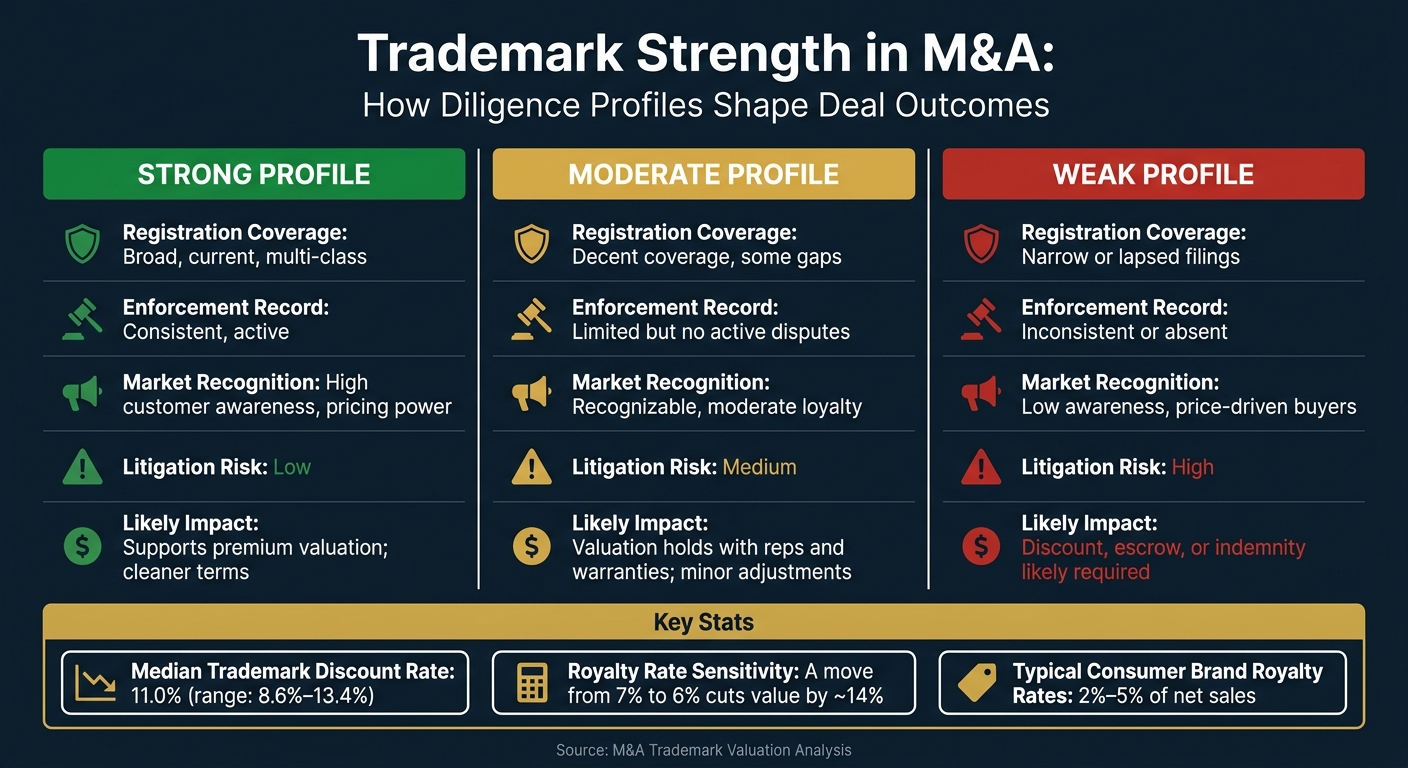
Trademark Strength in M&A: Strong vs. Weak Profile Impact on Deal Terms
| Area | What buyers test | What happens if it’s strong | What happens if it’s weak |
|---|---|---|---|
| Legal rights | Ownership, registration, scope, disputes, licenses | Smoother diligence, less deal friction | Holdbacks, indemnities, closing fixes |
| Brand strength | Awareness, pricing power, loyalty, repeat demand | More support for premium pricing | Lower value support |
| Valuation | Royalty rate, forecast revenue, discount rate, useful life | Higher indicated trademark value | Lower indicated value |
| Deal terms | Escrow, earnout, reps, covenants | Lighter risk protection | More buyer protection |
| Exit prep | IP audit, proof of use, brand-level P&Ls | Better seller position | More buyer questions and pressure |
So if I were advising a founder, I’d say this: don’t treat trademarks as just a legal file. In a sale process, they can affect the purchase price, the allocation, and the risk terms all at once.
In M&A, the issue isn't just what the mark is. It's how much value that mark helps support.
A trademark points to source. A USPTO registration gives the owner stronger nationwide protection, while common-law rights are often limited to a local area.
A trademark starts to matter a lot more when it helps drive:
Buyers usually split this into two buckets: legal protection and brand equity.
Legal protection covers ownership, scope, priority, and enforceability. Brand equity covers customer demand, trust, and retention.
That distinction matters. A clean legal position with little market recognition usually doesn't support a premium. On the flip side, strong brand equity without clean rights can create risk.
This split shows up most clearly in businesses where the brand itself helps generate revenue.
Trademark value tends to be highest in branded consumer products, franchises, DTC brands, and category-leading software.
If customers are buying based on price, features, or distribution instead of the brand, the trademark is often a secondary issue.
That's why buyers dig into both the legal side and the commercial side during diligence.
Buyers test trademark strength during diligence before they put a price on it. And the split can be sharp: a mark may look strong on paper but do little in the market. Or it may be well known with customers while carrying legal risk. That gap shapes what comes next in diligence: prove ownership and prove that the mark supports revenue.
The first thing buyers check is ownership. They review the chain of title for missing assignments, founder transfers, or marks that are still held by an old entity. If needed, they may require a pre-closing assignment to clean that up.
After that, they look at registration status. They want to see that filings are active, renewal deadlines were met, no cancellation is pending, and there is proof of genuine use in commerce. They also compare Nice class coverage and territorial filings against the company’s actual products, services, and markets. If those don’t line up, the mark may not protect what the business is actually selling.
Recorded licenses, liens, and security interests also matter. A loose or poorly written license can leave a third party with rights that survive the deal, reduce exclusivity, or create territory clashes the buyer didn’t expect. Oppositions, cancellations, and infringement claims can add cost, slow the closing process, and weaken the buyer’s position.
A protected mark is one thing. A mark that helps drive revenue is another.
Buyers want to know whether the mark affects pricing power, retention, repeat purchases, and market share. They also look at brand awareness, customer reviews, reputation, and how much revenue is tied to the brand itself instead of the product, the founder, or the distribution channel.
If a brand can charge more than generic options and still show strong loyalty, it is easier to defend as a driver of value. If the business has to spend heavily just to keep volume moving - and still shows little pricing power - the mark starts to look less like an asset and more like a cost burden.
These findings usually land in three deal positions:
| Profile | Registration Coverage | Enforcement Record | Market Recognition | Litigation Risk | Likely Impact |
|---|---|---|---|---|---|
| Strong | Broad, current, multi-class | Consistent, active | High customer awareness, pricing power | Low | Supports premium valuation; cleaner terms |
| Moderate | Decent coverage, some gaps | Limited but no active disputes | Recognizable, moderate loyalty | Medium | Valuation holds with reps and warranties; minor adjustments |
| Weak | Narrow or lapsed filings | Inconsistent or absent | Low awareness, price-driven buyers | High | Discount, escrow, or indemnity likely required |
When the legal picture is clean and the market case is clear, buyers are more comfortable with price and lighter deal protection. When the facts are mixed or weak, the deal often shifts toward escrows, special indemnities, or fixes that need to happen before closing. From there, buyers can turn trademark strength into a royalty-based valuation.
Once legal and commercial diligence shows that the brand supports revenue, buyers turn that proof into cash flow and royalty value.
The first step is to isolate the revenue the brand actually drives. That includes any price premium. In practice, buyers do this by splitting sales by brand, product line, and channel, then comparing the contribution margins of branded products against generic options.
Customer behavior matters just as much. High repeat purchase rates, low churn, and strong new-customer acquisition tied to brand recognition all help show that revenue is coming from the brand itself - not just lower prices or convenience.
If the evidence around the brand is strong, the buyer can support a larger revenue base and is less likely to discount the mark.
From there, the model moves into a brand-level forecast under base, upside, and downside cases. That forecast usually covers brand-linked revenue, price premium, marketing spend, and competitive pressure. It also uses a finite economic life, often 10 to 20 years for established consumer brands and less for fast-moving categories.
Relief-from-royalty (RFR) is the main method used to value trademarks in M&A because it links value to the economic gain of owning the mark instead of licensing it. [10] Put simply, the method applies a market-based royalty rate to the forecast of brand-linked revenue, turns those royalty savings into an after-tax figure, and then discounts them to present value using a rate that reflects brand-specific risk.
Studies of trademark valuations show a median discount rate of 11.0%, with the middle 50% of deals falling between 8.6% and 13.4%. [8]
Income, market, and cost methods can still support the analysis. But in M&A, RFR is usually the anchor.
| Approach | Required Data | Strengths | Limits | Typical M&A Use |
|---|---|---|---|---|
| Relief-from-royalty | Brand-linked revenue forecasts, royalty comparables, tax rate, discount rate | Directly ties value to owning the mark | Sensitive to royalty rate and discount rate assumptions | Primary method in M&A and purchase price allocation |
| Income (other forms) | Cash flow forecasts for brand-driven earnings, discount rate | Flexible; can model brand-specific margins and growth beyond simple revenue royalties | More complex; harder to isolate brand contribution vs. other assets | Used when the trademark drives a distinct cash flow stream or when RFR data is weak |
| Market | Transaction or licensing multiples for similar brands/trademarks | Anchored in observable market evidence | Limited data, especially for mid-market; comparability issues | Used as a cross-check to RFR |
| Cost | Historical and replacement cost of creating, registering, and promoting the mark | Simple and data is often available internally | Ignores brand equity and future economic benefits; rarely reflects true economic value | Rarely primary; occasionally used as a floor estimate or for very new/undeveloped marks |
This is where things often get a little tense. A lot turns on the royalty rate.
Analysts usually start with license comparables - actual agreements from similar industries and geographies. Then they adjust for things like exclusivity, geographic reach, profitability, brand strength, enforcement history, and remaining useful life.
Trademark royalty rates in licensing databases run from about 1% to 10%+ of net sales, with many retail and consumer goods brands grouped in the 2% to 5% range. [11] Established consumer brands with strong pricing power can fall in the 3% to 8% range. [9]
A mark with broad registration coverage, steady enforcement, and clear pricing power can support a rate near the top of the comparable range. A mark with weak coverage or limited customer recognition usually supports a lower rate.
And the math moves fast. Changing the royalty rate from 7% to 6% can cut indicated trademark value by about 14%. [9] A 1 percentage point move in the discount rate can also change present value by double digits over a long economic life. That's why royalty assumptions often end up at the center of price talks and earn-out debates.
Those outputs then flow straight into price, allocation, and deal protection.
Once the valuation team lands on an indicated trademark value, that number moves straight into price talks and purchase price allocation. Under U.S. GAAP (ASC 805), trademark value is recorded as a separate asset in purchase price allocation, and whatever is left goes to goodwill. [2][14]
From there, buyers pressure-test the number inside the deal model. Put simply, they want to see whether the cash flow tied to the brand supports the trademark line item when stacked against the rest of the assets. That check feeds right into PPA and pricing calls. [1][12]
When diligence turns up risk, buyers don’t just trim the value on paper. They also change how that value gets paid. If legal or commercial diligence weakens the mark, buyers usually reprice the deal or shift more risk back to the seller.
A common move is to use earnouts tied to branded revenue. That lets the buyer pay the full amount only if the brand does what the seller says it can do. Escrows and holdbacks set aside part of the purchase price for possible litigation costs or rebranding spend. Special indemnities can deal with known trouble spots, such as pending oppositions, assignment gaps, or inherited license disputes. [3][13][15]
Post-close covenants matter too. If a trademark’s value depends on steady enforcement, timely renewal, or continued marketing support, buyers may ask for minimum brand investment commitments, limits on major brand changes during an earnout period, or seller help with filing in more jurisdictions. [13][15]
The table below shows how buyers usually respond to common diligence findings:
| Trademark Risk Finding | Likely Deal Response |
|---|---|
| Pending infringement litigation or opposition | Price cut, indemnity, escrow, or closing condition |
| Narrow registration scope or limited geographic coverage | Price discount; covenant to expand filings post-close; escrow for rebranding costs |
| Ownership or chain-of-title defects | Cure required before closing; holdback; enhanced IP reps and warranties |
| Weak brand awareness or revenue dependence on a single mark | Larger earnout tied to branded revenue; risk-adjusted purchase price |
| Problematic license or co-brand agreements | Renegotiation as a closing condition; targeted indemnity; escrow |
Trademark value affects deal value only when the mark is both commercially strong and legally clean. [5][13] Buyers who mix up those two ideas can end up paying too much for a brand that looks good in the market but still carries hidden legal risk. In practice, those diligence findings often become the cleanup list before exit.
The right time to protect trademark value is before diligence begins. If a founder waits until a buyer sends over a request list, things can get messy fast. That's when teams start hunting for missing assignments, trying to prove use, or explaining why a core mark still sits under a founder's name or an old entity. Those issues can slow diligence and chip away at price leverage.[17][6][21]
Start with an IP audit and compare it against USPTO records. For each mark, map out:
Also track assignments from founders, contractors, and any prior holding companies so title is clean. At the same time, gather proof of steady use. That includes dated marketing materials, website screenshots, packaging, and brand guidelines that show the mark has been used on a continuous basis and in line with the registration.[17][15]
Then look at the numbers. Revenue, gross margin, and customer retention should be segmented by each trademarked product or service line, not just by entity or broad product category. RFR only works when revenue ties cleanly to the mark. If that data is buried in a general ledger without brand-level tagging, it's much harder to defend trademark value. And when value is hard to defend, buyers have an opening to discount it.[16][18][7][4]
Once the brand data is in order, it needs to be packaged in a way buyers and valuation teams can use. Phoenix Strategy Group can help build FP&A systems that segment P&Ls by brand, region, and channel. It can also help set up M&A-ready data rooms tied to brand forecasts. That gives buyers a cleaner view of how each mark supports the business, which helps during both diligence and deal modeling.[16][19][20]
In U.S. M&A, trademark value isn't just a legal issue. It's also a financial asset. When a mark is clean from a legal standpoint, used in a steady way, and tied to clear revenue and margin, it can support a higher enterprise value, better negotiating leverage, and more seller-friendly deal terms.[5][17][7][4]
Buyers split legal trademark rights from brand equity by treating them as two different things: the formal right to own and use the mark, and the goodwill built through customer trust and market recognition.
On the legal side, diligence checks that ownership is clean and documented. That usually means confirming registrations, assignments, chain of title, and active use.
On the value side, the goal is to isolate what the trademark contributes economically. Buyers often do that with methods like relief-from-royalty or MPEEM, then deduct contributory asset charges to separate the mark’s share from the rest of the business.
Build an IP-to-revenue mapping table that ties each registered mark to the product lines it supports, the customer groups that buy those products, and the revenue streams those sales create in USD.
Use financial records, such as SKU-level sales data, to put hard numbers on the revenue, gross margin, and contribution linked to each asset.
Then back up that link with proof. That can include:
The goal is to show business impact in plain terms, like higher gross margins, lower churn, or both.
Sellers should deal with trademark issues early, ideally years before an exit. That gives you time to run audits and even do mock diligence before buyers start digging.
For active prep, begin 3 to 6 months before investor outreach. Then try to fix any issues 6 to 12 months before closing. The goal is simple: make sure ownership records, assignment documents, and license obligations are current, organized, and enforceable.