Published on
September 12, 2026


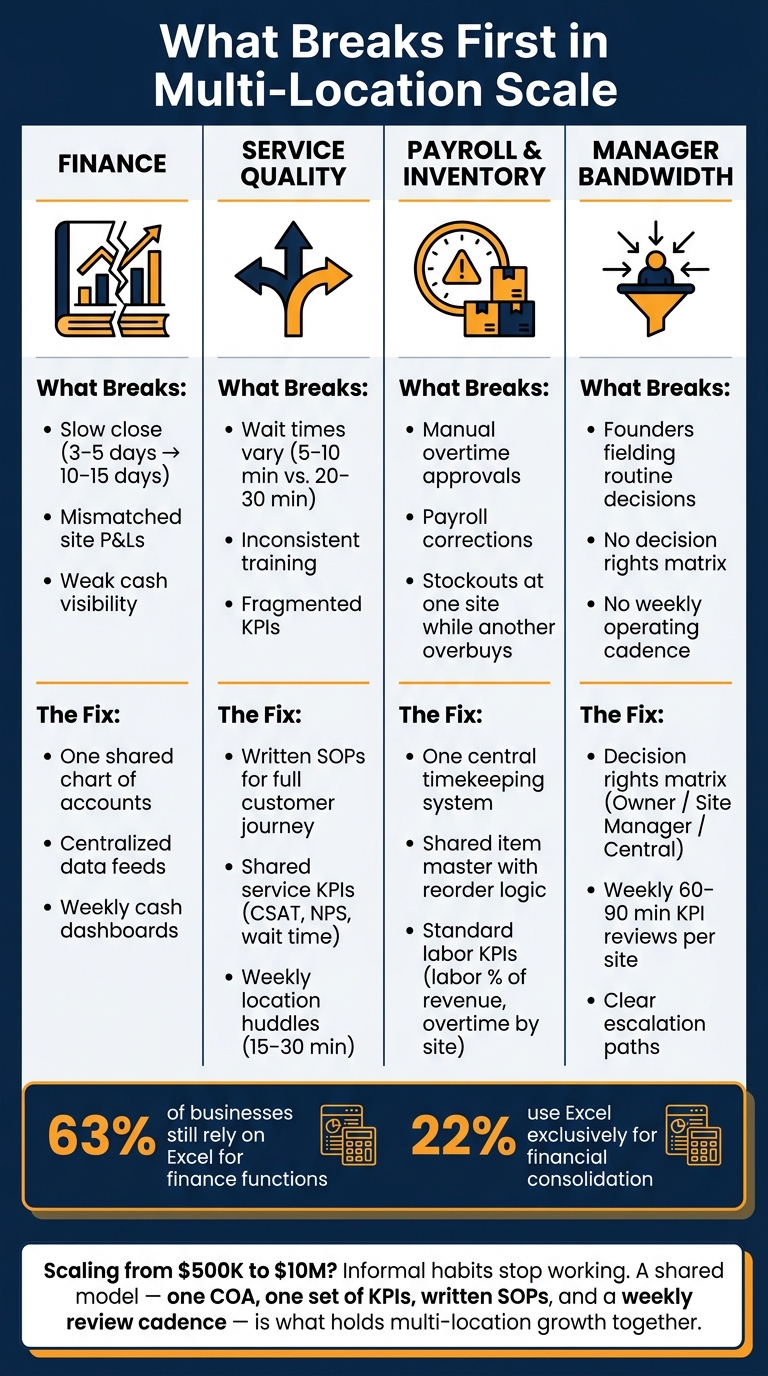
When I add new locations, the first things that usually fail are reporting, service consistency, labor control, and manager capacity. The pattern is simple: one site can run on founder oversight, but two or three sites need shared rules, shared data, and clear ownership.
If my close has slipped from 3–5 days to 10–15 days, if customers get a different experience by location, or if overtime and stock issues keep popping up, I’m usually dealing with the same root problems:
Here’s the short version:
The fix is not more spreadsheets or one-off site fixes. I need:
A few numbers show why this matters: 63% of businesses still use Excel in finance work, and 22% rely on it alone for consolidation. That setup gets messy fast when locations grow.
| Area | What usually breaks | What I need in place |
|---|---|---|
| Finance | Slow close, messy site P&Ls, weak cash view | Shared accounts, central data, weekly dashboards |
| Service | Uneven wait times and customer experience | Written SOPs, shared service KPIs, weekly huddles |
| Payroll & Inventory | Overtime drift, payroll fixes, stock gaps | Shared pay rules, item master, reorder rules |
| Management | Founder bottleneck, slow approvals | Decision matrix, weekly KPI reviews, role clarity |
If I’m scaling from $500,000 to $10 million in annual revenue, this is usually the point where informal habits stop working and a shared model has to take over.
What Breaks First When Scaling to Multiple Locations
The first hard break usually hits finance. Closes slow down, P&Ls get messy, and cash visibility starts to slip. Once a business no longer has one source of truth across locations, finance is usually where that gap shows up first.
At one location, a month-end close might take three to five days. Add a second or third site, and that same process can stretch to 10–15 days or longer [2][3]. Each branch sends numbers on its own timeline and in its own format, so finance ends up chasing data instead of reading it and making sense of it. In most cases, that points back to fragmented systems and inconsistent definitions.
Branch-level P&Ls break down for the same reason. If one location codes marketing spend to Advertising and another uses Promotions, you can't compare the two cleanly without manual cleanup first. Cash visibility gets weaker too. When local bank accounts, credit card deposits, and petty cash are all managed separately by site, leadership loses a clear picture of total cash on hand at the start of the week. That means hiring, purchasing, and payroll decisions get made with gaps in the numbers.
Without one shared data model, each site reports the same metric in a different way. You end up with disconnected systems: different point-of-sale platforms, separate payroll providers, and standalone accounting files, all calculating numbers by their own logic.
That becomes a problem fast when sites use different labor and COGS definitions. The same KPI can show different results across locations even when actual performance hasn't changed. So leadership sees conflicting branch results, loses trust in the reports, and starts leaning on gut feel instead.
The spreadsheet issue makes this worse. According to survey data, 63% of businesses globally still rely on Excel for finance functions, and 22% use it exclusively for financial consolidation [1]. As the number of locations grows, version-control problems and formula errors become hard to avoid.
The fix is simple in concept: use one shared finance model across every site.
It starts with a single master chart of accounts for all locations, backed by written definitions for each category that has caused confusion. Site differences should be handled with location tags or classes, not separate accounts. Central finance should control who can add new accounts. That one move cuts out much of the reclassification work that slows the close.
Next comes replacing manual spreadsheet rollups with a centralized data model that pulls from POS, payroll, and accounting systems automatically. Once that setup is in place, a standard site P&L becomes much easier to produce. Every location can be viewed in the same format, with revenue, COGS, gross margin, labor costs, and contribution margin lined up the same way every time.
A weekly dashboard for cash, margin, and site performance gives leadership one consistent set of numbers to work from instead of a last-minute scramble.
| Dimension | Single-Location Practice | Multi-Location Requirement |
|---|---|---|
| Chart of accounts | Ad hoc, informal | One standardized COA with written definitions |
| Expense coding | Informal, manager-driven | Documented coding rules enforced across all sites |
| Close timeline | 3–5 days, informal | Shared close calendar with location deadlines |
| Data rollup | Manual spreadsheet rollup | Centralized system with automated data feeds |
| KPI definitions | Loosely defined | Locked formulas applied consistently across locations |
| Site P&L | One-entity report | Standardized template, same structure at every location |
Once reporting is set up the same way across locations, the next crack usually shows up in day-to-day service. One site feels smooth and on point. Another feels scattered. To the customer, that doesn't feel like one company with a few rough edges. It feels like two different brands.
You can spot the gap fastest in wait times. One location may seat, serve, or process customers in 5–10 minutes. Another may leave people waiting 20–30 minutes with no explanation.
That difference hits harder than it looks on paper. A customer who waited 8 minutes at Location A and 25 minutes at Location B isn't just comparing two delays. They're starting to wonder if the brand can be counted on at all.
This usually starts with an undocumented service model. At one location, the founder and a few senior staff know the process by heart. It lives in their heads. Then the business opens a second or third site, and new teams try to rebuild that process from memory or by watching others. That's where the drift starts.
Small differences stack up fast. One manager has a looser approach to late arrivals. Another handles discounts case by case. Someone else is strict about scheduling rules. None of these choices seem huge in the moment, but together they change the experience.
Training often adds to the problem. New hires at one site might shadow seasoned staff for two weeks. At another, they may get a short walkthrough and head straight onto the floor. Same brand, same customer promise, totally different setup.
Measurement can split things even more. If locations track different KPIs - or don't track them at all - managers start pushing for different results. One might focus on speed. Another might focus on filling the calendar. Another may just try to get through the day. At that point, the customer experience drifts even farther apart.
That drift usually stops only when every location follows the same written steps and tracks them the same way.
The fix comes down to three moves.
When teams know the steps, train the same way, and look at the same scorecard, service stops depending on who happens to be working that day.
Once service quality is under control, the next problem usually shows up in the back office. Payroll errors and inventory imbalances are two operating-control failures that hit hard in multi-location growth, and both can stay hidden until the damage is already done.
After service drift, the next break usually shows up in back-office controls.
The warning signs usually hit daily operations long before they show up in a financial report. Managers are texting payroll fixes. Hours get adjusted by hand after the fact. Overtime gets approved informally, or not approved at all. On the inventory side, one site runs out while another sits on too much stock. COGS can jump from one period to the next with no clear reason.
These aren't one-off mistakes. They're control failures. Solving these systemic issues often requires the strategic oversight of fractional CFO services to rebuild financial controls.
The root issue is fragmented process design. When each location runs its own timekeeping method, the company loses a clean, consistent input into payroll. Rounding rules vary. Overtime thresholds get applied differently. Break deductions don't line up with what employees actually worked. Those gaps can turn into direct dollar losses and compliance risk.[5][7][8][9][11]
Inventory breaks in much the same way. If managers order on their own without a shared item master, each site starts solving for its own short-term needs. One location overbuys because it can't see another site's extra stock. Another runs out because the item name doesn't match across systems and the reorder trigger never fires. The result is distorted cash flow, emergency purchases at a higher cost, and COGS data leadership can't trust.[4][6][10][12]
Standardize timekeeping, pay rules, item masters, and reorder points across every site.
For payroll, that means one central time-and-attendance system feeding straight into payroll. No manual re-entry. No site-specific rounding rules. No ad hoc overtime approvals. Set overtime thresholds, shift differentials, and break deduction rules at the center, then apply them the same way everywhere. Run a payroll reconciliation every cycle, and compare labor data across locations to catch odd patterns early.
The labor KPIs worth tracking each week are:
For inventory, start with a clean shared item master. Use the same naming, units of measure, par levels, and reorder points across every location. Then set transfer rules so sites can move stock between locations before placing new purchase orders. Track inventory turns, stockout rate, and shrink by location on the same schedule as labor KPIs.
| Area | Manual, location-by-location | Centralized and standardized |
|---|---|---|
| Timekeeping | Each site uses its own process or tool | One integrated time and attendance process feeds payroll |
| Payroll rules | Local adjustments and frequent corrections | Central rules with fewer exceptions |
| Labor control | Local schedules and ad hoc approvals | Standard labor KPIs and approval thresholds |
| Inventory ordering | Managers order independently | Shared item master and reorder logic |
| Stock visibility | Fragmented, site-level visibility | Consolidated reporting across locations |
As these exceptions pile up, managers spend less time leading and more time fixing and reconciling errors.
As the number of locations grows, the owner often keeps acting as the main control point. If the management setup doesn't grow with the business, the founder becomes the fallback for nearly every call. That's when things start to drag.
The signs tend to look the same from one business to the next. Managers send routine discount approvals up to the owner. Hiring choices stall while everyone waits for a call back. Two locations deal with the same customer complaint in totally different ways based on who answered the phone.
That kind of pileup usually points to one issue: authority never got pushed down as the company expanded.
This usually isn't about people not trying hard enough. It's about unclear authority. There isn't a written line showing what a site manager can decide on their own and what has to move up the chain.
Without a weekly operating cadence - steady KPI reviews, issue logs, and clear follow-up - performance talks happen only when something goes wrong. Managers start to see that sending issues to the owner gets a faster answer than working through them on site. Over time, that habit feeds itself.
The fix is to turn decisions into a routine process instead of handling them case by case. Start with a decision rights matrix. This is a simple document that shows which decisions sit at each level of the company. Then pair it with a weekly 60- to 90-minute review for each site to cover KPIs, flag variances, and assign owners to specific next steps. When that rhythm is in place, most routine escalations stop landing on the founder's desk.[13][14]
The table below shows one way to split authority across three levels:
| Decision Category | Owner-Only | Site Manager | Central/Regional |
|---|---|---|---|
| Pricing & Discounts | Change base pricing strategy; approve promos over $5,000 per location | Approve customer discounts up to $50 per incident | Design promo calendars; analyze promo ROI |
| Hiring & Staffing | Approve new full-time roles; set pay bands | Hire within approved headcount and pay bands | Set staffing models and labor budgets per location |
| Inventory & Purchasing | Approve new vendors; purchases over $10,000 | Place routine orders within par levels | Negotiate vendor contracts; set reorder parameters |
| Customer Issues | Approve policy changes with legal/financial impact | Resolve complaints with credits up to $200 | Monitor NPS/CSAT trends; design service playbooks |
| Finance and KPIs | Set overall targets; approve budgets | Review weekly scorecards; act on local variances | Build dashboards; consolidate cross-location reporting |
When those calls are assigned clearly, the business can run on a steady rhythm instead of constant founder intervention.
A lot of the choices that end up on the founder's desk are financial ones - budget approvals, labor overages, vendor spend, and capex requests. If the company doesn't have clear financial guardrails and dependable data, those choices are hard to hand off. Phoenix Strategy Group can help with fractional CFO, FP&A, and data engineering services.
Multi-location growth usually starts to crack in the operating model first: reporting, service, payroll, inventory, and management cadence.
Across each failure point, the pattern is the same. Informal, owner-led habits stop working once a business runs across multiple sites. These issues may look separate on the surface, but they usually point to the same scaling gap.
The answer is a shared model: one chart of accounts, one close schedule, one set of KPI definitions, documented SOPs, and a weekly review cadence.
Site managers should own execution. Regional or central leaders should own cross-location performance. Finance should own reporting discipline.
If founders are still consolidating results by hand or fielding decisions that should already be systemized, Phoenix Strategy Group can help build the finance and data backbone for multi-location scale.
Look for early signs like:
If you're also having a hard time tracking unit economics, or you're relying on disconnected spreadsheets or platforms, your current infrastructure may no longer support multi-location operations.
Before you open another site, get your financial and operating processes in order. That way, reporting stays consistent and compliant as you grow.
Start with a unified chart of accounts. Then line up the rest of the basics:
It also helps to clean up existing data before you scale. Bad data has a way of following you around.
Finally, assign clear ownership for monthly closes and consolidation reviews so everyone knows who’s doing what, and nothing slips through the cracks.
Move away from founder-led approvals once your business grows beyond a single legal entity or starts operating across multiple subsidiaries and locations. At that stage, direct founder sign-off can slow everything down as transaction volume climbs and processes get more complex.
Instead, put formal, automated workflows in place. That means segregation of duties, role-based access, and clear approval hierarchies so the right people handle the right decisions. Phoenix Strategy Group helps companies build scalable financial systems and governance frameworks that support efficient, compliant growth.