Published on
August 21, 2026


If you need to exit a clean energy JV, the right path usually comes down to five things: the trigger, project stage, ownership terms, lender limits, and tax rules. In most cases, you’re choosing between a buyout, a third-party sale, a partner transfer, or a wind-down.
Here’s the short version:
A few facts drive the choice fast:
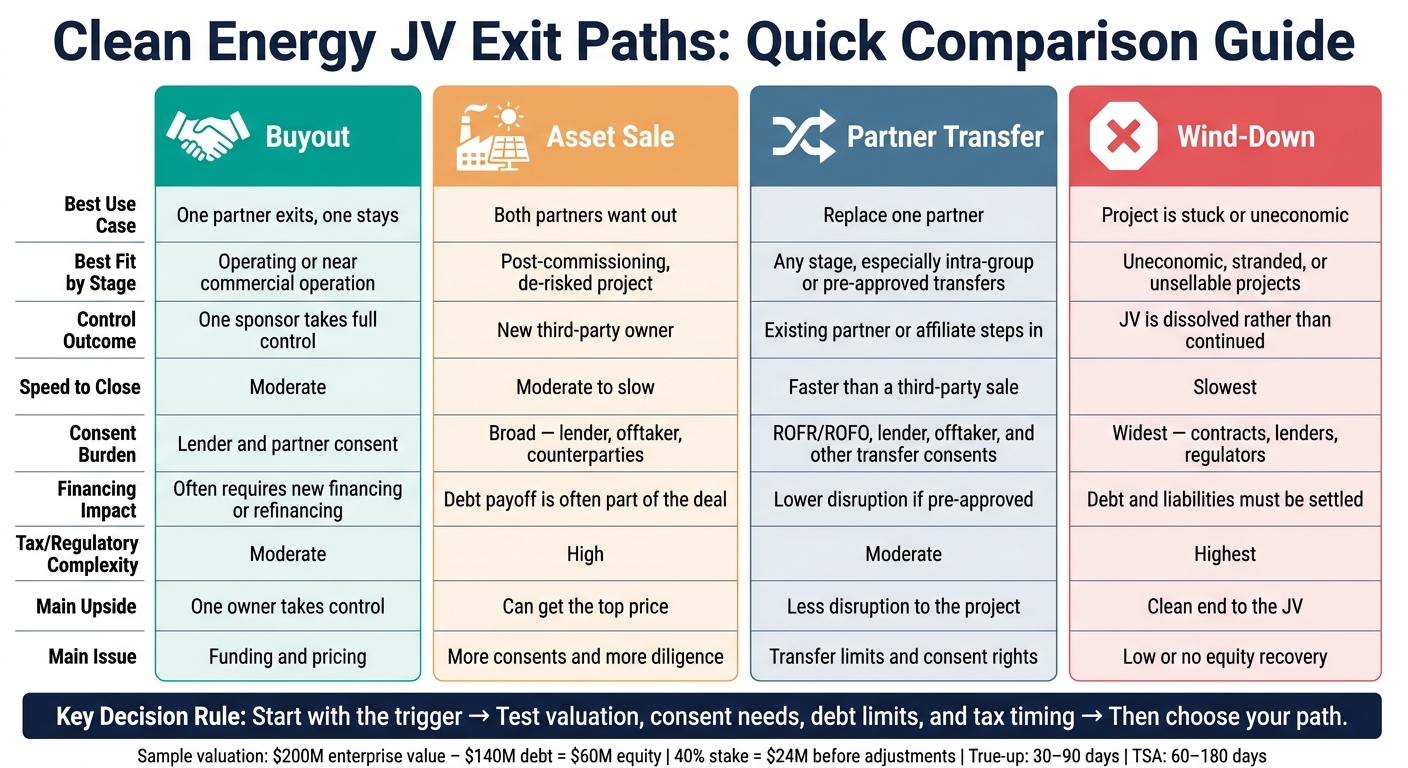
Clean Energy JV Exit Paths: Quick Comparison Guide
| Exit path | Best use case | Main upside | Main issue |
|---|---|---|---|
| Buyout | One partner exits, one stays | One owner takes control | Funding and pricing |
| Asset sale | Both partners exit | Can get the top price | More consents and more diligence |
| Partner transfer | Replace one partner | Less disruption to the project | Transfer limits and consent rights |
| Wind-down | Project is stuck or uneconomic | Clean end to the JV | Low or no equity recovery |
If I were reviewing this kind of exit, I’d start with one question: What triggered the exit? From there, I’d test valuation, consent needs, debt limits, and tax timing before picking a path.
Here’s the practical way to compare these paths: look at control, consent, speed to close, and financing impact. That makes it much easier to match the right exit path to the project’s stage and the JV’s ownership setup.
| Exit Path | Best Fit by Stage | Control Outcome | Speed to Close | Consent Burden | Financing Impact | Tax / Regulatory Complexity |
|---|---|---|---|---|---|---|
| Buyout | Operating or near commercial operation | One sponsor takes full control | Moderate | Lender and partner consent | Often requires new financing or refinancing | Moderate |
| Asset Sale | Post-commissioning, de-risked project | New third-party owner | Moderate to slow | Broad: lender, offtaker, counterparties | Debt payoff is often part of the deal | High |
| Partner Transfer | Any stage, especially intra-group or pre-approved transfers | Existing partner or affiliate steps in | Faster than a third-party sale | ROFR/ROFO, lender, offtaker, and other transfer consents | Lower disruption if pre-approved | Moderate |
| Wind-Down | Uneconomic, stranded, or unsellable projects | JV is dissolved rather than continued | Slowest | Widest: contracts, lenders, regulators | Debt and liabilities must be settled | Highest |
When one sponsor stays and the other exits, the core issue is simple: can the parties get to a price, and can the staying sponsor fund the deal?
A buyout makes sense when one sponsor wants full ownership and the other wants out. It tends to work best when valuation, financing, and tax equity issues have already been dealt with. In many JV agreements, the tools that drive this process are call options, put options, and shotgun clauses.
Under a shotgun clause, one party names the price, and the other must either buy at that price or sell at that price. That setup is often useful in 50/50 JVs, where deadlock can turn into a long, expensive standoff.
Buyouts are usually most workable for operating projects with steady cash flow, a clean ownership setup, and financing that can be put in place or refinanced without too much friction. They get tougher when construction risk is still hanging over the project, when tax equity sits in the capital stack, or when the JV agreement doesn’t already spell out how valuation should work.
If a buyout doesn’t line up, the next move is to test the other paths: sale, transfer, or wind-down.
A third-party asset sale can deliver the highest price. But it also brings the heaviest diligence load and the longest list of required consents, especially where offtake, interconnection, and land agreements have change-of-control terms.
A partner transfer is more limited in scope. If an existing co-venturer or affiliate takes the exiting party’s place, the project can keep moving with less disruption because the transferee already knows the asset and the JV setup. That said, the deal still needs to clear ROFR/ROFO rights, lender consent rules, and any change-of-control language in operating contracts.
Wind-down is the last-resort path. It comes into play when a project is uneconomic, stranded, deadlocked, or so encumbered that a sale just isn’t realistic. Instead of keeping the JV alive, wind-down shuts it down. That usually means:
In many cases, equity recovery is minimal or zero. So if a sale or transfer is still on the table, it will often lead to a better result.
Not every exit option works at every point in a project’s life. The table above lays out the menu, but stage and ownership structure decide what you can actually do.
Before COD, exits are harder because buyers are taking milestone risk. Permits may still be pending. Interconnection rights may not be assignable. And EPC contracts can include guarantees and liquidated damages that a buyer would have to take on. [1][3][4]
A lot of JV agreements also limit transfers until mechanical completion or COD. The goal is simple: protect lenders and keep permits and project execution on track. [1][5] In practice, that usually narrows the options to a partner buyout or a pre-approved transfer, often to an investment-grade utility or an established infrastructure fund, with ROFR/ROFO rules and lender consent layered on top.
At this point, price is based less on operating proof and more on what the project is expected to do. Buyers tend to focus on:
After COD, the picture changes. Valuation tends to improve, and more buyers can step in. Actual capacity factors, availability metrics, and revenue data give buyers a clearer view of cash flow. That usually leads to tighter pricing ranges and a bigger buyer pool, including infrastructure funds, pension-backed platforms, and corporate buyers chasing decarbonization targets.
Even then, an operating project sale is not plug-and-play. PPA assignability, O&M contract continuity, and lender change-of-control consents still need close review. An unauthorized transfer can trigger an event of default under the offtake agreement, so you need a clear map of every consent before taking the asset to market. [12] A buyout and a third-party sale can both work here, but each comes with its own consent chain.
If tax equity is still part of the structure, timing matters. A sale after the flip date can help avoid recapture or safe-harbor problems. [10][11]
When a project hits deadlock or distress, the goal often shifts from top price to speed and damage control. In a 50/50 JV, buy-sell mechanics are often the cleanest way to break a stalemate without ending up in court, since neither side has one-sided control. [2][7][8][9]
If the project breaches covenants, lenders may block distributions, set cure periods, step in, or force a sale, with sale proceeds going to debt repayment first. [3] Recapitalization can sometimes work if the JV agreement and financing papers allow it, but that usually dilutes current partners and can shift control.
When the asset is no longer workable - because of permitting setbacks that can't be fixed, revoked interconnection rights, or technology failure - dissolution often becomes the default path under state LLC or partnership law. At that point, termination costs tied to EPC, PPA, and land lease agreements can eat away at whatever value is left.
Once the exit path is set, execution usually comes down to three gates: price, consent, and closing mechanics.
Price usually comes from three valuation methods: DCF, comparable transactions, and FMV appraisals. The smart move is to use all three, compare the results, and then turn that range into a dollar purchase price. Different exit routes lead to different pricing logic. A buyout of a stable operating asset will often support a tighter DCF range. A distressed wind-down is less neat because recoverable value depends on what the market will pay for assets that may already be encumbered.
Start with enterprise value, then adjust for debt, cash, and working capital. Say a project has an enterprise value of $200,000,000 and $140,000,000 in nonrecourse debt. That leaves an implied equity value of $60,000,000, so a 40% partner stake is worth $24,000,000 before any other adjustments. Most deals also include a post-closing true-up, usually settled within 30 to 90 days, to reconcile the estimated figures used at closing with the actual balance sheet data.[24]
Tax timing can move proceeds by a lot. If tax equity is still in the structure, an exit before the flip can change value because the buyer has to model the remaining tax equity allocations and discount the equity value to reflect that. ITC or PTC recapture risk can also cut net proceeds if the deal happens during a recapture period. That’s why after-tax scenarios need to sit right next to the headline purchase price before anyone agrees to terms.
A fair price alone won’t get a deal across the line if the transfer consents are still hanging out there.
Project finance consents usually come from several parties, and each one moves on its own clock. Lender consent and tax equity consent are often the first big gating items. Either one can stop closing if ownership or control changes. The approval burden is heaviest in 50/50 JVs, tax equity structures, and lender-backed projects.
ROFR and ROFO procedures need to be followed exactly as written. A right of first refusal (ROFR) lets non-selling partners match a third-party offer. A right of first offer (ROFO) means the selling partner has to offer its interest to existing partners first, and only then can it sell to a third party on equal or better terms.[6][13][14][15]
The table below sums up the main consents most U.S. clean energy JV exits require:
| Consent Type | Who Holds It | Key Risk if Missed |
|---|---|---|
| Lender consent | Project finance lenders | Event of default or loan acceleration |
| Tax equity consent | Tax equity investor | Recapture exposure or deal block |
| ROFR / ROFO | JV partners | Transaction invalidated or litigation risk |
| PPA change-of-control | Offtaker / utility | Consent delay or deal block |
| Interconnection transfer | ISO / utility | Transfer delay or additional requirements |
| Permit transfer | State / local agencies | Permit lapse or reissuance required |
Transfer or control changes should be cleared with the offtaker in writing before signing. Get explicit offtaker consent for any ownership or control change. Don’t bank on a narrow reading of change-of-control language.
After price and approvals are lined up, the deal usually shifts to assignment documents, transition support, and who carries which liabilities.
The closing package for a U.S. clean energy JV exit usually includes assignment and assumption agreements, executed consents from all required counterparties, releases of partner guarantees or security interests, and updated schedules of assets and liabilities. The purchase price is paid - often wired in USD on the closing date - subject to the agreed adjustments.[20][23]
For operating projects, transition services agreements (TSAs) are now common. A TSA keeps the seller in place for operational, IT, or administrative support for a set period, often 60 to 180 days, while the buyer gets its own setup in place.[16][18] These agreements should say exactly what services are included, how long they last, what termination rights apply, and what happens if service levels fall short. In wind-downs, the focus shifts away from service continuity and toward liability and restoration allocation.
Decommissioning obligations need to be assigned at closing. Wind and solar projects carry site restoration duties that run with the land, and buyers need to formally assume any existing decommissioning plans and financial assurance tools - bonds or guarantees - already in place for landowners or permitting authorities.[19][17][21][22] Purchase agreements should clearly assign responsibility for pre-closing environmental conditions to the seller and post-closing obligations to the buyer, with indemnities covering any gap period.
The right exit path usually isn’t obvious at first glance. Out of the four paths covered - buyout, asset sale, partner transfer, and wind-down - the best one depends on the trigger, the project stage, ownership limits, and closing constraints. From there, stage shapes which path brings the least friction and the best value.
Operating projects with long-term PPAs tend to draw the broadest buyer pool and the strongest pricing. Early-stage development assets work differently. Permitting risk and interconnection uncertainty can make valuations feel more like options, which is why partner transfers or staged buyouts often make more sense than a full asset sale.
Sometimes the main issue isn’t price. It’s control. In those cases, speed can matter more than auction dynamics. Pre-agreed buy-sell rights can break a deadlock faster than a negotiated exit, and they can lower litigation risk when the relationship has fallen apart. That’s the core test for every JV exit.
Start with the trigger. Work through the constraints. Then choose the path that fits the asset, the stage, and the goal.
Choose the right joint venture exit path based on where the project stands, how ownership is set up, your money goals, and whether you want liquidity, continuity, or a clean split.
Delays often happen because deals need sign-off from multiple parties. That’s even more common when a state-owned entity is involved, or when the exit includes settlements or arbitration.
Another frequent source of delay is getting consent for change-of-control clauses in key contracts. That can include power purchase agreements, interconnection agreements, and equipment leases. Deals can also stall when personal guarantees tied to loans or leases aren’t formally released or replaced.
Project stage has a big impact on both risk and exit value. As a project moves from greenfield development to commercial operation, risk usually drops. At the same time, the way buyers value the asset shifts from projected capacity to proven cash flow.
Early-stage projects are often priced using market comparables and EV/MW metrics. Projects getting close to NTP tend to command more value because permits and interconnection have been de-risked. Once an asset is operational, buyers usually lean on DCF models and EV/EBITDA multiples instead.