Published on
August 3, 2026

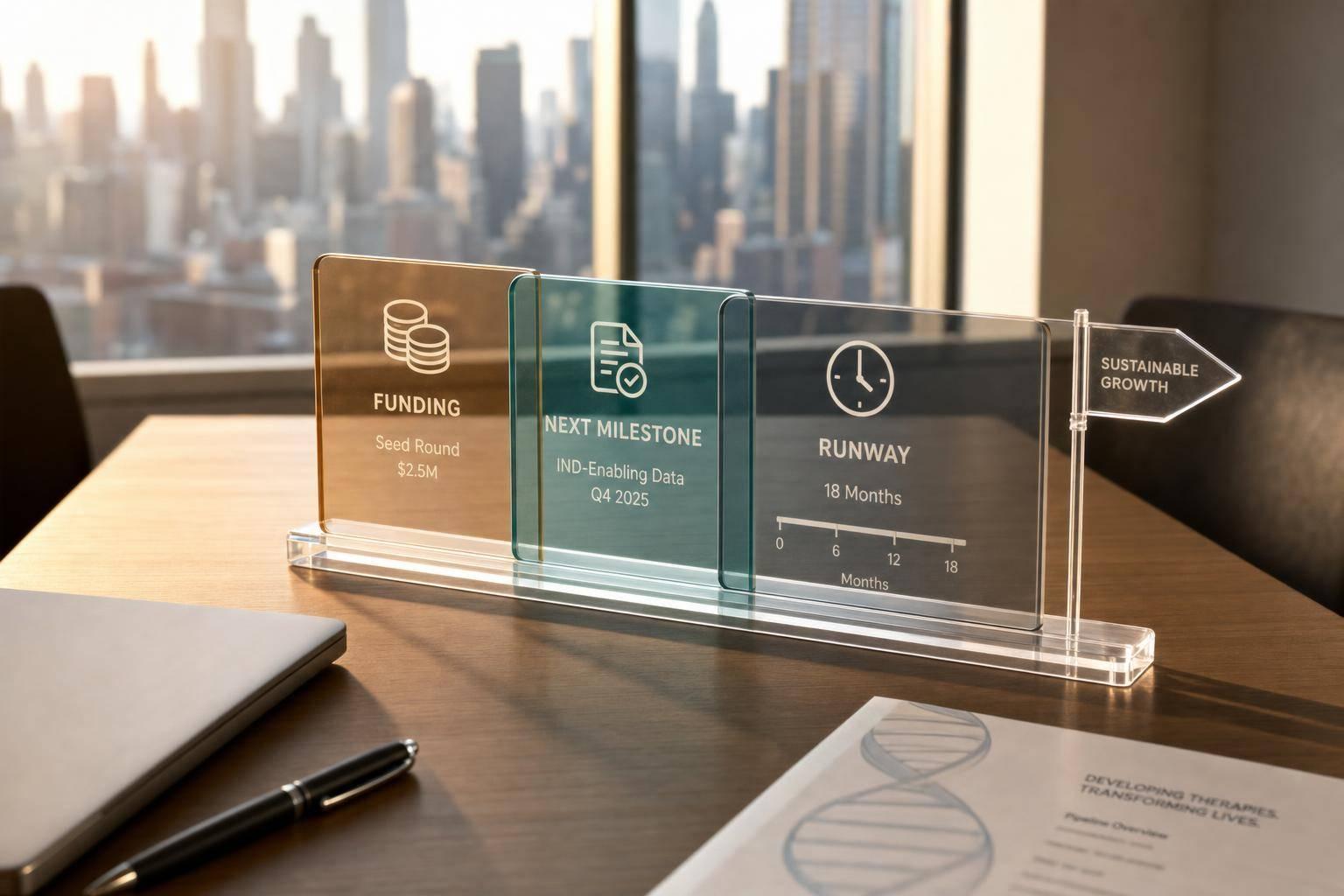
Biotech founders do not win investor meetings with big market slides alone. They win by showing what the money pays for, what data comes next, and how long the cash lasts.
If I were preparing this pitch, I would keep the story simple: this round funds a defined milestone, the team knows how to get there, and the proof is ready for review. That matters even more when seed rounds now take 142 days to close, warm intros can get 58%+ response rates, and many biotech companies need 18–24 months of runway at seed.
Here’s the short version:
A biotech pitch is less about telling a big vision story and more about proving one simple point: this capital gets the company to the next data or regulatory event that changes the risk profile.
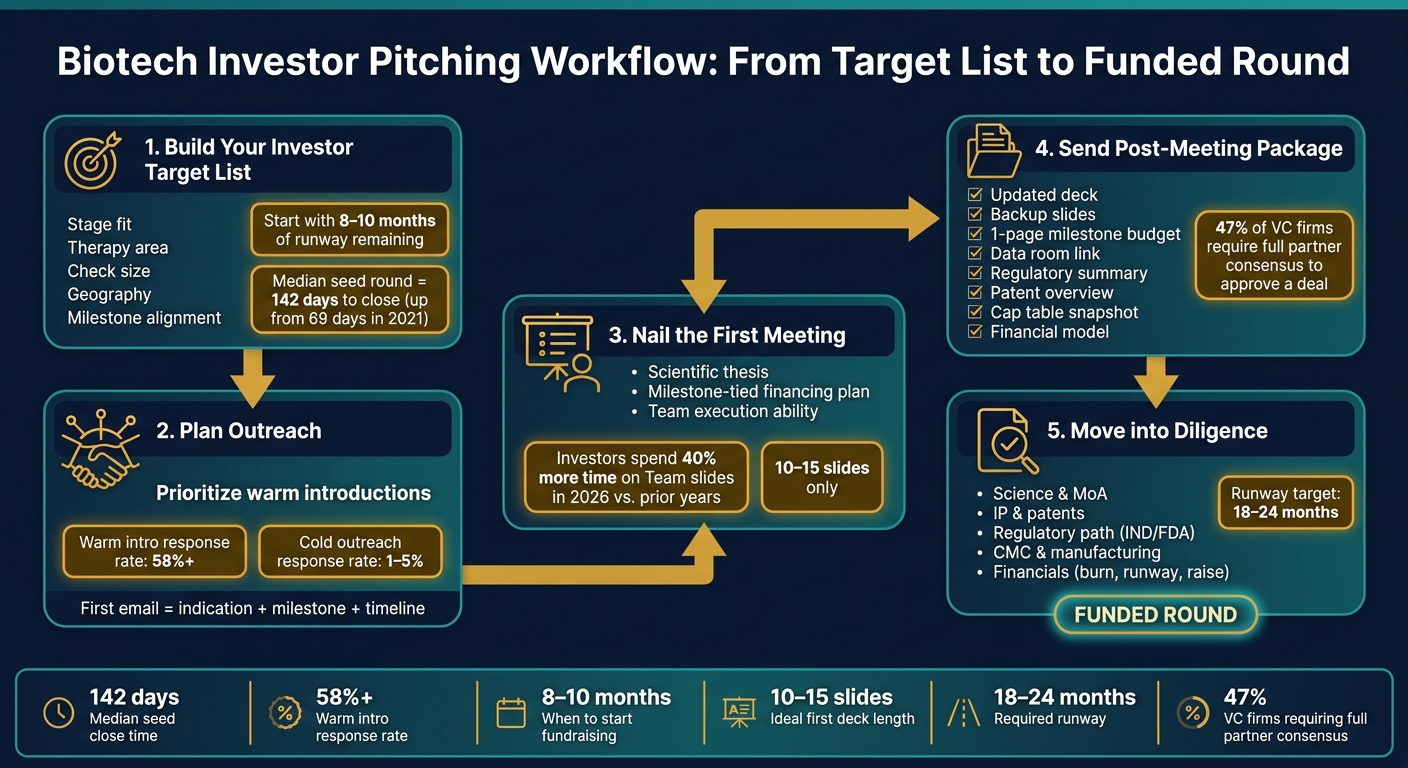
Biotech Investor Pitching Workflow: From Target List to Funded Round
Build your target list around fit: stage, therapy area, check size, geography, and the milestone this round will fund. You also need to know how each fund makes decisions. In plain terms, who can carry your deal into the partner meeting and argue for it when you're not in the room?
Timing matters just as much. The median seed round now takes 142 days to close, up from 69 days in 2021 [1]. That’s why you should start building your target list when you have 8–10 months of runway remaining [2]. If you wait until you're down to 4–6 months, you lose room to negotiate [2].
Once the list is done, keep outreach warm, short, and tied to a clear milestone.
Warm introductions should come first. Response rates for warm intros run at 58% or higher, compared with just 1%–5% for cold outreach [1]. So it’s worth mapping your network against your target list and figuring out who can open the door.
Your first email should be brief and direct. Say what indication you're pursuing, what milestone this round funds, and what your timeline looks like.
If you land the meeting, switch gears fast. Now you need to be ready on science, regulatory, IP, and financing.
The first meeting has one job: prove that this round buys a specific milestone and that your team can get there. The deck gets you into the room. The meeting gets you invited back.
That means showing three things with no fuzziness:
Investors in 2026 are spending 40% more time on Team slides in seed decks than in prior years [3]. They’re not just looking for a polished pitch. They want to know whether the people in the room can handle surprises and still move the company forward.
A good first call should trigger a fast, structured follow-up, not a generic thank-you note. Send a post-meeting package that gives your internal champion what they need to bring your deal to partners who weren’t in the meeting.
That package should include:
Each claim in the deck should map to a matching document in the data room. That way, the next step - science, IP, and regulatory diligence - is easy to start.
Before you walk into an investor meeting, make sure your core facts are locked in. Not just on the slides. In your head.
That matters even more now because investors are using AI tools to screen decks and pull out claims. If your spoken answers don't line up with what the deck says, that gap can look like a red flag, not confidence [3].
At a minimum, you should be able to answer these points on the spot:
You should know your burn, runway, and raise size without looking at notes. If an investor asks and you pause to check, the moment can go cold fast.
Your first pitch might happen before anyone opens a slide deck. It could be on a phone call, in a hallway at a conference, or during a short intro from a mutual contact. Those quick moments can turn into real investor conversations, so your verbal pitch needs to work on its own.
Keep it in a clear sequence: unmet need, product, proof, development plan, market, and ask.
That order helps because it gives investors the story they want, when they want it. First, why the problem matters. Then what you're building. Then why they should believe it.
Just as important, your spoken pitch and your deck need to say the same thing. Investors compare the two. Any mismatch chips away at trust. And when you get to the ask, be exact. State the raise amount and tie it directly to a milestone-based budget.
Do the pushback work before the meeting, not during it. Investors often press on clinical risk, market size, timelines, and use of funds. That's normal. In a way, every objection is a simple test: does this round buy a clear milestone?
| Pushback Category | Common Objection | Objection → Response |
|---|---|---|
| Clinical Risk | "The translational data looks incomplete." | Specific preclinical results, MOA clarity, CMC status |
| Market Opportunity | "Your pricing assumptions seem aggressive." | Use bottom-up market sizing: addressable patients × realistic price × credible capture rate |
| Trial Design | "The timeline feels overextended." | Detailed regulatory path, IND status, forecast vs. actuals |
| Use of Funds | "Why this raise amount?" | Specific dollar figure tied to defined milestones and 18–24 months of runway |
The same rule applies to differentiation. If you can't name the real-world workaround your target patients use today - whether that's an older drug or a manual process - your differentiation story will likely fall apart in live Q&A.
Once these answers are sharp, you can turn them into a deck that investors can scan in minutes. With the answers and objections in place, the next step is shaping them into a tight first-deck narrative.
A first investor meeting is not the moment to show a full diligence deck. Keep the main deck tight and centered on your opening case. It should answer the pushback you already know is coming: why this science, why now, and what this round pays for. In most cases, 10–15 slides is enough. The goal is simple: give investors enough to want the next meeting.
Build the deck around the milestone story: science first, proof second, execution third, financing last.
| Slide | Purpose | Investor Question Answered | Proof Points Required |
|---|---|---|---|
| 1. Company Thesis | Set the vision and core value proposition | Why now? | High-level mission; summary of the breakthrough |
| 2. Unmet Need | Define the problem and market opportunity | Is this market real and big enough to justify the risk? | Bottoms-up market math; validated demand data [1] |
| 3. Product/Platform | Introduce the solution | What have you built to solve the problem? | High-level description of the lead asset or platform |
| 4. Mechanism (MoA) | Explain the underlying science | How does it work biologically or chemically? | Mechanism diagram; biological rationale |
| 5. Supporting Data | Provide evidence of efficacy and safety | Is there proof that the science works? | Preclinical or clinical data; trial enrollment; publications |
| 6. Pipeline | Show the breadth of the opportunity | Is there a platform beyond the lead asset? | Lead asset status plus follow-on indications |
| 7. Regulatory Path | Outline the road to approval | How do you get this to patients? | FDA interaction history; IND status; regulatory wins |
| 8. CMC & Manufacturing | Address production scalability | Can this be manufactured at scale? | Manufacturing readiness; scale-up plans; CMC spend |
| 9. IP & Legal | Confirm freedom to operate | Is the technology protected from competitors? | Patent status; IP filing strategy; IP milestones |
| 10. Competition | Contextualize the solution | Why will you win against incumbents? | Comparator context; differentiation matrix |
| 11. Team | Establish execution credibility | Is this the right team to build this? | Domain expertise; prior exits; co-founder history |
| 12. Financing Ask | State the capital requirement | How much do you need and what for? | Specific dollar amount; use-of-funds breakdown |
| 13. Milestones | Map capital to value inflection points | What does this round actually buy? | Timeline for IND, Phase 1, or other key readouts |
| 14. Financials | Show fiscal responsibility | How much runway does the round buy? | Net burn rate; 18–30 months of runway projection [2] |
Every claim in the deck needs proof to back it up. If a slide makes a big promise and the next question is, “Can you show me that?”, you need the answer ready.
Science slides - MoA, Supporting Data, and Regulatory Path - need hard evidence. That means peer-reviewed publications, trial enrollment numbers, documented FDA interactions, and IND status. These are the slides where hand-waving hurts you fast.
Market slides should not lean on top-down TAM reports from research firms. Investors have seen that movie before. Use bottoms-up math instead: addressable patient count multiplied by a realistic price point and a believable capture rate [1]. That gives a much clearer picture of what the market can look like.
For financials, show net burn and runway, not just gross burn. That tells investors how long the cash actually lasts [2]. And on the team slide, domain expertise by itself isn't enough. Add proof that this group can execute - prior exits, years of directly related research, or a clear account of how the team spotted a gap others missed.
Put expanded preclinical datasets, detailed trial protocols, subgroup analyses, full manufacturing plans, and complete patent claims in the backup section. Those items matter for diligence, but if they show up too early in the main deck, they can bury the story.
Use backup slides for diligence and partner review. A clean backup section helps move review along and makes the next conversation - especially around valuation and milestones - a lot easier.
Once the deck is clear, investors will look at one thing fast: what does this money get the company to?
In biotech, rounds are priced around de-risking, not vague growth stories. So your round size should tie straight to a defined milestone, like a regulatory filing or a data readout. The valuation should feel like the price of reaching that next scientific or regulatory turning point.
Use the model-driven ask, even if the number looks uneven [3]. A precise ask shows you've done the work.
Just as important, connect runway to that de-risking event. The round should give the company enough time to reach the milestone that changes the risk profile and supports the next financing at a higher valuation. If the ask falls short of that window, investors will spot it.
Once the milestone is clear, the next step is talking about valuation without pushing too hard.
Keep the discussion tied to stage, evidence, and forecast discipline. Those three factors help protect valuation during diligence. Don’t lean on aggressive projections. Stay grounded in current runway expectations and stage-appropriate burn.
GAAP-based accrual accounting matters here too. It helps surface liabilities early instead of letting items like CRO milestones or IP legal fees show up late and force valuation re-trading during diligence [2].
Tight, honest quarter-over-quarter forecasts also help reduce late-stage valuation retrading.
At this point, investors will want the numbers behind the milestone story.
Your core package should include:
Each item should connect back to the financing ask and the milestone allocation shown in the deck.
For clinical-stage companies, a milestone allocation spreadsheet is best practice [2]. Every dollar of trial spend should link to a defined deliverable. It also helps to show both the trailing 3-month average burn and the forward 6-month projected burn, especially when trial costs or hiring are about to change the expense base.
After the meeting, send a package your internal champion can forward with no extra explanation. This is the handoff between the first meeting and diligence. 47% of VC firms require full partner consensus to approve a deal [1], so these materials need to carry weight on their own.
A strong post-meeting package should include:
Keep it organized so a partner can review the main claims without needing you in the room.
A strong biotech pitch starts with evidence. Prepare for investor-specific questions before the meeting. Keep the deck lean and tied to proof. Connect the financing ask to the milestones that remove the most risk.
Then follow up with materials that help investors build conviction on their own time. Science, regulation, IP, and financing need to support the same milestone story. That’s what helps move a first meeting toward a funded round.
Start fundraising 6 to 12 months before you need the money. That gives you enough time to tighten your pitch, build relationships with 40 to 50 potential investors, and adjust your plan based on what you hear.
There’s another reason to start early: it keeps you from negotiating with your back against the wall. When your cash runway gets short, investors often have more leverage, which can lead to punitive terms or unfavorable dilution.
If you plan to bring in a fractional CFO, the sweet spot is usually 6 to 9 months before the raise.
Size the round to cover 18 to 24 months of runway and get you to a clear milestone that moves the company forward. For an early-stage biotech, that could mean proof-of-concept data, patent filings, or preclinical efficacy.
For later rounds, tie the raise to specific clinical or regulatory targets, like an IND filing, a Phase readout, or FDA approval. Build in a 20% to 30% buffer, and set the ask from a detailed model, not random benchmark numbers.
After your first investor meeting, send more than a simple thank-you note. Your follow-up should help the investor’s internal champion explain your company clearly to the investment committee.
That means giving them the materials they need to tell your story without having to piece it together from memory. Share backup for the main points in your pitch, like technical documentation, product details, market data, or deeper numbers behind your claims.
The goal is simple: make it easy for the investor to assess your business without going back through the first discovery conversation all over again.