Published on
July 27, 2026


If your SaaS team still reviews every cash break by hand, you're wasting close time. I’d boil the whole article down to this: ML helps me match bank activity across bank feeds, Stripe, billing, AR, and the GL by handling exact matches, batched payouts, fuzzy matches, timing gaps, and anomaly flags in one workflow.
Here’s the short version:
A few numbers stand out. The article says ML-driven reconciliation can deliver 85%–95% straight-through matching for a mix of exact, fuzzy, and grouped transactions. That matters when one Stripe payout can bundle 12,000 charges into a single $152,417.89 bank deposit, or when a $48,200 deposit reflects $50,000 in charges, $1,100 in fees, and $700 in refunds.
My takeaway: ML does not just match amounts and dates. It helps me sort out net payouts, timing noise, refunds, fee offsets, contract changes, and GL posting issues before month-end turns them into a pile of breaks.
| Area | What ML handles |
|---|---|
| Cash matching | Exact, grouped, and fuzzy matches |
| Stripe reconciliation | Payouts, fees, refunds, and chargebacks |
| Timing gaps | Settlement delays, retries, and period cutoffs |
| Exception handling | Confidence scoring and anomaly flags |
| Revenue controls | Deferred revenue checks and roll-forwards |
| Governance | Audit logs, approvals, thresholds, and escalation |
If I were setting this up today, I’d focus on daily data feeds, clean IDs, one time zone, and review rules first - because without clean inputs, the match quality drops fast.
With the core workflow in place, the next step is how ML deals with the toughest cash-matching cases.
It starts with exact matches on amount, date, and stable IDs. If a Stripe payout has the same processor ID and dollar amount as a record in the system, it clears right away. Once those clean matches are out of the way, ML moves on to the messy stuff: batched payouts and items that could match more than one record.
For Stripe payouts, the model groups likely charges, fees, and refunds into settlement windows. Then it predicts which mix adds up to the bank deposit that actually hit the account. So a single $152,417.89 payout might include 12,000 charges, $4,200.35 in fees, and $3,100.12 in refunds. The system finds that link through pattern recognition rather than fixed rules. [2][5][6][9]
Fuzzy matching picks up the leftover breaks by looking at text similarity across customer names and invoice references. That means Acme Corp in Stripe can still match Acme Corporation, Inc. in the GL.
Run in sequence, this process usually looks like:
That flow pushes more items through auto-match and cuts down manual work. [5][9][2][6][7] It's also why Stripe payouts, refunds, and failed charges become much easier to reconcile when transaction volume starts piling up.
Anomaly detection is where ML starts paying off in day-to-day operations.
Each proposed match gets a confidence score. High-score matches can clear on their own. Lower-score items go to a reviewer queue based on team policy. At the same time, the model learns what normal cash activity looks like, such as usual payout ranges and fee ratios, and flags anything that falls outside that pattern.
That can include:
For growth-stage SaaS teams, this often changes the review process in a big way. Instead of checking 100% of transactions, the team only reviews the share the ML engine can't sort with high confidence. Reviewers handle the edge cases, and the system uses those decisions going forward. [2][4]
None of this works if the input data is messy.
Transaction IDs need to be deduplicated and normalized across systems. Timestamps need to line up to one reference time zone. And every match needs a full audit trail that shows which records were linked, what drove the decision, and who approved it. [2][6][9]
If that foundation slips, confidence scores get worse and auditability takes a hit. Once the data is normalized, the model can move beyond generic matching and handle SaaS cash reconciliation with much better accuracy.

Building on the earlier matching logic, Stripe is often the highest-volume SaaS case, which is exactly where ML saves the most time.
The main issue is simple: the bank does not see each charge. It sees the net payout amount. One bank deposit can include dozens or even hundreds of transactions after Stripe takes out fees, refunds, and chargeback adjustments. So if you try to reconcile at the single-charge level, the numbers usually won’t line up. The bank amount almost never matches gross sales. [10][11][12][13]
ML helps by using the payout ID as the main matching key. It groups the charges, fees, refunds, and chargebacks tied to that payout, then connects that full bundle to the bank deposit. Say a $48,200 bank deposit came from $50,000 in gross card charges, $1,100 in processing fees, and $700 in refunds in the same payout batch. ML rolls that payout bundle into one gross-to-net match against the bank deposit. [10][13]
After that, each payout should be posted as a gross-to-net journal entry that breaks out revenue, fees, and refunds. For example, a $1,000 sale with a $30 Stripe fee should be recorded as:
Once the payout match clears, ML can post that entry automatically. [14]
Failed charges are a normal part of SaaS billing, but they add a lot of noise to reconciliation. When a failed card gets retried and then goes through later, the settled charge lands in a different payout and can even fall into a different accounting period. Without ML, that timing gap can look like a break. [10][1]
ML cuts down these false exceptions by learning normal payout timing patterns, usually two to five business days after initiation. [10] In plain English, the model can tell the difference between a charge that never settled and one that’s just sitting in processor lag. That means finance teams spend review time on actual exceptions, not timing noise. It also keeps those timing gaps out of the exception queue.
Waiting until month-end to find reconciliation breaks gets expensive fast. A daily sync across four data layers - bank account, Stripe, billing system, and GL - lets the model catch issues as they happen instead of during a last-minute close rush. [13]
That daily feed should include both settled and pending items. If it only pulls settled activity, the model misses timing patterns and may flag normal delays as errors. With both types of data in the feed, it can spot timing differences before they turn into noise.
When a payout is missing, a refund is unapplied, or an invoice was billed but never collected, the exception shows up early instead of at month-end. For growth-stage SaaS teams dealing with fast-rising transaction volume, that early view improves cash reporting accuracy and cuts manual work at period-end. Those matched cash flows also feed deferred revenue and subledger-to-GL roll-forwards. Those same matches roll straight into deferred revenue and GL controls.
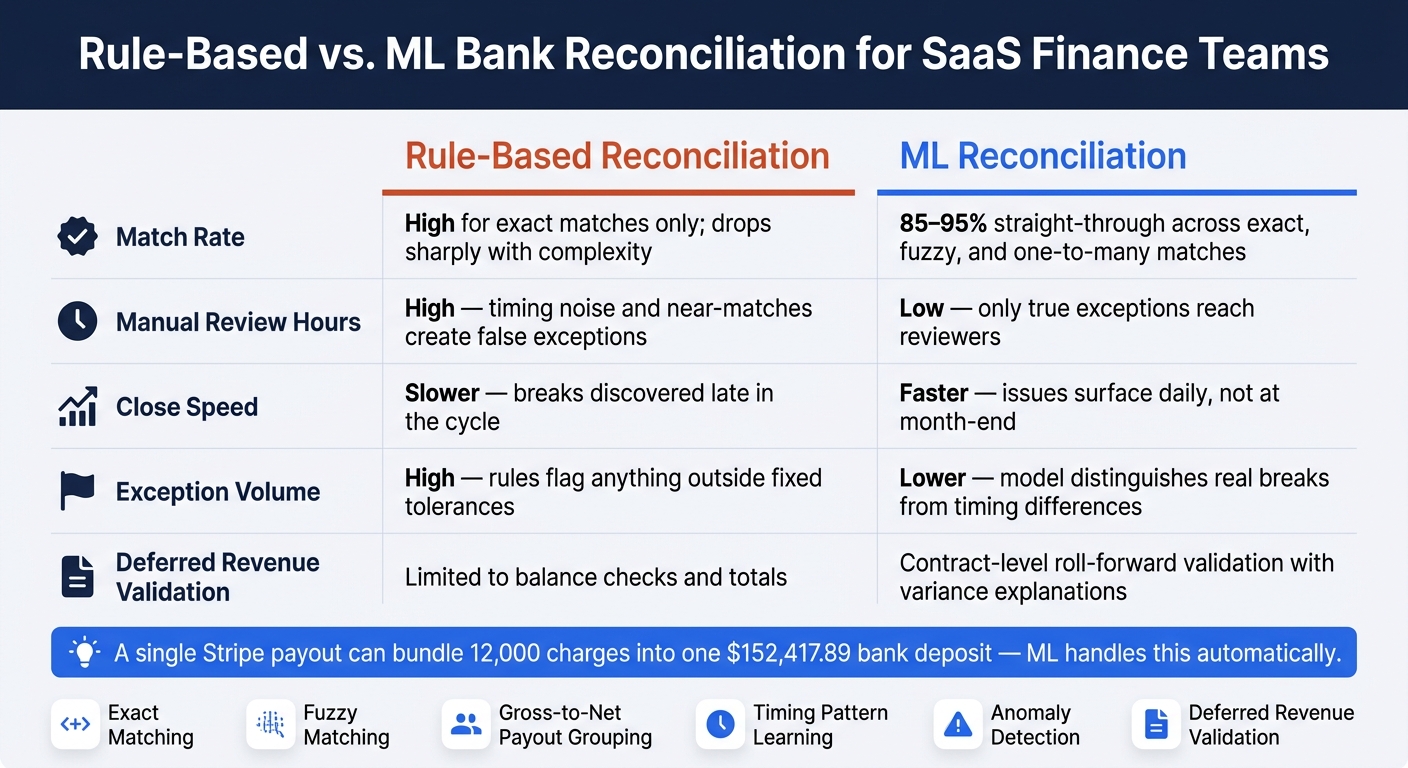
Rule-Based vs. ML Bank Reconciliation for SaaS Finance Teams
Deferred revenue is the next close control that matters. For SaaS companies under U.S. GAAP, the deferred revenue roll-forward needs to tie opening balances, billings, revenue recognized, adjustments, and closing balances for each period.
ML-backed workflows check this by learning the expected pattern for each contract type. An annual upfront billing should follow a 12-month recognition schedule. A mid-cycle upgrade should change the schedule and deferred revenue balance. A cancellation should reduce both. The model compares predicted movements with actual GL postings and flags anything that doesn’t match at the contract or customer level. Those same cash and billing matches also flow into the revenue subledger and GL roll-forward.
This is where ML tends to catch issues that plain rules miss. Think missing schedules, early revenue, or credit memos posted to the wrong GL account. If revenue gets recognized too soon because contract dates don’t line up, or a credit memo lands in the wrong account, those problems often show up during audit fieldwork if the close team doesn’t catch them first. Finding them during close cuts audit risk.
For this to work, the data model needs to be clean. Most teams begin with a canonical warehouse model built around unique IDs for each invoice, schedule entry, and journal entry. Without that setup, ML models can’t learn the links they need for validation.
The same matching logic goes past revenue and into bank-to-GL controls across the finance stack. Full multi-system cash matching ties together five layers:
ML scores matches based on amounts, timing, IDs, and memo text similarity. For one-to-many cases, like a bank deposit that includes many charges, refunds, and fees, the model checks whether a proposed group of processor transactions adds up to the bank amount within a set tolerance. It doesn’t force a one-to-one match when the data clearly says otherwise.
Continuous matching increases straight-through processing and leaves only real exceptions for review.
The difference shows up fast in review volume and close speed. Rules work well for clean transactions. ML handles batched payouts, retries, and contract changes at scale.
| Dimension | Rule-Based Reconciliation | ML Reconciliation |
|---|---|---|
| Match rate | High for exact matches; drops sharply with complexity | 85–95% straight-through across exact, fuzzy, and one-to-many |
| Manual review hours | High; exceptions include timing noise and near-matches | Low; only true exceptions reach reviewers |
| Close speed | Slower; breaks discovered late in the cycle | Faster; issues surface daily, not at month-end |
| Exception volume | High; rules flag anything outside defined tolerances | Lower; model distinguishes real breaks from timing differences |
| Deferred revenue validation | Limited to balance checks and totals | Contract-level roll-forward validation with variance explanations |
These are the cases where rules start to crack and ML keeps the close moving.
| SaaS Scenario | ML Capability Applied |
|---|---|
| Stripe payout with mixed charges, fees, refunds | Predictive matching; gross-to-net payout grouping |
| Failed charge → retry → settled in different period | Timing pattern learning; false exception suppression |
| Mid-cycle upgrade with pro-rated credit | Roll-forward automation; contract-level variance flagging |
| Annual billing with 12-month recognition schedule | Schedule validation; mis-timed revenue detection |
| Multi-processor bank deposit | One-to-many matching; aggregation match scoring |
| Credit memo booked to wrong GL account | Anomaly detection; misclassification flagging |
| High-volume SMB subscriptions with frequent retries | Batch grouping; retry pattern detection |
Once cash matching works across the bank, processor, billing platform, and GL, control becomes the next issue.
ML reconciliation only works as a control if the team runs it like one. Assign specific preparers and reviewers. Set confidence thresholds. Decide which matches can auto-post to the GL. A match does not count as a control unless it is logged, approved, and reproducible.
Keep an immutable, append-only record of source transactions, confidence score, model version, and any overrides. That record gives audit support, diligence support, and a clear trail for close sign-off. It also needs to cover the full scope, including Stripe payouts, refunds, failed charges, and deferred revenue postings.
Model governance needs the same level of discipline. A cross-functional group - often the CFO or VP of Finance, controller, and a data science lead - should own retraining decisions, set performance dashboards, and approve threshold changes before those changes affect reported results. [21][22][23] Breaks older than 5 business days should go to a supervisor. Breaks older than 10 business days should go to the controller or CFO. [20]
Once those controls are in place, the next move is to roll out the highest-volume reconciliations first.
Start with daily bank-to-GL, bank-to-Stripe payout, and processor-to-GL revenue and fee matching. These are the highest-volume reconciliations, they matter during close, and they tend to give the fastest drop in manual work when ML is added. [15][16][17]
Before deployment, check a few basics:
A phased 90-day rollout helps keep scope under control. Start with feeds and the chart of accounts. Then move to core cash matching. After that, set up break-rate and close-time dashboards. [15][17]
For growth-stage SaaS teams building this from scratch, Phoenix Strategy Group combines bookkeeping cleanup, fractional CFO guidance on materiality thresholds and controls, and data engineering to connect systems so ML reconciliation outputs feed straight into financial reporting and cash forecasts.
After the core workflows are live, track the effect on break rate, manual touches, and days to close.
ML bank reconciliation handles the messiness of Stripe payouts, refunds, failed charges, and deferred revenue postings by combining exact logic with predictive matching and by filtering out false breaks caused by timing differences. [18][19][24] That means finance teams spend less time matching line items and more time working real exceptions. ML cuts manual review in SaaS reconciliation by automating high-volume cash matches and isolating true exceptions, which makes an accurate, timely close possible as transaction volume grows.
Machine learning deals with Stripe payout timing gaps by using probabilistic matching instead of strict reconciliation.
So when dates or amounts don’t line up perfectly, the system doesn’t just fail and kick everything to manual review. It looks for the most likely match and assigns a confidence score, even when FX rounding or settlement delays throw things off.
By linking Stripe API feeds with your general ledger, it keeps checking merchant IDs and settlement reports on a continuous basis. That makes it easier to automate timing mismatches, cut down manual review, and keep cash matched correctly across both systems.
Reliable ML reconciliation starts with clean, normalized data from your ERP, banking platforms, billing tools such as Stripe, and CRM. Just as important, you need one system of record with the same field and metric definitions across every source.
The core inputs are cleared bank transactions, sub-ledger details, and payment settlement reports. From there, check data quality with schema checks, semantic modeling, and mapped IDs across systems. And when fixes happen, log those corrections as new entries so you keep an immutable audit trail.
Start by connecting your bank, ERP, and CRM systems. Then automate bank reconciliations so you can see cash balances as they change and spot unusual activity early.
Next, automate AR and AP reconciliations. After that, add three-way matching and key month-end reconciliations, such as revenue recognition subledgers and payroll, to cut manual bottlenecks and support audit-ready reporting.