Published on
August 24, 2026

If you need cash sooner, state and utility programs usually come first. If you want the biggest tax upside, federal incentives like Section 179D often lead on total dollar value.
I’d frame it this way: federal incentives can reach up to $5.00 per square foot, but the money usually shows up when taxes are filed. State credits, grants, and utility rebates are often smaller, but they can land during construction or soon after install. That timing can change the deal more than the headline amount.
Before I underwrite any project, I’d check these six things first:
For most deals, the order is simple:
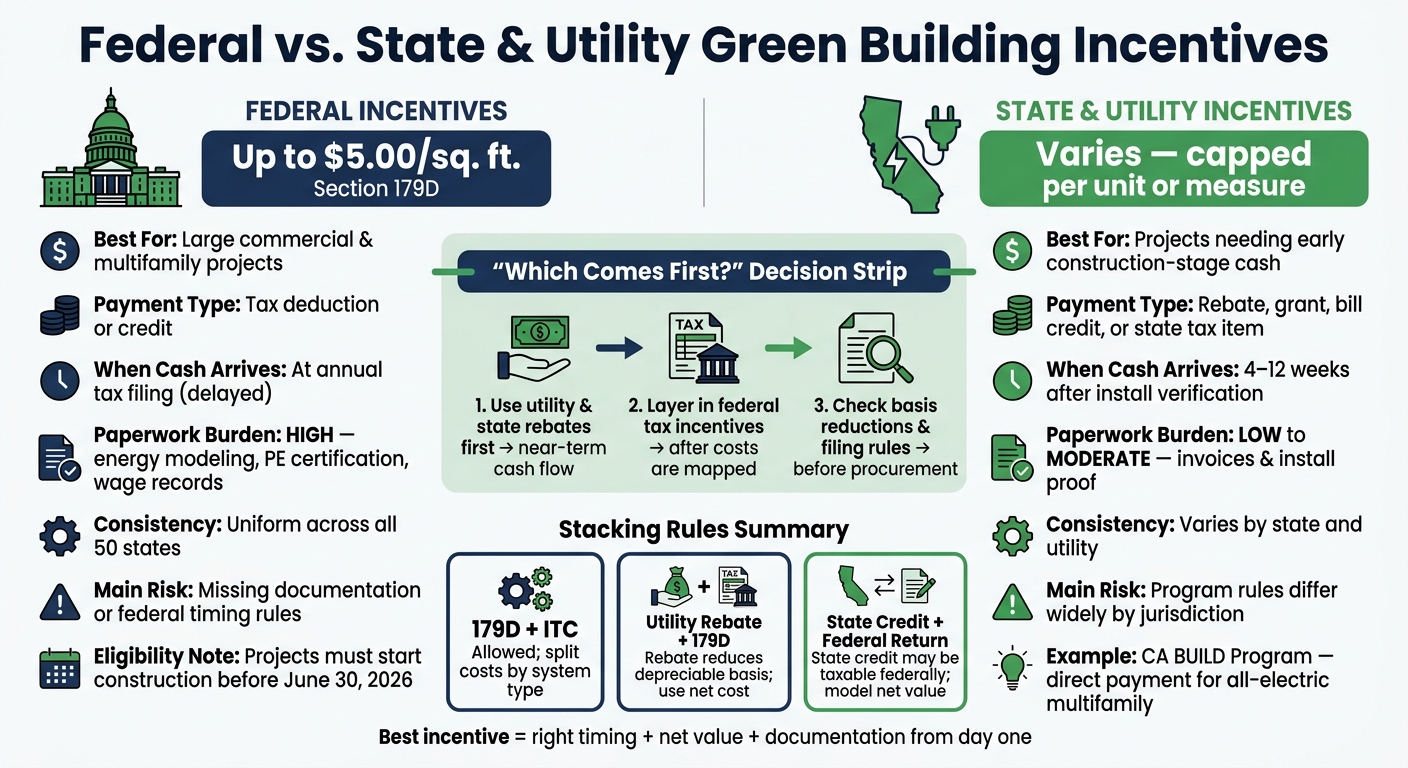
Federal vs State Green Building Incentives: Value, Timing & Complexity
| Factor | Federal Incentives | State & Utility Incentives |
|---|---|---|
| Best use | Larger commercial and multifamily projects | Projects that need early cash support |
| Top value | Up to $5.00/sq. ft. under 179D | Usually capped by unit, measure, or program |
| How paid | Tax deduction or credit | Rebate, grant, bill credit, or state tax item |
| When money shows up | Usually at tax filing | Often during construction or shortly after completion |
| Paperwork | Higher; modeling and certification | Lower; invoices and install proof are common |
| Main risk | Missing documentation or federal timing rules | Program rules vary by state and utility |
| Best fit | Deals with tax appetite and time to wait | Deals where early liquidity matters more |
So the short answer is this: the best incentive is not always the biggest one on paper. I’d rank them by when the money arrives, how hard the claim is, and whether the net value still holds after tax and basis changes.
Federal incentives can produce larger deductions than many state or utility programs. But there’s a catch: the cash benefit usually doesn’t show up until tax filing. So the next issue isn’t just value. It’s whether the project is big enough, and whether it can clear the rules.
Section 179D is the main federal tax tool for commercial green building projects. It’s a permanent tax deduction, and it scales based on square footage instead of just equipment cost. That makes it a strong fit for larger buildings.
The base deduction ranges from $0.30 to $1.00 per square foot, and it can increase to as much as $5.00 per square foot if the project meets federal prevailing wage and apprenticeship rules [3][1].
To qualify, the project needs energy modeling that shows savings against the ASHRAE 90.1-2007 baseline [3][1]. That’s where smaller deals can run into trouble. Projects under 20,000 square feet often don’t produce enough tax value to cover the cost of modeling and certification [3]. In plain terms, 179D tends to work better when the project is larger and the paperwork starts early.
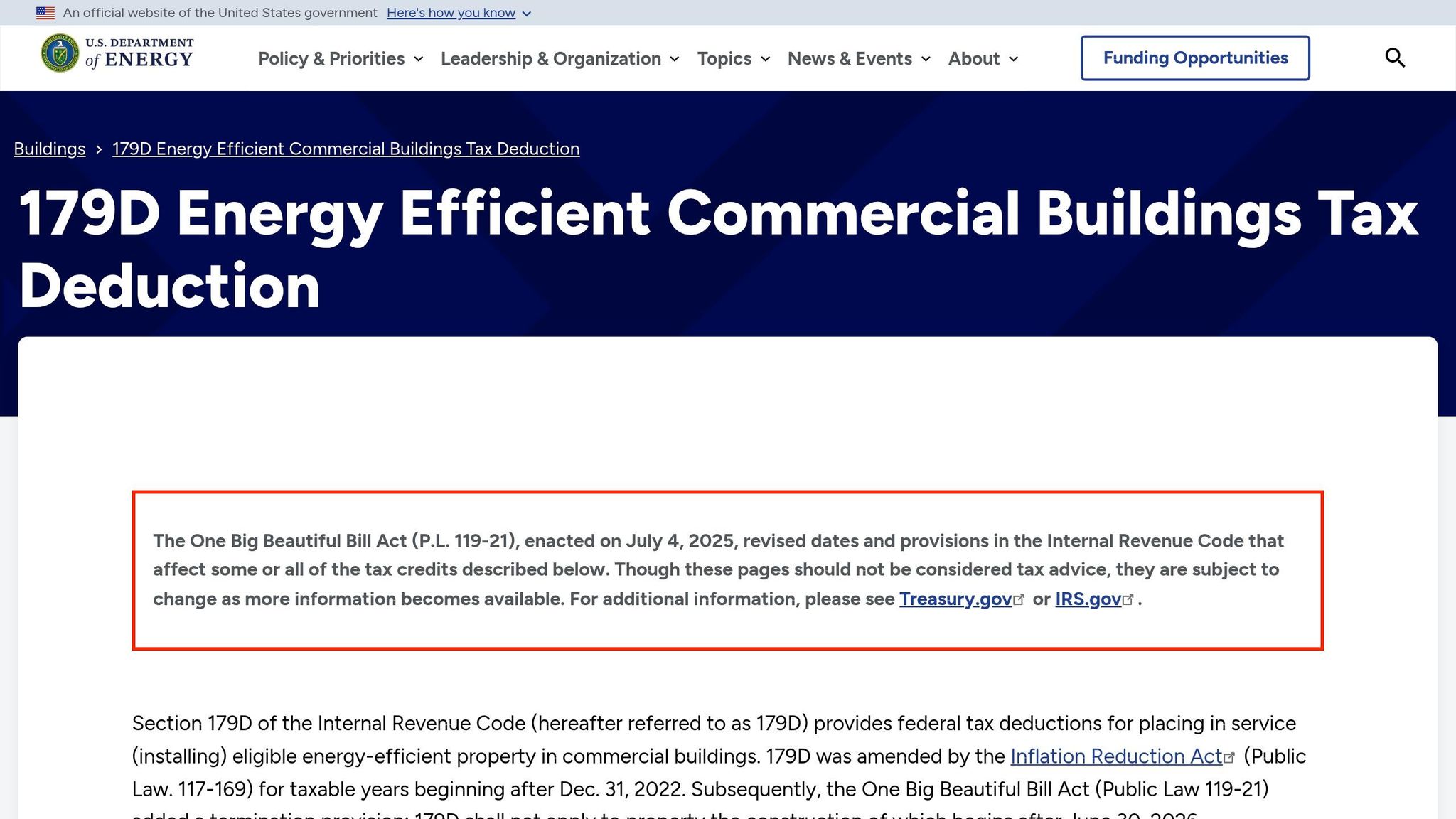
Under current 179D rules, projects that start construction after June 30, 2026, no longer qualify [1].
That size upside only pays off if the file can back up the claim.
Claiming 179D usually involves a feasibility review, energy modeling, a site inspection, and certification from a licensed engineer [1][3]. Without that certification, the deduction can’t be claimed [1][3].
For government-owned or non-profit buildings, there’s one more step. The deduction has to be assigned to the primary designer - usually the architect, engineer, or contractor - through a signed Letter of Assignment from the building owner [3].
If that document is missed early, the claim can get delayed. And that’s a common pain point. The paperwork load is heavy enough that 179D works best when it’s handled like part of the construction process, not something people scramble to fix at tax time. That same level of follow-through often decides whether the incentive can actually support the capital stack.
The cash value of 179D is usually realized when the federal tax return is filed for the year the property is placed in service [1][3]. And since 179D is a deduction - not a dollar-for-dollar credit - its value depends on the deduction amount multiplied by the business’s tax rate [3].
That delay is exactly why state and utility incentives can matter so much for near-term cash flow.
State and utility incentives usually put cash in your hands sooner. And in underwriting, that can matter more than a bigger tax break that shows up later. If cash is available during construction, it can do more work when timing is tight.
State incentives can come in a few forms: tax credits, abatements, and cash-style programs. Many now reward all-electric design and modeled emissions cuts[2][4].
The catch is that eligibility rules change from program to program. In many cases, those rules are tied closely to design choices, which means early energy modeling can shape the final payout.
California's BUILD program shows how this works. It operates as a direct payment for all-electric multifamily new construction, and incentive amounts are tied to modeled emissions cuts based on specific HVAC and appliance selections[4]. In plain English: the equipment you pick can change the dollar amount, so those choices need to be set early.
Utility programs usually move even faster than state tax incentives. Rebates for LED retrofits, high-efficiency chillers, and HVAC upgrades often require equipment invoices plus after-installation verification[1][4]. That makes utility money the first cash to arrive in many incentive stacks. Many programs pay within 4 to 12 weeks after installation is verified[4].
There’s one tax detail you don’t want to miss: utility rebates usually reduce the equipment’s depreciable tax basis for federal tax purposes[1]. For 179D, use the net cost after rebates, not the full invoice amount.
That same early-design logic shows up in other state programs too. California's SGIP works in a similar way for batteries and distributed energy resources: early design decisions can determine eligibility[4].
Federal programs bring the most consistency across the country and usually the biggest upside. Section 179D can be worth up to $5.00 per square foot, which is a big number on a large project. The catch? It takes work to get there. Modeling, certification, and filing costs can slow things down and add friction to the process [3].
That usually means dealing with:
State and utility programs tend to be smaller, but they're often much easier to claim.
| Feature | Federal (179D) | State & Utility Programs |
|---|---|---|
| Dollar Value | High - up to $5.00/sq ft for 179D | Moderate to low; often capped per unit or project |
| Standards Required | ASHRAE 90.1-2007; prevailing wage rules | Local building codes; specific equipment or GHG targets |
| Documentation | Energy models, PE certification, wage records | Invoices, equipment specs, installation verification |
| Nationwide Consistency | Uniform across all 50 states | Varies by state and utility |
| Paperwork Burden | High | Low to moderate |
That paperwork burden matters because it can delay when the benefit actually shows up in the deal.
After value and paperwork, timing becomes the next big underwriting test, often requiring expert fractional CFO services to manage the gap. Federal benefits usually show up when taxes are filed, not while the project is being built. That still has value, of course, but it doesn't do much for construction-stage cash flow.
Utility rebates are often the first dollars to arrive in many incentive stacks [4]. State grants and other direct-funding programs usually pay at milestones or at closeout.
| Incentive Type | Payout Mechanism | When Cash Arrives |
|---|---|---|
| Federal Tax Deduction (179D) | Reduces taxable income | Annual tax return, delayed |
| Federal Tax Credit (ITC) | Dollar-for-dollar tax reduction | Annual tax return; can be carried forward/back |
| Utility Rebate | Cash payment or bill credit | 4–12 weeks after verification |
| State Grant / Direct Funding | Milestone-based funding | During construction or at closeout |
If near-term liquidity matters, utility rebates and state grants usually do the heavy lifting first. Federal incentives then help the project's return after the tax year closes.
Once timing is sorted out, the next question is how these incentives work together on the same project.
Even if incentives pay at different points, their tax treatment still shapes the final net benefit. Federal and state incentives can sit on the same project, but the overlap has to be tracked with care. The basic rule is simple: you can't use the same dollar of cost for two different federal benefits [1].
So if a system could qualify for both 179D and ITC, the costs need to be split cleanly. Building efficiency systems should be assigned to 179D, while generation equipment should be assigned to ITC.
Rebates and ITC claims also affect basis. In plain English, federal benefits should be figured on net cost, not the full pre-rebate amount, and costs should be separated by incentive source before filing [1]. On top of that, some state credits may count as federal taxable income, which chips away at the state benefit's net value.
| Combination | Rule | What It Means in Practice |
|---|---|---|
| 179D + ITC on same site | Allowed, but costs must be separated | Efficiency systems go to 179D; generation assets go to ITC |
| Utility rebate + 179D | Rebate reduces depreciable basis | Calculate 179D on net cost after rebate, not gross invoice |
| ITC + depreciation | Basis reduction applies | ITC claim lowers the asset's depreciable value |
| State credit + federal return | May be treated as taxable income | Net value of state benefit can be lower than the headline number |
Map incentives before procurement. Sequencing affects net basis [1].
Federal incentives often bring the biggest tax upside. State and utility programs, on the other hand, tend to put cash in the deal sooner. So the right order comes down to three things: project size, tax appetite, and timing.
That means underwriting is less about chasing the biggest headline number and more about sequencing the stack the right way: cash first, tax value second, and documentation from day one.
If near-term liquidity is tight, start with utility rebates and state incentives. They can help the project sooner, which matters when cash flow is under pressure. If the deal has runway before filing or refinance, and there’s enough taxable income to use the deduction, federal incentives can do a lot for long-term ROI. Many well-structured deals capture both. But that only happens when the sequence is mapped out before procurement starts.
Use these checks to decide which incentive should come first:
It comes down to a simple tradeoff: is the tax break bigger than the cost to get it?
Claiming 179D isn't free. You need a qualified energy model and certification from a licensed engineer, which means a fixed upfront cost before you see any tax savings.
That’s why projects over 20,000 square feet are often a better fit. The bigger the building, the easier it is to spread those prep costs across more square footage.
For smaller buildings, the math matters more. Compare the expected deduction per square foot against those setup costs and check whether the net tax savings are worth it.
Yes. You can combine utility rebates with the 179D deduction on the same project.
Just handle your tax basis the right way: since the rebate lowers your net project cost, the 179D deduction should be based on the amount paid after the rebate, not the original price. Keep the incentives separate in your documentation.
Federal incentives tied to IRA tax credits - especially when turned into cash through direct pay or credit transfers - usually help cash flow first. Why? Because once a project meets the qualification and documentation rules, those credits can be converted into cash.
State and utility add-ons, such as BUILD/SGIP or home rebates, can help too. But the timing is less predictable, since it depends on how each program is run and when rebate payments go out.