Published on
September 13, 2026


If your finance data must stay secret for 5+ years, you should start post-quantum planning now. I’d treat this as a three-step job: find where RSA and ECC sit in HSM-backed systems, rank data by how long it stays sensitive, and line up vendor timing before 2030–2035 deadlines close in.
Here’s the short version:
A few dates stand out. The UK’s NCSC points to 2028 for discovery and planning, 2031 for moving top-priority services, and 2035 for full migration. The article also notes that cryptographic discovery alone can take 12 to 24 months, and Phase 2 programs can run $5,000,000 to $15,000,000 for larger firms.
| Topic | What I’d focus on first | Why it matters |
|---|---|---|
| Data risk | Data secret for 10+ years | More exposed to HNDL risk |
| HSM review | PQC firmware path, hardware replacement, FIPS 140-3 status | HSM limits can delay the whole move |
| App design | Remove hard-coded algorithms | Makes policy-based switching possible |
| Vendor review | ML-KEM / ML-DSA support, latency, compatibility | Cuts rework later |
| Migration plan | Hybrid first, retirement later | Lowers cutover risk |
So the core message is simple: start with a live crypto inventory tied to data classes and HSMs, then use that map to drive budgets, vendor reviews, and phased migration.
Start by sorting financial data based on how long it needs to stay secret. Then layer in three things that change the risk level fast: breach impact, regulatory or contract duties, and whether HSM-backed keys are part of the setup. Cloud Security Alliance guidance treats data that must stay confidential for 5 or more years as quantum-risk data, with 10+ years in the top-priority group.[2]
Two variables make this ranking much sharper: the damage a breach would cause, and whether the data depends on HSM-backed keys. Data with a long confidentiality window, high breach impact, and HSM dependence should move first. Implementation difficulty still matters, but only for sequencing work inside each migration wave. From there, the job is to map those priorities to actual data classes.
At the top of the list are digital asset private keys and settlement-signing keys. If those are exposed, the result can be immediate financial loss or loss of custody control. Just behind them are customer PII and KYC records. Those often carry 10+ year confidentiality periods and can trigger regulatory trouble if exposed.[2] Long-term contracts may require confidentiality for 10 to 25+ years.[7] Investor records and trading positions also belong in the first review tier because their confidentiality can stretch across many years.
| Data Class | Typical Retention / Confidentiality Horizon | Business Impact if Exposed | HSM Touchpoints | Migration Priority |
|---|---|---|---|---|
| Digital asset private keys | Immediate and ongoing | Direct loss of funds or custody control | Key generation, signing, custody controls | Highest |
| Customer PII / KYC records | 10+ years, sometimes indefinite | Identity theft, fraud, regulatory exposure | Encryption keys, certificate chains, access tokens | Highest |
| Account records and statements | 5–10+ years | Customer trust, audit, disputes | Encryption, archive keys, backup keys | High |
| Trading positions / strategies | Years to decades | Competitive harm, market abuse risk | Signing keys, access controls, internal PKI | Highest |
| Long-term contracts / legal archives | 10–25+ years | Legal enforceability, litigation risk | Digital signatures, timestamping, archival keys | Highest |
| Investor records / ownership / succession data | Decades | Financial, legal, and reputational damage | Encryption, signing, archival retention | Highest |
| Interbank payment and settlement messages | 5+ years | High operational and regulatory impact | Signing keys, message authentication, key exchange | High |
Europol uses shelf-life bands of under 2 years, 2 to 5 years, and over 5 years. That lines up with the case for early review of long-lived financial records.[6] Foreign exchange and derivatives records, for example, are often kept for 5 to 7 years under Dodd-Frank and EMIR.[7]
Once the priority ranking is in place, link each data class to the cryptographic systems that protect it. For every class, record the algorithm, key or certificate, HSM model, deployment type, application owner, calling systems, KMS or API layer, rotation schedule, backup locations, encryption state, and any outside vendors with shared key access.[5][8][9]
A practical place to begin is simple: scan where sensitive data is stored, sent, backed up, archived, and shared with outside vendors. Then check those findings with the system or service owner.[5] Give each data class a named owner and an estimated confidentiality horizon. That one move makes the spreadsheet useful day to day instead of letting it sit there and go stale. NIST’s migration guidance describes Phase 1 as identifying and documenting information assets along with the cryptography now protecting them.[10]
The target is a live cryptographic inventory that connects each data class to its keys, HSM, and dependent systems. That inventory shows which HSMs, KMS layers, and applications need crypto-agility first.
Put crypto agility first. HSMs, KMS layers, and applications should be able to switch algorithms through policy, not rewrites. PQC migration takes years, and cryptographic discovery by itself can take 12 to 24 months.[13] That’s why architecture matters just as much as algorithm choice.
Crypto agility means your systems are set up so algorithm changes happen through configuration and policy updates, not code changes. Here’s what to check across your HSM, KMS, and application layers:
| Capability | HSM Requirement | KMS/PKI Requirement | Application Requirement |
|---|---|---|---|
| Algorithm support | Firmware support for ML-KEM, ML-DSA, SLH-DSA | Support for hybrid certificate profiles | Integration with PQC-capable libraries (e.g., OpenSSL 3.x) |
| API layer | PKCS#11 or KMIP extensions for PQC | APIs that hide algorithm choice | Use of crypto-abstraction layers (no direct primitive calls) |
| Key lifecycle | Support for larger PQC key storage and generation | Automated rotation for hybrid key pairs | Policy-driven algorithm selection via configuration |
| Testing and compliance | FIPS 140-3 Level 3+ for PQC modules | Compliance with NIST SP 800-57 | Automated testing for signature size/latency limits |
Once data classes are ranked, map each one to systems that can swap algorithms without code rewrites. The big move here is simple: remove hard-coded algorithms. If your team uses abstracted crypto APIs, that tight link goes away. Then the algorithm can be changed through a policy file or configuration layer instead.
Use a hybrid classical-plus-PQC path so your classical baseline stays in place while PQC is tested in production.[11][13] That gives teams room to test without betting the whole system at once.
For high-frequency trading and payment workloads, use sandbox environments to measure latency before a broad rollout. PQC algorithms can bring larger keys and more compute, and those costs show up fast in systems where milliseconds matter.[12][14] Add build rules that block new quantum-vulnerable key creation.[13]
None of this works if HSM, KMS, and application teams move in different directions.
Migration tends to stall when application teams, infrastructure owners, and security leaders all move on their own timelines. A cross-functional steering group - usually made up of the CISO, CIO, and fractional CFO - is a practical way to keep those workstreams lined up.[12][13][14] Use one steering group to coordinate PKI reissuance, HSM firmware updates, and application changes.
That coordination also needs to reach outside the company. Require vendor upgrade paths that match your 2030–2032 critical-system timeline.[14][15] If a vendor can’t show a clear firmware upgrade path for PQC, that vendor becomes the weak link and can slow down an otherwise well-planned migration.
Once you've ranked data classes and mapped crypto agility, the next move is to line up standards, vendors, and refresh timing. If those three run on separate clocks, crypto agility starts to fall apart.
On August 13, 2024, NIST finalized three core PQC standards: FIPS 203 (ML-KEM, for key encapsulation), FIPS 204 (ML-DSA, for digital signatures), and FIPS 205 (SLH-DSA, a hash-based signature scheme) [16][17][18]. Treat these as the starting point for RFPs, risk models, and compliance reviews.
One planning mistake shows up again and again: people mix up algorithm validation with module validation. They're not the same thing.
A vendor may implement ML-KEM or ML-DSA and pass CAVP algorithm testing, but that still does not make the HSM FIPS 140-3 compliant. Full module validation through CMVP covers physical security, lifecycle controls, key management interfaces, and operational assurance. That's the standard production systems need to meet [19][20][21].
In plain terms, a vendor might ship PQC algorithms in firmware before the FIPS 140-3 module certificate is in place. That can work for pilots and lab testing. It does not clear the bar for live payment rails or regulatory reporting.
The table below turns standards updates and vendor signals into procurement actions, timing, and ownership. Use it in your next vendor review or steering group meeting.
| Standard / Vendor Signal | Internal Action | Target Timeframe | Budget Range (USD) | Ownership |
|---|---|---|---|---|
| FIPS 203 (ML-KEM) finalized | Update KMS and HSM RFPs to require ML-KEM support for key establishment | 2026–2028 | $150,000–$500,000 | Security Architecture (lead), Engineering, Finance (capex planning) |
| FIPS 204 (ML-DSA) finalized | Revise certificate policy and PKI design for ML-DSA signatures | 2026–2028 | $100,000–$300,000 | CISO, PKI/Engineering team |
| Vendor announces PQC-capable FIPS 140-3 module expected 2029 | Align hardware refresh cycle and PKI redesign to adopt PQC in core payment HSMs | 2029–2032 | $750,000–$2,500,000 | CISO, CTO, CFO/FP&A |
| FIPS 140-3 PQC module validation achieved | Move hybrid classical+PQC certificates into production for card issuance and interbank messaging | 2030–2033 | $250,000–$1,000,000 | CISO, CTO, CFO/FP&A |
| Vendor confirms end-of-support for classical-only firmware | Plan replacement schedules and depreciation timelines for legacy deprecation | 2033–2035 | Varies by replacement model | Security, Engineering, Finance |
Use these vendor signals to set phase gates for the 2026–2035 migration plan.
When you review HSM vendors, check a few things right away:
Those details sound small, but they shape budget, rollout risk, and how much rework your teams will face later.
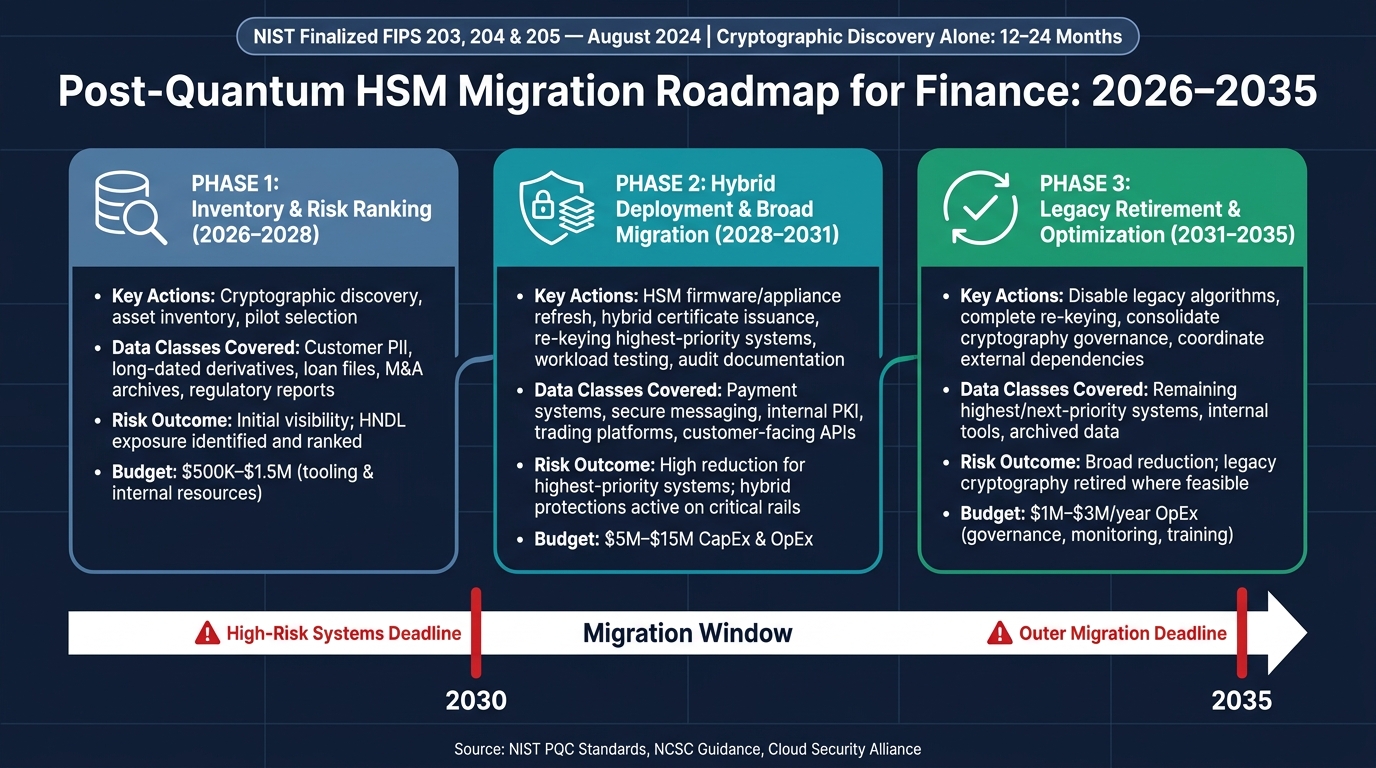
Post-Quantum HSM Migration Timeline for Finance: 2026–2035
With vendor signals mapped and standards in place, the next move is to turn that groundwork into an executive timeline. Use 2035 as the outer deadline and 2030 for high-risk systems [1][3][4]. That gives finance leaders a planning window they can defend in budget and board discussions.
Start with the cryptographic inventory already in hand and rank systems by retention horizon and business impact. Teams should review every HSM-linked system and finance data flow, catalog each key type and algorithm in use, and tie every cryptographic asset to its system, algorithm, HSM dependency, retention horizon, and exposure rating.
The first items to flag are data classes with 10+ year confidentiality horizons. These assets face the most pressure from harvest-now, decrypt-later attacks, so they belong in the first wave of PQC planning. Discovery and cataloging usually cost $500,000–$1,500,000 in tooling and internal resources during this period [22].
Once priorities are set, move those systems into hybrid PQC deployment. Phase 2 - roughly 2028–2031 - focuses on refreshing HSMs for NIST-selected PQC and rolling out hybrid certificates for payment, messaging, PKI, and trading systems. This is where testing stops being a paper exercise. Performance testing under live workloads is required, especially for high-volume payment systems and trading platforms. For larger firms, budgets usually land in the $5,000,000–$15,000,000 range across this window, covering hardware refresh, software upgrades, engineering time, and audit documentation [22].
After hybrid systems settle down, the work shifts to retiring classical-only crypto and cleaning up the exceptions that are left. Phase 3 - from 2031–2035 - disables legacy algorithms in HSM policies and KMS configurations, re-keys the highest- and next-priority systems, and moves custom cryptographic implementations onto standardized platforms. A practical way to do this is to begin with pilot-validated systems, then expand from there. External dependencies also need close coordination - payment networks, custodians, and market infrastructure - so protocol mismatches don’t turn into production issues. Ongoing cryptography governance and monitoring in this phase usually runs $1,000,000–$3,000,000 per year for finance firms [22].
The table below gives executives a single-view summary for board communication.
| Phase | Date Range | Key HSM Actions | Covered Data Classes | Expected Risk Reduction | Budget Categories (USD) |
|---|---|---|---|---|---|
| Phase 1: Inventory & Risk Ranking | 2026–2028 | Cryptographic discovery, asset inventory, pilot selection | Customer PII, long-dated derivatives, loan files, M&A archives, regulatory reports | Initial visibility; HNDL exposure identified and ranked | $500,000–$1,500,000 (tooling, internal resources) |
| Phase 2: Hybrid Deployment & Broad Migration | 2028–2031 | HSM firmware/appliance refresh, hybrid certificate issuance, re-keying highest- and next-priority systems, workload testing, audit documentation | Payment systems, secure messaging, internal PKI, trading platforms, customer-facing APIs | High reduction for highest-priority systems; hybrid protections active on critical rails | $5,000,000–$15,000,000 CapEx and OpEx (hardware, engineering, audit) |
| Phase 3: Legacy Retirement & Optimization | 2031–2035 | Disable legacy algorithms, complete re-keying, consolidate cryptography governance, coordinate external dependencies | Remaining highest- and next-priority systems, internal tools, archived data | Broad reduction; legacy cryptography retired where feasible | $1,000,000–$3,000,000/year OpEx (governance, monitoring, training) |
Start the cryptographic asset inventory now. Don’t wait for a perfect vendor roadmap or a formal mandate. Begin with the inventory, because every other decision flows from it.
Start by reviewing your current cryptographic inventory: active algorithms, certificates, and protocols. Then rank each one by business importance and by quantum risk.
Next, check whether your HSMs can support quantum-resistant algorithms. Put crypto-agility at the center of your plan, keep an eye on changing quantum-safe standards, and figure out whether your current hardware can be upgraded or whether you’ll need new systems to meet future security and compliance needs.
Start by ranking data based on sensitivity, compliance rules, and exposure to risk. That means you first need a clear inventory of your IT systems and databases so you know exactly where sensitive data lives.
From there, sort data by the rules attached to it, such as PCI DSS, SOX, GLBA, and SEC/FINRA requirements. Move the highest-risk systems first, especially the ones that store account numbers, personal identification information, and core transaction records.
A hybrid crypto rollout splits cryptographic work across two places: cloud HSMs for development and bursty scale, and on-premises HSMs for highly regulated, high-volume operations.
The safest way to do this is with a phased, risk-based approach. Start with the systems that carry the most risk. Then modernize step by step, often through middleware or APIs, instead of trying to swap everything out at once.
It also helps to automate key lifecycle tasks with IaC, require quorum approval for sensitive actions, and support crypto-agility with standards like KMIP.