Published on
August 25, 2026


If most of my wealth sits in one company, infrastructure can help spread that risk. It gives me exposure to assets like power, water, internet networks, and data centers that often produce steadier cash flow than a private business stake alone.
Here’s the short version:
What I’d focus on first:
| Route | Liquidity | Involvement | Concentration | Common Use |
|---|---|---|---|---|
| Listed fund/ETF | High | Low | Low | Easy entry, flexible access |
| Core private fund | Low | Low to medium | Medium | Income-focused, lower-risk end of private markets |
| Value-add private fund | Low | Medium | Medium | More upside, more manager and asset risk |
| Secondaries | Medium | Medium | Medium | Shorter path to deployment, possible rebalancing help |
| Co-investment | Low | High | High | Lower fee load, single-asset focus |
| Direct deal | Very low | Very high | Very high | Control, but heavy diligence and concentration |
Bottom line: if I’m a growth-stage owner, infrastructure can make sense when I size it against assets outside my business, pick the right vehicle for my timeline, and judge every deal on a net, after-tax basis.
For a founder with most of their wealth tied up in one company, infrastructure can add cash flow streams that don't move in lockstep with the business. Those cash flows often come from regulated utilities, contracted energy assets, or toll roads.
That steady profile helps in two main ways. First, it can smooth out total portfolio swings. Second, many infrastructure assets have revenues tied to inflation, which sets them apart from most bonds.
Compared with a founder portfolio that has no infrastructure exposure, adding an allocation will often mean:
The next step is choosing the type of infrastructure that matches your liquidity needs and time horizon. Strategies usually fall along a range from core to opportunistic [2].
Core is often a better fit for owners who are close to an exit. Value-add and opportunistic strategies make more sense only if you can handle more risk and longer lockups.
Allocation should be based on founder risk, not just total net worth. In practice, that means sizing it against investable assets outside the business [2].
A few factors should shape that decision. If your operating company sits in a cyclical industry, a larger allocation may make sense because infrastructure income is less tied to your main revenue stream. If the business already carries a lot of debt, a smaller allocation may be wiser so you don't put too much pressure on liquidity. And if an exit is close, the focus usually shifts to capital preservation, which leans more toward core infrastructure than value-add or opportunistic strategies [2].
Age and near-term cash needs matter as well. A longer time horizon makes it easier to live with the illiquidity of private infrastructure funds. Someone who is closer to a liquidity event should be more careful about locking up capital. Private funds often distribute cash slowly, so it's smart to plan for longer holding periods and limited near-term liquidity [2].
Private infrastructure funds also require capital calls, so you need enough liquid reserves to meet those commitments without selling company stock [2]. That cash cushion matters even more in private funds, where access to money is tighter.
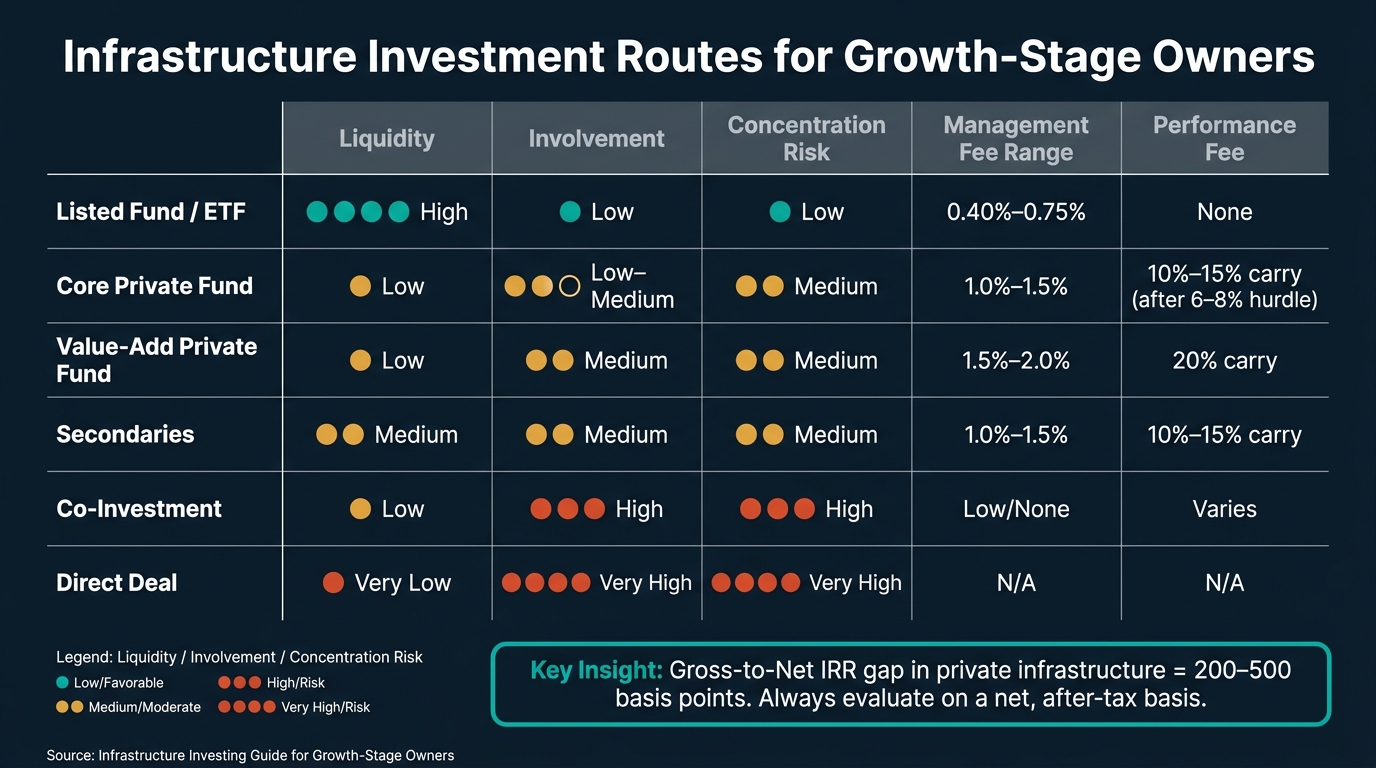
Infrastructure Investment Routes: Liquidity, Control & Cost Compared
You can get infrastructure exposure through listed funds, private funds, secondaries, co-investments, debt, or direct deals. Each path comes with a different mix of liquidity, control, and complexity. So the vehicle matters just as much as the asset.
For growth-stage owners, the main issue is simple: how much control, liquidity, and concentration are you willing to give up? The access route you choose shapes how liquid the investment is, how concentrated it becomes, and how involved you’ll need to be day to day.
Within private funds, the strategy you pick affects risk, cash-flow pattern, and hold period. Secondaries can offer more liquidity and make portfolio rebalancing easier. Co-investments and direct deals let you focus on a single asset or sector, but they also demand more due diligence and bring more concentration risk [2].
That leads to the next point: can your liquidity needs handle a private-fund hold period?
Private infrastructure is illiquid and long-dated. That can conflict with exit taxes, working capital needs, or ownership transition plans [1]. The problem tends to show up when company liquidity, tax obligations, and exit timing don’t match.
Use private infrastructure only for capital you won’t need in the near term. If you need more flexibility, secondaries or evergreen vehicles may fit better than a closed-end fund structure [1][2].
Once the access route is set, fees, taxes, and manager selection decide whether the allocation works in practice.
Once you pick the vehicle, the next job is simple in theory and messy in practice: figure out what you’ll actually keep, how taxes will hit, and whether the manager can do what the pitch deck says.
Headline returns can make a fund look better than it feels in your bank account. In private infrastructure, the gap between gross and net IRR often lands in the 200 to 500 basis point range, depending on the strategy.
That spread comes from more than one place. Management fees, carried interest, fund expenses, and leverage costs at the deal level all chip away at net returns. Here’s how the cost stack usually looks across common access routes:
| Fee Component | Listed Infrastructure ETF/Fund | Core Private Fund | Value-Add Private Fund |
|---|---|---|---|
| Management Fee Range | 0.40% – 0.75% | 1.0% – 1.5% | 1.5% – 2.0% |
| Performance Fee | None | 10% – 15% carry | 20% carry |
| Operating and deal expenses | Low (fund admin) | Moderate (audit, legal, admin) | High (deal-level, broken deal costs) |
Core private funds often have a 6% to 8% hurdle before carry kicks in. Value-add funds, by contrast, usually charge 20% carry and stack on more deal-level costs.
The practical takeaway is pretty plain: focus on net-of-fee returns, not glossy gross targets. Gross numbers are nice. Net numbers pay the bills.
For founders, structure has a direct effect on after-tax yield.
Most private infrastructure funds use LP or LLC structures. That usually means you’ll receive a Schedule K-1 and should expect to file an extension.
Two tax items matter most here.
First is depreciation. Infrastructure assets often qualify for accelerated depreciation under MACRS, which can shield taxable income if you’re investing through a taxable account or a holding company.
Second is UBTI (Unrelated Business Taxable Income). If you invest through a tax-advantaged account like an IRA, and the fund uses debt financing at the asset level, you may owe tax on that income even inside the sheltered account.
Entity choice matters too. Holding the investment personally, through an LLC, a blocker corporation, or a REIT-like vehicle can change after-tax returns in a big way. Run that model before you commit capital, not after the first K-1 shows up.
Once fees and taxes are on the table, manager execution becomes the main swing factor.
If most of your wealth is tied to one company, manager quality matters even more. A weak operator doesn’t just hurt returns. It can make illiquidity worse and put more pressure on capital calls at the wrong time.
Judge managers on data, not slides. A few areas deserve close attention:
Phoenix Strategy Group's FP&A and cash flow forecasting services help growth-stage owners align capital calls with business liquidity and exit timing.
These choices shape whether the allocation fits cleanly into exit planning.
Once you've sorted out fees, taxes, and manager quality, the last piece is timing the exit.
For founders, infrastructure is mostly a timing tool. It can help cut concentration risk tied to a single operating company before and after an exit. At the same time, it can add a steadier base of cash flow.
A staged approach tends to work best.
Start choosing managers and structures 12 to 36 months before an exit, and use surplus cash flow to fund initial commitments [2]. This is also a good point to decide between a listed fund and a private fund. A listed fund may suit you better if you want more liquidity. A private fund may fit better if you want a longer-term income profile linked to inflation.
After the deal closes, you can expand your infrastructure commitments. Spreading those new commitments over several years can lower timing risk and help you avoid putting too much money to work at a single market peak [2].
Timing matters for a simple reason: capital calls may show up before sale proceeds hit your account.
That’s why you need to model capital calls across the full exit process [2]. Put infrastructure commitments, estimated taxes, debt paydown, and working capital needs into the same cash flow forecast [2]. If you split them into separate models, it gets harder to see where pressure might build.
Before you commit capital, decide what job infrastructure should do in your portfolio. Then choose the access route that fits your liquidity needs and timeline, and line it up with your exit plan.
Also, review each deal on a net, after-tax basis, and do actual manager due diligence before moving ahead.
Match the asset, vehicle, and timing to your exit plan. Then judge each investment on a net, after-tax basis.
It comes down to your liquidity needs and how much risk you can live with. But in most cases, infrastructure is a long-term allocation, not something to treat like cash or a short-term reserve.
A good rule of thumb is to keep illiquid private infrastructure to about 20%–30% of net investable assets. And that’s after you’ve set aside money for taxes, living costs, and other near-term needs. In plain English: this is money you should mainly place in your 10+ year bucket.
It can make sense if you want inflation-linked, long-life, regulated, or contracted cash flows and lower volatility than broad equities. But that only works if you're comfortable with longer holding periods and, at times, weaker liquidity and valuations than large-cap infrastructure.
The main thing is portfolio construction. You also want reputable managers or structures that can manage operational and regulatory risks in an active, hands-on way.
If you're planning an exit, pay close attention to lockups and deal complexity. Those two factors can shape your timing more than many investors expect.
Capital calls can shape exit planning because they ask for more money on a set schedule. If you're getting ready to sell, that timing can squeeze liquidity at the worst moment.
With infrastructure, monetization often takes longer. That can push back the point when returns are fully unlocked. Plan for expected funding needs, keep cash reserves, and make sure capital calls don’t get in the way of taxes or other near-term obligations after a sale.