Published on
August 25, 2026

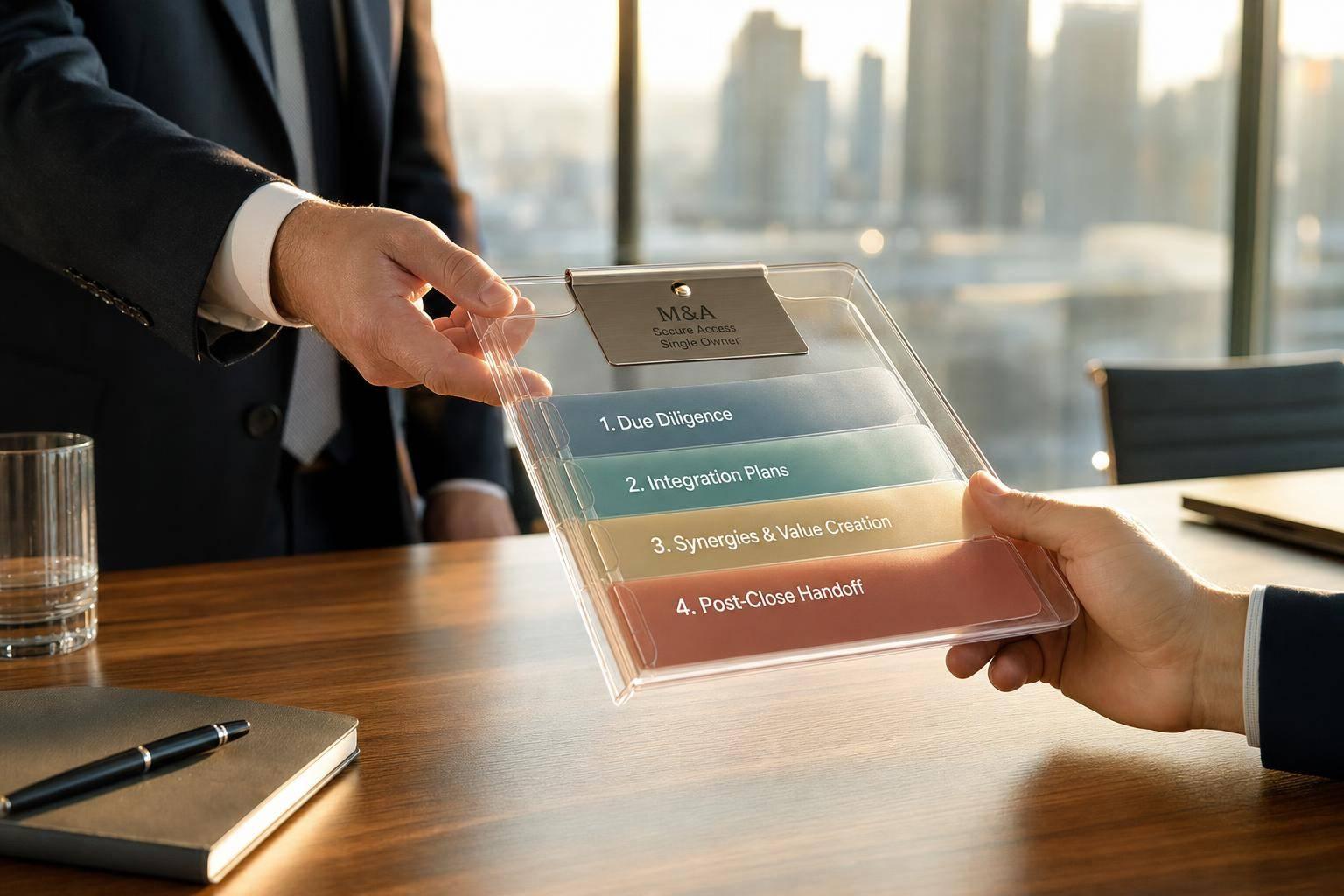
If alliance data sits in email, Slack, and spreadsheets, your deal slows down and risk goes up. One clear setup fixes that: keep each data type in one approved system, assign one owner, limit access by role and deal stage, and hand off open items before the deal team disappears.
The article’s main point is simple. During an M&A deal, you need to control four things at the same time:
That matters because diligence already takes a long time. The article cites an SS&C/Intralinks report showing an average due diligence period of 203 days, with 2020–2022 deals averaging 247 days. If buyer questions on partner revenue, customer overlap, or compliance take days to answer, the process gets harder than it needs to be.
Here’s the short version of what I’d take from it:
What I like here is the restraint. The article does not push a big software build. Instead, it argues for a small system that people will stick with: one deal hub, one issues log, one handoff process, and a few revenue and compliance check-ins after close.
If you’re a founder, CFO, or deal operator, that’s the core takeaway: keep the record clean, keep access tight, and make the handoff usable on Day 1.
Before diligence starts, assign clear owners to three knowledge sets: diligence files, partner revenue and overlap data, and compliance/handoff records. Keep each set in one owner-approved file with a U.S. date stamp (MM/DD/YYYY), version number, and approval status.
Your diligence record should include audited and unaudited financials, trial balances, QoE workpapers, bank statements, customer and vendor contracts, operating metrics, request lists, and open issues. Set up the data room by workstream - finance, legal, operations, tax, HR, IT, sales, marketing, and M&A - with a top-level index tied to the buyer request list.[5][6]
File names matter more than people think. A file like QOE_support_v3_06-30-2026.xlsx, with a revision log on the first tab showing who changed what, when, and why, saves time right away. Tag every document by workstream, deal phase, and status: Draft, Under Review, Approved, or Superseded. That makes it easy for bankers, founders, finance leads, and legal teams to filter for the current approved version instead of chasing updates by email or Slack. The CFO or FP&A lead should own financial workpapers. Legal should own contracts and the related issue logs.
Financial files show what got tested. Alliance revenue and overlap data show what the deal may be worth.
In alliance-driven deals, revenue data needs to go down to the customer level. The VP Sales or alliance manager should own the partner revenue and customer mapping files. Teams should track booked revenue by customer, product, channel, and fiscal period for the last 12–24 months. CRM pipeline exports should include opportunity stage, expected close date, deal size ($), probability, and owner. Gross margin assumptions - including discounts offered through alliance channels and any revenue-sharing terms - should live in a dedicated Revenue and Margin Assumptions workbook linked to the master financial model, with FP&A listed as the owner.
Customer overlap analysis is where these deals can get messy. A matched account list should show which customers are shared across the acquiring company, the target, and the alliance partner. It should also include:
This file feeds cross-sell planning, channel conflict resolution, and combined revenue forecasting. It also flags concentration risk. If the top five overlapping accounts make up an outsized share of combined revenue, that can change valuation assumptions and shape the protections negotiated in the purchase agreement.
Once the value and overlap picture is in focus, the next step is to track the issues that can slow down closing.
Compliance knowledge works best in a structured issue log. Each issue should list category, owner, due date (MM/DD/YYYY), dependency, and status. Keep the status labels simple and parallel: Open, In Progress, Pending Third-Party Input, Closed.[8][9]
During diligence, this log shows the deal team which items are closing conditions and which ones can wait. At signing and close, it turns into the handoff package passed from bankers and lawyers to operators in finance, sales, legal, and IT. That package should also include open integration items, customer and partner commitments made during negotiations - such as pricing guarantees, SLAs, and exclusivity terms - and references to the final approved diligence files and models used to set the purchase price. Without that package, open items, commitments, and approved files often get lost at close.[7][10]
After that, lock the final record into the shared access and audit process.
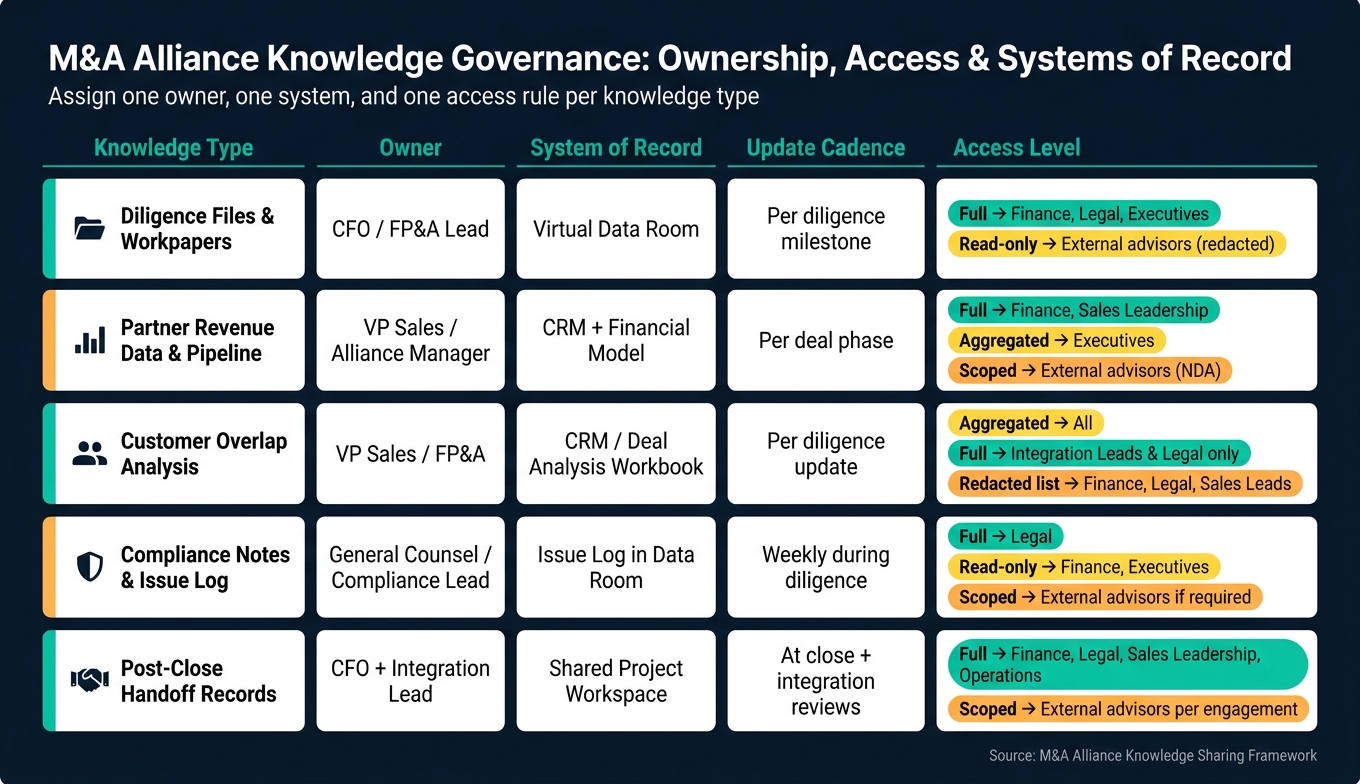
M&A Alliance Knowledge Governance: Ownership, Access & Systems of Record
Once the handoff package is ready, tighten access based on role, deal phase, and sensitivity. That keeps alliance knowledge from turning into a problem. The goal is simple: give people ONLY the access they need, when they need it, using least-privilege access and phase-based disclosure tied to deal phase and sensitivity.[11][12][13][14][16]
Set access by function, not by title. Finance should handle financial files. Legal should handle compliance materials. Sales should handle overlap analysis and handoff records. External advisors should get only scoped, redacted access under NDA.
A three-tier model usually works best:
If someone asks for access outside policy, send that request to Legal or Compliance. They can approve it, offer a narrower option, or deny it in writing. Every exception should go into an Access Exception Register with the request, reason, owner, approvers, due date, and expiry date.[4][14][15]
Use a file naming format like this:
DealName_Workstream_FileType_Scope_VYYYY-MM-DD_AuthorInitials
For example:
ProjectFalcon_Finance_Diligence_PartnerRevenue_V2026-08-15_JD.xlsx
This format makes files easier to find because it includes the deal identifier, workstream, and scope. Skip labels like new, final, or latest. They sound helpful, but they usually create confusion. Version numbers and dates are far more reliable.[17][18][19]
Tie version numbers to deal milestones. Use v1.x for pre-LOI drafts, v2.x for post-LOI updates that include alliance partner data, and v3.x for board- or lender-ready files. After key approvals, lock earlier versions so no one can edit them. If something changes, create a new version and add a short change summary in the file metadata or at the top of the document.[4][1][14]
Audit trails matter because they make the record defensible. Turn on activity logging in the data room, document repository, and CRM so you can see who accessed, edited, downloaded, or shared each file. For lender reviews and purchase agreement support, you should be able to export logs that show when data changed, who approved the final version, and which external parties viewed specific files under each engagement.[2][3][12]
Use the matrix below to keep ownership, access, and storage aligned across teams.
| Knowledge Type | Owner | System of Record | Update Cadence | Access Level |
|---|---|---|---|---|
| Diligence files & workpapers | CFO / FP&A Lead | Virtual data room | Per diligence milestone | Full: Finance, Legal, Executives; Read-only: External advisors (redacted, scoped to engagement) |
| Partner revenue data & pipeline | VP Sales / Alliance Manager | CRM + financial model | Per deal phase | Full: Finance, Sales Leadership; Aggregated: Executives; Scoped access: External advisors under NDA |
| Customer overlap analysis | VP Sales / FP&A | CRM / deal analysis workbook | Per diligence update | Aggregated for all; redacted list for Finance, Legal, Sales leads; full only for designated integration leads and Legal |
| Compliance notes & issue log | General Counsel / Compliance Lead | Issue log in data room | Weekly during diligence | Full: Legal; Read-only: Finance, Executives; Scoped: External advisors if required |
| Post-close handoff records | CFO + Integration Lead | Shared project workspace | At close and during integration reviews | Full: Finance, Legal, Sales Leadership, Operations; Scoped: External advisors per engagement |
Define retention rules by knowledge type before close so archived records stay consistent.
The simplest way to keep alliance data under control is this: give each data type one home.
Diligence materials belong in the data room. Customer and account data belong in CRM. Revenue, margin, and actuals data belong in ERP. Compliance notes belong in the GRC log. Open items belong in the handoff tracker.
That split sounds basic, but it saves teams from the usual mess. If finance is looking at one file, sales is using another, and legal has a third version buried in email, things drift fast.
Set up each system with the same naming structure by deal code, date (MM/DD/YYYY), and workstream. Then write that map into the deal playbook so nobody has to guess where something lives.
Spreadsheets should stay temporary. If a spreadsheet is still in use after 30 days, or if it shows up in a deal memo, archive it in the data room with an owner and date. Or move the data into CRM, ERP, the compliance log, or the task tracker. Customer-level data and any data that affects revenue should be in CRM or ERP before signing.
When storage is mapped this way, finance, sales, legal, and operations can all work from the same records instead of piecing things together from side files.
A set review rhythm keeps knowledge from slipping through the cracks. Each review should pull from the right system of record, not from personal folders or one-off files.
Here’s the cadence:
At major decision points - investment committee approval, final LOI, signing, Day 30, and Day 90 post-close - create a short written milestone summary. Keep it tight. Note what was decided, what changed in the deal thesis or integration plan, and which systems were updated because of it.
Those summaries give you an audit trail that’s much easier to follow than a long email chain.
Use the stage map below to assign who creates, checks, approves, and uses each type of knowledge. That clears up handoffs at signing and helps Day 1 go a lot more smoothly.
| Stage | Knowledge Type | Creates | Validates | Approves | Receives / Uses |
|---|---|---|---|---|---|
| Pre-close | Diligence files & workpapers | M&A team, external advisors | Finance, legal, technical SMEs | Deal sponsor, Investment Committee | All workstreams, board, external auditors if needed |
| Pre-close | Customer & pipeline overlap | Sales ops, strategy/finance | Regional sales leaders, alliance lead | CRO / Head of Sales | Account teams, pricing, customer success |
| Close | Final deal terms & obligations | Legal, corporate development | Compliance, finance | Executive leadership, board | Finance, sales, operations, legal |
| Close | Day 1 operating & comms plans | Integration management office | Sales, operations, HR, IT | Executive sponsor | Frontline managers, support teams |
| Post-close | Revenue & synergy tracking | Finance, FP&A | Business unit leaders, alliance manager | CFO, executive sponsor | Board, investors, alliance steering committee |
| Post-close | Compliance remediation status | Compliance, legal | Operations, IT security | Chief Legal Officer / CCO | Regulators (if applicable), audit, executive team |
Once the systems and owners are clear, the next step is the post-close handoff and closeout trail.
After close, turn the deal record into an operating handoff. The goal is simple: make sure ownership, deadlines, and follow-up don't slip through the cracks. Use the handoff tracker and system-of-record map you already set up, then work through every open item against that structure.
Start with a central open-issues log prepared at or before closing. Each unresolved diligence finding, customer communication plan, pricing change, renewal risk, and other integration follow-up item should have its own line. Give every item one owner, one due date, a status, and a link to the supporting file. Keep this log focused on post-close execution only.
Within 5–10 business days of close, run a formal handoff meeting or a short series of meetings with operating leaders. Review each item one by one. In the meeting, confirm the item, assign the owner, and lock in the due date.
After operating owners are in place, turn the deal model into a revenue follow-up plan. Build a revenue bridge that connects diligence findings to revenue assumptions by segment, product, and channel. Use alliance revenue, overlap, and pipeline data from diligence to update post-close targets.
That bridge should also include a customer-level list with:
From there, assign each key account to an owner, whether that's an account executive or CSM. Give each account a target outcome and a timeline. Finance should then update forecasts and CRM stages based on the bridge. Synergies need to be tracked with leading indicators and realized revenue, not just rough estimates.
Revenue follow-up and compliance remediation should move side by side.
Any alliance-related consent, privacy, IP, or regulatory gap that wasn't fully remediated before close should move into a formal exceptions register at closing. Hand that register to legal and compliance. Each entry should spell out the affected entities, the law or policy involved, interim controls, remediation steps, a named owner, and a target closure date. Tackle high-risk items first, then record legal and compliance sign-off.
Once remediation is in motion, assemble the final closeout package. This should include the executed transaction documents, the final deal model, core diligence reports, the post-close issues log, the compliance exceptions register, and post-close reporting templates.
Use one naming convention across the archive, such as 2026-08-26_Acquisition_TargetName_[DocumentType]. Then freeze the data room and export an archive with documents, Q&A logs, and audit trails. Assign a retention owner and follow your document retention policy. Most companies keep core deal records for 3–7 years.[20][2]
After the archive is locked, the last job is to keep the system lean and easy to run on the next deal.
The basic system is straightforward: capture the right knowledge early, assign one owner to every record, control access with clear rules, and archive a clean post-close package before the transaction team disbands.
For founders, the practical takeaway is this: don't overbuild. You need one central deal hub tied to your existing CRM, ERP, and compliance log. You need a standard issues log template for every deal. You need a short set of post-close meetings with clear checklists. And you need a small set of dashboards that show revenue versus the deal model and the status of compliance remediation.
If the setup gets too heavy, people won't use it. If it's too loose, the next deal team won't learn much from it.
Each deal record should have one named owner. That keeps accountability clear and cuts down on confusion when the pressure starts to build.
In an M&A process, assign one person to each major risk and each critical workstream. If everyone owns it, no one owns it.
Map every file and record to a verified individual, and use least-privilege access so people only see what they need to do their job. That helps prevent permission drift from planning through post-close integration.
Use a least-privilege approach so each user can access only the files they need for their role. Put sensitive documents in a VDR with granular permissions, multi-factor authentication, encryption, and access logs.
For highly sensitive customer data, redact key details until later deal stages. Require NDAs before granting access, and remove permissions as soon as a stakeholder is no longer involved.
Include an immutable VDR archive as the permanent disclosure record, along with the full activity log, Q&A records, and any TSAs that cover data handling, storage, and access.
Also add core process documentation, key personnel details and leadership succession plans, an audit of AI tools for unauthorized access, and a central system for tracking any conditional regulatory obligations.