Published on
September 7, 2026

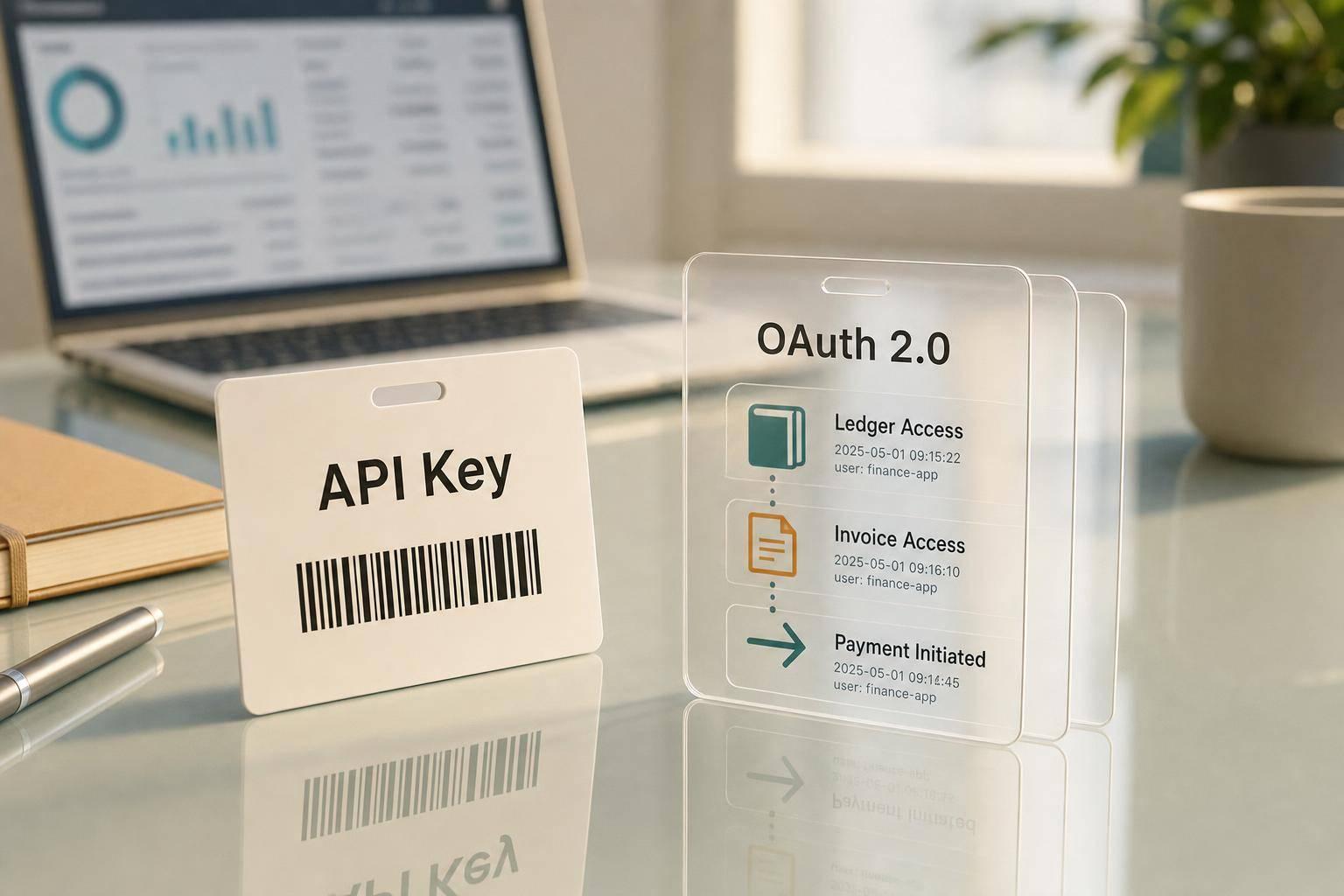
If I’m connecting finance tools, I’d use API keys for low-risk internal jobs and OAuth 2.0 for third-party access to accounting, payments, or forecasting systems.
Here’s the short version:
If one static key leaks, it can stay active until someone shuts it off. That can expose data across linked finance systems and, in some cases, payment actions too. By contrast, OAuth uses short-life tokens and tighter permissions, which helps limit damage.
For a growth-stage company, I’d think about three things first:
Simple rule: use API keys for internal syncs you control end to end. Use OAuth when outside apps need access to sensitive finance data or money movement features.
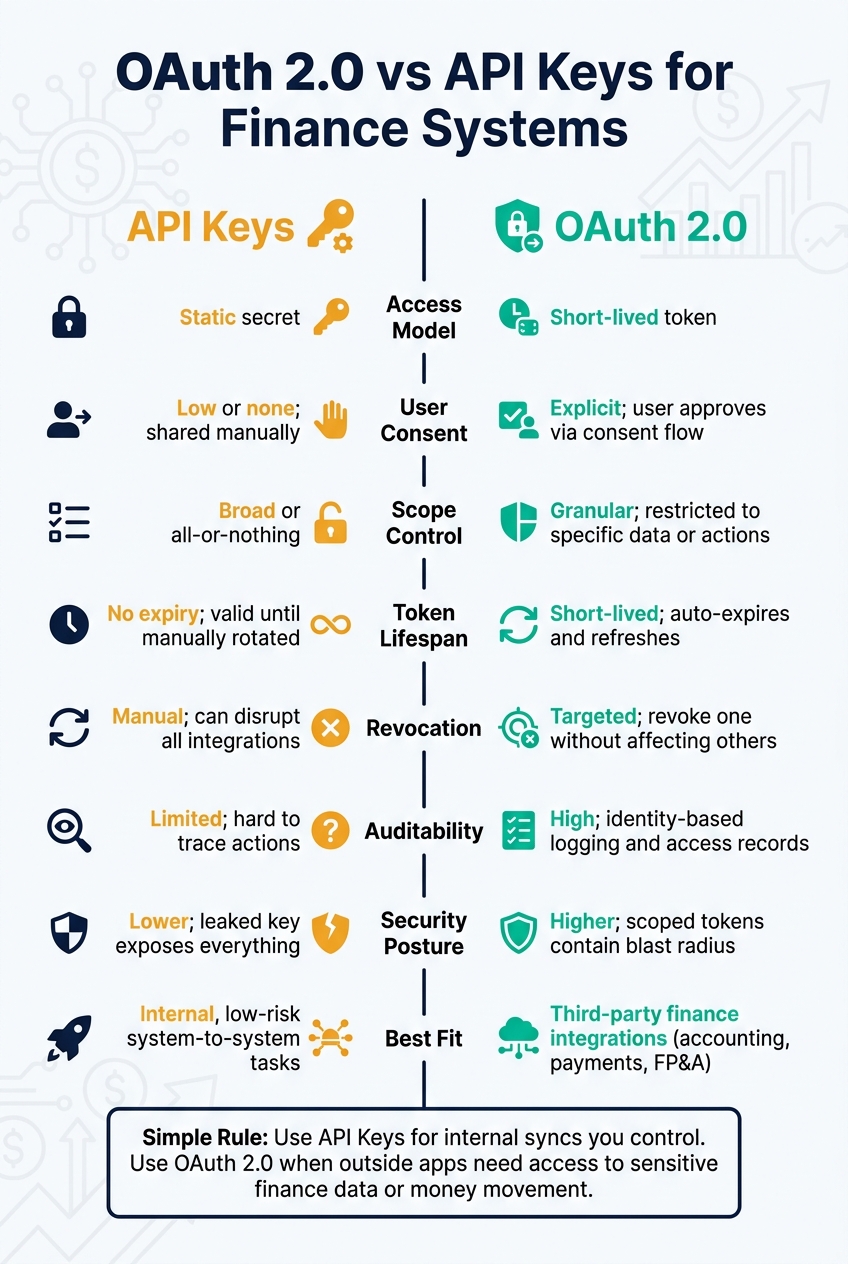
OAuth 2.0 vs API Keys for Finance Systems: Side-by-Side Security Comparison
| Factor | API Keys | OAuth 2.0 |
|---|---|---|
| Access model | Static secret | Short-life token |
| User approval | Usually none | Required through consent flow |
| Permissions | Often broad | More granular |
| Expiry | Often no expiry | Expires by default |
| Revocation | Manual, can affect many connections | Targeted, per integration |
| Audit trail | Often limited | Better user- or app-level tracking |
| Best fit | Internal system-to-system tasks | Third-party finance integrations |
In other words: if I need simple access, API keys can work. If I need control, traceability, and tighter limits, OAuth is the better choice.
An API key is a static secret sent with each request. The provider checks it, then allows the request. It’s fast to roll out.
API keys make sense for internal, system-to-system tasks your team controls end to end. Think batch data pulls or reporting syncs between accounting, payments, and forecasting tools. For low-risk internal workflows, that can be enough.
But the cracks start to show when access needs to change based on the person, their role, or the action they’re trying to take. That’s where API keys feel more like a master key than a front-desk badge. Older accounting platforms and ERPs often still require API keys or other non-OAuth methods. [1]
API keys are simple, but that simplicity comes with tradeoffs. In many cases, they allow broad access until someone turns them off. They usually don’t expire, don’t support fine-grained scopes, and don’t tell you which user was behind a given action. That weakens the audit trail and makes internal control and audit work harder. [1]
Revocation is blunt. If one key is exposed, every integration using that key can lose access at once. Rotation can also be a headache, since each client has to be updated before access comes back. Those limits matter a lot more once finance access moves beyond internal syncs and into user-authorized workflows.
API keys are static and often give broad access. OAuth narrows that access down. That makes OAuth 2.0 a better fit for finance integrations that need limited, auditable access to accounting records, cash data, or payment actions.
OAuth scopes limit what a third-party tool can do. For example, an integration can read a general ledger without permission to initiate payments. [1]
That kind of separation matters in finance. A tool may need to pull records for reporting, but it shouldn’t also have the power to move money. OAuth helps teams set those boundaries with more precision.
OAuth access tokens expire after a short time. Refresh tokens can issue new ones without asking the user to sign in again. If a token gets intercepted, that shorter lifespan cuts down the window of risk.
With a static API key, access often stays open until someone revokes it by hand. OAuth makes revocation simpler and easier to track.
OAuth can also tie each action to a user or service account, which strengthens audit trails. That’s a big deal for finance teams and fractional CFO services that need clear access logs and data lineage. It becomes even more important when one integration touches accounting, payments, and forecasting.
When you compare OAuth and API keys in finance systems, the gap comes down to a few controls that matter a lot: consent, scope, rotation, revocation, and audit trails.
The core difference is simple: API keys are static. OAuth tokens are short-lived and scoped.
That sounds like a small technical detail, but in finance workflows it changes a lot. When access is too broad, one leaked credential can expose data, trigger actions, or open doors across multiple connected systems.
| Dimension | API Keys | OAuth 2.0 |
|---|---|---|
| User Consent | Low or none; shared manually between parties | Explicit; user approves third-party access through a consent flow |
| Scope Control | Limited; usually broad or "all-or-nothing" access | Granular; access restricted to specific data or actions |
| Token Lifespan | Static; stays valid until manually rotated | Short-lived; tokens expire automatically and refresh as needed |
| Revocation | Manual and often disrupts all connected integrations | Straightforward; revoke one integration without touching others |
| Auditability | Limited; harder to trace which app did what | High; supports identity-based logging and detailed access records |
| Security Posture | Lower; a leaked key exposes everything it covers | Higher; short lifespan and scoped access contain the blast radius |
| Operational Burden | Low; simple to set up and maintain | Higher; requires managing token expiry and refresh logic |
| Startup Fit | Best for early-stage internal tools | Better for growth-stage companies with third-party integrations |
API keys are the easiest option. But there's a catch: anyone who has the key gets whatever access that key allows until someone rotates or revokes it.
In a finance stack, that tradeoff gets serious fast. A leaked API key can expose every connected system it touches. OAuth gives you more control, because you can revoke one integration without breaking the rest.
That matters in accounting, payments, and FP&A workflows. If one credential is compromised, the big issue isn't just whether access was lost. It's how far that access spreads.
OAuth also gives teams cleaner audit trails, which makes it easier to trace who accessed what and when across connected finance systems.
Once the control tradeoffs are on the table, the next step is simpler: pick the model that fits your stage and your risk profile. The right fit comes down to three things: growth stage, integration type, and the impact of a breach.
API keys work well for internal syncs that your team fully controls. OAuth is the safer pick for third-party finance integrations that need scoped, revocable access.
When outside vendors enter the picture, OAuth 2.0 becomes the standard option for systems that handle accounting data, payment processing, or forecasting. For regulated finance workflows, OAuth also gives stronger auditability than static API keys.
Here’s the plain-English difference: if an API key leaks, it exposes everything that key can touch until someone revokes it by hand. OAuth cuts that risk by limiting access to the exact data or actions that were granted.
The main job is to match the access model to two things:
Start with least privilege from day one, not as a cleanup job later. Before you connect any new finance tool, figure out what data the integration needs to read or write. Then check whether the access model can enforce that line. OAuth makes this pretty direct through scopes. API keys usually don’t.
It also helps to plan revocation before anything goes wrong. With OAuth, you can shut off one integration without knocking the rest of your stack offline. That choice matters a lot more once several finance systems rely on the same integration.
After looking at consent, scopes, rotation, revocation, and audit trails, the rule is pretty simple: use API keys for internal, low-risk workflows; use OAuth 2.0 for third-party accounting and payments systems. This isn't just a technical choice. It's an operational one.
Access control is part of internal control, not some small setup detail. For U.S. companies under SOX, access logs and change records need to back up internal controls.
As you add more vendors, API key risk starts to stack up. One leaked key can expose everything that key can reach. OAuth cuts down that blast radius with scoped, expiring tokens that you can revoke without breaking other integrations.
The right access model should fit the sensitivity of the data, the day-to-day complexity of the system, and the level of control your stack needs.
Switch from API keys to OAuth 2.0 when your integration moves beyond simple internal or trusted use and starts serving third-party access.
API keys are easy to set up. That’s why they work well for early-stage, tightly controlled integrations. But they often grant broad, long-lived access until someone revokes them by hand.
OAuth 2.0 gives you more control. You can limit access with specific scopes, set tokens to expire, revoke access more easily, and require clearer user consent. As your operations and data flows get more complex, those controls help cut exposure risk and keep access tighter.
Yes. API keys can be used safely in finance systems if you treat them like high-value security assets. That said, they’re usually less strong than OAuth 2.0 for third-party integrations.
Store keys in encrypted environments or secret vaults, not in source control or config files. Use strict role-based access control, rotate keys every 30 to 90 days, and keep detailed, immutable audit logs.
Beyond stronger security, OAuth 2.0 gives you fine-grained scope control. That means you can limit a third-party app to only the permissions it needs, like read-only access to transaction data instead of payment initiation.
It also supports user consent and makes audits easier with standardized logs for token issuance, revocation, and scopes. On top of that, it makes credential management simpler by using short-lived access tokens and refresh tokens instead of permanent keys.