Published on
September 7, 2026


If you move before your equity vests or before you exercise options, you may owe tax to more than one state. In most cases, states look at where you worked during the earning period - not just where you live when the tax event happens.
Here’s the short version:
A few numbers show why this matters. California’s top state rate is 13.3%. New York state can reach 10.9%, and New York City can push the combined rate to about 14.776%. Illinois is 4.95%, and Georgia is 4.99%.
| Equity event | Usual tax trigger | Common state sourcing period | Main issue |
|---|---|---|---|
| RSUs | Vesting | Grant to vest | Move before vesting |
| Restricted stock | Vesting | Grant to vest | 83(b) can shift tax to grant |
| NQSOs | Exercise | Grant to exercise | Old state may still claim income after a move |
| ISOs | Varies by state | Often tied to workdays and state rule | California treatment can differ |
What I take from this is simple: track your workdays, keep your grant and event dates, and check your W-2 state wage split before filing. That can make the difference between a clean return and a tax notice later.
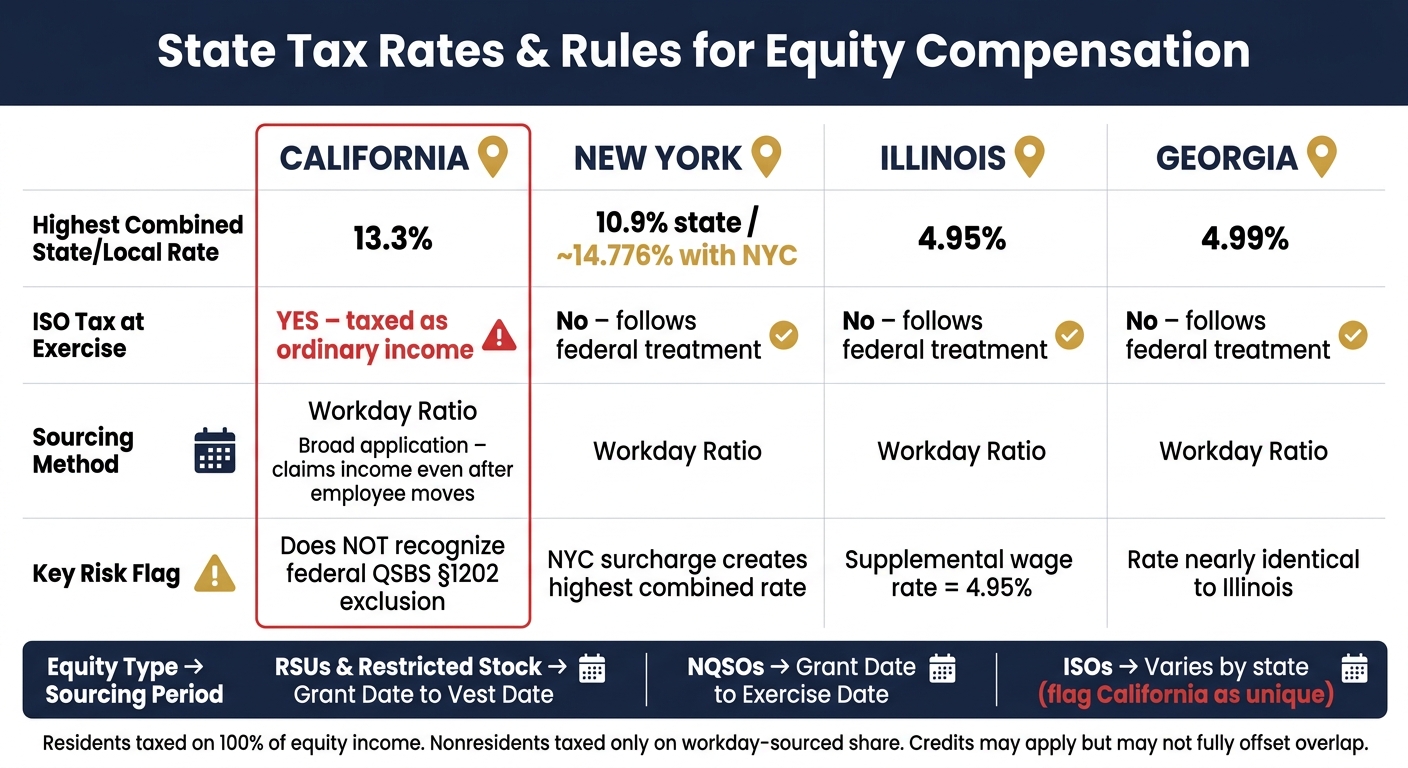
State Tax Rates & Rules for Equity Compensation: Key States Compared
Once you know the taxable event, the next step is to split the income based on workdays. In most cases, states source equity income by looking at the share of workdays performed in that state during the award's earning period.
Here’s where the equity type matters. For RSUs and restricted stock, the earning period runs from the grant date to the vest date. For NQSOs, it runs from the grant date to the exercise date.
That difference isn't small. Vest dates are usually fixed by the award schedule. Exercise dates, on the other hand, are often up to the employee. So an employee can move, exercise later, and still owe tax to the prior work state if most of the grant-to-exercise workdays were there.
For example, an NQSO exercised after a move can still be taxed mostly by the former work state if that state accounts for most of the workdays in the grant-to-exercise period.
Residents are taxed on all equity income. Nonresidents are taxed only on the sourced portion.
The key factor is residency status at the time of the taxable event. That status decides whether a state taxes the full amount or only its allocated share.
A resident state may still tax all of the income even when another state also claims part of it. That’s why resident credits matter. But that credit doesn't just happen on its own. You need the right records and the right filings, and even then, it may not wipe out the full tax bill if the two states use different sourcing rules.
Some states push the workday rule harder than others. California and New York usually call for the most detailed workday tracking.
California’s top rate is 13.3%, and its rules are broad. It taxes ISO exercises as ordinary income, does not recognize the federal QSBS exclusion under §1202, and claims a workday-ratio share on options granted during California employment even after the employee has moved away [1][2].
New York City’s combined state-and-city rate can reach about 14.776%. Illinois is at 4.95%, while Georgia is at 4.99% [1][2].
The table below shows the main differences across states that often come up in equity reviews.
| State | Highest Combined State/Local Rate | ISO Tax at Exercise? | Sourcing Method |
|---|---|---|---|
| California | 13.3% | Yes (ordinary income) | Workday ratio (broad) |
| New York | 10.9% (state) | No (follows federal) | Workday ratio |
| Illinois | 4.95% | No (follows federal) | Workday ratio |
| Georgia | 4.99% | No (follows federal) | Workday ratio |
These state-by-state differences often lead to withholding gaps and filing mismatches later on.
Once sourcing is set, your move changes the filing order, not the old state's share of pre-move workdays.
Here's the key idea: moving to a new state doesn't wipe out the first state's right to tax the work you did while you were there. The source state's portion stays tied to the workday split during the earning period. That stays the same even if the taxable event happens after you've moved.
So timing matters. If you move earlier in the vesting period, the source state's share is usually smaller. If you move later, that share usually stays larger. That sourcing split then drives which state returns come next.
Remote and hybrid work can split sourcing across more than one state. Remote days count where you physically worked, not where your employer's office is located.
That means you need to track workdays by state during the vesting or exercise period. A simple, dated work-location log can go a long way here. If a state asks how you calculated sourcing, that record helps back it up.
After the sourcing split is set, filing usually follows that split.
In many cases, that means:
Your home state will often tax the full amount first, then allow a credit for tax paid to the source state. But that credit doesn't always cancel everything out. In practice, you can still end up with a residual tax gap.
Even when the sourcing rule is clear, payroll can still withhold for the wrong state.
When RSUs vest or stock options are exercised, that income shows up as ordinary W-2 wages. So state payroll withholding usually kicks in at the time of the event. Employers often use the state's supplemental wage rate. In Illinois, for example, that rate is 4.95%[1].
Here’s where things get messy: payroll often withholds based on the employee’s current resident state, not the state tied to the income under sourcing rules. If those two states don’t match, the withholding may not match the actual tax result.
That problem usually surfaces first on the W-2.
The most common issue is state wage allocation. Payroll systems often report 100% of the equity income to the employee’s current resident state, even when nonresident sourcing rules say part of that income belongs to a prior state.
A simple example shows how this plays out. In March 2026, an employee exercises NQSOs with a $300,000 spread. They received the grant in January 2023 while working in Chicago, then moved to Austin, Texas, in June 2025. The grant-to-exercise period covers 38 months, and 76% of the grant-to-exercise workdays were in Illinois. That gives Illinois a 76% sourcing ratio, which means $228,000 is Illinois-source income. At 4.95%, the Illinois tax due is $11,286 - even though the employee now lives in Texas[1].
If the W-2 doesn’t show the right state wage split, good records can save a lot of stress. The key items usually include:
Those records can help support the return if the W-2 allocation is off.
Founders run into one extra timing issue: an 83(b) election moves taxation from vesting to grant.
The filing window for an 83(b) election is short, and the election shifts the income recognition event to the grant date instead of the vesting date. In plain English, that means the ordinary income gets taxed at grant rather than at vesting.
Once sourcing is set, the next problem is proving it. That’s where many teams get stuck. A nonresident return or audit often comes down to one thing: records.
The four record types that matter most are:
That last point matters more than it may seem. If you don’t have a clean count of total workdays during the service period, it gets much harder to back up the state allocation.
Also, record the exact date residency changed. Not “sometime in June.” Not “mid-quarter.” The actual date supports the sourcing file.
Clean sourcing files don’t help much if payroll and tax reporting run on different numbers. Equity administration, payroll, HR, and finance need to work from the same facts before the taxable event happens.
That means wage data, state data, and workday data should line up across teams. If one system shows one service-period timeline and another shows something else, you’re asking for trouble. It’s the kind of mismatch that can turn a routine filing into a long back-and-forth.
Once the internal process is lined up, the next step is keeping the filing rules straight.
States source equity compensation based on where the services were performed, not where the employee lives today. In most cases, residents are taxed on 100% of equity income by their home state. Nonresidents, by contrast, are taxed only on the share tied to workdays performed in that state during the service period. If someone moves between states with tough sourcing rules, two states may claim the same income, which creates overlap and a double-tax risk [1][2].
For founders with restricted stock, a few dates need to stay tied together: the grant date, the vest date, and any 83(b) filing. Those dates drive when state income shows up.
States often divide equity income after a move with a workday apportionment formula. In plain English, they tax you based on how many workdays you spent in each state during the award’s accrual period.
For RSUs, that period usually runs from grant to vesting. For stock options, it often runs from grant to exercise. So if you moved between states during that window, more than one state may tax part of the income based on where you worked along the way.
Your tax liability usually depends on where you did the work during the vesting period or the grant-to-exercise period. That rule can apply even when payroll withheld tax for the wrong state.
A lot of states use a workday allocation method. In plain English, they look at where your workdays happened during that period and divide the income based on that.
That can lead to a two-state filing issue:
No. A Section 83(b) election changes the timing of the federal income tax event from vesting to grant. It does not change which state can tax the restricted stock.
State sourcing rules still focus on where you performed the work during the relevant period, which is usually the grant-to-vesting period.