Published on
August 5, 2026


A renewable project is financeable only if its PPA supports debt repayment. From my read of this piece, lenders focus on four things: the buyer’s credit, the PPA term, how much revenue falls into merchant exposure, and what lenders get back if the contract ends early.
If I had to sum it up in plain English, it’s this:
Here’s the core point: I’d treat the PPA less like a sales contract and more like the project’s credit backbone. If any one of those four parts is weak, lenders usually react with lower leverage, tighter covenants, more reserves, or a higher cost of debt.
A short side-by-side view makes that clear:
| Credit factor | What lenders are asking | What happens if it’s weak |
|---|---|---|
| Off-taker credit | Will the buyer keep paying? | Lower leverage, higher spread, more support |
| Contract term | Does contracted revenue cover the loan? | More caution on debt sizing |
| Merchant tail | How much repayment depends on market prices? | Lower debt and tighter terms |
| Termination protection | Can lenders recover debt if the PPA ends? | Harder underwriting and less lender comfort |
If I were screening a deal fast, I’d start there.
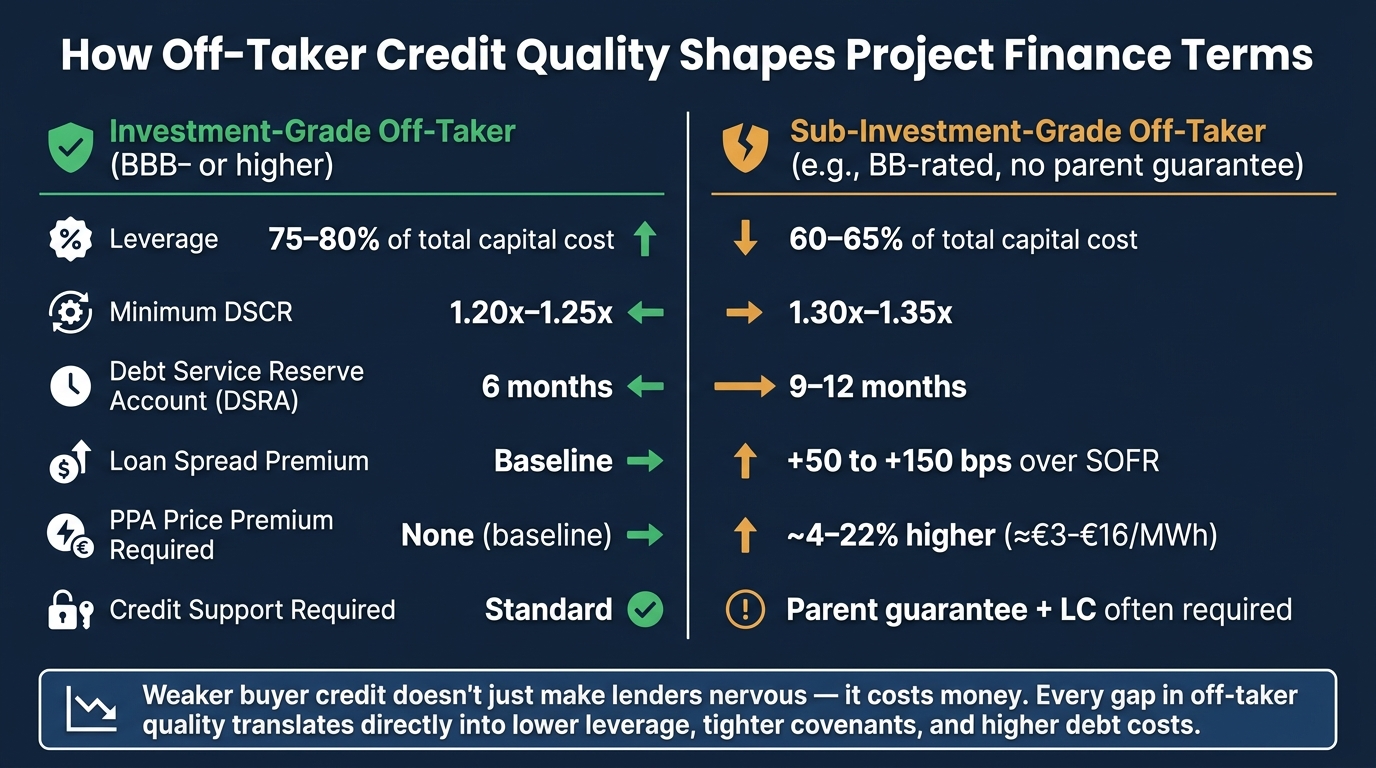
PPA Credit Factors: How Off-Taker Quality Shapes Project Finance Terms
Lenders start with one question: who is paying the PPA? A project is only as bankable as the buyer behind its cash flow. That’s why off-taker credit is the first screen in project finance.
The review usually starts with credit ratings from S&P, Moody's, or Fitch. Investment grade, usually BBB− or higher, is the normal baseline for standard project finance terms.[4][5] If the buyer falls below that line, lenders tend to ask for more credit support and stricter loan terms.
But ratings are only the start. Lenders also dig into audited financial statements, payment pass-through setups, and parent support structures. For regulated utilities, the main issue is simple: can PPA costs be passed through to ratepayers? For corporate buyers, lenders want to know whether the company can keep honoring its energy commitment through good years and bad ones.
Parent support can make a big difference here. A parent guarantee or parent keep-well agreement from a stronger entity may let lenders underwrite the deal to the parent’s credit profile instead of the subsidiary’s.
In day-to-day deal work, utility PPAs usually move through credit review with less friction than corporate PPAs. The reason is pretty straightforward: utilities often have stronger and more predictable payment backing.
Weak off-taker credit changes the math fast. It pushes up debt costs and cuts leverage.
A solar project with an investment-grade utility off-taker can often support:
Now swap that buyer for a BB-rated corporate off-taker with no parent guarantee. In that case, leverage usually falls to about 60–65%, the minimum DSCR climbs to 1.30–1.35x, and the DSRA can stretch to 9–12 months.
Loan pricing shifts too. The margin gap between an investment-grade off-taker and a sub-investment-grade one often lands in the 50–150 basis point range over benchmark rates like SOFR. In plain English, weaker buyer credit doesn’t just make lenders nervous. It costs money.
Research from the German market puts a number on that effect. Non-investment-grade off-takers can require PPA prices that are about 4–22% higher - or roughly €3–€16/MWh - than a default-free case just to deliver the same equity return.[6] That kind of buyer weakness can also force a project to add credit support before closing.
Once lenders get comfortable with buyer credit, they move to the next issue: contract length and merchant exposure, and how long that credit can carry repayment.
Once lenders are comfortable with off-taker credit quality, they look at timing next: how long the contracted revenue lasts and whether it covers the full debt term. In project finance, that timing matters just as much as the buyer's credit.
Standard utility-scale PPAs usually run 15 to 25 years.[1] When the PPA term lines up with the debt tenor, lenders can connect repayment directly to contracted cash flow.
If the PPA expires before the loan is fully repaid, the project has to depend on market prices for the remaining years. That's where things get less comfortable. Revenue becomes harder to predict, and lenders usually respond with more caution on pricing and leverage.
The merchant tail is the stretch after the PPA ends but before the debt is paid off. During that period, power is sold at market prices, so revenue no longer has the same contract-backed certainty.
The longer that merchant tail runs, the more risk lenders have to build into the deal. In plain English, a short uncovered period may be manageable. A long one can change the whole credit picture. That often means lower leverage, higher reserve requirements, or pressure on sponsors to pay down more debt while contracted revenue is still in place.
| Revenue Profile | Visibility | Lender Confidence | Leverage Impact |
|---|---|---|---|
| Full-term contracted | High; revenue is contractually defined through repayment | High | Supports higher leverage, often around 60% to 80%[1] |
| Partial merchant exposure | Moderate; contracted cash flow is clear, tail is not | Lower | Leverage may be trimmed; reserves or tighter terms may apply |
| Merchant tail | Low; repayment depends on market pricing | Lowest | Leverage is typically reduced further |
The pattern is simple: the less of the repayment period covered by contracted revenue, the more conservative lenders get. Sponsors can improve bankability by matching PPA duration to debt maturity. The next credit test is what happens if the PPA fails.
If merchant exposure means weaker future revenue, termination risk is more blunt: the contract can disappear. And when a PPA falls apart, lenders aren't focused first on megawatt-hours. They're focused on one thing: how much cash they can get back. That's why termination language gets so much attention. It's where lenders size up whether their debt can still be recovered if an off-taker defaults or causes an early termination.
Bankable PPAs tie termination payments to clear items like outstanding debt, accrued interest, reserve balances, and unwind costs.[15] Lenders want formulas they can check line by line. If the contract just says "fair market value" and leaves the math unclear, underwriting gets a lot harder.[12]
Cure periods also matter. They give the defaulting party a short window to fix the problem before the contract ends. Payment defaults often get 5 to 30 days, while non-monetary defaults often get 30 to 90 days.[13][14] That extra time can make a big difference because it gives lenders a chance to step in before project cash flow stops.
The formula matters, sure. But lenders also need rights they can use in the real world if the default turns into a fight.
Lenders also need direct rights tied to the PPA itself. Direct agreements or consent letters usually give them notice rights, restrict contract changes without their consent, and confirm that assignment of the PPA is allowed.[9][11] They also block material changes to price, tenor, or termination terms unless lenders sign off.[2]
Step-in rights are a big deal because they help keep the project running long enough to protect repayment. In practice, lenders can appoint an operator of their choosing under a three-party agreement, subject to any needed market registration approvals.[7][8] A well-drafted PPA should also say plainly that step-in, by itself, does not give the off-taker the right to terminate, so long as performance duties are still being met.[10]
Typical standstill and step-in setups give lenders:
These rights don't solve every problem. But they give lenders time, control, and a better shot at getting repaid if things start to go sideways.
These protections help recovery, but sponsors can calm lender concerns even more with added credit support.
After lender protections are set, sponsors can lower risk before closing by adding direct credit support.
If an off-taker's credit profile doesn't meet lender thresholds, the deal can still get done with extra support. Parent guarantees move exposure to a stronger entity. Letters of credit give lenders a bank-backed source they can draw on. DSRAs help cover near-term debt service.
Size matters here. LCs often cover 3 to 12 months. DSRAs usually cover 6 to 12 months of senior debt service at close.[13][16][17] And when the buyer is a non-investment-grade corporate, lenders often want both an LC and a parent guarantee, not just one or the other.
Even with support in place, lenders still want a model that shows how repayment holds up under pressure.
Build one model that ties together the PPA terms, generation, opex, debt, and tax equity. Then test merchant tail revenue across base, downside, and severe downside cases.
In the financing memo, spell out counterparty concentration and downgrade sensitivity in plain terms. Lenders shouldn't have to hunt for the weak spots. The clearer this is, the easier it is to see how the deal performs if conditions turn.
A PPA gives lenders more comfort only when it does two things at the same time: it supports predictable cash flow, and it gives lenders a way to recover value if the off-taker defaults or the PPA ends early [3][20]. If both pieces are in place, lenders can underwrite with more confidence. If one is weak or missing, they usually respond by tightening terms.
In practice, every PPA-backed project comes down to four credit factors [3][18][19][20]. Off-taker credit shapes the odds that scheduled payments will actually be made. Contract tenor shows how much of the debt repayment period is covered by contracted revenue. Merchant tail exposure shows how much risk moves to uncontracted market prices once the contract ends. And termination protections spell out what lenders may recover if the PPA breaks down before the debt is fully repaid.
For sponsors, the job is pretty clear. Find the weakest factor, then deal with it head-on - through structural protections, modeling, or targeted credit support. That is the sponsor's playbook.
The four factors are summarized below.
| Credit factor | What it determines |
|---|---|
| Off-taker credit | Likelihood of scheduled payments being made |
| Contract tenor | How much of the debt window is covered by contracted revenue |
| Merchant tail | How much revenue risk shifts to uncontracted market prices |
| Termination protections | What lenders can recover if the PPA fails before debt is repaid |
A PPA is bankable when it gives lenders enough confidence in future revenue to cut financial risk and support debt repayment.
What matters most? The off-taker’s credit quality, the length of the contract, and clear terms around pricing, volumes, and settlement. Those details help manage basis risk, curtailment, and merchant tail exposure.
When cash flows are more predictable, projects can often support lower discount rates and stronger debt service coverage ratios.
There’s no one-size-fits-all cap here. The amount of merchant tail a project can support comes down to its risk tolerance.
Merchant cash flows are harder to bank on than contracted revenues. Why? They move with the market. That means exposure to price swings, cannibalization, and basis risk.
Because of that, analysts usually use a higher discount rate for merchant periods. A common range is 9% to 14%, compared with 6% to 9% for contracted cash flows.
As the PPA term gets shorter, the deal becomes more sensitive to market forecasts and what happens at re-contracting. In plain English: the less contracted revenue you have locked in, the more the valuation leans on future power prices and your ability to sign the next agreement on decent terms.
Lenders look for credit support that makes cash flow steadier and cuts default risk on the other side of the deal.
The biggest factor is usually a long-term PPA with an investment-grade offtaker. That gives the project more predictable revenue and can reduce financing costs.
If the counterparty is weaker, sponsors may need extra backstops, such as:
Lenders also want a DSCR of at least 1.25x, along with reserve accounts, so the project has more room to handle operating issues or market swings.