Published on
July 30, 2026

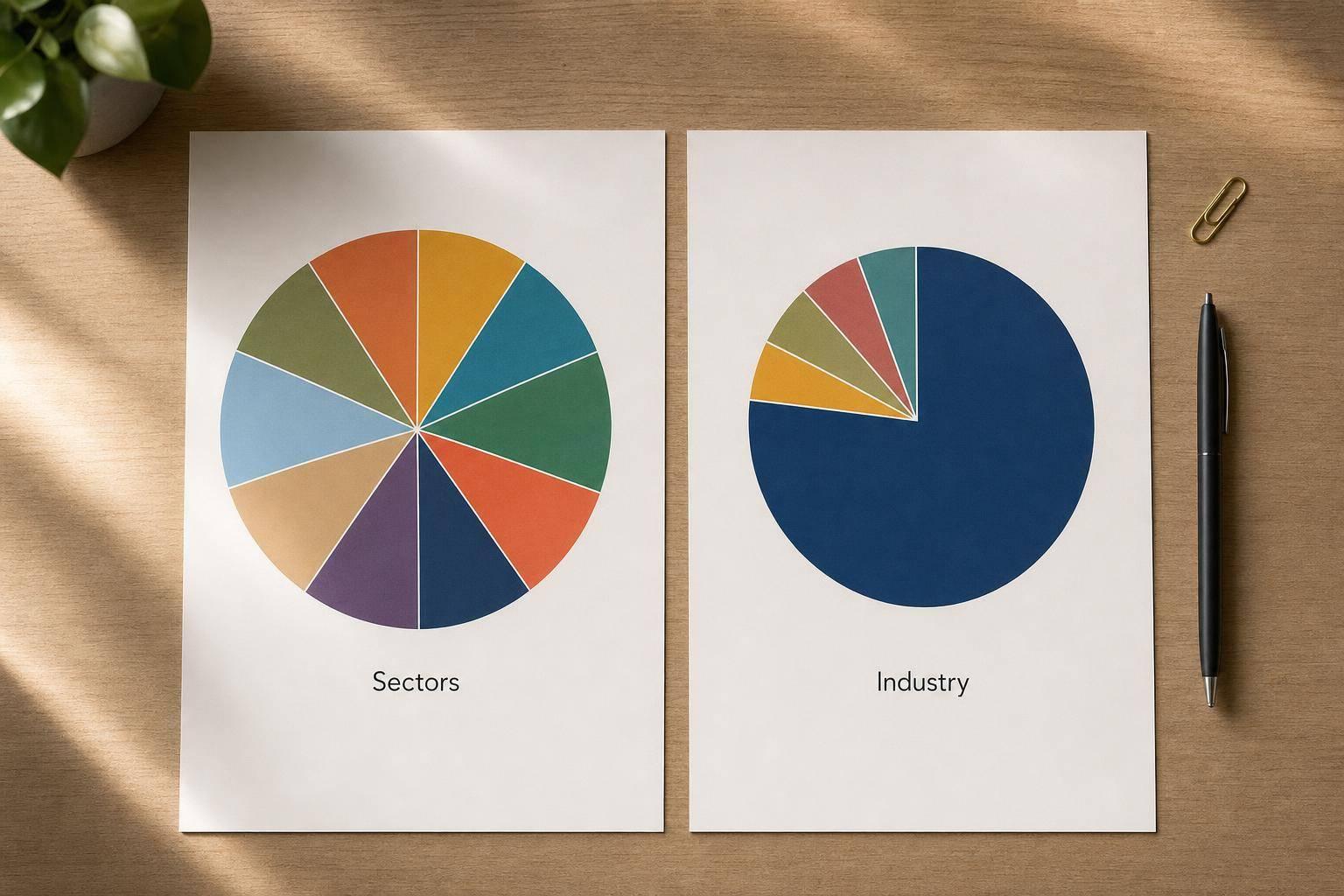
If your company already ties most of your net worth to one part of the market, your personal portfolio should not copy that same risk.
Here’s the short version: sector diversification spreads money across broad parts of the market, while industry diversification splits money across narrower groups inside one sector. In the U.S., the GICS system tracks 11 sectors and 158 sub-industries, which shows how much more narrow an industry bet can be.
If I were reading this as a founder, I’d take away four points right away:
| Criteria | Sector Diversification | Industry Diversification |
|---|---|---|
| What it means | Spread money across broad market groups | Spread money across narrower groups inside one sector |
| Example | Technology + Healthcare + Energy | Software + Semiconductors + Hardware |
| Main driver | Big economic forces | Business model, competition, margins, regulation |
| Risk level | Lower concentration | Higher concentration |
| Best fit | Most founders | People with a clear, capped thesis |
I see the main issue as simple: if your income, equity, and exit odds already depend on one sector, your investments should help offset that exposure, not add to it. The article makes that line clear without overcomplicating it.
A sector is the broad market bucket. An industry is the smaller group inside that bucket.
That may sound like a small wording difference, but it matters. Risk doesn’t move the same way at each level. If you’re a founder, this is especially important. Your portfolio shouldn’t quietly repeat the same risks already tied to your company. The line between sector and industry helps you see whether you’re cutting broad market risk or just trimming company-level exposure.
A sector is a broad market group. In the U.S., the market usually uses GICS, which splits stocks into 11 sectors and 158 sub-industries [5].
Each sector tends to move with a few big forces, like rates, regulation, and demand [5]. Real Estate is a good example. It’s often very sensitive to interest rate moves [5].
Here’s the catch: one sector can hold many industries, and those industries may run on very different business models with very different pressure points. If you only look at the sector level, those differences can get blurred.
An industry is a narrower group of companies with similar business models and similar competitive forces. Under GICS, those 11 sectors are split into 158 sub-industries [5].
Healthcare shows this well. Pharmaceuticals and Biotechnology sit in different industries, and they deal with different regulatory and timing risks [1][3]. Financials work the same way. Banks, insurers, and card issuers all sit in the same sector, but they don’t react the same way to rates, credit conditions, or regulation [5][3].
The table below shows what that looks like in practice:
| Sector | Example Industries Within It | Main Sector Drivers |
|---|---|---|
| Technology | Software, Hardware, Cybersecurity, Artificial Intelligence | Innovation, R&D, demand |
| Healthcare | Pharmaceuticals, Biotechnology, Medical Devices | Regulation, patents |
| Financials | Banks, Insurance, Investment Firms, Credit Card Companies | Rates, credit |
| Energy | Oil & Gas Exploration, Renewable Energy, Refining | Commodities, geopolitics |
| Consumer Staples | Food & Beverage, Household Goods, Personal Care | Essential demand |
Put simply, sector diversification changes your mix of big market drivers. Industry diversification keeps you inside one sector while trimming exposure to one narrow slice of it.
With those terms set, the next step is to compare how sector and industry diversification affect concentration, volatility, and the forces behind returns.
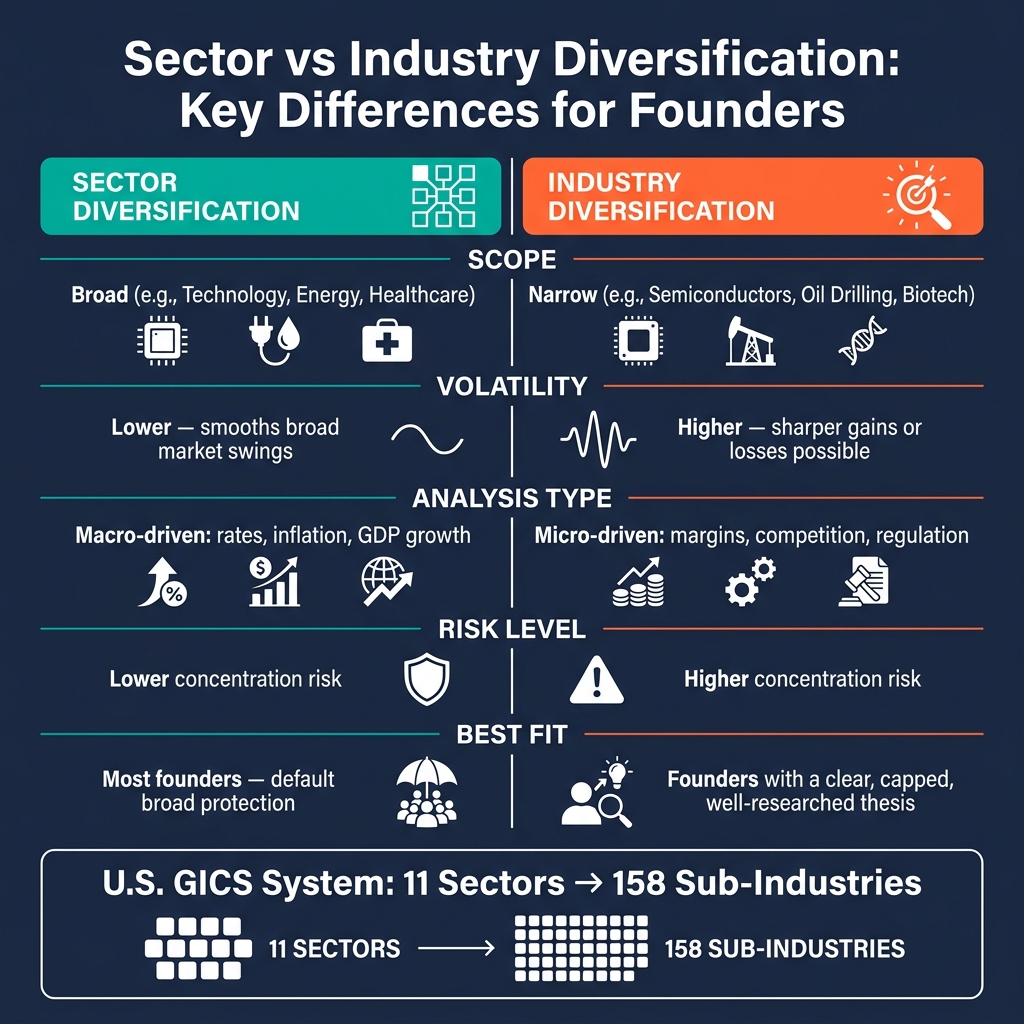
Sector vs Industry Diversification: Key Differences for Founders
Sector diversification spreads capital across different economic drivers. Industry diversification keeps your money inside one sector, which means your portfolio can still get pulled around by the same big market force.
| Aspect | Sector Diversification | Industry Diversification |
|---|---|---|
| Scope | Broad (e.g., Technology, Energy) | Narrow (e.g., Semiconductors, Oil Drilling) |
| Volatility | Lower; helps smooth broad market swings | Higher; can produce sharper gains or losses |
| Analysis Required | Macro-driven (rates, inflation, growth) | Micro-driven (margins, competition, regulation, management quality) |
| Primary Advantage | Default for broad protection | Targeted conviction or thesis-driven plays |
| Risk Type | Reduces company- and industry-specific risk | Carries higher concentration and industry risk |
The first gap shows up in concentration.
Sector diversification spreads capital across parts of the economy that don't all move for the same reason. Industry diversification stays packed inside one sector, so if that sector gets hit, a lot of the position can fall at the same time.
That’s the trade-off in plain English: a concentrated sector bet can do very well when the call is right, but it can also make losses hit harder when the market turns.
The next split comes down to what drives returns.
Sector allocation is about the big picture. Federal Reserve rate decisions, GDP growth, and inflation cycles all help decide which sectors lead and which fall behind. Consumer Staples often hold up better during slowdowns, while Consumer Discretionary tends to do better during expansions. When you make a sector call, you're mostly reading the economy, not sweating every detail of one business.
Industry allocation works the other way around. It leans on bottom-up research: margins, competitive position, management quality, and regulatory exposure. Two industries in the same sector can behave very differently, which means the call takes more detailed work.
That’s why sector calls can be made from a higher level, while industry calls need tighter judgment.
The day-to-day cost is attention.
For founders, this is often the biggest practical difference, often requiring support from fractional CFO services to manage the complexity. Sector diversification can usually be handled with broad index funds or sector ETFs, then checked from time to time and rebalanced when allocations drift. The decision pace is lower.
Industry diversification asks for more hands-on work. Regulatory changes, competition, and shifts in business models can move fast inside a narrow industry. That means more frequent monitoring, deeper research, and a greater chance of being wrong on one specific call. For founders, that extra work is a real cost.
This is where the choice gets practical: broad protection asks less from you, while narrow conviction asks more.
Once the terms are clear, the next step is simple: figure out which level does more to reduce overlap with your operating company.
For many founders, broad sector exposure is the best starting point [4][5]. The idea is pretty straightforward. Put capital into sectors that don't move in lockstep with your business risk. If your company sits in Consumer Discretionary and the economy cools off, more defensive sectors like Consumer Staples or Utilities may help soften some of that pressure [1][3].
Sector ETFs or mutual funds are usually the easiest way to do this [4][5]. They make it easier to spread exposure without having to pick a long list of individual names. It also helps to set allocation guardrails and rebalance when your portfolio drifts back toward concentration.
That default usually changes only if you have a clear, narrow thesis.
Industry tilts work best when they're tied to a specific, well-researched view.
Say you spent years in health care operations before founding your current company. In that case, you may have a real edge when looking at Pharmaceuticals or Medical Devices that a generalist investor doesn't have. That edge might come from operating experience, deeper research, or access.
The hard part is being honest with yourself.
Ask whether you have an edge or only familiarity.
For founders, the main test is total exposure, not whatever label sits on the portfolio.
Your operating company is part of that exposure. If your personal holdings stack more money into the same sector, you're not diversifying. You're repeating the same risk in a different wrapper. A better move is to use personal investments to build exposure in sectors outside your core business.
| Founder Situation | Recommended Approach |
|---|---|
| Business in cyclical sector (e.g., Consumer Discretionary) | Prioritize defensive sectors in personal portfolio (Utilities, Consumer Staples, Health Care) |
| Business in high-growth tech | Diversify away from Information Technology; use broad sector ETFs for coverage elsewhere |
| Strong domain expertise in adjacent industry | Targeted industry tilt acceptable, but cap exposure and monitor actively |
| Limited time for portfolio management | Broad sector ETFs across several sectors; review periodically |
That framework sets up the allocation bands covered next.
Founders already have a lot riding on one business. So the first step is to measure total exposure, not just what sits in a brokerage account.
Start by listing every asset you own, including:
Then map each asset to a sector using GICS.
A lot of founders miss one part of this: the customer base. If your SaaS company sells mostly to banks, your revenue is tied to the Financials sector even if the company itself is classified under Technology [2][3]. That kind of hidden exposure should be part of the full picture.
Once you can see everything in one place, set allocation bands so no single sector takes up too much of your total net worth. If a sector goes past your limit, flag it. If it moves outside its band, rebalance.
For founders, sector diversification is the default defense. Industry bets should stay narrow, deliberate, and capped. Map your holdings, set bands, and rebalance when needed. That helps prevent doubling down on the same risk.
Sort your holdings with a standard system like GICS. Then place each company in its main sector and sub-industry. After that, work out each segment’s share of your total portfolio.
Next, compare those weights against a benchmark index. That makes it easier to spot overconcentration and see where your portfolio leans too hard in one direction.
If a company spans more than one sector, assign its weight based on its primary business activity.
An industry tilt is worth a look when you want your portfolio to line up with a specific market view or growth trend.
If you put more weight into one sector or industry, your returns may go up if that view plays out. But there’s a trade-off. This kind of move usually fits investors who can handle more risk, because it can add more volatility and downside risk than a broadly diversified portfolio.
Rebalancing should be a disciplined part of your broader portfolio strategy. The goal is to keep your asset allocation aligned with your original strategy, investment goals, and risk tolerance, not to predict market moves.
In plain terms, that means checking your portfolio on a regular basis and making adjustments so the mix of assets stays in line with your plan.