Published on
September 8, 2026


If I sell a business, the biggest tax mistake is waiting too long to fund a donor-advised fund. In many cases, I need to act by December 31, 2026 to claim a sale-year deduction, and if I want to avoid capital gains on the gifted piece, I may need to transfer shares before the sale is locked in.
Here’s the short version:
A few numbers frame the issue fast: long-term capital gains can face up to 23.8% federal tax, before state tax, and stock transfers to a DAF can take 5–10 business days. So this is not a December 30 job.
If I had to boil the article down to one point, it would be this: timing, asset choice, deduction caps, and paperwork need to line up before the sale year ends.
The first call is simple in theory, but it changes a lot in practice: fund the DAF before the sale closes with the asset itself, or after closing with cash.
If you make a pre-sale gift, the asset goes into the DAF before the gain is realized. If you make a post-sale gift, you’re giving cash after the deal and getting a deduction only. That timing can decide whether the deduction shows up in the exit year.
If you donate long-term appreciated stock or eligible private shares before closing, the DAF sponsor becomes the owner. The sponsor can then sell the shares without recognizing capital gains tax. In most cases, you can claim a fair market value deduction for the donated piece and avoid recognizing the gain on that piece.[7][20][21][23]
That said, timing has to be clean. The IRS can still treat the gain as yours if the sale was already, for all practical purposes, locked in when you made the gift.[6][17][18][19][20][22]
A good example is Estate of Hoensheid v. Commissioner. There, the Tax Court taxed the seller after negotiations were complete and the price was fixed, even though the deal had not yet been signed.[4][5][8]
To lower that risk, make the gift before:
The charity also needs to be listed as a shareholder on the company’s books, and it cannot be under any duty to sell.[20][21]
A post-sale cash contribution can still give you a charitable deduction if the DAF receives the funds by December 31. It does not change the gain from the sale, but it may offset taxable income for that year, subject to the 60% of AGI limit for cash gifts.[9][10][13][15][2]
Here’s the part people trip over: for a current-year deduction, the sponsor must receive the cash or securities by December 31. That sounds easy until year-end gets tight.
Appreciated securities transfers can take 5–10 business days, so it’s smart to check the sponsor’s cutoff well before the last week of December.[1][11][12][3][16]
Once timing is set, the next step is choosing the asset to contribute.
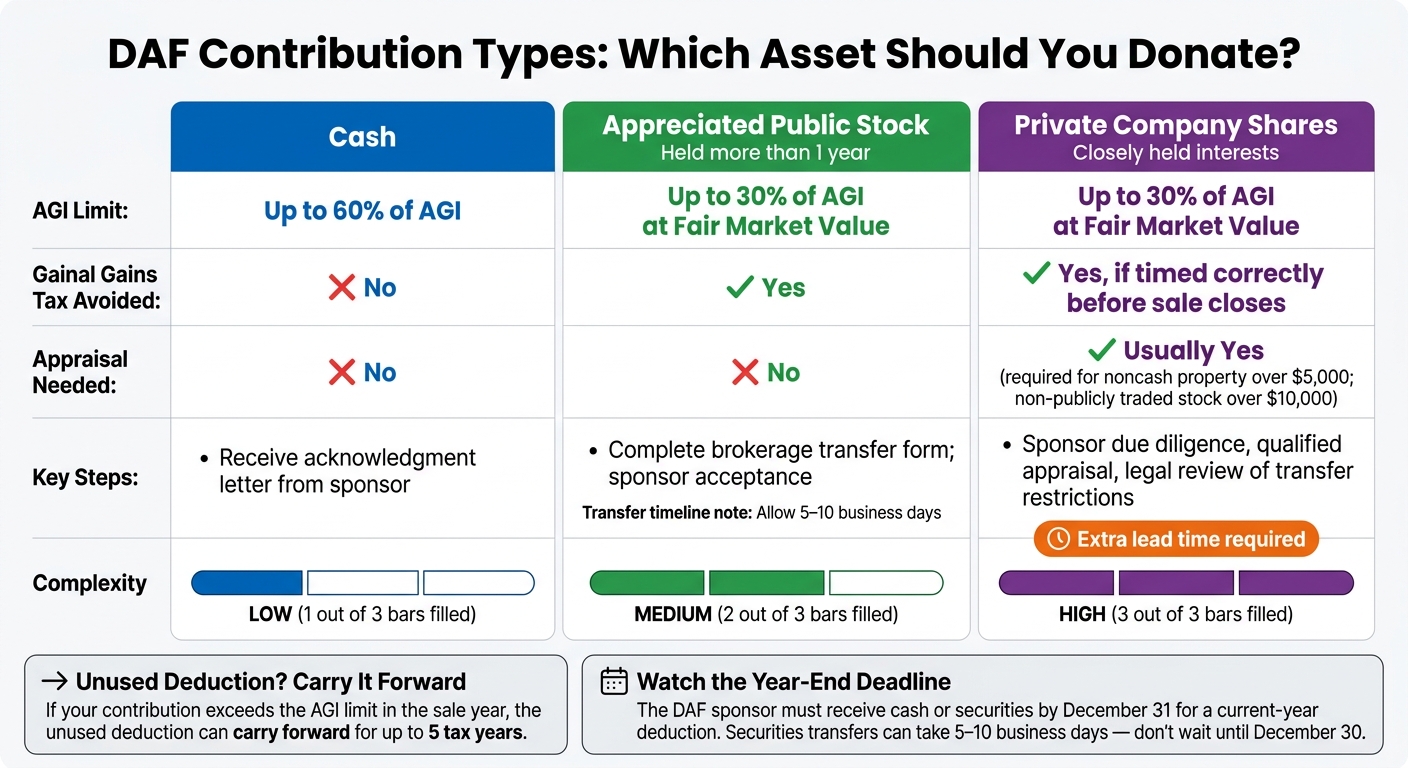
DAF Contribution Types: Cash vs. Public Stock vs. Private Shares
After timing, the next call is the asset itself. Once the timing is locked in, the asset you contribute shapes both the tax result and the chance that the transfer goes through without problems.
Cash is the easiest option. You send the funds, keep the acknowledgment letter, and you're done. Cash gifts are deductible up to 60% of AGI, but they don't help you avoid capital gains tax. [28][33][34][35][36]
Appreciated public stock held for more than one year is often the better tax move. You can deduct the full fair market value and avoid capital gains tax on the built-in gain. The DAF can then sell the shares without tax, which keeps the full amount available for grants. Publicly traded securities do not need a qualified appraisal. [28][33][34][35][36]
Private company shares can offer the same kind of tax upside, but the process is more involved. Transfer rules, review by the sponsor, and appraisal work can all slow things down.
| Asset Type | Typical AGI Deduction Limit | Capital Gains Tax Avoided | Appraisal Required? | Required Steps |
|---|---|---|---|---|
| Cash | Up to 60% of AGI | No | No | Acknowledgment letter from sponsor |
| Appreciated public stock (held >1 year) | Up to 30% of AGI at FMV | Yes | No | Brokerage transfer form; sponsor acceptance |
| Private company shares / closely held interests | Up to 30% of AGI at FMV | Yes, if timed correctly | Usually yes | Sponsor due diligence; appraisal; legal review of transfer restrictions |
Public stock is pretty direct. Private stock is where things can get messy.
Private shares can work well, but they need legal and tax review ahead of time. In many cases, sponsors look through the company's documents before they agree to accept the gift. Transfer limits in shareholder agreements, like rights of first refusal, consent rules, or drag-along provisions, can delay the transfer or stop it altogether. If those issues aren't cleared before closing, the DAF plan can fall apart right when you need it most. [28][30][31][32]
Closely held stock also usually needs a qualified appraisal. That adds more coordination and more lead time. So if a sale is on the horizon, don't wait until the deal is binding to start the process. [24][25][26][29]
Once you've picked the asset, the next issue is simple: how much can you deduct this year?
The answer depends on the annual AGI limits. Cash gifts are generally limited to 60% of AGI, while gifts of long-term appreciated property are generally limited to 30% of AGI.[2][41][42][43]
If you're selling a business, your AGI in the year of the sale can jump. That means even a capped deduction can still be quite large. And if your contribution goes past the annual limit, the unused piece can usually carry forward for up to five tax years.[25][28][39]
This is why it helps to model your exit-year AGI before you decide on the gift amount. You can line up the contribution with what you can use this year, or make a plan for the five-year carryforward. Once the amount is set, the focus shifts to the paperwork that backs up the deduction.
Three documents matter most here:
| Document | When Required | Key Details |
|---|---|---|
| Contemporaneous written acknowledgment | Any single gift of $250 or more | Must identify the donor, describe the gift, confirm the date, and state whether goods or services were received in exchange [1][27][2] |
| Form 8283 (Noncash Charitable Contributions) | Total noncash gifts over $500 | Section B required for property over $5,000; the DAF sponsor signs the appraisal summary [37][38][39] |
| Qualified appraisal | Noncash property (excluding publicly traded securities) over $5,000; certain non-publicly traded stock over $10,000 | Must be completed by a qualified appraiser; if the claimed deduction exceeds $500,000, the appraisal itself must be attached to the return [27][38][40][14] |
This paperwork is not just admin work. It is part of the deduction itself. A missing or non-contemporaneous acknowledgment can put the deduction at risk.[1][27] If a required appraisal is missing, or Form 8283 is incomplete, the IRS can deny the deduction.
Before you file, do a quick check:
Use those documents before filing, not after. That's what gives the deduction a much better shot of holding up under IRS review.
With the deduction in place, the next move is handling grants and recordkeeping inside the rest of the exit plan.
Once the deduction is locked in, the next job is figuring out how the DAF will support your giving over time. Funding the account is just the starting line. The way you plan grants is what gives the DAF its day-to-day use.
Set an annual grant plan that includes multi-year commitments, plus a flexible reserve for future gifts. That gives you room to support the causes you care about now without boxing yourself in later.
On the recordkeeping side, keep a simple grant ledger. Log grant approvals, recipient names, amounts, dates, and purposes. That keeps your records clean and tax-ready.[44][45][46]
Sale proceeds usually need to do a lot more than fund charitable giving. They may need to cover living costs, debt, reserves, and future investing. That’s why DAF funding should sit inside your full liquidity plan, not outside it.
Because DAF gifts are irrevocable, planning your cash flow matters. Before you commit, model DAF funding against after-tax proceeds, living expenses, debt, reserves, and future investments. Run a few contribution scenarios and compare the outcomes.
That kind of modeling helps you see how each option affects:
When those pieces line up, the gift fits into the post-exit plan instead of fighting against it.
Use a DAF only after timing, asset choice, deduction limits, records, and grant planning are aligned.
Start planning 18 to 24 months before your expected business exit. That lead time gives you more room to line up tax moves and stay on the right side of compliance.
The big thing to watch: your DAF must be legally set up and funded before you sign any binding sale agreement. If you wait until the sale is right around the corner, the IRS may view it as constructive receipt of income. If that happens, the tax outcome you were aiming for can disappear.
Yes. In post-exit planning, you can contribute LLC or partnership interests to a donor-advised fund. You can also give interests funded with sale proceeds after the deal closes.
The big thing is paperwork. The transfer needs to be documented the right way and valued properly for IRS purposes. Gifts of business interests come with stricter substantiation rules, so it pays to be careful here.
Your deduction depends on clean, accurate records. For non-cash assets worth more than $5,000 - like business equity - you need a qualified appraisal.
If you use a trust structure, there’s more paperwork too. You’ll need ongoing reporting, including annual Form 1041 filings and any required Form 709 gift tax reporting.
Slipshod records or missed filings can give the IRS a reason to deny the deduction.