Published on
August 29, 2026

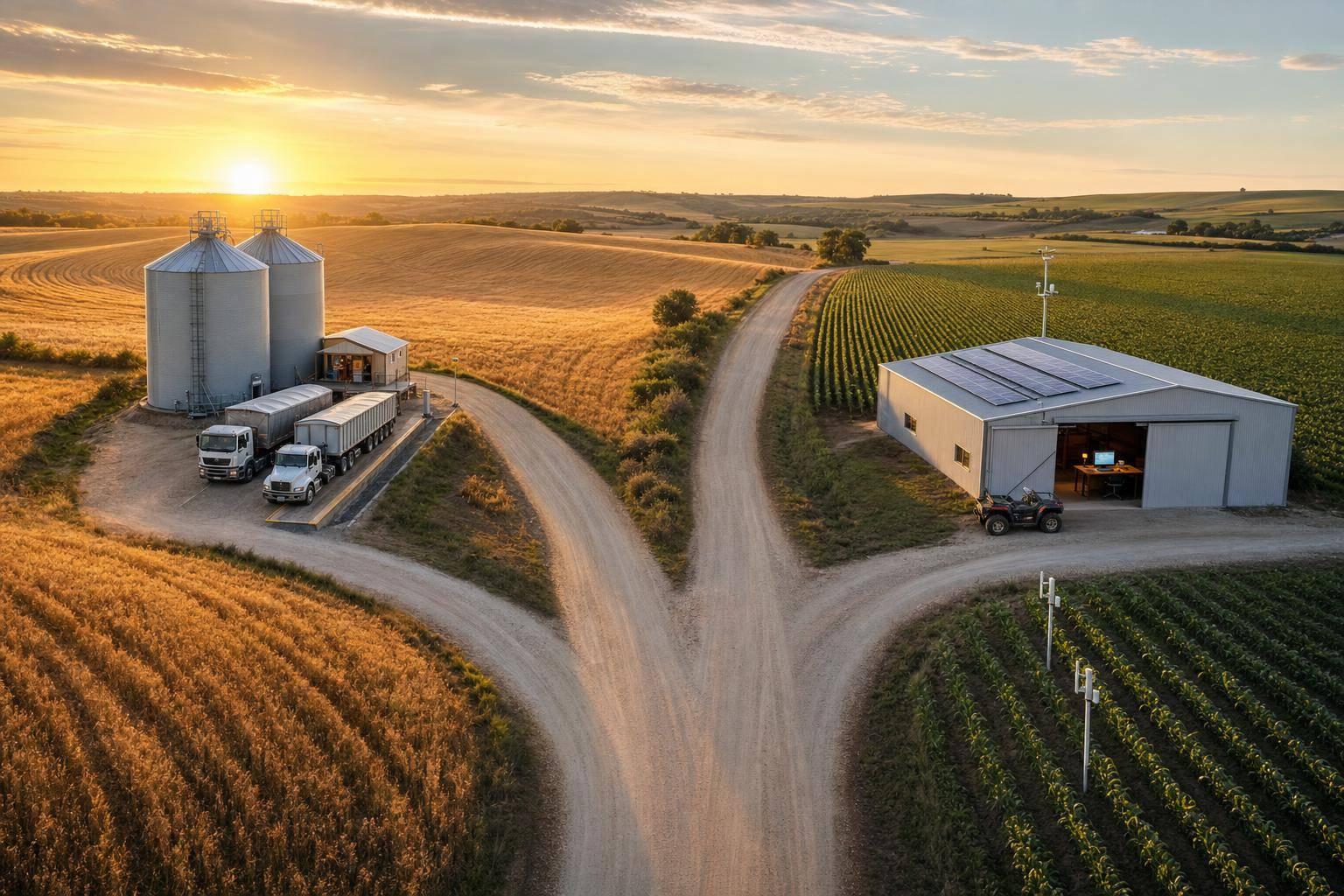
Here’s the short answer: agri-fintech demand splits in two. In some markets, farmers want credit first. In others, they want software first. That one difference shapes product fit, sales, margins, risk, and growth.
I’d sum it up like this:
If I were reading this to make a business decision, I’d focus on one question: What feels more urgent to the farmer right now - cash flow or control?
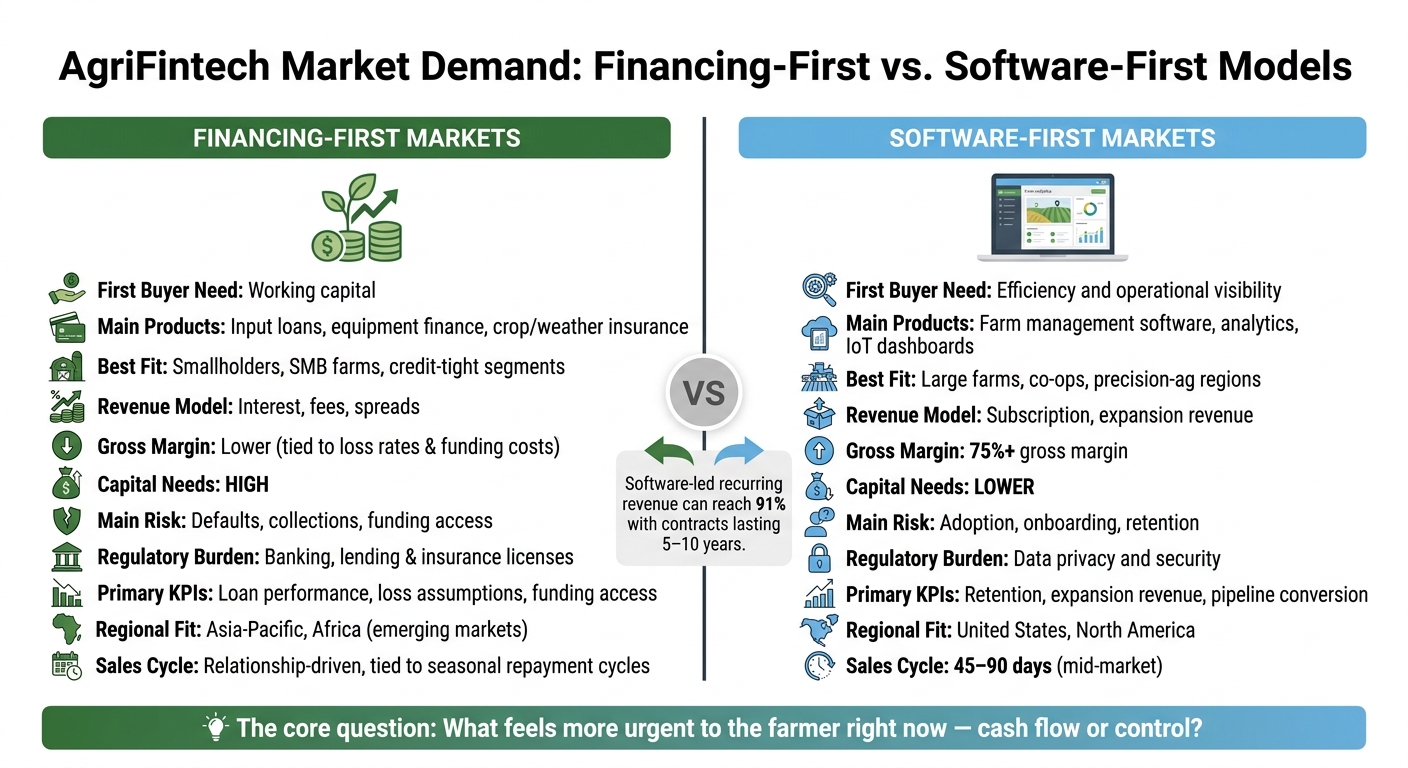
AgriFintech Market Demand: Financing-First vs. Software-First Models
| Area | Financing-First Markets | Software-First Markets |
|---|---|---|
| First buyer need | Working capital | Efficiency and visibility |
| Main products | Input loans, equipment finance, insurance | Farm management, analytics, IoT dashboards |
| Best fit | Smallholders, SMB farms, credit-tight segments | Large farms, co-ops, precision-ag regions |
| Revenue model | Interest, fees, spreads | Subscription, expansion revenue |
| Margin profile | Lower, tied to loss rates and funding costs | Higher, often 75%+ gross margin |
| Main risk | Defaults, collections, funding access | Adoption, onboarding, retention |
| Capital needs | High | Lower |
| U.S. fit | Lower | Higher |
My takeaway: don’t start with the product you want to sell. Start with the first problem the market wants solved. That’s what decides whether financing or software gets pulled in first.
In credit-constrained markets, farmers usually buy liquidity before software. Seed, input, equipment, and insurance financing tend to win first because they fix an immediate cash-flow problem. That pressure shapes which products get traction first.
The financing products with the strongest demand in agriculture tend to line up with specific pressure points in the farm calendar.
Digital lending helps with short-term working capital tied to planting and input purchases. Input finance gives farmers a way to buy seed, fertilizer, and chemicals on credit. Asset finance covers equipment and hardware when the upfront price is the main hurdle. Crop and weather insurance deal with a different risk altogether: a bad season that wipes out a farmer’s ability to repay.
Agricultural IoT devices often need upfront financing at the start of deployment, in a market projected to reach $3 billion by 2026 [1].
The demand signal here is simple and urgent. If a farmer can’t afford inputs in March, they’re probably not setting aside time to review software options. Money comes first.
That’s why finance-first products often reach adoption faster in fragmented SMB segments, including independent farms, smallholder cooperatives, and mid-market agribusinesses without in-house IT. These buyers put liquidity ahead of long-term control gains.
Once a lender or finance partner is in place, cross-sell costs tend to drop and expansion gets much cheaper. But there’s no free lunch. Underwriting, loan servicing, collections, and compliance all add operating weight and need dedicated infrastructure.
Financing revenue can grow fast, but it’s less predictable than software revenue. Returns depend on repayment timing, default rates, funding costs, and seasonal income. That’s the central tradeoff.
The main business-model effects are capital intensity and forecast risk. Those issues call for clear underwriting standards and a plain-eyed view of working-capital needs before scaling. Put differently, if the underwriting is loose or the capital plan is thin, growth can turn messy fast.
Where cash isn’t the bottleneck, the buying decision shifts from access to funding toward operational control.
In large farm operations, the buying decision moves past simple access and lands on efficiency. These farms often already have connected machines, digital records, and teams spread across a lot of acres. What they need next is better visibility and tighter control. That’s why software tends to win first in places where farms already have money to spend but want sharper oversight.
Crop management platforms help with planning and yield optimization. Farm management software covers compliance, payroll, inventory, and analytics. Analytics tools pull sensor, drone, and satellite data into one dashboard, so teams aren’t bouncing between systems.
Software-led demand is strongest in North America, especially the United States, where precision agriculture use runs deepest. Large farms and cooperatives focused on efficiency and yield often share the same setup: high acreage, connected equipment, and staff already working with digital records. In that environment, software becomes useful right away.
That concentration helps explain the regional split. Some markets lean toward software because farm operations are ready for it. Others lean toward finance-first models because the first need is still access to inputs, tools, or credit.
Once software becomes part of daily farm work, switching gets harder and contracts often last five to ten years. That helps support recurring revenue as high as 91% and gross margins above 75%.[2] In plain English: the revenue base is more predictable, more contracted, and easier to finance at scale.
So regional expansion becomes less about finding buyers and more about matching product depth to the maturity of the farm operation.
That demand split shapes more than product strategy. It affects how a company grows, pays for that growth, and deals with risk day to day.
The U.S. leans software-first. That comes from large farms, precision-ag demand, and the push to run big operations more efficiently while handling compliance reporting [1].
In parts of Asia-Pacific and Africa, financing tends to come first. The reason is pretty simple: upfront software and hardware costs still keep many smallholders from adopting new tools [1].
That split has a direct effect on how companies sell, what kind of funding they need, and how much regulation they have to deal with. If demand starts with finance, growth depends more on underwriting capacity. If it starts with software, growth depends more on getting people to adopt the product.
| Dimension | Software-First (U.S.) | Finance-First (Emerging Markets) |
|---|---|---|
| Product fit | Data analytics, AI, IoT integration | Credit access, basic farm management |
| Sales cycle | 45–90 days (mid-market) [4] | Relationship-driven and tied to seasonal repayment cycles [4] |
| Capital intensity | Lower; R&D and customer success | Higher; requires lending capacity and risk infrastructure |
Software-led businesses often post gross margins above 75% [2]. But that doesn’t mean growth is easy. Adoption is the hard part, and onboarding plus customer success take steady investment [2].
Financing-led models work differently. Their cash flows can be more predictable, which can make debt funding easier. The tradeoff is that more risk sits on the balance sheet [2]. On top of that, compliance gets tougher across frameworks tied to the CFPB and banking regulators [3].
| Feature | Software-Led Model | Financing-Led Model |
|---|---|---|
| Working-capital needs | Moderate (R&D, customer success) | High (lending book, debt facilities) |
| Regulatory burden | Data privacy and security | Banking, lending, and insurance licenses [3] |
| Scalability | High | Constrained by capital availability and risk appetite |
For operators, this choice affects capital planning, hiring, and how fast they can expand.
Those differences in margins and capital needs shape how a company should fund growth and how it should measure progress. This isn't just a product choice. It's a funding choice and an operating choice too. If you get it wrong early, you can end up hiring the wrong team, tracking the wrong KPIs, and burning runway.
Financing-led businesses need tight forecasting around loan performance, loss assumptions, and access to funding. Those are the numbers that matter most.
Software-led businesses play a different game. What matters most is pipeline conversion, implementation capacity, and expansion revenue.
The metrics shift with the model:
| Model | Primary KPIs | Main Scaling Constraint |
|---|---|---|
| Software-Led | Retention, expansion revenue, pipeline conversion | R&D, sales, customer success |
| Financing-Led | Loan performance, loss assumptions, funding access | Lending capacity, debt facilities |
The main point is simple: financing leads when access to cash is the binding constraint, while software leads when operations are already moving online.
Each path produces a very different kind of business. Finance-led growth depends on capital discipline. Software-led growth depends on retention discipline. The right growth strategy comes from matching your product design, funding structure, and KPIs to the demand pattern that exists in your market - not the one you hoped would exist.
It depends on your customer’s main pain point and on how the industry works.
A finance-first market usually needs access to capital, puts weight on embedded lending, and often runs on transaction-based revenue.
A software-first market tends to care more about day-to-day efficiency, product-led adoption, shorter sales cycles, and buyers who focus on function over deep industry operating experience.
Yes. Many companies follow this sequence to steady day-to-day operations and bring in cash before putting money into software.
Starting with financing can give a business the liquidity it needs for seasonal demand, bulk discounts, or early-stage operations. Then, once revenue becomes more predictable, software can help automate tasks, sharpen decision-making, and support long-term growth.
For financing-led models, the numbers that matter most are liquidity, risk control, and capital velocity. That usually means tracking Net Orderly Liquidation Value, inventory turnover, cost of funds, repayment timelines, Key Risk Indicators, and a liquidity buffer.
For software-led models, the focus shifts to unit economics, capital efficiency, and scale. The main KPIs here are recurring revenue mix, contribution margin, burn multiple, utilization rates, and the remote oversight ratio.