Published on
September 15, 2026


If partners can’t agree on the same record, they lose time, cash, and control. I’d sum this up in one line: blockchain helps when multiple companies need one shared record for records, payments, data versions, ownership, and workflow status.
Here’s the short version:
What I take from the article is simple: blockchain can help cut reconciliation work and make shared events easier to verify, but it does not fix bad source data, replace contracts, or settle governance questions.
Quick comparison
| Trust gap | What goes wrong | Where blockchain helps | What it still can’t do |
|---|---|---|---|
| Records | Different logs show different facts | Creates one shared audit trail | Can’t prove the input was true |
| Payments | Milestones and approvals don’t match | Runs payment rules from shared events | Needs clear contract logic |
| Data versions | Teams argue over which record counts | Keeps one accepted transaction history | Doesn’t replace core systems |
| Ownership | Rights and custody are hard to trace | Records transfers and approvals | Doesn’t replace legal rights |
| Workflows | Handoffs and status updates don’t line up | Tracks shared state changes in near real time | Keeps errors if bad data is entered |
I see the article’s main point this way: blockchain is most useful when trust breaks between companies, not inside one company. If you’re dealing with cross-industry partners, shared approvals, or delayed settlement, that’s where it fits.
When companies from different industries work together, trust usually breaks down in the same five places: records, payments, data, rights, and workflow tracking. Put simply, the cracks tend to show up around who recorded what, when it happened, and whether everyone agrees on it.
Each partner runs its own database. That sounds normal enough, but it creates a messy problem fast. One system may show a shipment as dispatched, another as in transit, and a third as delivered. Now the same event has multiple timestamps and multiple versions.
APIs can pass data back and forth. But they don't settle disputes about system state. If two partners disagree on the version of an event or the timing of it, people still have to step in and sort it out by hand. So instead of moving work ahead, teams get stuck reconciling facts.
Things get even messier when partners define milestones in different ways. One company may treat work as complete at handoff. Another may not count it as delivered until its own approval is logged.
You see this all the time in supply chains. Certifications, inspection results, and location updates don't always line up across partner systems. When that happens, teams can spend hours - sometimes days - piecing together what happened from disconnected logs and fragmented records. Billing gets delayed. Settlement slows down too.
This friction hits the business where it hurts. Longer reconciliation cycles slow cash receipts. Disputed milestones push billing dates back. Compliance teams lose time repeating audit work instead of fixing the process behind it.
Decision-making slows down too. Without one verifiable sequence of events, leadership has a harder time moving on renewals, escalations, or contract changes.
That’s why the first trust gap comes back to weak records and fragmented audit trails.
Each partner runs its own database. That means the same approval, timestamp, or status can drift across systems.
And that creates plain old business friction.
APIs can move data from one system to another. But they don't settle the bigger issue: which record is the source of truth? When partners don't agree, someone has to step in by hand. Then compliance teams get pulled into piecing together audit history from scattered logs instead of staying focused on current operations.
Blockchain tackles this with one shared audit trail. In a permissioned blockchain, partners use a shared ledger, so everyone is working from the same record. Entries are tamper-evident, and auditors can follow the sequence without rebuilding it from bits and pieces spread across different systems.
That said, blockchain has limits. It can help protect record integrity, but it can't fix bad inputs. Put simply: blockchain can prove what was recorded, not whether the record was true in the first place. Sensitive raw data and large files should stay off-chain. Only state changes and proofs should go on the ledger. [1]
Record mismatches don’t stay small for long. They often lead straight to payment delays. Most disputes begin when partners don’t agree on something basic, like an invoice’s status or whether a milestone was approved. If timestamps or approval statuses don’t match, teams have to step in and reconcile everything by hand. At scale, that manual work slows settlement and locks up working capital.[1]
Smart contracts can cut a lot of that back-and-forth. They encode approval thresholds, milestone triggers, and delivery confirmations, then release payment once those conditions are met. Because everyone works from one shared event, there’s less need to compare records across separate systems. On permissioned chains, approved payments can settle in seconds, which makes them a good fit for high-volume settlement.[1]
That said, blockchain doesn’t erase every payment risk. It only carries out the logic written into it, so vague terms can open the door to new disputes. That’s why governance needs to be set early, including who runs the nodes and how exceptions are handled.[1]
When the record itself is in dispute, payment delays turn into data conflicts.
That’s where things get messy. Each partner may keep a different “source of truth” as timestamps, documents, approvals, and transaction history drift apart over time. Then someone has to step in and sort out which version is right.
Every mismatch adds more reconciliation work, more delay, and more risk.
APIs can move data from system to system. But they can’t decide which record should count as the authority. So the same reconciliation work keeps happening across organizations, and it gets slow and expensive.
A permissioned shared ledger changes that by giving partners one agreed transaction history and a set of validation rules. No single participant can rewrite the record on their own, and teams don’t have to piece together evidence from disconnected databases just to figure out what happened. For performance and privacy, the best setups keep large files and sensitive raw data off-chain and record only the approved changes that multiple parties need to trust. [1]
That said, blockchain is not a database replacement. It still relies on APIs, data governance, and legal agreements. If the integration is poor, you can end up with one more silo instead of one trusted record. In consortium models, shared control can also lead to governance deadlocks when there’s no clear process for approving policy changes or dealing with production incidents. Projects are often delayed by open questions around data residency, node ownership, and local compliance rules, so those calls need to be made before production engineering begins. [1]
Once versions split apart, ownership and workflow disputes usually come next.
When version control falls apart, the next fight is usually ownership.
In cross-industry deals, partners often don't spell out rights for jointly built assets, shared datasets, or custody records. And when inspections, certifications, or handoffs move across several organizations, figuring out who had what - and when - can take days of manual digging through disconnected systems. Without clear governance, ownership disputes can stall partnerships before they produce results. [2]
On-chain rights records can help here. If you encode ownership rights, transfer rules, and approval thresholds into smart contracts, partners get a programmable, tamper-evident record of who holds what and when it changed. No single party can alter the record on its own. The shared ledger acts as a neutral record. It shows who approved what, and when, without forcing one party to simply trust another's account.
That said, blockchain records the submitted data and the timing of that submission. It does not prove that the original input was correct. Governance gaps, open questions about data residency, and local compliance rules can also slow rollout. Those calls need to happen in the design phase, not after production starts. A common setup is to keep sensitive raw data off-chain and store only hashes, status changes, and approvals on-chain. [1]
The practical move is simple: define IP ownership before launch, not after a dispute. Then back that up with clear exit terms and a plain process for approving policy changes.
That same shared record can also make workflow tracking much easier. Once ownership is settled, the ledger can track multi-party workflow performance too.
Once rights are clear, execution becomes the next trust test. Partners still need one shared view of what’s happening across the partnership. In multi-party workflows, each organization tracks handoffs, approvals, and deliveries in its own system. When those records don’t line up, arguments about timing and status usually follow.
A shared, permissioned ledger shifts that setup. Instead of every partner keeping a separate log and debating which one is right, each handoff, status update, and approval is written to one common record - time-stamped and hard to change. Permissioned chains can finalize updates in seconds, so performance data shows up in near real time instead of appearing days later in a reconciliation report.
The key is simple: only put shared state changes on-chain. State transitions that several parties need to trust - like custody changes, inspections, handoffs, and approvals - fit well on the ledger. Large files and sensitive data should stay off-chain.
There’s still a catch. Blockchain records bad inputs just as permanently as good ones. If a partner logs the wrong timestamp or adds a false certification at the source, the ledger preserves that error just like it would correct data. The shared record makes the disputed state easier to see, but it doesn’t settle who was right. That’s the same tradeoff that separates legacy tracking from blockchain-based tracking.
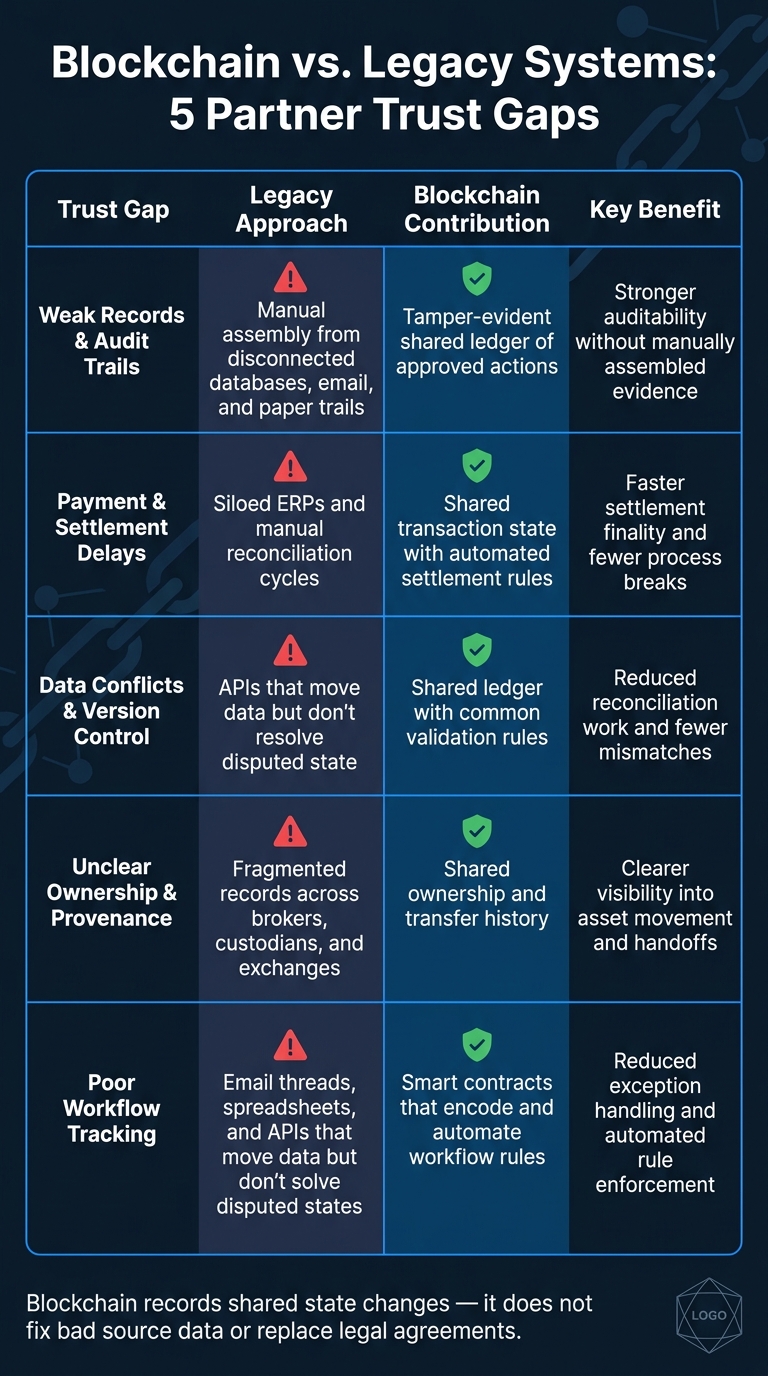
Blockchain vs. Legacy Systems: 5 Partner Trust Gaps Solved
The five trust gaps above point to one core issue: partners don't share the same version of the facts. Legacy tools usually work fine inside a single company. The trouble starts when several organizations need to agree on the same event record.
Blockchain adds a shared coordination layer. It doesn't replace current systems, contracts, or business agreements. It helps when multiple parties need one accepted record of what happened. The table below shows where blockchain can help and where legacy tools still do the job.
| Trust Gap | Legacy Approach | Blockchain Contribution | Primary Benefit | Remaining Limitation |
|---|---|---|---|---|
| Weak Records & Audit Trails | Manual assembly from disconnected databases, email, and paper trails | Tamper-evident shared ledger of approved actions | Stronger auditability without manually assembled evidence | Large files and private raw data must stay off-chain |
| Payment & Settlement Delays | Siloed ERPs and manual reconciliation cycles | Shared transaction state with automated settlement rules | Faster settlement finality and fewer process breaks | Requires integration with existing identity and banking rails |
| Data Conflicts & Version Control | APIs that move data but don't resolve disputed state | Shared ledger with common validation rules | Reduced reconciliation work and fewer mismatches | High-volume process data often must remain off-chain for performance |
| Unclear Ownership & Provenance | Fragmented records across brokers, custodians, and exchanges | Shared ownership and transfer history | Clearer visibility into asset movement and handoffs | Legal agreements still required to define rights |
| Poor Workflow Tracking | Email threads, spreadsheets, and APIs that move data but don't solve disputed states | Smart contracts that encode and automate workflow rules | Reduced exception handling and automated rule enforcement | Fast-changing rules belong off-chain |
Here's the simple rule. If the issue is internal workflow automation, blockchain is probably overkill. But if the issue is shared trust across organizations, it's worth a close look.
That said, the hard part isn't just the ledger. Teams still need to sort out governance, data residency, and system integration before production engineering starts.
That's the tradeoff at the center of the decision: readiness, cost, and control. Once the trust model is defined, the next step is checking whether the process and data stack can actually support it.
Blockchain can close partner trust gaps, but only if the business has the money, systems, and operating discipline to support the network. The five trust gaps explain why a company may need blockchain. Readiness decides whether it can work in practice.
In plain English: trust gains on paper don't mean much if the company can't fund, govern, and run the network day to day.
Blockchain is not a fix for messy operations. It works when the process is already tight, workflows are digitized, and data ownership is clearly defined.
That means blockchain should stay focused on shared events where one trusted record matters most, such as custody handoffs, certifications, and payment triggers. If a process still leans on manual reconciliation, clean that up first. Otherwise, you're just layering new infrastructure on top of old confusion.
Before any engineering starts, answer three questions:
Those answers shape the whole setup. Consortium models make sense for cross-industry alliances. Private models fit workflows run by one organization. In a consortium, no single party controls the ledger, and governance is shared across participants.
Compliance also needs to guide the design from the start. It should shape data placement, permissioning, retention, and reporting before engineering begins. The design phase is the time to spell out who handles permissioning, retention, and reporting. Once the control model is clear, the next step is simple: do the economics make sense?
Costs depend on the network model, how deep the integrations go, and how complex the ERP environment is. Transaction volume and settlement frequency also matter because they decide whether the model makes financial sense.
Working capital is often the clearest ROI lever. A good way to test the case is to compare blockchain against the current state:
That side-by-side view helps make the investment case easier to defend to a board or investor.
For growth-stage teams, the business case has to tie back to cash flow and planning discipline, not just technical fit. If a company is raising capital or getting ready for an exit, blockchain decisions should show up in FP&A and forecast assumptions.
This is where advisors can help. They can connect blockchain choices to FP&A, cash flow forecasting, and implementation economics so the decision fits the company's growth plan, not just its tech stack.
Blockchain can help partners stay aligned on shared records, trigger agreed payments, cut version mix-ups, show where things came from, and make multi-party workflows easier for approved partners to see.
Across all five use cases, the same idea keeps showing up: partners need one record they can trust. In cross-industry alliances, that can mean fewer disputes, fewer delays, and less time wasted on reconciliation.
That said, blockchain doesn't work on its own. It still relies on APIs, data governance, legal agreements, and solid workflow design.
The payoff comes from strong governance, clean data, and integrations that work in practice. Use blockchain when a shared, tamper-evident record makes a process cheaper, faster, or more reliable. If shared truth is the bottleneck, blockchain deserves a serious look.
Blockchain makes sense when several parties need to rely on the same record and no one wants arguments later about who changed what, when, or why.
That matters most when a tamper-evident trail can cut down on operational drag, especially in areas like reconciliation, disputes, audit evidence, and approval or status-change governance.
In plain English: if teams, vendors, partners, or other outside parties keep checking each other’s records, blockchain can help by giving everyone a shared source of truth.
It tends to pay off most in high-volume workflows with multiple approvers, along with fraud controls where immutable records and multi-party checks carry weight. That’s where the value shows up.
On the other hand, if you only need to fix an internal workflow, or you’re trying to prove something that happened off-chain, blockchain usually isn’t the right tool. In those cases, it can add more complexity than it removes.
Sensitive information and large files should stay off-chain. That matters for privacy, security, and regulatory compliance.
This covers items like PII, proprietary business records, invoice details, vendor contracts, W-9 forms, high-volume operational data, frequently changing application states, and large documents.
Instead, put only hashes, timestamps, and approval metadata on-chain. That gives you an immutable audit trail without exposing the raw data itself.
Use a phased, strategic approach with a strong focus on governance and integration. Start with a high-friction, multi-party process where blockchain can add a verifiable audit trail without forcing you to replace your current ERP or treasury systems.
From there, set clear success metrics, design around your existing stack, and put governance and compliance rules in place early. Then test in stages: proof of concept, pilot, and scale only after the results show ROI.