Published on
September 15, 2026


If you need to send money across borders, the short answer is this: stablecoins are usually faster, while SWIFT fits bank-based payments and standard finance review.
I’d break it down like this:
If I had to simplify it even more:
Quick comparison:
| Factor | Stablecoins | SWIFT |
|---|---|---|
| Speed | Seconds to minutes | 1–5 business days |
| Availability | 24/7/365 | Bank hours and cut-off times |
| Fees | Network + provider costs | Wire, bank, and intermediary fees |
| FX | Often lower spread, based on provider | Often less clear |
| Liquidity | Less cash tied up in transit | More cash can sit in transit |
| Access | Wallets + providers needed | Uses bank accounts |
| Audit trail | On-chain time-stamped records | Message trail can lose data |
| Risk | Issuer, code, and key risk | Bank and correspondent bank risk |
So when I look at this comparison, I don’t see one rail that wins every time. I see two payment models with different tradeoffs, and the right pick depends on how fast you need funds to land, how your team handles review and reconciliation, and whether the other side can receive the payment without extra friction.
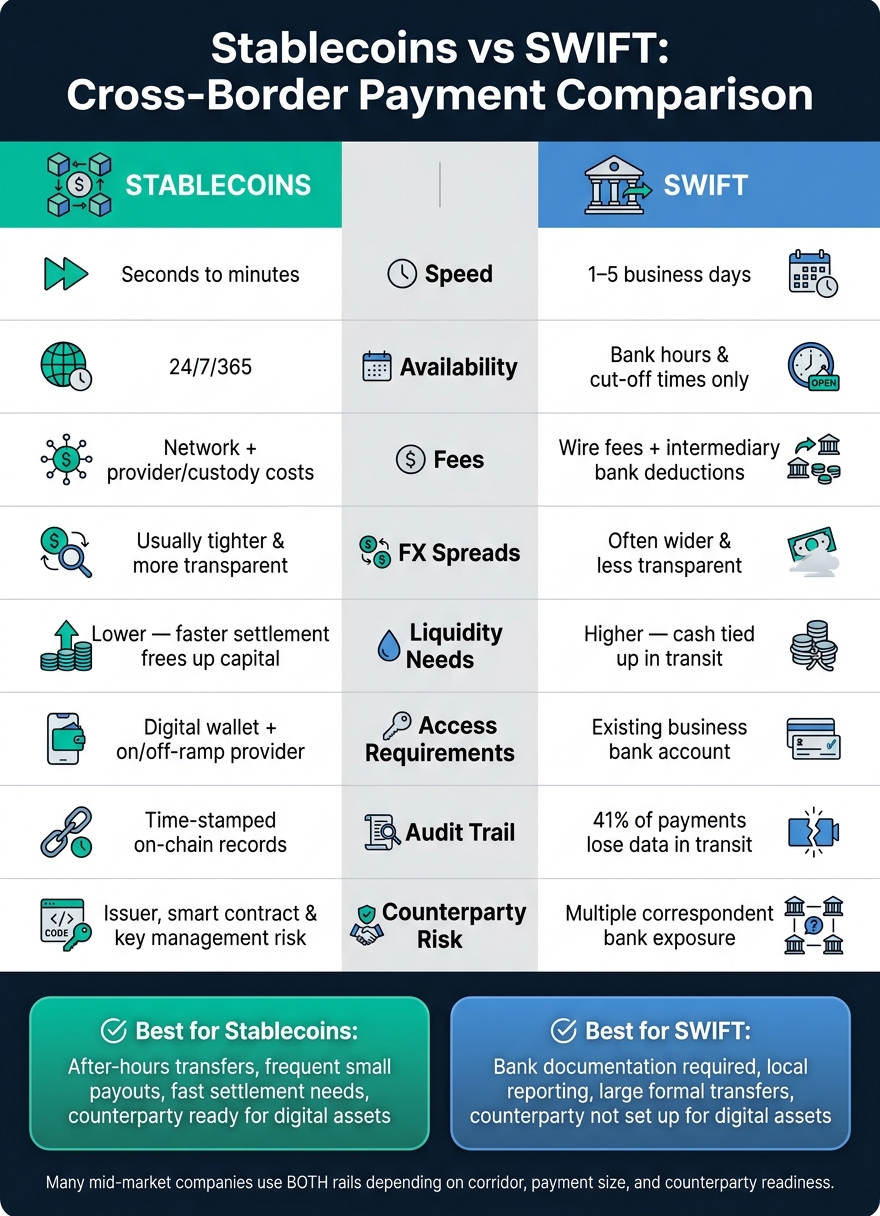
Stablecoins vs SWIFT: Cross-Border Payment Comparison
With stablecoins, the path is pretty direct. You convert U.S. dollars into a stablecoin, send it over a blockchain network, and the recipient converts it into local currency.
The on-chain part settles in seconds to minutes and runs 24/7/365. But that doesn't mean the whole payment is instant. The fiat on-ramp and off-ramp still take time, and that's usually where most delays show up.
There’s also work happening behind the scenes. Teams need wallets, custody, and accounting integration. That affects internal controls and reconciliation, and it adds day-to-day work for finance and ops teams.
SWIFT works in a very different way. It starts with bank instructions, not token transfers. Your bank sends a wire instruction, and the money moves through a chain of correspondent banks before it reaches the destination account.
Each bank in that chain follows its own cut-off times and settlement schedule. Cross-border wires usually take 3–5 business days to settle [1][2]. On top of that, each intermediary bank may deduct a fee before sending the rest onward [1].
The process can also strip out payment data. About 41% of cross-border transactions are affected by data truncation, where sender or receiver details get removed as the payment passes through multiple banks [2]. That weakens audit trails and slows exception handling. In plain English, it makes reconciliation harder for both the sender and the recipient.
For mid-market companies moving money across borders, the best rail depends on cash flow, internal controls, and counterparty exposure, not just raw speed. Treasury teams have to weigh the tradeoffs.
| Factor | Stablecoins | SWIFT |
|---|---|---|
| Speed and availability | Seconds to minutes, 24/7/365 [1] | Typically 1–5 business days, limited by banking hours [1][2] |
| Sending fees | Network fees plus platform or custody charges [1] | Outgoing wire fees and fees deducted by recipient-side banks [1] |
| FX spreads | Usually tighter, depending on on/off-ramp [1] | Often wider and less transparent [1] |
| Intermediary fees | On-chain transfers avoid intermediary bank fees; on/off-ramp provider fees may apply [1] | Multiple correspondent banks can add intermediary fees [1] |
| Liquidity needs | Lower; faster settlement reduces pre-funding needs [1] | Higher; slower settlement ties up working capital and depends on correspondent bank liquidity [1] |
| Banking access | Requires digital wallets and on/off-ramp providers [1] | Uses existing business bank accounts through correspondent banks |
| Audit trail | Time-stamped on-chain records [1][2] | Standardized messages that can lose data in transit [2] |
| Counterparty risk | Issuer, smart contract, and key management risk [1] | Exposure to multiple intermediary/correspondent banks [1] |
Speed often gets the attention first. But cost, access, and control are what decide whether a payment rail actually fits the day-to-day workflow.
This is where stablecoins stand out most. The on-chain part of the payment settles in seconds to minutes, and the network stays open 24/7/365 [1]. If cash needs to move now, that matters. There’s no waiting for the next banking window.
SWIFT works very differently. Transfers depend on bank cut-off times, business hours, and holiday schedules, so settlement usually takes 1–5 business days [1][2].
That said, stablecoin payments don’t skip fiat conversion. Companies still need on-ramp and off-ramp steps to move between dollars and the blockchain. Even with that extra work, the full process is usually faster than SWIFT. And faster settlement means less cash sitting idle between send and receipt.
Tracking is another big difference. Stablecoins leave time-stamped on-chain records that are transparent and easy to check [1][2]. SWIFT messages are standardized, but details can get lost or trimmed as payments pass through intermediary banks. When that happens, exception handling slows down and reconciliation gets messier for both sides [2].
Once speed is settled, the next issue is simple: does the cost and liquidity setup make sense for the business?
SWIFT costs can stack up fast. You may deal with outgoing wire fees, deductions from intermediary banks, and FX spreads along the way. Stablecoins still come with costs too, mainly network fees and provider or custody charges, but the faster settlement can reduce pre-funding needs [1].
That matters for working capital. If money clears faster, less cash gets tied up in transit.
Still, lower cost on paper doesn’t mean much if the finance team isn’t set up to handle the operating side. Wallet management, custody, and internal controls all need to be in place.
The last tradeoff is operational. It comes down to how each rail fits current systems, internal controls, and the company’s comfort with risk.
SWIFT works through existing business bank accounts and correspondent banking networks. That makes adoption more familiar. Stablecoins ask for more setup up front: a digital wallet plus an on-ramp or off-ramp provider to move between fiat and blockchain rails [1].
On audit trails, stablecoins have a clear edge. Time-stamped on-chain records make it easier to trace payment activity [1][2]. SWIFT messages follow a standard format, but data can still be truncated as funds move through intermediary banks [2].
Counterparty risk also changes depending on the rail. With SWIFT, exposure sits across multiple intermediary and correspondent banks. With stablecoins, the risk shifts to the issuer, the smart contract code, and private key management [1].
Neither option is risk-free. The risk just shows up in different places. That’s why finance teams need controls built around the rail they choose, including custody policies, reconciliation workflows, and exception-handling procedures before anything goes live.
These tradeoffs lead to one practical question: which rail fits the payment, the counterparty, and the controls you already have? In most cases, the answer is pretty straightforward. The right rail comes down to who you're paying, how fast the money needs to move, and what your team needs from a control and review standpoint.
Use stablecoins when speed and settlement timing matter more than bank-hour convenience. They make sense for payments that need to move after hours or settle fast for working-capital reasons. They're also a good match for frequent, smaller cross-border payouts, where faster settlement can free up cash sooner [1].
That said, this only works if the counterparty is ready for it. Stablecoins are a better fit when the recipient can accept the asset directly or convert it through a supported provider. If that setup isn't there, extra conversion steps can eat into the speed advantage.
Use SWIFT when the payment depends on bank documentation, local reporting, or standard treasury workflows. It's usually the better option when a payment needs bank records, local reporting, or a more conventional approval path.
SWIFT also makes more sense when the counterparty is in a region where stablecoin on/off-ramp support is limited or unreliable. The same goes for larger transfers that need formal compliance review [2].
Most mid-market companies don't pick just one rail for everything. They use both, based on the payment type.
Before standardizing on one rail, finance teams should map four things: the payment corridor, transaction size and frequency, counterparty readiness, and whether internal controls - like custody policies, reconciliation workflows, and sanctions screening - are in place for that rail.
Choose the rail based on corridor, payment size, counterparty readiness, and control requirements.
The tradeoff is simple: stablecoins lean toward speed, while SWIFT leans toward established banking controls.
That makes the choice pretty straightforward. The right rail depends on how fast funds need to arrive, whether the counterparty is ready to receive that payment method, and what your internal controls can handle.
For most mid-market teams, the best option is the one that fits payment timing, cash flow, and control requirements. In plain English, match the rail to payment timing, cash flow, controls, and counterparty readiness.
Stablecoin payments usually settle in seconds or minutes. That’s a big jump from SWIFT, which often takes three to five business days.
The catch is the off-ramp. Turning digital assets back into fiat can slow things down and add friction.
How long final settlement takes comes down to a few things:
Even with that extra step, a well-integrated workflow is still much faster than a standard wire transfer.
Before using stablecoins for cross-border payments, companies need strong regulatory and operational controls in place.
Start with the basics: confirm the token’s classification and check that the issuer is properly authorized. From there, put AML/KYC, sanctions screening, and Travel Rule compliance into day-to-day process. If that part is weak, the whole setup can go sideways fast.
On the operational side, the controls need to be just as tight. That means secure key management, multi-signature wallets, approval workflows for higher-value transfers, address validation, blockchain monitoring, independent reserve audits, and an immutable audit trail for reporting and review.
Think of it this way: moving money on-chain may feel fast, but speed without control is a bad mix. The right setup helps companies move funds with more confidence while keeping records clean and review-ready.
Choose based on transaction volume, urgency, and infrastructure.
Stablecoins are a strong fit for businesses that care most about speed and lower costs. Settlement usually happens in seconds or minutes, they’re available 24/7, and fees are often below 1%. The tradeoff is that you need tight risk management and clear audit trails.
SWIFT often makes more sense for companies that want established banking workflows and regulatory familiarity. But settlement usually takes 3 to 5 business days, and payments may come with extra fees and currency exposure.
Many businesses end up using a hybrid approach.