Published on
August 26, 2026


If AI touches forecasts, pricing, fraud checks, or customer decisions, informal controls are not enough. I’d put a formal AI compliance framework in place now because most firms already use AI in core work, while only 8% to 25% have a fully implemented governance framework.
Here’s the short version:
What I take from the article is straightforward: don’t wait until AI is buried inside day-to-day work. Once AI starts shaping investor materials, lending conversations, or M&A diligence, the cost of weak control can jump fast in delays, deal friction, and bad decisions.
What matters most:
This article argues for early structure, not more hesitation. I agree with that. If you can’t show who owns each model, what data it uses, how it is checked, and what happens when it fails, you have a control gap already.
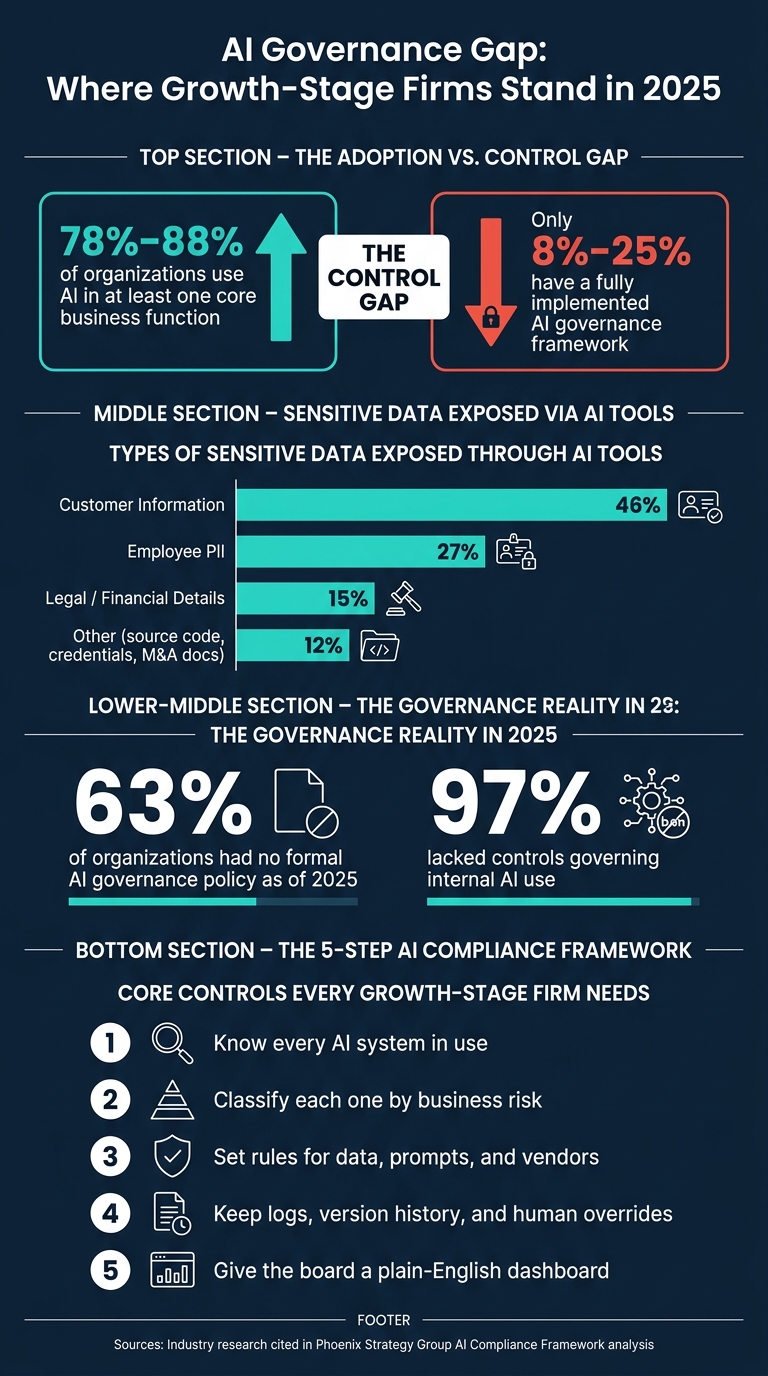
AI Governance Gap: Where Growth-Stage Firms Stand in 2025
When AI starts shaping pricing, forecasting, fraud checks, or cash planning, model drift stops being just a data science issue. It becomes a money issue.
Take a sales forecasting model trained on a narrow slice of past data. If no one checks for drift, it can keep projecting inflated revenue long after the market changes. That can lead to over-hiring, too much inventory, and write-offs when results fall short.[3][9] In pricing, models built to chase short-term margin can end up treating some customer groups or regions unfairly, creating bias that's hard to defend to investors or regulators.[3][5] In cash flow planning, flawed assumptions can understate liquidity needs enough to push a company into covenant breaches or emergency capital raises.[6]
A lot of growth-stage firms validate a model once and then let it run. No recalibration. No drift monitoring. No fairness checks. Risk experts keep pointing to black-box opacity, data bias, and model drift as recurring operating risks, not odd one-off events.[18][19] Without formal validation and monitoring, mistakes pile up quietly until they land in a board meeting or lender review.
That puts pressure on another weak spot: data controls and vendor review.
Risk starts the moment an employee pastes customer data into an AI tool or uploads financial files to get a quick summary. In generative AI exposure scenarios, customer information makes up 46% of sensitive data exposed, followed by employee PII at 27% and legal or financial details at 15%.[14] Source code, access credentials, M&A documents, and internal financial data can leak the same way.[15]
The deeper problem is weak control over how data is handled. Many firms still don't have data-classification rules, approved-use lists, retention policies, or redaction standards. That's a rough answer to give an auditor asking how customer data was protected.
Vendor risk has the same problem. Many SaaS tools now come with built-in AI that processes sensitive data, but customers often get limited visibility into what happens behind the scenes. If contracts don't require audit trails, notice of model changes, or limits on training use, the company takes on that risk.[7][4] Many vendor risk programs still skip AI-specific due diligence, so tools get approved without a clear view of what they do with company data.[12][13]
Without those rules, the company also loses the record it may need later to explain why a decision was made.
An AI audit trail shows what the system did, what inputs it used, which model version ran, and whether a human stepped in.[17][16] Without that record, leadership can't piece together how a major decision happened, whether it was a loan underwriting call, a pricing shift, or a cash flow forecast.
This gets more serious when outside parties start pressing for answers. Boards can't oversee risk in any meaningful way if all they get is a narrative with no hard metrics behind it. Investors and buyers now want structured proof: model inventories, validation records, incident logs, and bias findings, not just a verbal rundown of how AI is used.[2][8][10] When that proof isn't there, companies can face valuation discounts, deal friction, or indemnity requests because the AI risk can't be measured with confidence.[7][11] Without that evidence, boards, lenders, investors, and buyers have no solid way to judge AI risk.
Those gaps point straight to the controls the framework needs to add next.
These risks call for a formal framework built on three things: inventory, tiered review, and reporting.
Every AI system - whether it's a custom model, a third-party analytics tool, or an embedded SaaS feature - should sit in one central model register. That register should show the model's purpose, data sources, owner, and validation status. If a system isn't in the inventory, it shouldn't be deployed.[24]
After that, each model should be placed into a risk tier. Use three tiers:
Tier 3 models need pre-set performance thresholds and rollback triggers.
The NIST AI Risk Management Framework groups this work into Govern, Map, Measure, and Manage.[21][1] For a growth-stage firm, governance isn't some separate side project. It's part of how models get approved, monitored, and retired.
Data rules need to be specific. People should know exactly what data they can use and what stays off-limits. That means written policies that spell out what data can go into prompts, what can be used for training or fine-tuning, and what must be de-identified first. Sensitive categories - unencrypted customer PII, unreleased financials, and M&A deal terms - should be clearly banned from third-party AI tools unless a contract guarantees data isolation.
Vendor intake needs its own checklist too. When you're reviewing an AI-powered tool, look at whether the vendor uses customer data to train its models, what audit logging it offers, how model updates are handled, and whether the vendor has SOC 2 or a similar security certification. Contracts should also cover data ownership, incident notification timelines, and the right to receive assurance reports. That's the paper trail buyers and lenders want to see during diligence.[23]
Keep model cards, version logs, usage logs, and human-override records. Together, they form the audit trail needed to explain high-risk decisions.
AI governance needs one named owner. In most firms, that's the CTO, CIO, CDO, or fractional CFO. That person is accountable for the framework and for reporting on it. Around that owner, a small cross-functional working group from finance, operations, legal, and security can meet each quarter to review new use cases, approve risk tiers, and track incidents.
Incident escalation should plug into the playbooks the company already uses. If approval rates shift for a protected customer group, if a model starts producing outputs that clash with known business conditions, or if there's a data leakage event, there should be clear escalation steps: who gets notified, how fast, and what kind of issue triggers a board briefing.
Board reporting doesn't need to get technical. A one-page dashboard with red, yellow, and green status indicators for high-risk AI systems, plus a short summary of active models, recent incidents, and upcoming deployments, gives directors what they need for solid oversight.[20] It also gives the company something concrete to point to during funding rounds and deal reviews.
That control structure gives growth-stage firms the evidence they need for scale, funding, and diligence.
Once the basics are in place, the next step is the business case. Why does this matter when a company grows?
As teams, products, and markets expand, weak controls can turn normal growth into hidden risk. Without standardized controls - model inventory, review tiers, and monitoring - each new use case adds risk that no one is fully managing. What looks fine at a small scale can get messy fast when more people, tools, and decisions depend on AI.
This kind of discipline also shapes how outside parties view the business. If the models behind revenue projections, churn analysis, or cash flow forecasts are tracked and validated, FP&A can lean on outputs that are easier to explain during diligence and in board reporting.
AI governance is now showing up in diligence, and a lot of companies still can’t prove what they say they control. As of 2025, 63% of organizations had no formal AI governance policy in place, and 97% lacked controls governing internal AI use.[25]
That matters because buyers and lenders are looking closely at a few simple things:
A formal framework turns AI oversight into something people can inspect. Instead of broad claims, a company can point to model logs, validation records, incident history, and vendor review materials. That gives investors and lenders something concrete to review.
Regulatory pressure is also building. State AI laws are pushing expectations higher, which makes documented governance a deal-readiness issue, not just a compliance task.
Building that paper trail usually takes coordination across finance, data, and governance. For many growth-stage companies, AI governance breaks down for a simple reason: no one ties it back to reporting, diligence, and decision-making.
Phoenix Strategy Group helps connect AI governance to FP&A, financial reporting, and M&A readiness so controls appear where they need to - in diligence, board materials, and funding work.
Those risks lead to a clear takeaway: growth-stage firms need formal AI compliance now, not once AI is already baked into the business. Loose controls may be fine during a pilot. But they tend to fall apart when AI starts driving repeat business decisions. That’s when gaps turn into direct liabilities in funding, lending, and M&A.
The answer isn’t more hesitation. It’s early governance. Trying to bolt governance on after AI is already part of core workflows is slower, more expensive, and far more disruptive than putting it in place early. A formal framework gives teams guardrails, so they can move faster with fewer surprises.
For teams that need help putting that framework into practice, Phoenix Strategy Group can help connect AI governance to financial reporting, board materials, and transaction readiness.
Growth-stage companies should put AI controls in place early - ideally while AI projects are still being designed. That makes life a lot easier later. If you wait, governance often turns into a retrofit job, and retrofit work tends to cost more, take longer, and create friction across teams.
A formal framework starts to matter even more when vendor use grows, internal decisions get split across different teams, or the company is getting ready for fundraising, audits, or M&A. At that point, a clear setup helps the business scale with fewer surprises, support investor diligence, and cut risks like data privacy issues, model drift, and regulatory noncompliance.
AI systems are considered high risk when they can materially affect decision-making, compliance, security, or stakeholder trust.
Under frameworks like the EU AI Act, that includes systems used in healthcare, banking, recruitment, credit scoring, and fraud detection. If AI influences financial statements or other sensitive operations, it should also be reviewed for bias, accuracy, and security risk.
In plain terms, if the system can shape outcomes in ways that affect people, money, or control, it deserves closer scrutiny.
An effective AI compliance framework needs input from more than one team. Legal, risk, compliance, data science, and IT all need a seat at the table. That kind of shared governance helps keep blind spots from slipping through.
You also need one central inventory of every AI system in use. That includes approved tools, in-house models, vendor systems, and shadow AI - the tools people start using on their own without formal review. If you can't see what's being used, you can't manage the risk.
Beyond that, the framework should cover a few core areas:
Put simply, this isn't just a policy on paper. It's a working system for knowing what AI you have, how it works, where it can go wrong, and who is responsible at each step.