Published on
August 9, 2026

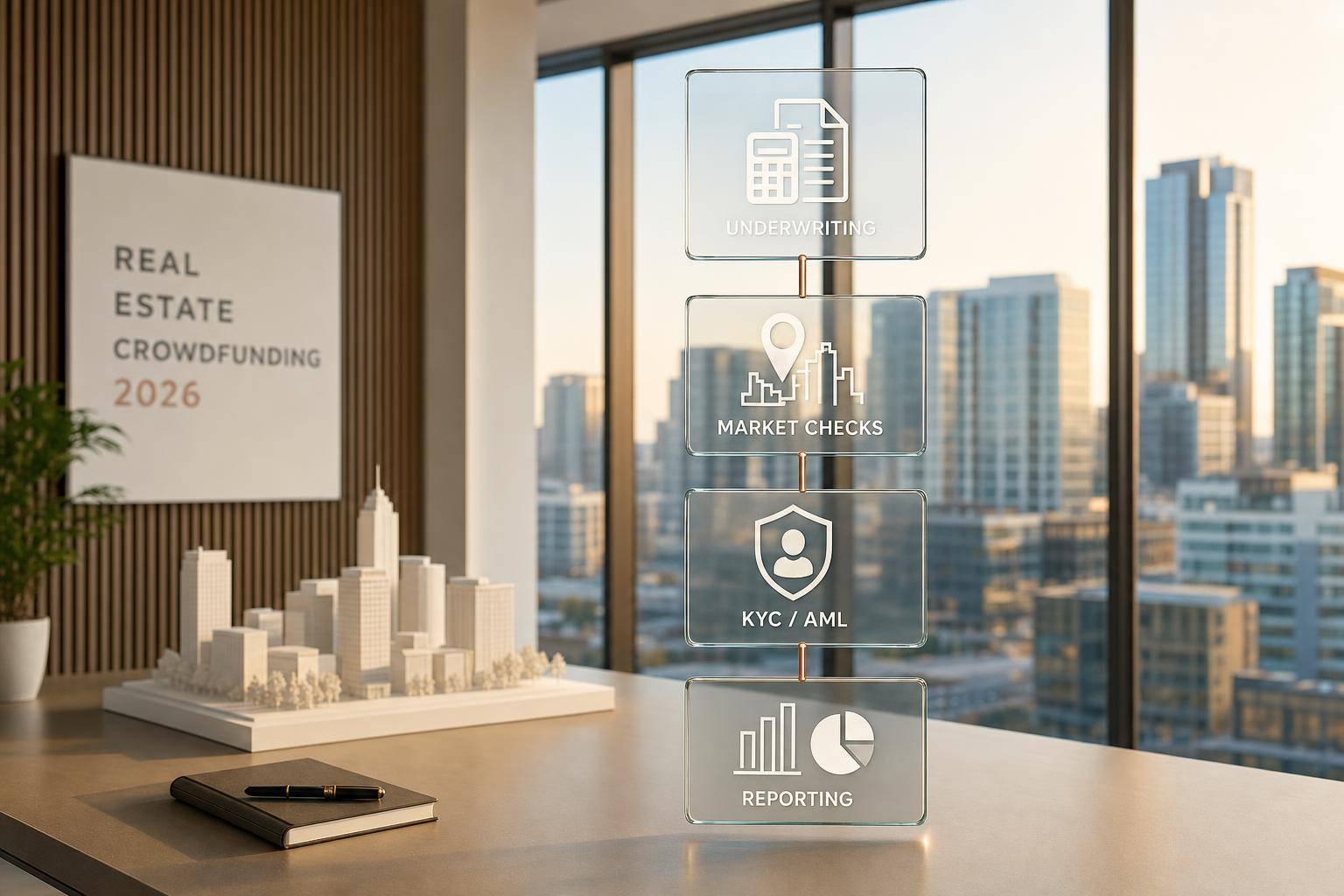
If you review U.S. real estate crowdfunding deals in 2026, the main issue is simple: there are more tools and more deals, but not more time. Manual underwriting can still take 6–8 hours per deal, while the market now includes 219+ AI tools for CRE work, with 43 tied to sourcing and underwriting.
If I had to boil this article down to one point, it’s this: no single tool does everything well. I’d split the stack by job:
Here’s the part that matters most for me: tool choice is a workflow decision, not a feature decision. Some tools help me screen deals faster. Some help me test sponsor assumptions. Others help me control investor access, run distributions, or track asset cash flow after close.
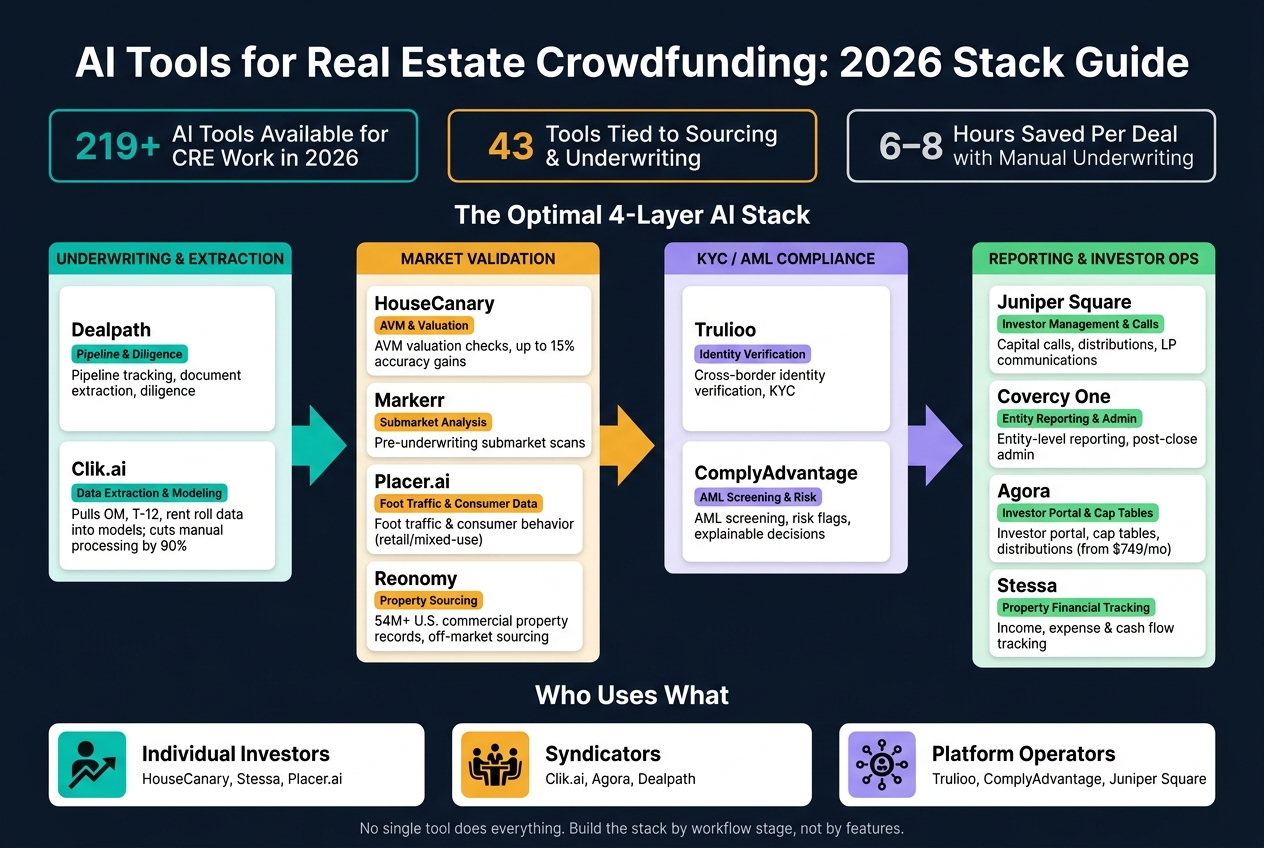
AI Tools for Real Estate Crowdfunding: 2026 Stack Guide
| Tool | Best for | Main use |
|---|---|---|
| Dealpath | Deal teams | Pipeline tracking, document extraction, diligence |
| Clik.ai | Underwriting teams | Pulling OM, T-12, and rent roll data into models |
| HouseCanary | Valuation checks | AVMs, forecasts, market review |
| Markerr | Market ranking | Pre-underwriting submarket scans |
| Placer.ai | Retail and mixed-use review | Foot traffic and consumer behavior |
| Reonomy | Off-market sourcing | Ownership and parcel research |
| Trulioo | Investor onboarding | KYC, identity verification, access control |
| ComplyAdvantage | Compliance review | AML screening and risk flags |
| Juniper Square | Fund admin | Subscriptions, capital calls, distributions |
| Covercy One | Post-close admin | Entity reporting and cash-flow tracking |
| Agora | Syndicator investor ops | Investor portal, cap tables, distributions |
| Stessa | Portfolio tracking | Income, expense, and return tracking |
My takeaway: the best setup usually combines underwriting, market checks, KYC/AML, and reporting in one stack. And even with AI, I’d still want a person to review assumptions, comps, sponsor inputs, and exception cases before money goes out the door.
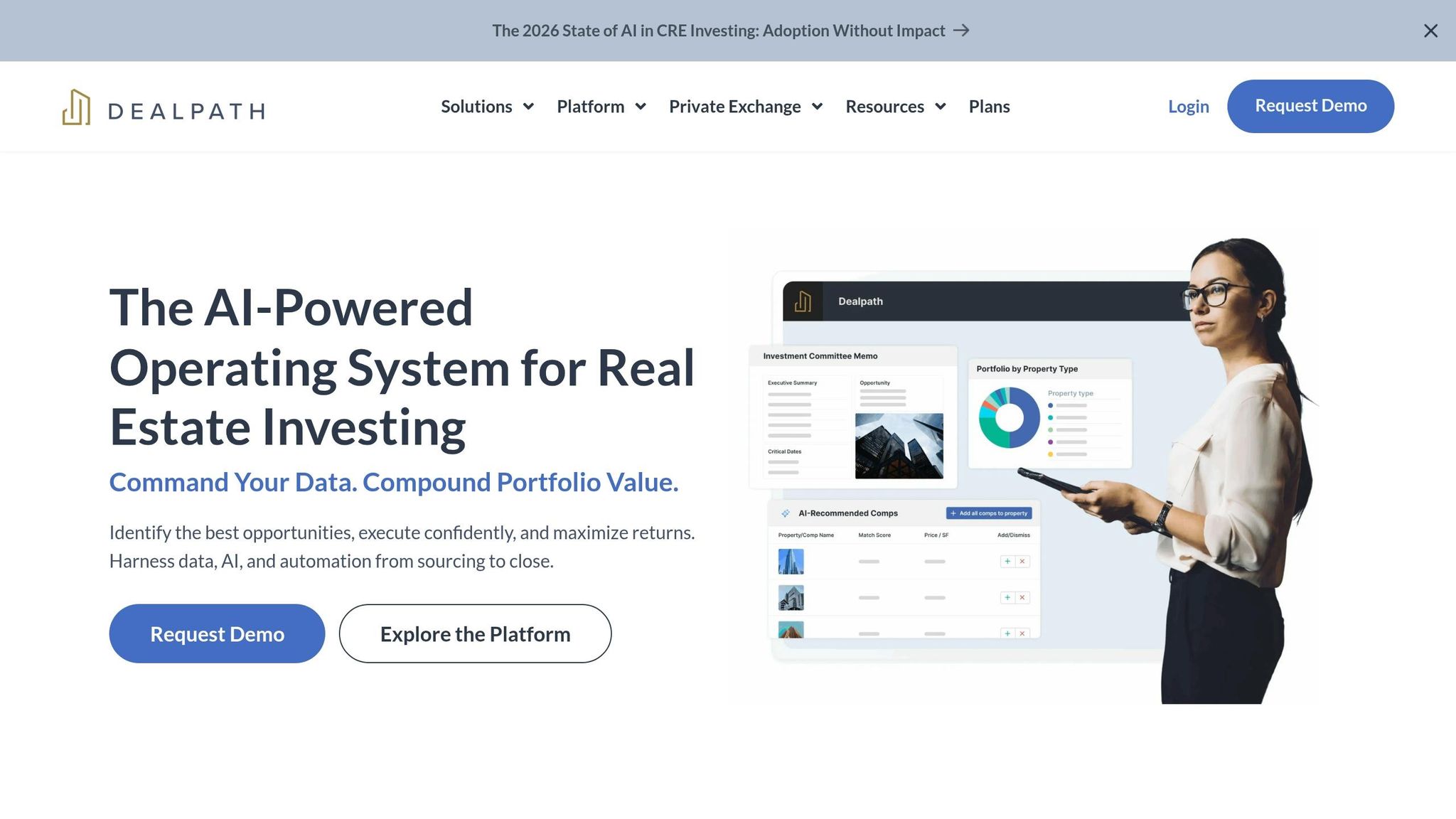
Dealpath brings sponsor-side deal flow into one place, from sourcing to closing. Its AI Extract tool pulls OM and lease data straight into underwriting fields, which cuts down on manual entry and helps teams compare deals in a more consistent way. [1]
Dealpath automates data extraction, diligence tracking, and investment committee reporting. [1]
Here’s where Dealpath fits in the workflow:
| Workflow Stage | What Dealpath Handles |
|---|---|
| Intake | Centralized pipeline tracking and deal sourcing management |
| Underwriting | AI Extract pulls OM and lease data into underwriting fields |
| Diligence | Centralized document management and task-based workflows |
| IC Reporting | Automated reporting and data visualization |
This tool makes the most sense for GPs, syndicators, and investment teams that need audit trails and standardized reporting across deals. It’s positioned as an enterprise-level platform and uses custom pricing. [1]
The next tool focuses more narrowly on underwriting automation.
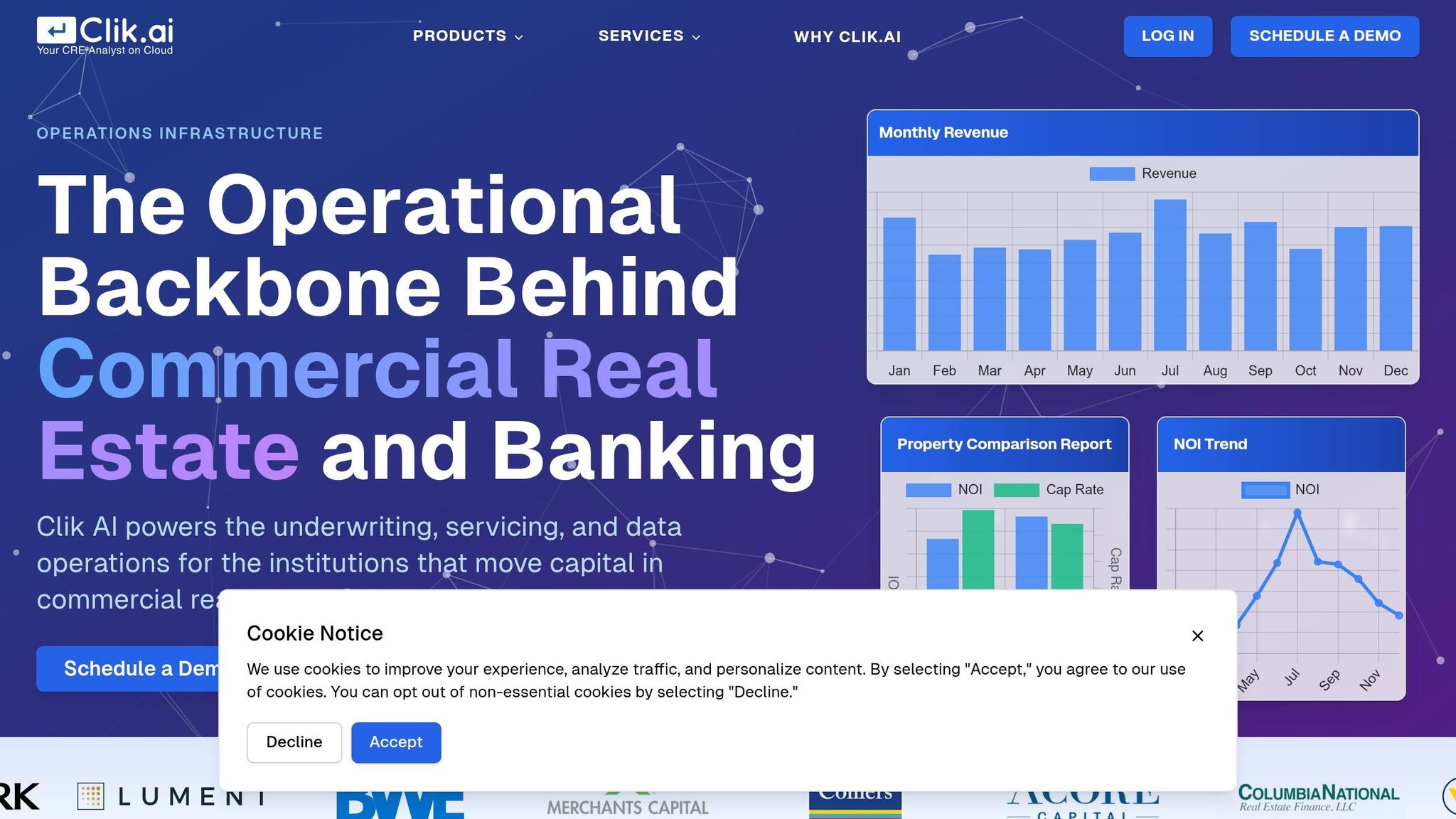
Clik.ai handles financial spreading during underwriting. Its AutoUW engine pulls data from Offering Memorandums, T-12s, and rent rolls into standardized pro forma models.[1] That makes it a fit after screening, not during the first pass of market scanning.
Clik.ai depends on uploaded deal documents, not its own database, so the data it surfaces is tied to the property itself, including financial and occupancy details.[1] For crowdfunding investors reviewing several deals at once, it works best next to a market-scan tool. One gives you the asset-level numbers; the other helps you compare those numbers with market trends and comparable sales.
The platform says it cuts manual processing time by 90%.[1] So the job changes in a pretty direct way: instead of building a model from zero, analysts check and refine AI-generated outputs. Less data entry, more judgment.
Clik.ai is built for enterprise users, especially sponsors and investment teams working through a high volume of deals.[1] Its main upside is faster diligence across many sponsor deal packages. Next: a broader market and ownership view.
HouseCanary helps crowdfunding teams check sponsor valuations and keep an eye on markets from acquisition through the hold period. For platform teams, it works as an independent valuation check that can flag deals worth a closer look during screening. For investors, that can mean faster screening and better post-close monitoring.
It fits best when sponsor underwriting needs an outside market check.
The platform uses institution-grade data and predictive analytics to forecast market direction, rather than just summarize past performance. It also includes neighborhood-level heatmaps, which help teams judge local market trends and neighborhood outlook.
HouseCanary’s Automated Valuation Model (AVM) supports pre-acquisition valuation checks. Its generative AI assistant, CanaryAI, gives users natural-language access to property data and market forecasts.
That said, human review still matters in markets with limited comps.
HouseCanary claims valuation accuracy gains of up to 15%.[4] That makes it a strong fit for institution-grade investors and platform teams that need to manage risk across many deals.
Next, the focus shifts from valuation to ownership and parcel-level market data.
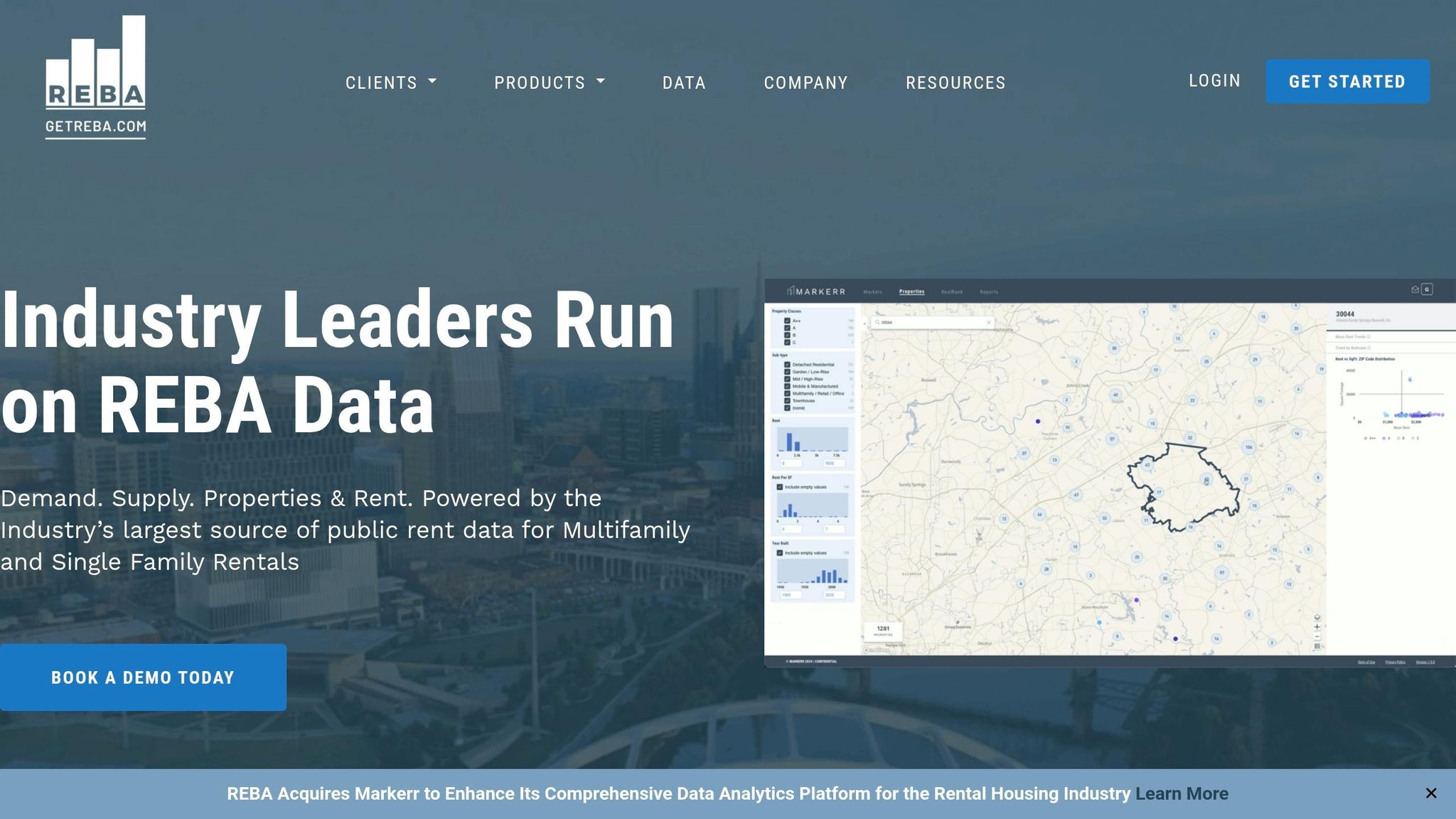
Markerr helps investors rank markets and sites before underwriting.[1]
The platform pulls together mobility data, supply pipeline data, and credit data to show demand patterns and location trends.[2]
It uses those inputs to speed up pre-underwriting market screening.[1]
Markerr is a good fit for institutional teams screening multiple submarkets before underwriting.[1]
Next, Reonomy shifts from market screening to parcel and ownership data.
Unlike valuation tools, Placer.ai looks at what people actually do on-site. That makes it useful for market research before a deal and for monitoring after close. Investors can use it to scan U.S. markets for high-traffic areas and up-and-coming retail corridors, then watch how consumer behavior and foot traffic change after acquisition. [1]
Its core data comes from foot traffic and consumer behavior pulled from mobile location panels. [2] That data helps with trade area analysis for single properties, retail chains, and larger markets across the U.S. [1]
There is a catch. Accuracy tends to fall in thin-data markets, including rural areas and trophy assets. And after big regime shifts, the models can lag until they’re retrained. [2]
Placer.ai automates the collection and visualization of location data. In plain English, it cuts out a lot of the manual work behind foot-traffic counts and survey-based trade area modeling. [1]
Placer.ai is a strong fit for retail, hospitality, and mixed-use assets where foot traffic has a direct impact on value. It also offers freemium pricing. [1]
Next, Reonomy shifts the focus from consumer traffic to parcel and ownership data.
Reonomy is built for the sourcing stage. It comes into play before underwriting and verification, when sponsors are still hunting for deals and trying to spot openings that haven’t hit listing platforms yet. That early look into ownership can help teams find off-market properties ahead of the crowd. [1]
Reonomy covers more than 54 million commercial properties across the U.S. It pulls together public records and its own data to turn messy ownership details into something far easier to use. Still, it’s best to think of Reonomy as a sourcing tool, not an underwriting platform. [1]
Its AI and machine learning systems connect scattered records and organize them into structured ownership data. That cuts down the manual work of tracing LLCs, which can otherwise feel like pulling on a thread that never ends. Once the ownership trail is clear, the next move is to verify the actual people behind the entity. [1]
For investors, Reonomy’s main strength is ownership research. It helps users identify the people behind property-holding LLCs so they can handle outreach and validation with more direction. In plain terms, it supports deal origin and validation, not post-acquisition analysis. [1]
After deal sourcing and underwriting, the next choke point is simple: confirming who can actually invest.
Trulioo sits at the investor onboarding gate. It checks participants before they get access to deals or permission to view documents. For U.S. crowdfunding platforms, these identity checks help support onboarding that lines up with SEC and FINRA requirements. [3]
Trulioo pulls from a broad network of global data sources, including government records, credit files, and utility data, to verify investor identities. [3] That matters even more for U.S.-focused platforms with cross-border investors, since international transactions can come with a higher fraud risk. [6]
Trulioo automates KYC checks to help stop fraud and account takeover. It also supports AML screening for higher-risk onboarding. On top of that, it includes multi-factor authentication and real-time alerts for account changes. [6]
For investors, the main upside is controlled access. Only verified users get into the deal flow and receive sensitive updates. The platform screens who enters the pipeline and helps protect deal documents and investor accounts. [6]
Once investors are cleared, the platform can move straight into capital tracking and distribution workflows.
Where Trulioo handles identity checks, ComplyAdvantage focuses on compliance risk. On a real estate crowdfunding platform, it serves as the compliance layer by screening investor applications and account activity for risk. [3][6]
The platform uses risk indicators to flag higher-risk applications before approval. [2]
ComplyAdvantage cuts down manual review time for flagged applications. It also supports explainable decisions by showing visible drivers and confidence scores. [5][2]
For investors, that means more consistent screening and fewer missed red flags. [2] Centralized screening also helps stop drift across teams or markets. And AI can spot issues that manual reviews might miss, which improves risk mitigation. [5][3] That screening layer also supports cleaner capital flows and better reporting downstream, often managed by a fractional CFO.
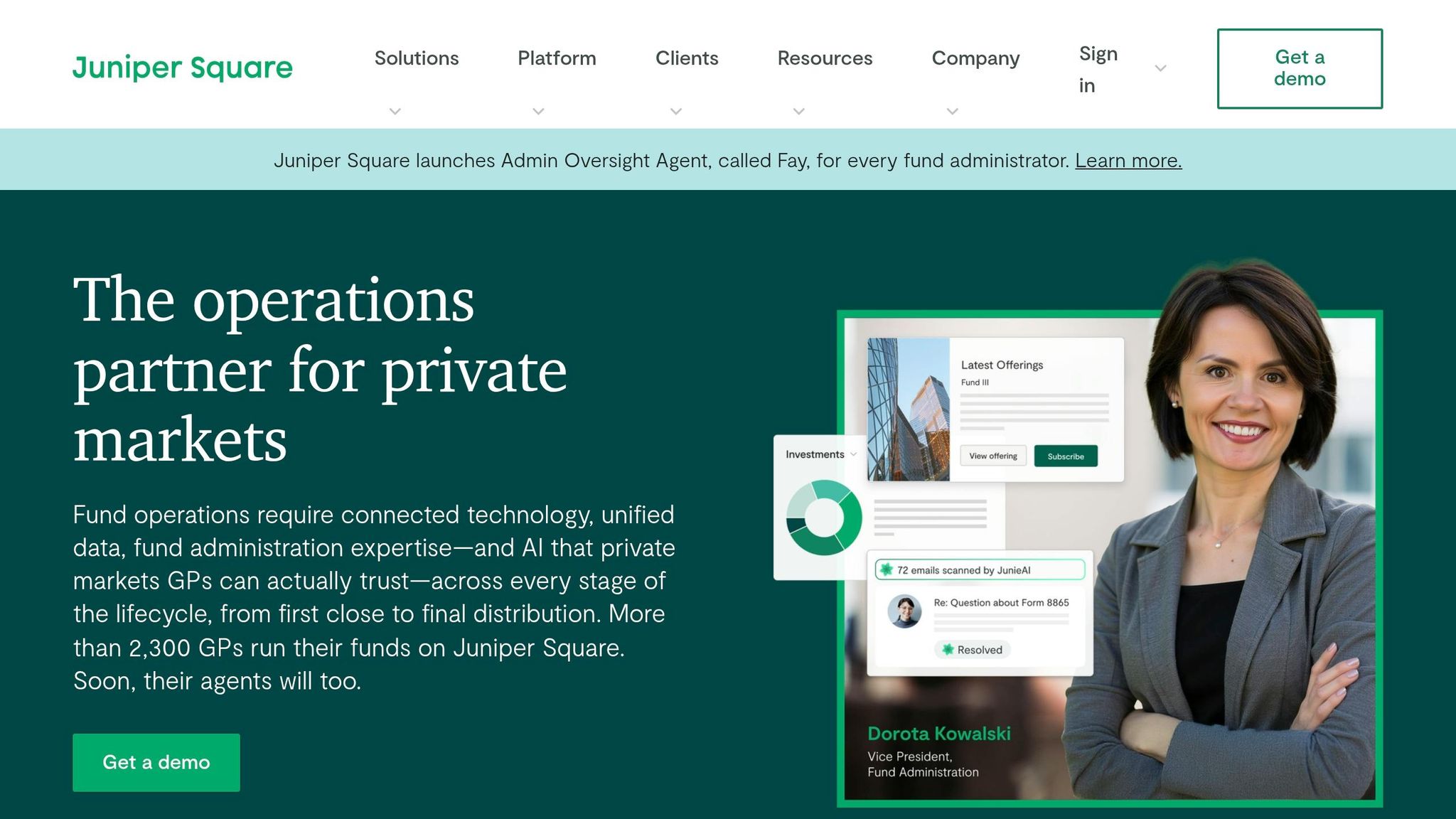
Once identity and compliance checks are done, Juniper Square takes over the investor operations side. It fits best in post-approval fund administration: subscriptions, capital calls, distributions, and investor records, all in one system for investor operations.
Its main strength is workflow automation, not underwriting. In plain terms, it helps teams run the process after an investor is approved, rather than decide who should be approved in the first place.
The platform automates onboarding compliance inside the subscription workflow. [1]
For investors, Juniper Square streamlines subscriptions, capital calls, and distributions in one workflow. [1] The next tool moves from fund administration into payment and distribution workflow automation.
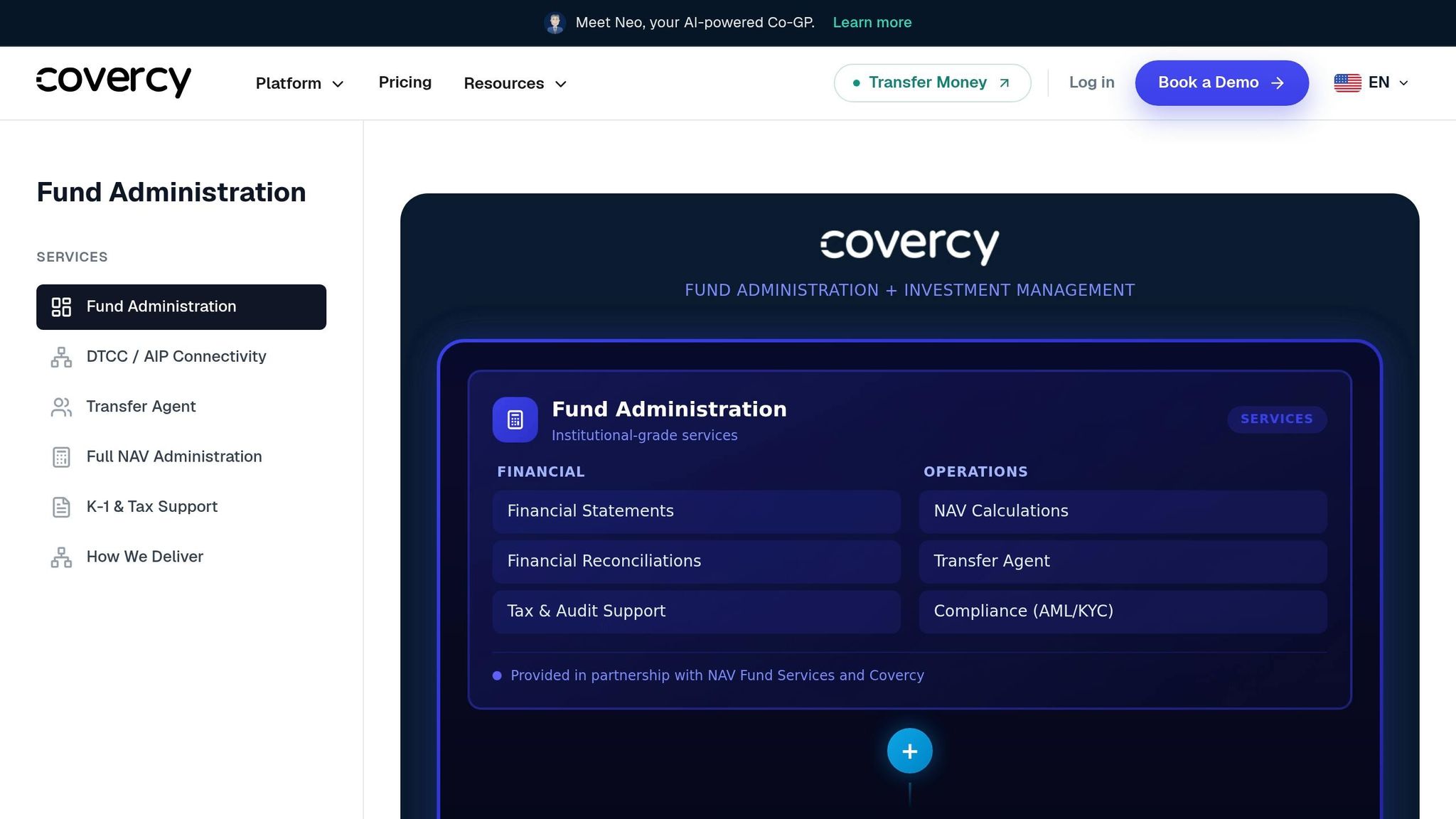
Covercy One is built for post-close investor administration. That means it handles the work that comes after money is committed and deployed, like capital calls, distributions, and entity reporting.
Instead of spreading those tasks across emails, spreadsheets, and separate tools, it puts them in one place. The key point is simple: this is a post-close tool, not a screening or underwriting tool.
Its main strength is centralized entity-level reporting and tracking.
That matters because post-close work can get messy fast. When reporting and records live in one system, it’s easier to see what’s happening at the entity level without hunting through scattered files.
For investors, the main upside is cleaner administration and clearer visibility into capital calls, distributions, and portfolio status.
In plain English, Covercy One helps keep reporting and cash-flow records lined up after capital is deployed. It’s less about deciding where to invest and more about keeping the back-office side of the investment process orderly once the deal is done.
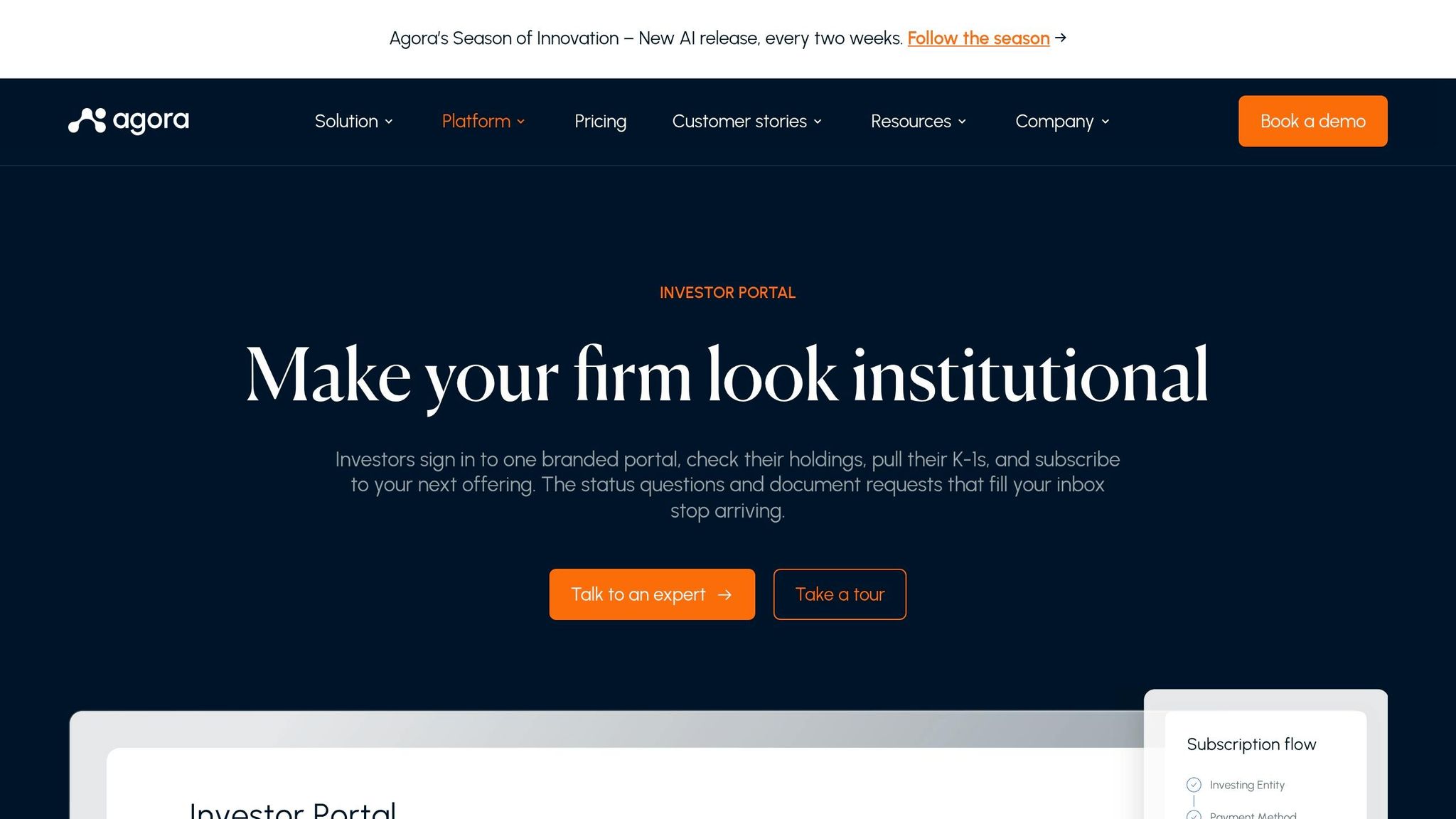
Agora is built for post-close investor relations and cap table management for GPs and syndicators. Put simply, it brings scattered investor work into one place instead of leaving teams to juggle emails, spreadsheets, and files across different systems. That’s the core appeal: one workflow instead of a patchwork process. [1]
Agora works as the main hub for investor records, KYC/AML files, subscription agreements, cap tables, and capital account histories. It also tracks commitments, signed documents, funded amounts, and data-room engagement. [1]
That matters because investor ops can get messy fast. One missed document or outdated figure can turn into a headache. Agora is meant to keep those records connected, so teams can see the full picture without digging through folders and back-and-forth threads.
Agora automates manual syndication work, including waterfall calculations, capital calls, and distributions. That cuts down on admin and takes some of the repetitive work off the team’s plate. [1]
For LPs, the result is simpler reporting and faster access to account activity. In plain English: fewer delays, fewer manual updates, and less waiting around for basic information. [1]
For LPs, Agora serves as the investor portal for capital account details, distribution history, and updates. Pricing starts at $749 per month. [1]
The next tool moves from investor operations to property-level tracking.
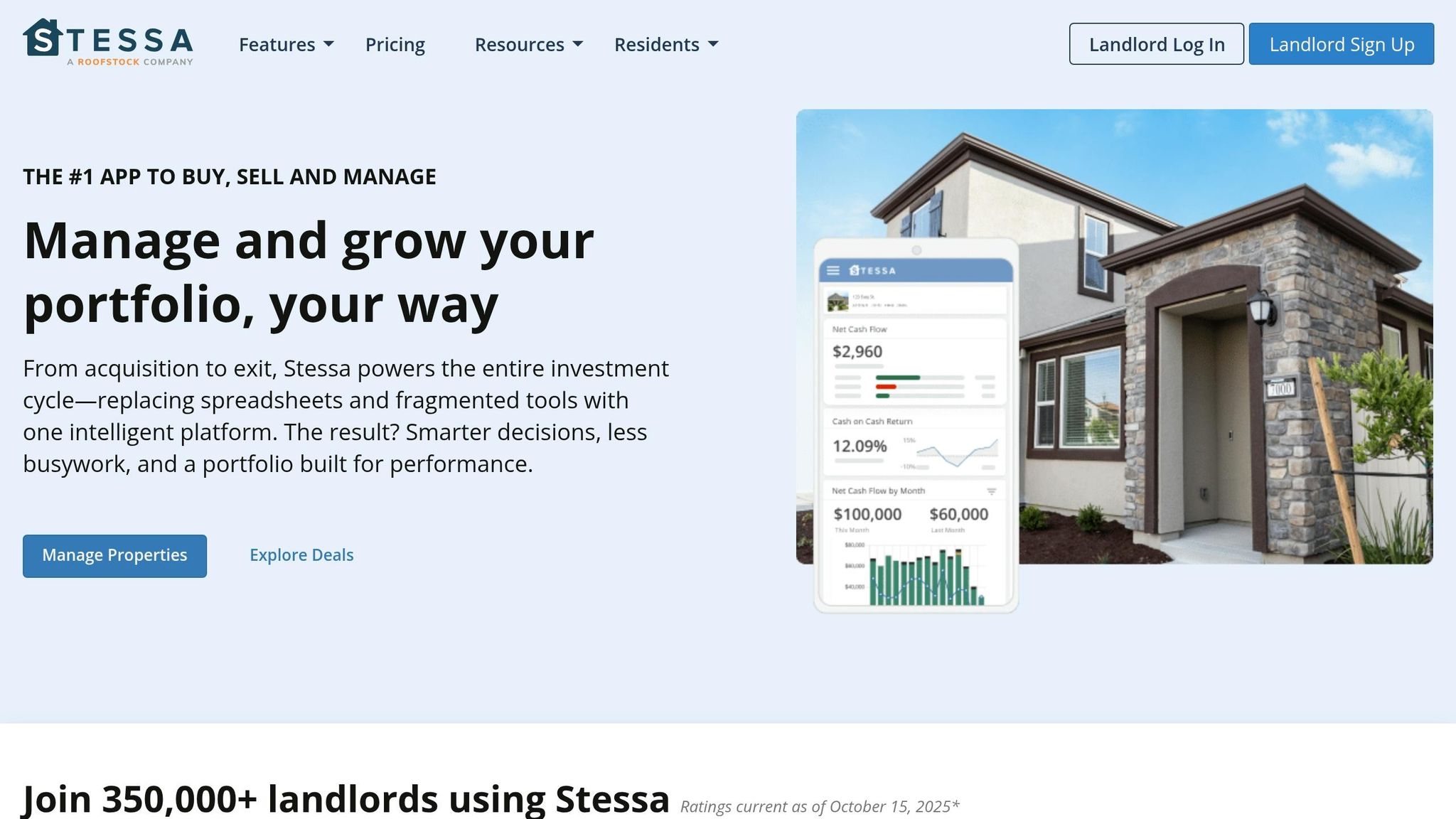
Many fund admin tools kick in once the reporting starts. Stessa picks up in a different place: it helps investors track how assets they already own are doing. It automates income, expense, and receipt tracking for individual investors and small to mid-sized portfolio owners. [4]
Stessa tracks cash flow, returns, and portfolio performance. It also supports tax reporting for investors who manage more than one asset. [4]
That said, its job starts after an asset is acquired. Stessa does not underwrite deals or provide market-level comping. [4]
Its automation focuses on the day-to-day work that can eat up time:
Those features give investors a clear audit trail and cut down the manual work tied to tax prep. [4]
For investors who have direct holdings along with passive stakes, Stessa brings portfolio performance into one view. [4] That's useful for keeping tabs on what you own.
But it's not built for deal screening or underwriting.
These tools fall into four main jobs: sourcing, underwriting, compliance, and post-close operations. So the better question isn’t “Which tool wins?” It’s which part of the workflow gets better.
Dealpath and Clik.ai are built for acquisition teams that need speed. Clik.ai’s AutoUW engine cuts manual data processing time by 90% [1], which matters when teams are sorting through OMs, rent rolls, and lender files at scale.
On the investor side, the most useful tools show their assumptions clearly. That matters because AI can move fast, but if the logic is hidden, it’s hard to trust the output without a second look.
Another tradeoff shows up in data coverage. Some tools give you broad reach. Others help you go deeper in one market. Reonomy and Placer.ai add ownership and foot traffic context that helps with early due diligence. HouseCanary and Markerr are more useful when you’re pressure-testing one deal or digging into a submarket before making a call.
For compliance, Trulioo and ComplyAdvantage focus on identity checks and AML screening, especially when investor onboarding crosses borders. After the deal closes, the work changes. Juniper Square, Agora, and Covercy One shift the focus to capital calls, distributions, and LP updates. From there, it becomes more about capital administration and investor reporting.
AI can speed up analysis. It can’t remove the need for human review.
Use the table below to match each tool to the job it handles best: sourcing, underwriting, rent forecasting, market scans, compliance, or portfolio tracking.
| Tool | Core Strength | Key Tradeoff | Best-Fit Scenario |
|---|---|---|---|
| Dealpath | Institutional pipeline tracking and AI document extraction | Enterprise setup and pricing complexity | Sponsor teams managing high-volume deal flow |
| Clik.ai | AutoUW workflow that reduces manual data processing time by 90% [1] | More oriented toward debt and lending workflows | Acquisition teams spreading OMs and rent rolls |
| HouseCanary | AVM valuation checks and CanaryAI market forecasts | Limited accuracy in thin-comp markets | Teams needing independent valuation checks on sponsor projections |
| Markerr | Pre-underwriting market screening using mobility, supply, and credit data | Best suited to institutional submarket screening | Teams ranking markets before underwriting begins |
| Placer.ai | Foot traffic and demand signals for local due diligence | Less useful when foot traffic is not a key value driver | Early-stage analysis for retail, hospitality, and mixed-use assets |
| Reonomy | 54 million U.S. commercial property records [1] | Ownership depth varies by market | Off-market sourcing and ownership research |
| Trulioo | Cross-border identity verification | Most valuable when investor bases extend beyond the U.S. | Platforms onboarding international investors |
| ComplyAdvantage | AML and compliance screening | Needs to fit existing onboarding workflows | Ongoing investor screening |
| Juniper Square | Capital calls, distributions, and LP communications | Limited pre-close sourcing or underwriting capability | GPs managing complex fund admin and LP relations |
| Covercy One | Centralized entity-level reporting for capital calls and distributions | Post-close tool only | Investors tracking capital deployment and distributions |
| Agora | Capital raising and investor portal tools | Starts at $749 per month [1] | Syndicators scaling investor relations |
| Stessa | Automated income, expense, and cash flow tracking | Does not underwrite deals or provide market comps | Individual investors monitoring direct and passive holdings |
Once you line these tools up by workflow stage, the choice is less about a single product and more about how you build the stack. The strongest 2026 setups usually bring together four layers: underwriting/extraction (Dealpath or Clik.ai), market validation (HouseCanary or Markerr), KYC/AML (Trulioo or ComplyAdvantage), and reporting (Juniper Square or Agora) [1][2]. That in-between space matters a lot. It's often where deals get stuck, delayed, or quietly fall apart.
The right stack also changes based on who owns the workflow.
When you assess any tool, put three things ahead of AI sales language: clear assumptions, strong data coverage, and a good integration fit. Build around tools you can audit. Speed helps, but model transparency matters more.
Prioritize tools based on the real estate work you want to automate, whether that’s deal sourcing, underwriting, or portfolio reporting. Start with your biggest bottlenecks. Then pick software that connects with your current property management and accounting systems so data moves cleanly from one place to another.
For growth-stage companies with complex capital structures, Phoenix Strategy Group offers financial advisory, data engineering, and FP&A support to help build a scalable technical foundation tied to your investment goals.
Before you underwrite a deal, use AI-powered tools for document intelligence and financial modeling. Platforms like NextProp AI, InvestorPilot, and other underwriting engines can pull data from offering memorandums, rent rolls, and T-12 financial statements.
They take messy source files and map the data into standardized pro forma models. That makes it much easier to run valuations and screen deals in minutes instead of grinding through spreadsheets by hand.
If the capital stack gets more complex, Phoenix Strategy Group can help validate sponsor projections and stress-test assumptions.
AI can process huge amounts of data fast and with steady accuracy. That’s a big plus. But when a decision gets nuanced, or when you need to pressure-test the logic behind an automated output, human review still matters more.
That’s especially true when looking at a sponsor’s track record, reputation, and fit with investors. It also matters when testing rent growth assumptions and sorting through complex capital structures. These aren’t areas where you want to run on autopilot.
Phoenix Strategy Group can step in with expert, unbiased review to help keep forecasts realistic and grounded in institutional standards.