Published on
September 2, 2026


If your API docs lag behind your code, launches slip, support tickets pile up, and partner revenue gets pushed back. I’d fix it with four moves: tie docs to code changes, assign one owner, put review deadlines in place, and publish release notes that tell partners what changed and what they need to do.
Here’s the short version:
I see this as a workflow issue, not just a writing issue. When documentation is part of the release path, teams ship with fewer delays, partners get clearer guidance, and support spends less time fixing avoidable confusion.
Below, I’ll walk through the main bottlenecks and the fixes that help fintech teams keep docs in sync with product changes.
When your API changes and the docs don't, partners end up building against instructions that no longer match the product. That gap shows up fast in outdated OpenAPI files, old code samples, and stale auth steps. And this isn't just messy. It leads to broken integrations.
Once the spec drifts, each team starts working from a different source of truth.
The usual warning signs are pretty clear: request fields don't match, response examples no longer reflect current behavior, and error codes show up in production without any mention in the docs. At that point, partners are left guessing, and support teams have to clean it up.
Authentication docs are one of the biggest risk areas. Old guidance for OAuth 2.0 token refresh flows or mTLS certificate rotation schedules can stop an integration cold, especially in heavily regulated settings [1].
Rate limiting can cause the same kind of pain, just in a quieter way at first. If your docs don't spell out the current limits or the retry pattern clients need to follow - specifically, exponential backoff with jitter - partners may create a retry storm. That's when a wave of retries hits the API at the same time, overloads it, and gets the client blocked [1].
Environment-specific limits can also lead to rework when they aren't spelled out in plain English.
Treat the OpenAPI spec as the single source of truth. If the code changes, the docs should change in the same pull request. No updated spec, no merge. That's not something to leave to good intentions. Your CI pipeline should enforce it.
It also helps to add automated checks before merge for:
Automation catches a lot, but the publish path still needs a clear owner.
API documentation slows down fast when no one owns the final publish. Product, engineering, developer relations, compliance, and support all touch the docs at some point. Once ownership is clear, the next thing that tends to go sideways is review delay.
One team updates the endpoint. Another edits the guide. Then no one steps in to settle a conflict or close out compliance feedback.
What happens next is messy. Partners get incomplete integration guides. Support teams end up sharing internal notes instead of official docs. And every API change turns into a pile of untracked Slack threads instead of a clean publish.
Start by naming a directly responsible individual (DRI) for API documentation. In many fintech teams, that person is a developer experience engineer, a technical writer embedded in product or engineering, or an API platform product manager. The DRI owns final quality and publication.
A simple responsibility matrix helps keep input organized without turning the process into red tape.
| Role | Responsibility |
|---|---|
| Engineers | Technical accuracy - request/response examples, error codes, edge cases |
| Product managers | Business context - what changed, why, and what partners need to know |
| Compliance/legal | Regulatory and policy wording - data handling, consent, disclosures |
| Support/customer success | Common issues, FAQs, and clarity for typical partner questions |
| DRI | Consolidates input, resolves conflicts, enforces style, and publishes |
The matrix should also spell out the events that automatically trigger a documentation task. That includes:
When any of those happen, a documentation task gets created and sent to the right owner. No tribal knowledge. No guessing who should pick it up.
Review deadlines matter too. Without them, the queue drags on. Engineering reviews should happen within 1–2 business days, and compliance within 2–3 business days for medium-risk changes. If a reviewer doesn’t respond in that window, the DRI follows a documented default: escalate or move ahead with publication and flag the change in release notes for retrospective review. [2][3]
Even with ownership in place, review queues can still slow release.
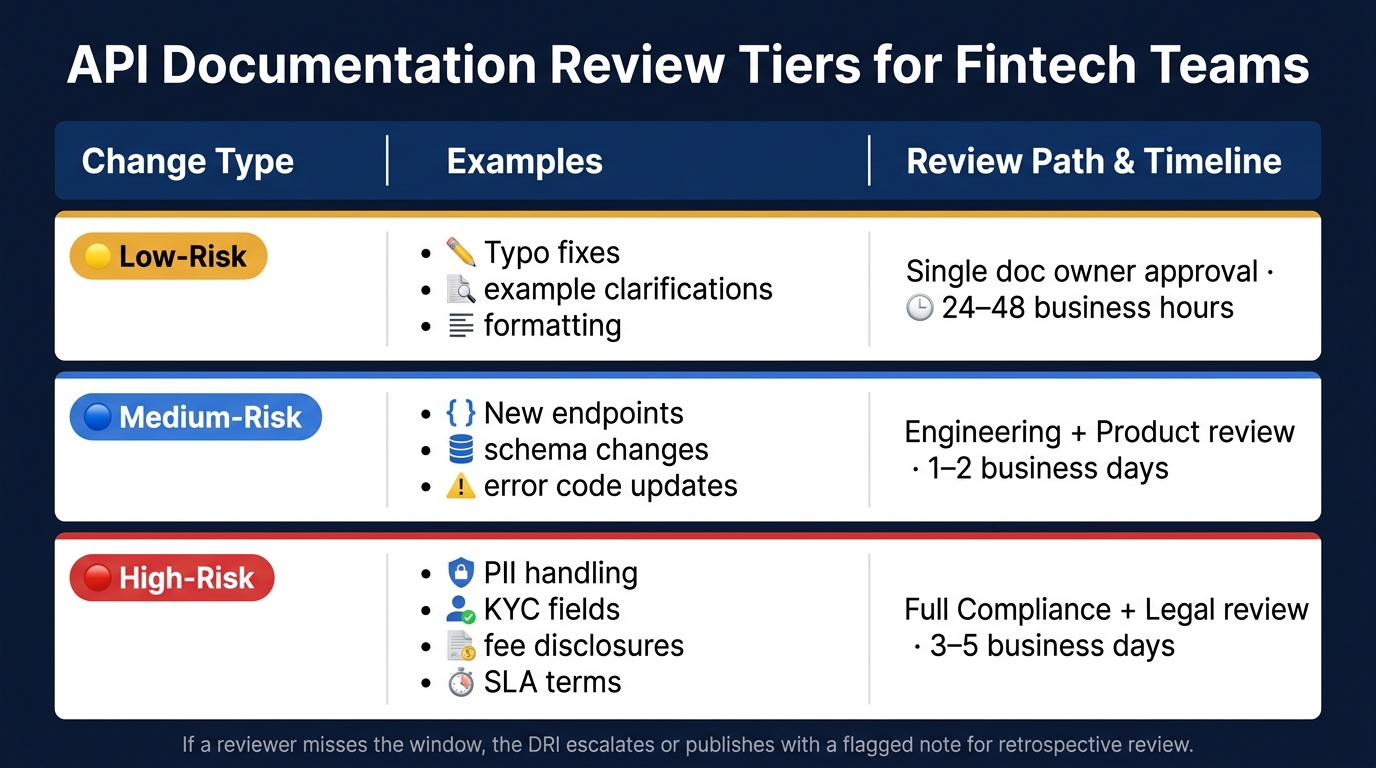
API Doc Review Tiers: Risk Levels, Examples & Approval Timelines
A named owner helps. But releases can still get stuck when product, engineering, and compliance all work on different clocks.
If there isn't one review order and one place everyone trusts, teams start waiting on each other. Product pauses for engineering. Engineering waits for compliance. Compliance reviews an older draft. Then the same issue gets discussed three different ways. That leads to stalled approvals, mixed feedback, and slow sign-off.
This becomes a bigger problem during partner onboarding. Partners can't ship until the docs, terms, and implementation details are approved - especially when those docs cover PII handling, KYC fields, fee disclosures, and SLA terms. If a document sits in review for an extra day, partner onboarding slips by an extra day too. Across dozens of integrations, that delay stacks up fast.
The fix is simple in theory: treat documentation like part of the release, not cleanup after the release.
In practice, that means doc updates should live in the same pull request as the code change. Set clear reviewers. Put hard windows on reviews. Add escalation rules so work doesn't just sit there quietly.
Risk tiering keeps this from turning into a traffic jam. A typo fix shouldn't go through the same path as a change to fee disclosures or KYC fields.
| Change Type | Examples | Review Path |
|---|---|---|
| Low-risk | Typo fixes, example clarifications, formatting | Single doc owner approval, 24–48 business hours |
| Medium-risk | New endpoints, schema changes, error code updates | Engineering + product, 1–2 business days |
| High-risk | PII handling, KYC fields, fee disclosures, SLA terms | Full compliance + legal review, 3–5 business days |
Pre-approved templates help move this along. Compliance and legal can review and sign off on standard structures ahead of time, like a template for new REST endpoints that already includes vetted language around authentication, rate limits, error handling, and regulatory considerations. Then future updates only need a check that the template was used the right way. You don't have to argue over the same wording every single time.
The review surface matters too. If product leaves comments in a shared doc, engineering answers in a ticket, and compliance sends edits by email, the whole process gets muddy fast. No one has a clean view of what's done, what's blocked, or which version is current.
One review thread fixes that. Pull requests with inline comments work well. So does a doc platform with tracked suggestions. Either way, everyone should work from the same diff. That keeps the audit trail clear and cuts down on back-and-forth.
Once approvals speed up, the next bottleneck is making sure partners know exactly what changed and what they need to do next.
Once approvals are done, release notes are what tell partners exactly what changed and what they need to do next.
If you ship an API change without clear release notes, things can go sideways fast. You can end up with production incidents, or worse, silent data corruption that no one spots right away. And when you’re dealing with a lot of partner integrations, a single undocumented breaking change can spread everywhere.
A good release note doesn’t need to be long. It needs to be complete.
At a minimum, every API update should include these fields:
| Field | Purpose |
|---|---|
| Affected API version | Tells partners exactly which version is impacted |
| Date (MM/DD/YYYY) | U.S.-formatted date of the change |
| Summary of change | Plain-language description of what changed and why |
| Action Required (Yes/No) | Immediate signal for whether partners need to do anything |
| Migration steps | Step-by-step instructions if action is required |
| Effective date | When the change goes live |
| Deprecation/sunset date | Deadline for partners still on the old version |
That table may look simple, but it does a lot of work. It answers the questions partners ask first: What changed? Does this affect us? When do we need to act? If those answers are buried or missing, support tickets pile up and rollout risk climbs.
The next issue is consistency. One change has to show up across every doc, SDK, and partner workflow at the same time.
That’s where scale gets tricky. The biggest risk usually isn’t the change itself. It’s mismatch across surfaces. Maybe the SDK says one thing, the docs say another, and a partner-facing reference still shows the old behavior. That kind of drift causes confusion fast.
The fix is a single source of truth for every partner-facing surface. Shared templates, versioning standards, and automated validation help keep docs, SDKs, and partner references in sync so teams aren’t updating each one by hand and hoping nothing gets missed.
These bottlenecks aren't documentation problems at heart. They're workflow problems, which means they need workflow fixes.
The move is simple: make documentation part of the release process. That means one source of truth, one owner, time-boxed reviews, and clear release notes.
When docs are part of how a team ships, things start to run better. Teams ship faster, support load drops, and partner integrations scale with fewer delays. Once documentation lives inside the release workflow, it stops being the bottleneck.
Treat documentation as a release gate, not something you circle back to after development. If the code ships, the docs should ship too. That means updating documentation inside your CI/CD workflow so changelogs, API references, and release notes move out in the same release cycle as the code.
This matters because docs tend to drift when they live outside the delivery process. One small API change, one renamed field, one missing note in the changelog, and suddenly users are working from stale info. Tying docs to the pipeline helps prevent that.
You can use tools like oasdiff in CI/CD to flag API changes and stop merges when breaking changes don't come with matching doc updates. Pair that with Conventional Commits, and changelog generation gets a lot less manual. Tools like release-please or semantic-release can turn commit history into changelog entries automatically, which saves time and cuts down on missed updates.
API documentation works best when it has shared ownership. That’s what keeps it accurate and in step with the product as it changes.
Technical writers should guide clarity and consistency. At the same time, engineering, product, and support need to review updates so deprecations and migrations stay in sync.
For partner integrations, set named owners before launch across three areas:
A RACI matrix can make accountability clear and help avoid gaps in documentation or controls.
Every API release note should include a version identifier, release date, effective date, and a change category: Added, Changed, Deprecated, or Removed.
It should describe the update in plain English, spell out the impact level, name the affected endpoints or schemas, and link to migration guidance.
Breaking changes need a clear 60- to 90-day notice window and should be visually highlighted so teams can spot them fast.