Published on
September 21, 2026


If I don’t need income, I’d usually look at a DAF first. If I do need income, I’d look at a CRT. That’s the core choice.
Here’s the short version in plain English:
If I’m trying to diversify a low-basis stock position, the tradeoff is simple: simplicity and pure charitable giving with a DAF, or income plus more paperwork with a CRT.
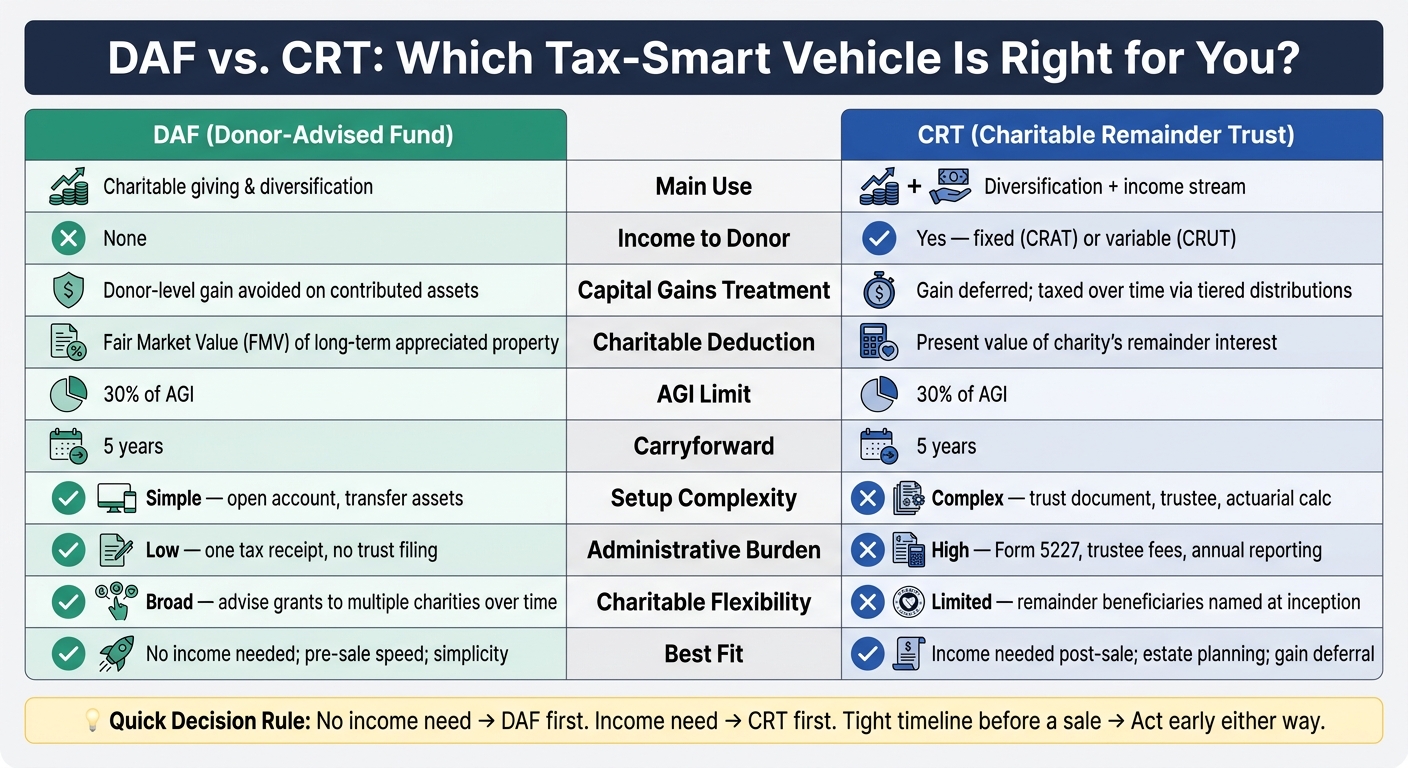
DAF vs CRT: Tax-Smart Diversification Comparison Chart
| Criteria | DAF | CRT |
|---|---|---|
| Main use | Charitable giving and diversification | Diversification plus income |
| Income to donor | No | Yes |
| Capital gains result | Donor-level gain avoided on donated assets | Gain deferred and taxed over time |
| Deduction | Usually FMV for long-term appreciated property | Based on charity’s remainder interest |
| AGI limit | 30% for appreciated property | 30% for appreciated property |
| Carryforward | 5 years | 5 years |
| Setup | Simple | More work |
| Admin | Low | Trust filing, trustee, annual reporting |
| Best fit | I want tax-aware giving without income | I want income after the sale |
I’d use this framework first: no income need = DAF; income need = CRT; tight timeline before a sale = act early either way.
A donor-advised fund is a charitable account run by a public charity. When you donate appreciated stock - or, if the sponsoring charity allows it, pre-sale interests in a closely held business - legal ownership moves to the charity, not to you. The charity then owns the assets and can sell them without paying capital gains tax, which means you avoid that tax yourself. You still keep advisory privileges: you can recommend how the funds are invested and which qualified charities should get grants, but you can't take the money back or receive income from it.[5][7][9][11]
A DAF is irrevocable. Once the assets go in, they're no longer yours, and you can't pull income from them later. That's the big tradeoff. The upside is simplicity. A CRT gives up some of that simplicity in exchange for an income stream.
For long-term appreciated property held for more than one year, the deduction is usually based on fair market value, not your cost basis, up to 30% of your adjusted gross income (AGI) in the year of the gift. If you can't use the full deduction right away, you can carry the rest forward for up to five more tax years, with the same 30% AGI cap applying each year.[4][7][8]
Take a simple example: a $1,000,000 gift of appreciated stock produces a $300,000 deduction in year one if AGI is $1,000,000. The unused amount carries forward and can be used later as AGI permits.[4][7][8][10]
Cash gifts to a DAF are deductible up to 60% of AGI. But when someone is planning around a concentrated stock position, donating appreciated property is usually the better tax move. Why? Because you sidestep the gain instead of selling first, paying tax, and then donating what's left after tax.[3][6][9]
The setup and upkeep for a DAF are light. You pick a sponsoring charity, open the account, and transfer the assets. From there, the charity handles the account administration and grant processing. You also get one tax receipt for the contribution. There's no trust document to draft, no trustee to name, no annual trust return, and no actuarial math to deal with.[5][9]
That makes a DAF a strong fit when tax-aware diversification matters more than getting current income. It's often a good match for a founder nearing a liquidity event who wants to donate part of their pre-sale shares, avoid personal capital gains tax on that block, and decide later which charities should receive the grants. It can also work well for owners who want to front-load several years of charitable giving into one high-income year - often called charitable bunching - while sending grants to operating charities over time.[6][8][9] If income from the donated assets matters, the CRT is the next structure to look at.
A charitable remainder trust (CRT) is an irrevocable trust under IRC §664. You transfer appreciated assets into the trust, the trust can sell them without immediate tax at the trust level, reinvest the proceeds, pay you income for life or for up to 20 years, and then pass the remainder to charity.[16][18]
That’s the big split between a CRT and a DAF: a CRT is built to pay you income. If your goal is to diversify a concentrated position and still keep cash flow coming in, that point matters a lot.
CRATs are about steadiness. CRUTs give you more movement.
A charitable remainder annuity trust (CRAT) pays a fixed dollar amount each year, no matter what the portfolio does. A charitable remainder unitrust (CRUT) pays a fixed percentage of the trust’s assets, revalued each year, so the payout goes up or down with the portfolio.[17][20][21][22]
Both structures must:
That 10% minimum can put a cap on how high the payout rate can go, especially for younger donors or trusts with more than one beneficiary.[13][16][17][21]
In plain English, a CRAT fits better if you want fixed income. A CRUT fits better if you want income tied to portfolio results. A CRUT also lets you add more contributions after the trust is funded, while a CRAT does not.[17][20][21][22] That choice leads to the next issue: how much deduction and how much extra work are you willing to trade for that income stream?
The CRT deduction is based on the present value of the charity’s remainder interest, not the full amount you put in. The calculation uses IRS Section 7520 assumptions and depends on factors like your age, the payout rate, and the trust term.[2][12][14] In general, a lower payout rate, a shorter income term, or an older beneficiary leads to a larger deduction. The deduction is capped at 30% of AGI, with a five-year carryforward for any unused amount.[23]
A CRT also defers capital gains tax rather than wiping it out. When the trust makes distributions, those payments are taxed under the §664(b) tier rules - ordinary income first, then capital gains, then tax-exempt income, and then return of principal.[18][24] So the gain shows up over time instead of hitting all at once. For many people, that timing difference is the whole ballgame.
The flip side is paperwork and oversight. A CRT needs an irrevocable trust document, a trustee with fiduciary duties, active investment management, and annual Form 5227 reporting.[15][19] It also brings legal fees, trustee costs, and yearly reporting expense. If you want tax-aware diversification and a personal income stream, those added steps may be worth it. For business owners planning ahead of a sale, the key issue is pretty simple: is that income stream worth the added administration? That’s what sets up the direct comparison with a DAF.
A DAF is usually the better fit when the main goal is charitable giving with less hassle. A CRT is built for a different job: it lets you keep an income stream after the sale while still setting aside part of the value for charity.
Here’s the side-by-side view that matters most before a liquidity event:
| Dimension | DAF | CRT |
|---|---|---|
| Primary objective | Charitable impact; simplified giving | Income stream with charitable commitment |
| Donor income | None | Fixed (CRAT) or variable (CRUT) payments |
| Capital gains treatment | Donor-level gain avoided on contributed assets | Gain deferred; taxed over time via tiered distributions |
| Deduction mechanics | FMV deduction for long-term appreciated property; 30% AGI cap; five-year carryforward | Remainder-interest deduction; same AGI limits and carryforward rules |
| Control | Donor advises on grants and investments | Trust terms and trustee govern; irrevocable at funding |
| Administrative burden | Low | High - trust document, trustee, Form 5227, annual accounting |
| Cost | Modest | Higher - legal setup, trustee fees, ongoing administration |
| Charitable flexibility | Broad; can support multiple charities over time | Limited to named remainder beneficiaries at inception |
| Best use case | Pure philanthropic leverage; simplicity; pre-sale speed | Income smoothing post-sale; estate planning; gain deferral |
With concentrated positions, timing is the dealbreaker. In both cases, the transfer has to happen before a binding sale. If you wait too long and the sale is already locked in, the tax result can change fast.
Private-company shares add another layer. They often come with transfer limits, and they may also need an appraisal. That means the window to act can be tighter than people expect.
Sometimes the answer isn’t DAF or CRT. It’s both.
A blended setup can use a DAF for the part you want to give away outright, while a CRT handles the slice that should keep paying income over time. That can be a clean way to split two goals that pull in different directions.
There’s also a common handoff structure: a DAF can serve as the CRT remainder beneficiary. In plain English, the trust can make income payments during its term, and when that term ends, the remaining assets flow to the DAF for future grantmaking.
Use the comparison above to narrow your choice based on income needs, timing, and asset type. The biggest filter is simple: if you don’t need income, a DAF usually makes more sense. If you do need income, a CRT is the better match.
Here’s the short version:
| Founder priority | Better fit |
|---|---|
| No income needed; maximize charitable capital | DAF |
| Need a structured income stream after the sale | CRT (CRAT or CRUT) |
| Asset is publicly traded stock | Either; DAF is simpler |
| Closely held stock | DAF if accepted; CRT only if income matters enough to justify the extra work |
| Liquidity event is imminent | DAF |
| Have more lead time before the sale | Either; CRT needs more lead time |
| Want to support multiple charities over time | DAF |
| Want income now and charity later | CRT or a blended approach |
Timing also matters. Both structures need to be funded before a binding sale.[1][25] Miss that window, and the planning may not work as intended. With private company shares, transfer limits and appraisal work can make that window even tighter.
Once you’ve picked the structure, move fast on setup. Before funding either vehicle, coordinate with a CPA, estate attorney, appraiser, and transaction counsel.
For growth-stage owners planning an exit, Phoenix Strategy Group can help with fractional CFO support, FP&A, and exit-planning analysis. That includes cash-flow modeling to show how contributing part of your equity to a DAF or CRT affects liquidity, runway, and deal readiness before and after closing. In plain English, it helps you see how much can go into a DAF or CRT without putting pressure on liquidity or the deal itself.
You need to legally set up and fund the DAF or CRT before you sign any binding sale agreement. If you wait until after that point, the IRS may treat the gain as personally taxable under the assignment of income doctrine.
That’s the hard deadline.
Still, it helps to start 18 to 24 months before an expected exit. That extra runway gives you more time to handle structuring, compliance, and tax planning.
Both can work for closely held shares, but they serve different goals.
A CRT is often the better pick for illiquid business equity. Why? It can defer capital gains tax when the asset is sold, let the full proceeds stay invested without an immediate tax hit, and turn that value into an income stream.
A DAF can also take private company shares, but it tends to involve more setup work. That often means extra lead time for due diligence, a qualified appraisal, and legal review of any transfer restrictions.
As a rule of thumb, CRTs tend to make more sense for assets worth $500,000 or more.
Yes. A donor-advised fund (DAF) can be named as the remainder beneficiary of a charitable remainder trust (CRT).
That setup lets you receive income from the trust during its term, while still giving you a way to guide how the remaining assets go to charities over time once the trust ends. When used together, these tools can help with tax planning and long-term charitable giving.