Published on
August 3, 2026

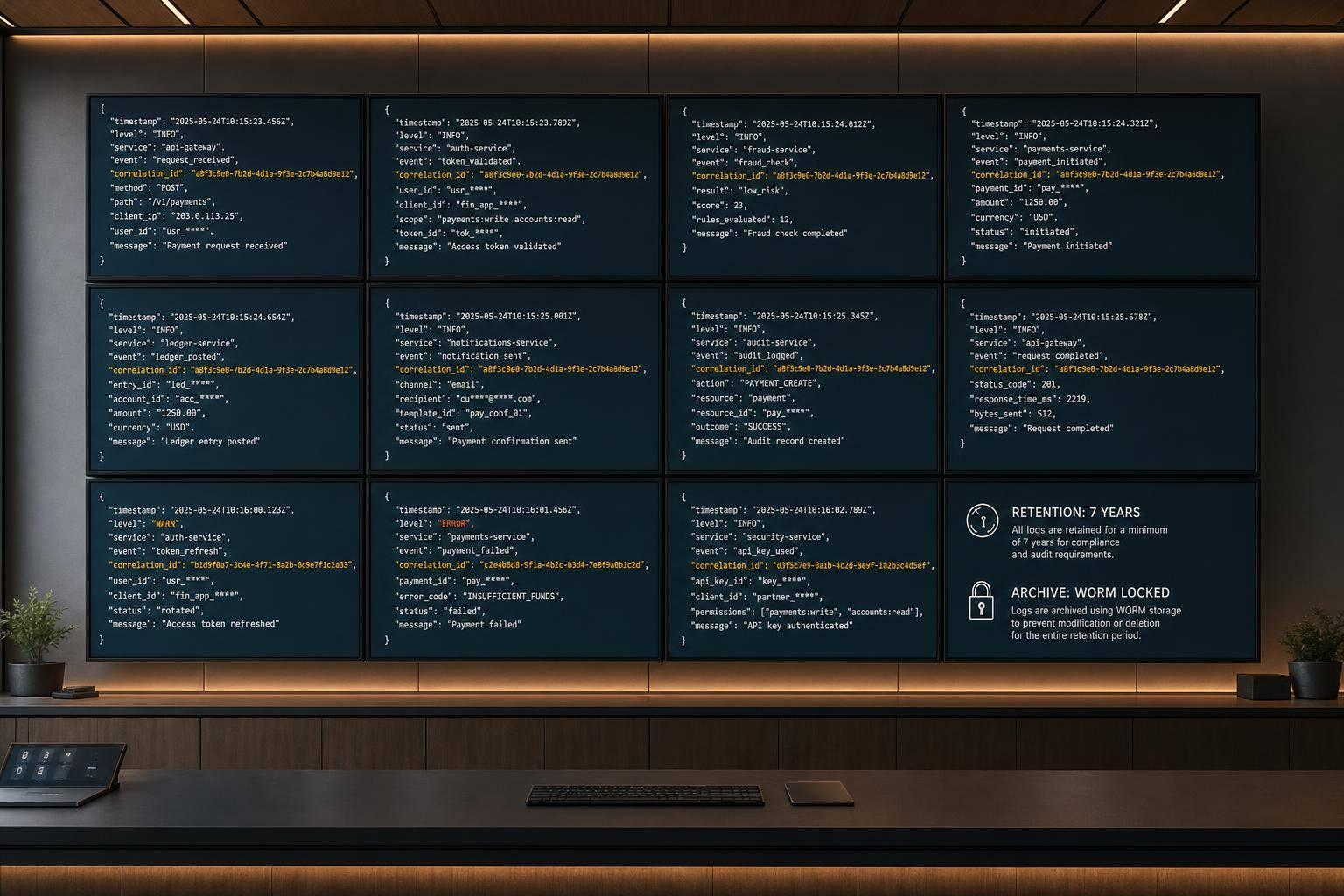
If your finance APIs are not logged the right way, you cannot prove who did what, trace failed payments, or support audits. For finance platforms, the baseline is simple: log each API event across gateways, apps, identity tools, databases, data pipelines, and cloud systems; keep 12 months of logs with at least 3 months easy to access for PCI DSS use cases; and keep many finance control records for up to 7 years.
Here’s the short version of what matters:
A few numbers make the point. The article notes that 92% of financial and insurance firms had a production API security issue in the prior year, and nearly 1 in 5 had an API breach. It also notes that in 42% of studied attacks, logs were absent or altered, and attackers tried to disable or erase logs in 82% of those cases.
If I had to reduce the whole article to one line, it would be this: build finance API logging as a control system, not just a debug tool.
Before you write logging code, tie logging needs to the business processes the API supports. The goal is simple: figure out what each rule says you must prove, then identify which API calls create that proof. Start with the rulebook. Then turn those rules into API events.
Each rule set covers a different part of finance operations. That means each one maps to a different group of API events.
PCI DSS Requirement 10 applies to card payment endpoints. It calls for audit trails for access to systems that store, process, or transmit cardholder data, admin actions, invalid access attempts, authentication changes, and events that start or stop logging itself[10][11]. In practice, that means logging card token creation, token updates and deletions, authorization requests and responses, capture and settlement calls, refund and dispute events, and any admin API that changes payment routing rules or security settings.
SOX-aligned internal controls center on financial reporting integrity. Any API that can change the general ledger, journal entries, chart-of-accounts structure, or approval workflows needs logs that show who made the change, what changed, when it happened, and which endpoint was used.
FFIEC guidance covers bank connectivity and ACH flows. It expects logs for remote access, privileged user actions, ACH initiations, balance and transaction pulls, and abnormal API activity[1][5]. Partner terms may add more items, such as consent capture, KYC and onboarding status changes, dispute and chargeback actions, and webhook delivery status.
A regulatory-to-event mapping table helps keep this clean. Each row should connect a rule clause to a business process, the API endpoints involved, and the exact event types required.
If core fields are missing, audits get messy fast. Incident review does too. So start with one standard schema across every service.
| Field | What It Captures |
|---|---|
| UTC timestamp and local time zone | Exact event time; local display aligns with close calendars and cutoff times |
| Actor identity | Human user ID, service account ID, or external partner ID |
| Auth reference | Token ID, API key ID, or OAuth client ID, never the raw secret |
| Endpoint + HTTP method | e.g., /v1/payments/{id}/refund + POST |
| HTTP status and outcome | Success or failure, with reason where available |
| Source IP | Supports fraud review and access analysis |
| Session or device ID | Connects multiple calls within the same user journey |
| Action type | e.g., authorize_payment, update_journal_entry |
| Correlation ID | Ties related events across microservices for a single transaction |
| Source system | e.g., payments-gateway, ledger-service, reporting-ETL |
For finance workflows, add a business object reference like payment_id, invoice_id, or journal_entry_id. Also add a customer or account key such as customer_id or bank_account_id. That gives controllers and fractional CFOs a clean path from a financial statement back to the API event behind it.
The best way to enforce this is through shared middleware or logging libraries. That way, no new service goes live without these baseline fields already filled in.
Once the schema is locked, the next step is deciding which event types each system must send.
For payments, log payment create, authorization, capture, refund, void, dispute open/update, tokenization, card-on-file changes, and failed auth[8][6][9].
For banking, log ACH create, cancel, return, settlement, balance and transaction pulls, account link/verify/disconnect, OAuth issue/refresh/revoke, and consent capture/withdrawal[2][7][9].
For reporting, log report requests/completions, exports and recipients, reconciliation starts/completions, match results, adjustments, schedule changes, and admin policy updates[3][4].
Each event type should also include a job, report, or reconciliation run ID. Without that, tracing why a report or reconciliation result looked a certain way on a given day becomes far harder than it should be.
With the event list in place, you can map those events to the systems that generate them.
Once you've defined your event types, the next job is simple in theory and messy in practice: make sure logs are coming from the right places. And not just coming in, but coming in in a format you can govern, search, and audit.
Finance platforms need logs from six separate layers. Each one shows a different part of what happens when an API call hits your system.
API gateways are the first place to capture logs. Every inbound payment or banking request passes through them, so they should log the HTTP method, path, status code, latency, caller identity, source IP, TLS details, rate-limit decisions, and whether a WAF or threat filter blocked the call. This is the first record of the attempt.
Application services sit behind the gateway and run the business logic. Their logs should record transaction lifecycle events such as payment_initiated, payment_authorized, and payment_settled, along with idempotency keys, balance changes, ledger postings, and exceptions. This is the layer where an API call changes financial state.
Identity systems like OAuth, SSO, and MFA show who got access and what they were allowed to do. Capture login attempts, MFA outcomes, token issuance and revocation, consent, and scope assignments such as initiate:payments or read:transactions. These logs matter when you're trying to confirm whether a client had the right permissions before a high-value transfer went through.
Database audit logs on core financial tables such as payments, ledger entries, and accounts should record who accessed or changed records, the SQL operation type, and the primary key affected. For reporting queries, also log access to sensitive views where PII or account data is exposed.
ETL/ELT logs carry traceability into reporting. Log each job run with source and destination datasets, row counts, validation results, schema changes, and the time window of upstream API-driven data included in the run.
Cloud logs such as VPC flow, load balancer, and container runtime logs help connect API incidents to network or compute events. For example, they can show that a firewall change happened at the same time failed wire transfer calls started showing up.
Raw logs from six systems are hard to work with if they can't be joined. The answer is a shared JSON schema and one correlation ID that moves through every layer.
Generate the correlation ID at the gateway and pass it downstream in X-Correlation-ID. Every service, queue, database operation, and pipeline job that touches the same transaction should keep that ID attached. If a payment fails at settlement and you need to trace it from the customer's API call to the ledger posting and then into the daily reporting aggregate, that correlation ID is what turns a long manual hunt into a short investigation.
Each source can then add its own details on top of the shared schema:
Document the schema in a shared Finance API Logging Standard and make it a release gate. New APIs and major changes should show compliant log output before they go to production.
With logs standardized, the next step is to assign retention, integrity, and access controls by log type.
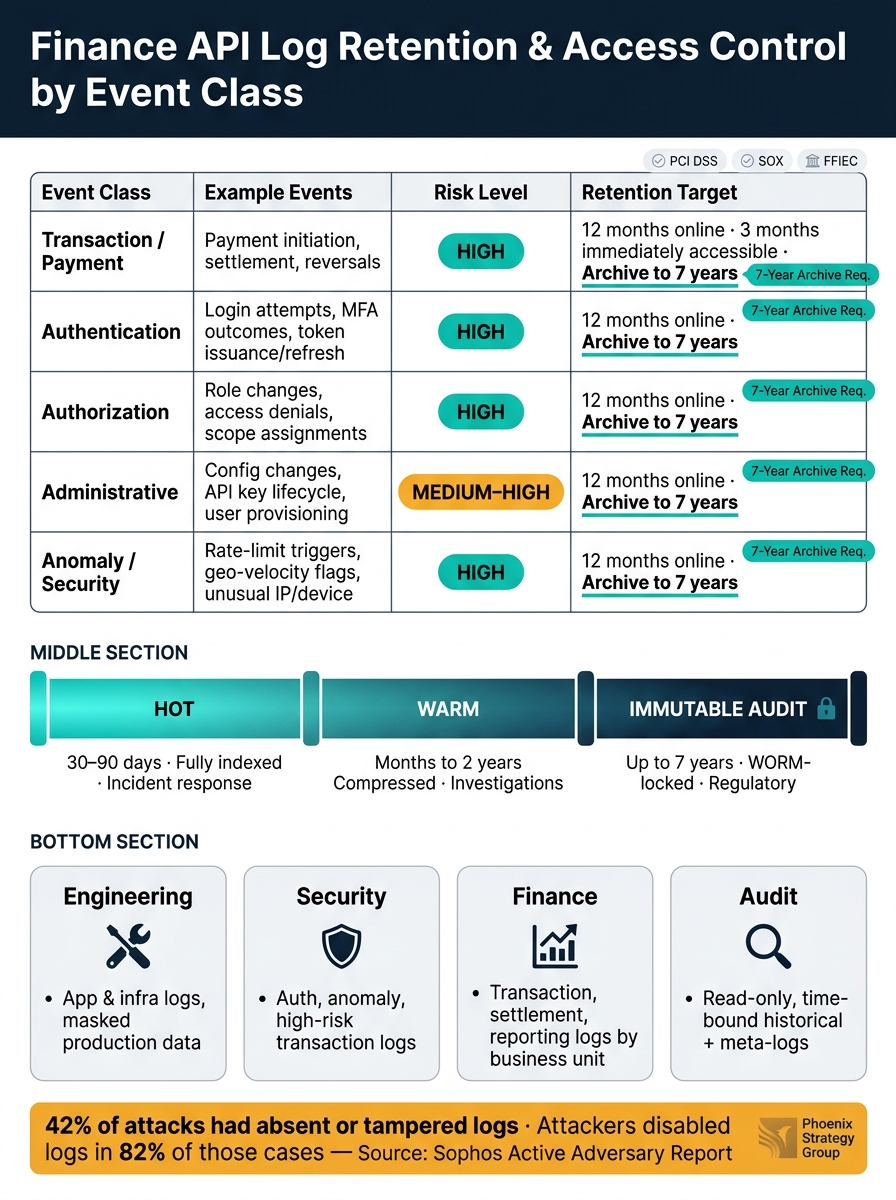
Finance API Log Retention & Access Control by Event Class
Once logs are coming in from standardized sources, the next job is getting them audit-ready. In plain English, that means deciding how long each log type stays around, making sure records can't be quietly changed, and limiting who gets to read what. Apply the same controls across the payment, banking, and reporting logs defined earlier.
Start by sorting events into five classes for payment, banking, and reporting activity: authentication, authorization, transaction, administrative, and anomaly. Then pressure-test each class with three simple questions:
Those answers drive the risk level and retention schedule. Set retention by event class, and if more than one rule applies, keep the longest required period.
| Event Class | Example Events | Risk Level | Retention Target |
|---|---|---|---|
| Transaction / Payment | Payment initiation, settlement, reversals | High | 12 months online; 3 months immediately accessible; archive to 7 years |
| Authentication | Login attempts, MFA outcomes, token issuance/refresh | High | 12 months online; archive to 7 years |
| Authorization | Role changes, access denials, scope assignments | High | 12 months online; archive to 7 years |
| Administrative | Config changes, API key lifecycle, user provisioning/deprovisioning | Medium–High | 12 months online; archive to 7 years |
| Anomaly / Security | Rate-limit triggers, geo-velocity flags, unusual IP or device patterns | High | 12 months online; archive to 7 years |
Storage should also be tiered. Think of it like putting tools in the right drawer instead of dumping everything in one box.
At the same time, low-value operational noise like health checks can be pruned hard to keep costs under control.
Logs only work as evidence if no one can tamper with them. If a record can be changed after the fact, it stops being proof and starts being a story. Use write-once storage, hash chaining, and encryption at each stage.
At the capture layer, log batches should include cryptographic hashes so missing or changed records can be spotted later. In cloud setups, configure object storage with WORM (write-once, read-many) or object-lock policies that block deletion or modification until the retention date expires. Encrypt logs in transit over TLS and at rest with AES-256 or an equivalent standard, using customer-managed keys plus separate audit trails for key management actions. It also helps to run periodic integrity checks by recomputing hashes on archived segments and matching them against stored digests.
Just as important, finance logs must never include full PANs, CVVs, passwords, private keys, full Social Security Numbers, or unredacted bank account numbers. Log truncated PANs instead, using the first 6 and last 4 digits. Mask SSNs, such as XXX-XX-1234, and use tokenized payment identifiers in place of raw values. Authentication logs should capture outcomes, methods, and risk scores, but never the secrets themselves. The safest way to do this is centrally: use middleware that redacts sensitive fields and blocks forbidden data before anything gets written.
Not everyone working around financial systems needs the same window into the logs. Engineering, security, finance, and audit teams all need different slices of the data, so access should follow job function. Use the same rules across payment, banking, and reporting logs, then narrow access by role.
| Role | Primary Responsibilities | Approved Log Access | Typical Reports/Queries |
|---|---|---|---|
| Engineering | System reliability, performance, debugging | Application and infrastructure logs with masked production data; full non-production access | Error rate by endpoint, latency distributions for payment APIs |
| Security | Threat detection, incident response | Authentication, authorization, anomaly, and high-risk transaction logs across all systems | Failed login trends, suspicious IP clusters, transactions outside expected geographies |
| Finance | Reconciliations, close, exception handling | Transaction, settlement, and reporting logs scoped by business unit | Unmatched payments, out-of-period postings, audit trail for manual adjustments |
| Audit | Control testing, evidence validation | Read-only, time-bound access to historical logs and meta-logs for audit evidence | Retention policy changes, segregation-of-duties checks, approval workflow reconstruction |
Least privilege should be strict and specific. Finance users may need transaction status events, but not raw error traces. Engineering may need performance metrics, but not the ability to change retention policies. Audit may need to search by date and correlation ID, but not alter or delete records.
Meta-logging closes a gap that teams often miss. Every search, export, configuration change, and permission update in the logging system should create its own audit trail. Store that trail in a separate, tightly restricted log stream that no operational role can modify. For example, flag any export over 100,000 records or any change to a retention policy.
Create a quarterly access roster for everyone with log-system access, grouped by role. Review it for dormant accounts, excess privileges, and departed employees. Document each outcome, and record those updates through meta-logging so auditors can see that least privilege is being checked and maintained in practice.
Once log sources are standardized, retention is set, and access is locked down, the next move is simple: use those logs every day, not just when an audit shows up. Centralized monitoring turns raw log data into two things finance teams need all the time: alerts you can act on and evidence you can point to.
A Salt Security report found that 92% of financial and insurance organizations experienced a significant security issue in production APIs in the prior year, and nearly 1 in 5 suffered an actual API security breach.[12] That’s a strong argument for active monitoring instead of letting logs sit in storage.
Start with a short list of high-signal alerts tied to the finance events you defined earlier. Focus on the issues most likely to affect cash, reporting, or control checks:
Send alerts to the team that can act on them. Finance may need ticketing or email. Engineering may need chat. Either way, the alert should include enough detail to cut down back-and-forth: correlation ID, USD amount, timestamp with time zone, and user ID. Stick with the same event names and correlation IDs from earlier steps so each alert ties back to one finance action without guesswork.
Once alerts are running, the same logs become useful during close. They help explain variances, trace missing settlements, and show what happened when the numbers don’t line up.
If a settlement is missing, begin with the processor report or bank statement and trace backward through the API logs. Look for payout_failed, settlement_reversed, or bank_transfer_pending events tied to that correlation ID. This is where logs save time. They can show whether the issue is just timing - for example, settlement initiated on June 30 and bank receipt on July 1 - or a real failure that calls for an accrual entry.
Fee variance work follows the same pattern. Compare the effective fee rate with the contracted schedule, then review configuration-change logs for updates to basis points, minimum fees, or cross-border surcharges near the period in question. That trail gives finance a clear reason for the adjustment and gives auditors the support they expect to see.
Database and application audit logs help with journal entry validation too. If a reconciling difference shows up between a billing sub-ledger and the general ledger, query by correlation ID or transaction reference to see how the entry was mapped and whether anyone used a manual override. Approval-workflow events - such as journal_approved_by_cfo - show that entries above review thresholds went through the required sign-off process, which supports SOX control testing.[13][14] In plain terms, auditors can trace the path from exception to logged control activity without hunting through email threads or screenshots.

Technical logging is only one side of the job. The other side is making sure the data ends up where finance leaders actually use it: models, dashboards, and forecasts.
Phoenix Strategy Group works with growth-stage companies across bookkeeping, fractional CFO services, FP&A, and data engineering support. That mix helps connect API log outputs to FP&A needs, turn raw event data into cleaned analytic tables, and push those tables into KPI dashboards and cash flow forecasting models. The result is straightforward: API logs become usable for FP&A, forecasting, and audit support.
After centralized monitoring, the next job is making sure logs stay useful for security, control, and finance work. API security logging needs to keep pace with changing systems, controls, and regulatory demands. When these parts line up, logs stop being a passive archive and start working as an active control tool.
That payoff is practical, not just theoretical. Security and finance teams can trace a settlement discrepancy or incident back to the exact event in the transaction path. Auditors can also pull SOX control evidence from structured log data instead of piecing together screenshots and ad hoc reports.
The risk of poor logging is plain. A Sophos Active Adversary report found logs were absent or tampered with in 42% of studied attacks, and attackers tried to disable or erase logs in 82% of those cases.[15] For finance platforms, that makes log coverage and integrity a core control issue, not just an IT preference.
Treat logging as a measurable program. Track:
Keep critical logs append-only, use role-based access, and maintain meta-logging.
Phoenix Strategy Group can help align logging with FP&A, cash forecasting, and audit-ready evidence for financing and M&A.
For audits, financial platforms need detailed, immutable logs for every API interaction. Each log entry should include the user ID, timestamp, action, resource accessed, source IP address, outcome, and correlation IDs so teams can trace an event from the original request, through middleware, all the way to the final ledger posting.
Logs should also record all configuration changes and security events. And they need to be stored securely in WORM storage to help prevent tampering.
Correlation IDs tie related events together across systems, from bank statement ingestion to middleware processing to the final ERP posting.
Think of them as the transaction’s shared ID across its full lifecycle. They help finance teams check data lineage, connect events in centralized logs, spot anomalies, and rebuild a payment’s history during investigations or regulatory reviews.
Finance logs should never include unmasked or plaintext sensitive information, such as:
Use masked identifiers or secure tokens instead.
Also, never include real credentials, sensitive system details in API documentation, or sensitive information in endpoint paths.