Published on
September 12, 2026


If you want lending decisions in 2–5 seconds without losing control, start with three data feeds: bank, payroll, and bureau. Then keep the first build simple: use 10–20 plain-English features, set clear approve / review / decline rules, and log every step for at least 25 months when adverse action rules apply.
Here’s the short version:
In other words: this is not just about making credit calls faster. It’s about building a system you can explain, audit, and tune with live performance data.
If I were setting this up from scratch, I’d begin with one bank API, one payroll API, one bureau source, one scorecard version, and strict logging from day one.
After normalization, each source adds a different underwriting signal. Bureau data shows a borrower’s credit history. Payroll data confirms what they earn. Bank data shows how money actually moves in and out of their account.
Bank APIs like Plaid, MX, and Finicity connect to a borrower’s checking or savings account after consent and authentication. Once connected, they can return account data and transaction history within seconds, often covering the last 12–24 months. That information feeds straight into cash-flow features your scoring engine can use.[1][3]
The signals that tend to matter most include:
For gig workers and borrowers with variable income, longer transaction windows help smooth out uneven deposits. If the income pattern is highly volatile, the file will often move to manual review.[2][8]
Payroll APIs such as Argyle, Pinwheel, and Atomic connect straight to payroll systems like ADP, Workday, Gusto, and Paychex once a borrower grants access. Common fields include employer, employment status, hire date, pay frequency, and verified net income.[5][6]
For risk assessment, net income, tenure, and pay regularity usually matter most. Because this data comes from the payroll system of record instead of a borrower-uploaded document, fraud risk drops. It can also cut verification time from days to seconds.[5][14]
Bureau data from Experian, Equifax, and TransUnion - often accessed through API aggregators like Bloom Credit and Agility Credit - delivers a credit score such as FICO or VantageScore, along with tradeline detail, utilization, inquiry history, and derogatory events.[7][10][11][12]
In most lending stacks, bureau data serves as the primary screen. Bank and payroll features then fine-tune decisions around the edges, especially for near-prime or thin-file borrowers. In those cases, cash-flow signals can support an approval that bureau data alone would not justify.[2][8][13]
These inputs then become the raw material for features, scorecards, and approval bands in the next section.
Once bank, payroll, and bureau data are normalized, you move into the part that actually drives the credit call: feature logic and policy rules. The API data turns into features. Those features, combined with policy rules, turn into the decision.
For a first production build, keep it tight. Aim for 10–20 core features that tie straight to default risk and can be explained in plain English to underwriters, compliance teams, and investors.[28][30]
A good starting set looks like this:
One thing matters a lot here: keep a record of exactly what the system saw at decision time. Snapshot each input with a timestamp and decision ID. Then version your feature definitions in a registry or a Git-managed document, using names like dti_v1 and dti_v2, so formula changes are tracked and past decisions can still be reproduced.[26][29][30]
A simple four-step pipeline works well here, and you should stop as soon as an application hits a hard decline.
Here’s a practical mid-prime personal loan setup: auto-approve at bureau score ≥ 740, DTI ≤ 35%, utilization under 50%, and no recent delinquencies. Send applications to manual review for scores between 660–739 or DTI between 36–45%. Auto-decline for scores below 660 or for any hard-stop trigger.[19][27][29][31]
Under ECOA, U.S. lenders must give specific adverse action reasons for a denial. That means each decline band should map to clear reason codes. Generic low-score explanations won’t cut it.[15][18][20][22]
Once the scorecard is set, the next choice is the framework behind it. This is a tradeoff between speed, explainability, and model complexity. In plain terms, the right setup depends on how far along your team is with data.
Most growth-stage teams begin with rules, then move to a hybrid setup after 6–18 months of performance data.[15][16][23][24][25]
Once the rules are in place, the next layer is request flow, latency control, and logging.
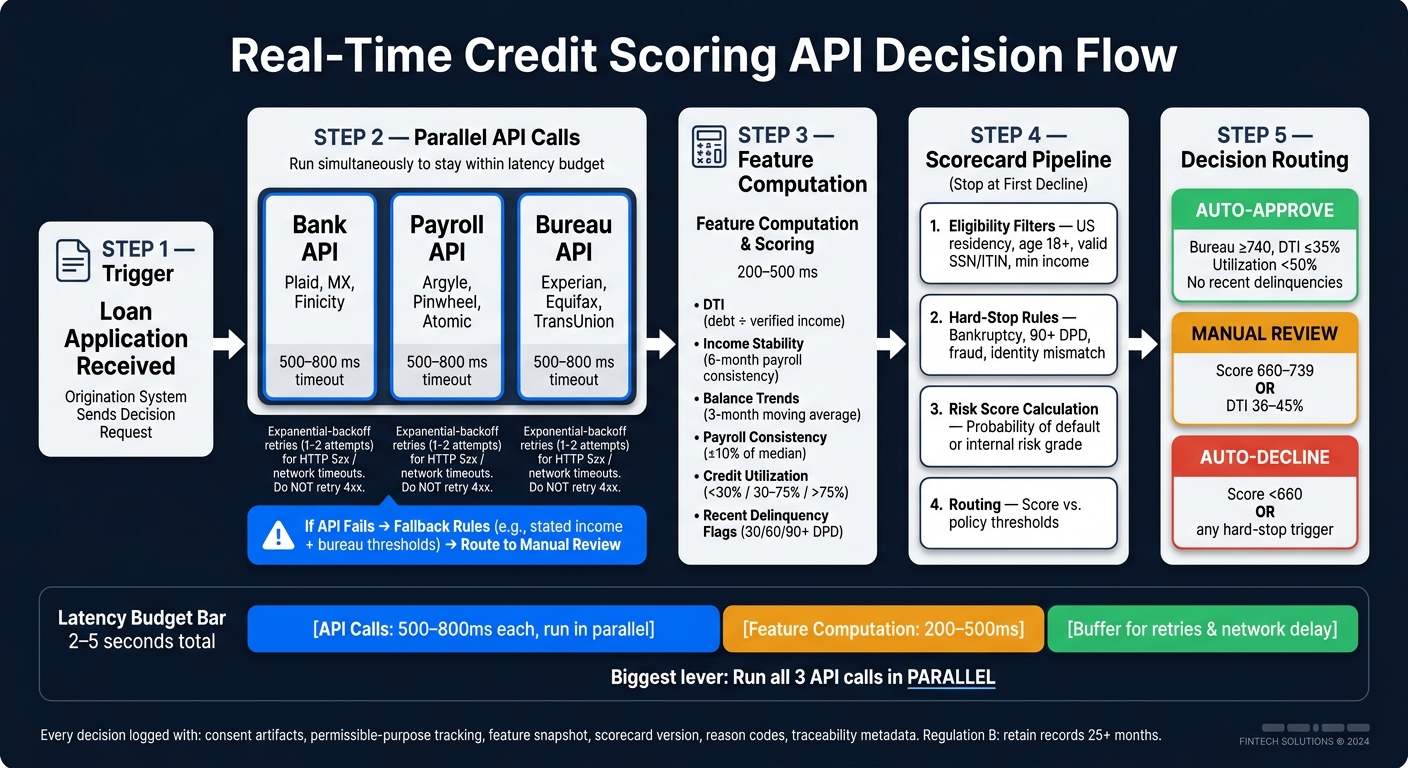
Real-Time Credit Scoring API Decision Flow: From Application to Approval in 2–5 Seconds
Once your scorecard rules are set, the next bottleneck is production wiring. The origination system sends a single decision request to the decision service. That service then calls bank, payroll, and bureau APIs in parallel, scores the file, and returns one of three outcomes: approve, decline, or review.
For most consumer lending decisions, aim for a total latency budget of 2–5 seconds. A practical split looks like this:
The biggest lever here is simple: run the three external calls in parallel. That one design choice does more than anything else to keep the request inside budget.[4]
Each provider should have a clear timeout. Pair that with exponential-backoff retries, usually one or two attempts, for short-lived failures like HTTP 5xx responses or network timeouts. Don’t retry 4xx errors. Use a stable idempotency key so a retry returns the same result and doesn’t trigger duplicate bureau pulls.[37][38]
Fail-safe behavior also needs to be written down ahead of time. This should live in policy, not in scattered if/else blocks. If bureau data is unavailable, you might allow limited approvals for low-risk files or send the application to manual review. If bank data fails, fall back to stated income plus bureau thresholds, flag the file for post-funding verification, and route it to review instead of dropping the application.[37][38]
Every decision needs a complete, durable record. This isn’t optional. Regulation B requires that records supporting adverse action notices be retained for at least 25 months for consumer credit.[36] CFPB guidance also makes it plain that AI-based underwriting models have the same adverse action duties as any other method. Generic explanations like "failure to achieve a qualifying score" are explicitly insufficient.[32][33]
A strong decision log should capture six items for every record:
Tag each log entry with the exact scorecard version, such as Scorecard_v3.1, along with any A/B test flags active at that time. That makes it possible to reconstruct a past decision without querying production, which helps with regulatory exams and internal model review.[34][35] Store logs in an access-controlled, append-only system.
Once the decision flow is stable, rollout metrics can help tune thresholds and watch approval quality.
Once the decision flow is stable, use a phased rollout to test risk, latency, and reporting before you scale volume. Growth-stage lenders often rush this step. That usually leads to extra compliance exposure, messy operations, and weak reporting. A phased plan keeps the first version simple and gives you hard performance data before you pile on more moving parts.
After the decision engine goes live, phased rollout does more than support safer credit decisions. It turns underwriting output into operating data that finance, pricing, and investors can actually use. That link matters. If underwriting data is messy, FP&A models and portfolio reporting will be messy too.
| Phase | Technical Tasks | Governance Steps | Metrics to Track |
|---|---|---|---|
| Phase 1: Policy & Compliance Foundations | Define input schemas; implement access controls and encrypted logging | Document credit policy, decision criteria, and exception handling; define MRM approvals | Policy exceptions per 100 applications; time to produce compliant adverse action reasons |
| Phase 2: Minimum viable decision engine | Route bank, payroll, and bureau data through a single decision service; implement latency budgets (max 2–5 seconds per decision) and fail-safe behavior when an upstream API times out | Credit committee approval of rule sets; define production change-control procedures | Approval, decline, and manual review rates; average decision latency; API error rate |
| Phase 3: Feature Engineering & Monitoring | Add only features that improve discrimination and are easy to monitor; build real-time monitoring dashboards | Formalize model validation procedures; set up champion–challenger experiments | Gini and KS statistics; delinquency and charge-off rates by score band, segment, and origination cohort |
| Phase 4: Strategy Optimization & Finance Integration | Connect risk grades, expected loss, price, and limits to FP&A and warehouse reporting | Align credit and finance committees on target ROE/ROA and loss budgets; implement investor reporting | Net interest margin; loss rates; contribution margin by product and cohort; LTV/CAC ratio by risk tier |
A useful benchmark in Phase 4 is to send 5–10% of live traffic through a pilot rollout, then watch it closely. The exit criteria should be strict: approval rate stays within a preset band of the current policy, adverse-action notices do not fail, and latency stays within SLA[39]. Only move to full volume after the pilot stays inside those limits.
Once underwriting is dependable, the next job is to connect decision data to FP&A and portfolio reporting. Phoenix Strategy Group helps growth-stage lenders do that by turning API-driven underwriting outputs - risk grades, expected loss estimates, approval data, and credit limits - into FP&A models, unit economics dashboards, and investor reporting tied to actual portfolio performance.
Start small. Use a limited set of dependable data sources - one bank API, one payroll API, and one bureau. Then build clear approve, decline, and review rules, along with well-defined adverse action reasons. Put logging and basic performance dashboards in place before you touch anything more advanced.
Hold off on added complexity until you have at least 3–6 months of origination vintages with observed early delinquency data. If you add too much too soon, decisions get unstable and debugging gets painful, without much gain in risk discrimination. Build the base first, monitor it closely, and use performance data to decide what comes next.
Lenders bring together bank, payroll, and bureau data by pulling those feeds into one governed data layer. In plain English, they keep everything in one place so the system can use it the same way every time.
That unified setup maps both static and real-time data points to a weighted scoring model.
Bureau data sets the baseline. Then bank and payroll APIs layer in real-time signals. When key events happen, the system can recalculate scores instantly, which helps automate decisions without losing auditability.
If a data API times out or fails, your system shouldn't bring the whole credit application to a halt. Build for failure paths, not just clean approvals.
Set up structured workflows that send failed checks to human review instead of knocking the application off track. Use asynchronous processing for non-urgent tasks. And make sure your integration contract spells out clear remediation steps for downtime.
Move from a rules-only model to a hybrid approach when you start getting meaningful live signals that call for action before a scheduled review.
Use it when transaction and alert events - like volume spikes, new counterparties, fraud, KYC/KRI updates, sanctions hits, or adverse media - should trigger immediate rescoring and rerouting to enhanced due diligence, manual review, or auto-approval based on the latest risk tier.