Published on
July 24, 2026


If you're pitching climate or energy VCs in 2026, fit matters more than name value. In this market, firms want proof of sales, pilot conversion, uptime, and a clear path to lower costs, especially from Seed to Series B.
Here’s the short version:
In other words: if you need a lead, start with firms like CEV, EIP, and BEV. If you need customer access, look hard at EIP and energy corporate VC arms. If you're still early, Congruent and CEV are often a better match than later-stage funds.
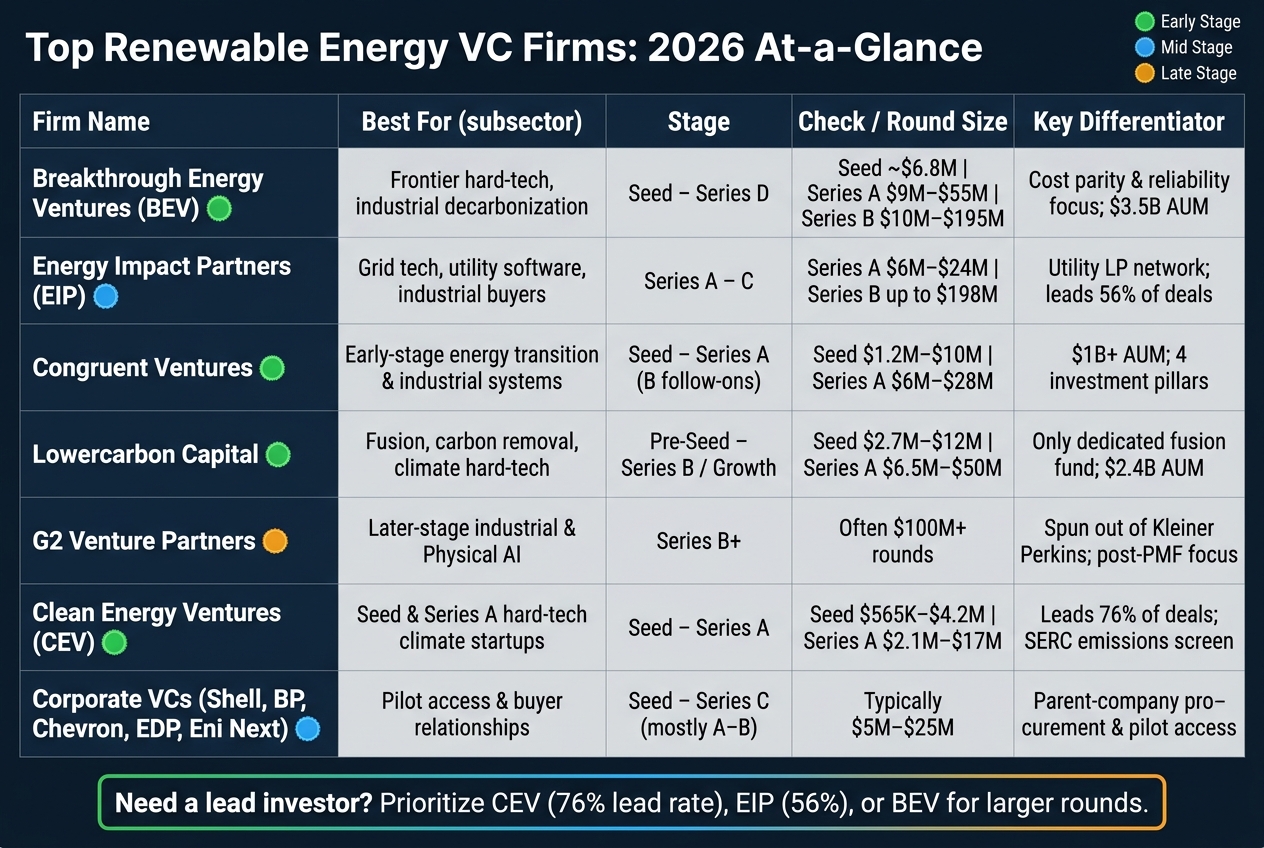
Top Renewable Energy VC Firms Compared: Stage, Check Size & Focus (2026)
| Firm | Best For | Stage | Initial Check / Round Range | What They Care About Most |
|---|---|---|---|---|
| Breakthrough Energy Ventures | Frontier hard-tech, industrial decarbonization | Seed–Series D | Seed around $6.8M; Series A $9M–$55M; Series B $10M–$195M | Cost parity, reliability, scale path |
| Energy Impact Partners | Grid tech, utility software, industrial buyers | Series A–C | Series A $6M–$24M; Series B up to $198M | Utility adoption, cybersecurity, uptime |
| Congruent Ventures | Early-stage energy transition and industrial systems | Seed–Series A, with B follow-ons | Seed $1.2M–$10M; Series A $6M–$28M | Scale, resource use reduction, go-to-market path |
| Lowercarbon Capital | Fusion, carbon removal, climate hard-tech | Pre-Seed–Series B / growth | Seed $2.7M–$12M; Series A $6.5M–$50M | Science, emissions scale, capital stack |
| G2 Venture Partners | Later-stage industrial and AI-for-physical-systems companies | Series B+ | Often $100M+ rounds | Field proof, scale in large markets |
| Clean Energy Ventures | Seed and Series A hard-tech climate startups | Seed–Series A | Seed $565K–$4.2M; Series A $2.1M–$17M | Emissions math, lead fit, commercial path |
| Corporate / Strategic Energy Investors | Pilot access and buyer relationships | Seed–Series C, mostly A–B | Often $5M–$25M | Parent-company fit, deployment path |
Bottom line: I’d shortlist investors by stage, subsector, lead behavior, and buyer access before anything else. That one filter can save founders weeks of outreach to funds that were never the right fit.
Breakthrough Energy Ventures (BEV) backs frontier climate hardware and industrial decarbonization on the path to net zero. For founders, BEV is the bar for capital-heavy climate hardware that has a real shot at commercialization.
BEV invests in fusion, geologic hydrogen, long-duration storage, direct air capture, sustainable aviation fuels, and other asset-heavy climate technologies [4][7]. In practice, that usually means bigger rounds, deeper technical review, and a longer path to close.
BEV invests from Seed through Series D, though it is most active at Series A and Series B [2][4][3]. Check sizes grow with stage. Seed checks are usually around $6.8 million, Series A rounds range from $9 million to $55 million, and Series B rounds range from $10 million to $195 million [5][2][3].
| Stage | Typical Check Size |
|---|---|
| Seed | ~$6.8M |
| Series A | $9M – $55M |
| Series B | $10M – $195M |
BEV manages more than $3.5 billion and often leads Series A and B rounds [7][2].
BEV's Catalyst program links capital with policy support for hydrogen and direct air capture [7]. The firm also backs pre-venture climate materials and technology founders [4].
At BEV, big climate goals alone won't carry the pitch. The firm cares most about cost parity and reliability. Founders need to show a believable path to beating the Green Premium [8].
A recent example: Commonwealth Fusion Systems closed an $863 million Series B2 round in August 2025 [4].
Best fit: founders with validated pilots, strong technical milestones, and a clear path to cost parity.
If Breakthrough Energy Ventures is the benchmark for frontier hardware, EIP is the benchmark for utility adoption.
Energy Impact Partners (EIP) tends to make sense for founders selling to utilities, grid operators, and industrial buyers. Its main edge is simple: it links startups with a network of utilities and industrial companies that can lead to real pilot programs and actual purchasing power.
EIP's core focus in 2026 is on grid modernization, utility software, industrial decarbonization, advanced nuclear, and industrial cybersecurity [1][9]. That includes areas like grid-construction tools, wildfire analytics, and electrified industrial equipment.
One area getting more attention is AI for grid operations. In plain English, EIP is paying close attention to AI systems that help make data centers more flexible for the grid. You can see that in its March 2026 investment in Emerald AI [9].
That focus also shows up in the rounds it joins and the kinds of companies it backs.
EIP is most active from Series A through Series C, and it leads about 56% of its deals [1]. It made 16+ investments in the 12 months through May 2026.
| Stage | Typical Round Size |
|---|---|
| Series A | $6M – $24M |
| Series B | $11M – $198M |
| Series C | $53M – $160M |
For founders, one of the biggest draws is access to EIP's utility and industrial LP network. That can help move pilot programs faster and make first-customer talks a bit less of a cold start.
EIP also runs specialized vehicles alongside its core fund, including the Deep Decarbonization Frontier Fund ($485M) and the Elevate Future Fund ($111.9M), which focuses on diversity in clean energy [9].
EIP keeps coming back to one core issue: can utilities and grid operators adopt this tech in a commercial setting?
A good example is March 2026, when EIP led a $28M Series A for ThinkLabs AI, an AI-powered grid orchestration company, alongside co-investors NVentures and Edison International [9].
If you're pitching EIP, you should be ready for close questions around:
Best fit: founders building grid-ready software, infrastructure tech, or industrial decarbonization hardware with a clear path to adoption by large utility or industrial customers.
Next is a fund with more of a software-and-systems bent, smaller checks, and a broader early-stage reach.
Congruent Ventures is a large early-stage climate fund with a clear focus on energy transition and industrial decarbonization. For renewable energy founders, it tends to make the most sense when a company sits where energy transition meets industrial systems. The firm manages over $1 billion in AUM [10][12]. It also closed a $275M Fund III and a $300M+ Continuity Fund in late 2023, which gives it room to keep backing portfolio companies as they grow [10][12].
Congruent groups its investments into four pillars: Energy Transition, Mobility and Urbanization, Food and Agriculture, and Sustainable Production and Consumption [2][10]. In 2026, the firm has paid close attention to interconnection bottlenecks, biomining, industrial heat decarbonization, and carbon markets [11].
You can see that thesis in the portfolio. Congruent backed Fervo Energy, an energy infrastructure company focused on geothermal power [10][12], and Pico MES, which builds factory and machinery control software for small and mid-sized manufacturers [2]. That pair says a lot. The firm is comfortable backing both hard-tech energy systems and software tied to industrial operations.
Congruent is most active at Seed and Series A, and its Continuity Fund can support Series B follow-ons [10][12]. It leads about 30% of its deals [2].
| Stage | Typical Round Size |
|---|---|
| Seed | $1.2M – $10M [2][3] |
| Series A | $6M – $28M [2][3] |
| Series B | $10M – $90M [2][3] |
Congruent works like a hands-on early-stage partner for teams building scalable hardware, software, or services that cut energy and resource use. In plain English: it wants companies that can grow and make a measurable dent in how industry uses power and materials [2][11].
Congruent’s diligence seems to center on one core test: can this technology improve energy or resource consumption at scale? [2] That sounds simple, but it’s a high bar. A founder can’t just pitch a good idea. They need to show how it works in the market, how it gets adopted, and why the impact can extend far beyond a pilot project.
The firm also appears open to high-capital, long-time-horizon bets in frontier areas like fusion and geothermal [10][12]. That matters because not every early-stage investor wants to touch sectors with long build cycles.
Founders pitching Congruent should come prepared with a clear commercialization path and a direct explanation of how the company fits within one of the firm’s four pillars [2][11].
Best fit: early-stage founders in energy transition, industrial heat decarbonization, or sustainable production and consumption - especially teams building across hardware and software with a clear resource-impact story.
For founders who want a more thesis-driven climate investor, the next profile shifts toward a tighter frontier-energy lens.
Lowercarbon Capital backs frontier climate tech built to beat fossil fuels on both cost and performance. The firm manages about $2.4 billion in assets under management [13] and has invested in more than 100 companies. The focus is pretty direct: carbon removal, clean power, and hard-tech decarbonization at scale.
Lowercarbon puts its money into nuclear fusion, direct air capture, industrial decarbonization, and climate cooling tech [13][15]. It also runs the only dedicated early- and growth-stage nuclear fusion funds in the world [15].
One recent deal shows how this plays out. In May 2026, Lowercarbon joined a $100 million Series B for Thea Energy, a startup building stellarator magnetic confinement tech for commercial power generation [14]. That makes the firm a strong match for teams taking on deep technical risk with a clear path to commercial power or large-scale carbon reduction.
Lowercarbon invests from Pre-Seed through Series B through both early-stage and growth funds [15]. It leads about 41% of its deals [2][6].
| Stage | Typical Round Size |
|---|---|
| Pre-Seed / Seed | $2.7 million – $12 million [2][6] |
| Series A | $6.5 million – $50 million [2][6] |
| Series B / Growth | $20 million – $150 million [6] |
So science alone usually isn't enough. Founders also need to show they're ready for the demands that come with each stage.
The team works directly with scientists and inventors, then adds hands-on help through climate-tech and industry networks [13][16].
Lowercarbon's diligence centers on scientific proof and large-scale emissions impact. The team wants to know whether a company can credibly remove or avoid billions of tons of CO2, not just make small gains at the edges [17]. For growth-stage companies, the questions get tougher: what's already proven, and what still needs scale validation? [17]
Founders should also be ready to map out a capital stack that can grow beyond subsidies. That means showing how equity will work alongside debt, grants, carbon credits, or asset finance [18]. The firm's decision timeline is about one month [13].
Best fit: founders building frontier hard-tech, especially in fusion, carbon removal, or industrial decarbonization, with strong scientific grounding and a clear path to gigaton-scale impact.
Next comes a firm with more of a utility- and grid-focused lens.
G2 Venture Partners looks different from the frontier-tech funds covered earlier. Its focus is later-stage sustainability and industrial transformation across energy, transportation, manufacturing, agriculture, and logistics [19]. So if you're building software or systems that cut energy use, strengthen grid resilience, or update industrial operations, G2 is a fund worth looking at.
In 2026, G2 has put a lot of attention on "Physical AI" - AI for physical operations, including autonomous driving and industrial automation [19]. The firm is also active in AI-powered vegetation management, which can help improve grid resilience [19].
You can see that focus in one of its biggest deals: G2 co-led Waabi's $1 billion Series C in January 2026, backing autonomous trucking at scale [19]. That gives you a pretty clear read on the firm's thesis. It isn't just interested in big ideas on paper. It backs companies bringing AI into physical, high-stakes industries.
G2 mainly invests in Series B through growth-stage companies after product-market fit. Its recent deals have been $100 million+ [19].
That stage focus matters. This is not the kind of fund that usually steps in when a company is still testing whether the product works. G2 tends to come in when the business has traction and needs capital to expand into large markets.
G2 was spun out of Kleiner Perkins, and that gives portfolio companies access to a broad institutional network [19].
For founders, that can matter as much as the check itself. In sectors like energy, logistics, and manufacturing, growth often depends on the right customer ties, policy context, and operating contacts - not just code.
G2 favors companies that are past proof of concept and ready to scale across large, established industries [19]. The best fit signal for founders is simple: show that the technology already works in the field - especially in grid resilience, energy efficiency, or industrial decarbonization - and that it can update a legacy sector fast.
If your company still lives mostly in pilot mode, G2 may be too early a target. But if you've already shown field performance and now need to scale across heavy industry, the fit becomes much stronger.
CEV sits in a part of the market that many climate startups struggle with: the stretch between technical proof and the first commercial-scale rollout. Clean Energy Ventures (CEV) is an early-stage institutional fund that backs Seed and Series A climate companies looking for an active lead investor.
CEV focuses on scalable, hard-tech climate companies. Its main areas include green hydrogen, zero-emission ammonia, carbon utilization, long-duration energy storage, and grid optimization. Examples from its portfolio include Advanced Ionics in green hydrogen and NitroFix in zero-emission ammonia [1].
CEV usually invests $565,000–$4,200,000 in Seed rounds and $2,100,000–$17,000,000 in Series A rounds [1]. It also uses convertible notes in the $500,000–$2,500,000 range [1].
This is not a sit-back-and-watch kind of fund. CEV leads about 76% of the deals it joins, so founders should expect a hands-on lead investor, not a passive name on the cap table [1].
CEV brings management experience and a deep industry network to help founders move from technical validation to commercialization [20]. That matters because getting a lab-tested idea into the market is often where climate startups hit the wall.
CEV screens deals with its Simple Emissions Reduction Calculator (SERC). The fund looks for technologies that could cut cumulative emissions by at least 2.5 gigatons of CO2e by 2050 [21].
So founders need to do more than say the product helps climate goals. They should be ready to show the math, quantify the emissions impact, and explain how that impact could play out over a 30-year adoption curve [21].
Founders who need bigger rounds or later-stage scale capital should move to the next profile.
Specialist climate funds often lead when the main issue is technical risk. Corporate investors play a different role: they help show there’s real buyer demand. If a founder needs customers, pilot projects, or a way into procurement teams, these investors can make a big difference. That matters most when early sales depend on a parent company’s infrastructure, customer base, or distribution channels.
Corporate VCs usually invest in what their parent company wants to use, sell, or test.
Shell Ventures backs technologies that align with Shell’s energy and manufacturing businesses [2]. BP Ventures leans toward renewable energy and manufacturing [1]. Chevron Technology Ventures focuses on oil and gas tech and energy software [2]. Eni Next, based in Boston, covers carbon capture, utilization, and storage (CCUS), energy storage, and sustainable mobility [23].
For founders, the main issue isn’t just check size. It’s whether the investor can help land pilots and first deployments. Active energy-focused CVCs usually invest in the $5 million to $25 million range [22].
| Investor | Typical Stage | Round Size Range | Strategic Focus |
|---|---|---|---|
| Shell Ventures | Series A, B | $2.4M – $126M [2] | Complementary energy tech, software |
| BP Ventures | Series A, B | $3M – $42M [1] | Renewable energy, manufacturing |
| Chevron Technology Ventures | Series A, B | $3M – $24M [2] | Oil & gas tech, energy software |
| EDP Ventures | Seed, Series A | $321K – $14M [2] | Energy software, IT |
| Eni Next | Seed to Series C | Recent: $12.5M Series B [23] | CCUS, energy storage, mobility |
CVCs stand out because of access, not only capital. They can open doors to procurement teams, pilot sites, and operating partners. Captura’s June 2026 Series B is a good example of that kind of signal. Its $12.5 million round included Eni Next, Aramco Ventures, EDP Ventures, Equinor Ventures, Hitachi Ventures, and National Grid Partners [23]. That sort of syndicate can help confirm that commercial demand is there.
CVCs usually screen for strategic fit before anything else. Founders should be ready for a direct question: How does this technology serve the parent company’s specific operations?
After that, they want proof from the field. That includes pilot programs with industrial partners, customer traction, and a clear path into existing infrastructure. Put simply, founders need a sharp story for how the product solves a parent-company problem and fits into day-to-day operations.
Use these investors as a fit screen first, then compare them with specialist climate funds based on stage, round size, and subsector.
Not every climate fund is a match for every founder. The big differences usually come down to stage, check size, sector focus, and who they can open doors to. That’s why investor fit is the best place to start before you stack firms side by side by subsector and round size.
Breakthrough Energy Ventures (BEV) and Clean Energy Ventures (CEV) are the clearest matches for science-heavy, capital-intensive startups. BEV leads Series A rounds from $9M to $55M and Series B rounds from $10M to $195M [2][3]. CEV leads 76% of its deals and writes Series A checks from $2.1M to $17M [1][2].
Energy Impact Partners (EIP) stands out in this category. If utility relationships matter almost as much as the money itself, EIP is a strong pick. It writes Series A checks from $6M to $24M and has joined Series B rounds as large as $198M [1].
Stage fit matters more than many founders think. A fund can look perfect on paper and still be the wrong match if the round size or timing is off.
A simple way to build a shortlist is to start with stage, then sort by whether you need a lead investor, a syndicate partner, or strategic access. If you need a lead, move CEV (76% lead rate) or EIP (56% lead rate) higher on the list than firms that mostly join rounds without leading them [1][2].
| Startup Type | Stage | Capital Need | Likely Best-Fit Investors | Typical Check Size |
|---|---|---|---|---|
| Frontier hard-tech / manufacturing | Series A–B | High | Breakthrough Energy Ventures, Clean Energy Ventures | $2.1M – $195M [1][2] |
| Grid / utility software (SaaS) | Series A–C | Moderate–High | Energy Impact Partners | $6M – $198M [1] |
| Early-stage hardware / prototyping | Pre-Seed–Seed | Low–Moderate | Clean Energy Ventures, Congruent Ventures | $565K – $4.2M [1][2] |
| Carbon removal / climate biotech | Seed–Series A | Moderate | Lowercarbon Capital | $2.7M – $50M [2] |
| Energy transition (mobility, urbanization) | Seed–Series B | Moderate | Congruent Ventures | $1.2M – $28M [2] |
| Scaling with strategic access | Series A–B | Moderate–High | Shell Ventures, BP Ventures | $2.4M – $126M [2] |
This section helps you split lead capital from strategic access.
That distinction matters more than it may seem at first. Some investors are best when you need a firm to lead the round, underwrite the risk, and dig into the science. Others are best when you need help getting in front of utilities, industrial buyers, or pilot partners. In plenty of cases, the right answer is not one or the other, but a mix of both.
For hard-tech founders, the main tradeoff is technical depth vs. capital flexibility.
Funds like Clean Energy Ventures and Breakthrough Energy Ventures stand out when you need an early lead and deep technical diligence. That can make a big difference when you're looking for someone to anchor a round and stress-test the technology before other investors come in.
There is a catch. Specialist funds often have smaller follow-on reserves than large energy companies, and some operate within subsector limits tied to their mandate. Breakthrough Energy Ventures in particular focuses on technologies that can contribute to net-zero by 2050 [2]. That's a high bar, and it usually means the technical case has to be strong from day one.
For founders selling to utilities or industrial customers, pilot access can matter more than valuation.
Corporate and strategic investors such as Shell Ventures and BP Ventures stand out when customer access matters just as much as capital. Their built-in customer base and procurement ties can shorten the path to pilots and early sales in ways pure financial investors usually can't.
The tradeoff is speed and alignment. Both Shell Ventures and BP Ventures show a higher follow-on rate than lead rate [2], so they more often join rounds than set the pace. Diligence may involve several internal stakeholders, and priorities can change with the parent company.
Energy Impact Partners sits somewhere in the middle. It leads 56% of its rounds [1], and its utility-heavy LP base can give portfolio companies direct buying power. That said, the same strategic access that makes EIP useful can also slow diligence and internal alignment.
| Firm | Main Pros | Main Cons | Best fit |
|---|---|---|---|
| Breakthrough Energy Ventures | Patient capital; strong technical diligence; large rounds [2] | Very high technical bar; long-term horizon required [2] | Frontier hard-tech, long-duration storage, industrial decarbonization |
| Energy Impact Partners | Utility and strategic network; leads 56% of rounds; rounds as large as $198 million [1] | Strategic access can slow alignment and diligence [1] | Grid optimization, utility software, energy SaaS |
| Congruent Ventures | Active early-stage presence; rounds up to $90 million [3] | Often follows rather than leads [2][3] | Mobility, urbanization, early energy-transition bets |
| Lowercarbon Capital | Fast-moving; strongest for carbon removal and emissions-cutting themes [2] | Best fit narrows outside carbon removal and climate biotech [2] | Seed/Series A founders in carbon removal or climate biotech |
| Clean Energy Ventures | Leads 76% of deals; deep early-stage technical support [1] | Maximum check size capped at about $17 million [1] | Seed and Series A hardware founders needing a clear lead |
| Shell Ventures and BP Ventures | Large checks; global commercial reach; deep industry expertise [2] | Slower diligence; strategic priorities can shift with the parent company [2] | Series B+ scale-ups seeking distribution or pilot partners |
Use this matrix to rank investors by lead role, stage, and access.
The best renewable energy VC is the one that lines up with your stage, subsector, and path to market.
Use the comparison above as your first screen. Start with subsector fit, then narrow by stage and check fund size. After that, look for firms that regularly lead rounds. If you need an active lead, put Clean Energy Ventures, Energy Impact Partners, and Breakthrough Energy Ventures near the top of your list [1][2].
It also helps to study portfolio pattern. Have they backed companies with a similar level of tech risk? Do they know your go-to-market motion? That matters a lot. A fund that understands long sales cycles, pilot projects, or hardware scale-up is often a better match than a big-name investor with the wrong pattern.
Once you’ve narrowed the list, shape your materials around the type of investor you’re contacting. Show a financing plan tied to the next milestone, along with the metrics that show you can get there.
Frontier hardware investors will pressure-test the technical case early, and they won’t go easy on it. Corporate or strategic investors tend to look at things through a different lens. With them, lead with the deployment story, not just the technology [2].
Investor fit matters more than investor fame.
A follow-on-heavy software fund is the wrong anchor for a Series A hardware round. Match the firm to the round, not the brand.
Look at a VC’s past investment stage, usual check size, and sector fit. Narrow your list by round - like Seed, Series A, or Series B - and confirm the firm’s geographic focus and track record in your subsector, such as renewable energy or smart grids.
This gives you a clear read on whether your funding needs line up with the firm’s investing sweet spot. Phoenix Strategy Group can help with this work through financial advisory, FP&A, and M&A support.
Yes - make a lead investor your top pick, especially if they can also open doors to strategic customer access.
In renewable energy, some firms bring far more than money. If they have strong corporate partner networks, they can offer buying power, industry perspective, and commercial connections that can matter just as much as the check itself.
A sector-focused investor can also help you deal with grid bottlenecks and react to market shifts. That makes them more than a source of capital - they become a core partner as you scale your business.
Prepare metrics that show both technical viability and scalable market potential. Focus on revenue trajectory, capital efficiency, round-size needs, operational milestones, and the scientific or technical edge of your solution.
That means your materials should answer a simple investor question: Can this work, and can it grow without burning cash too fast? Clear numbers help make that case. Show how revenue is moving, how much capital the business needs at each stage, what milestones you expect to hit, and why your science or tech is hard to copy.
Phoenix Strategy Group can help tighten these materials through bookkeeping, fractional CFO services, and FP&A support so your financials are ready for investor due diligence.