Published on
September 22, 2026


Most businesses do not have a cash problem. They have a cash rule problem. If you do not set a reserve target, a floor, and a use case for extra cash, your bank balance can mislead you fast.
I’d boil this article down to one point: keep enough cash to cover 3 to 6 months of core costs, then use a clear model to decide what happens next. The article walks through five ways to do that: percentage of revenue, fixed runway, tiered thresholds, seasonal buffer, and covenant-based floors. It also shows when each model fits, where each one can fail, and how to stack them into one written policy.
A few facts stand out:
If I were setting this up, I’d use this order:
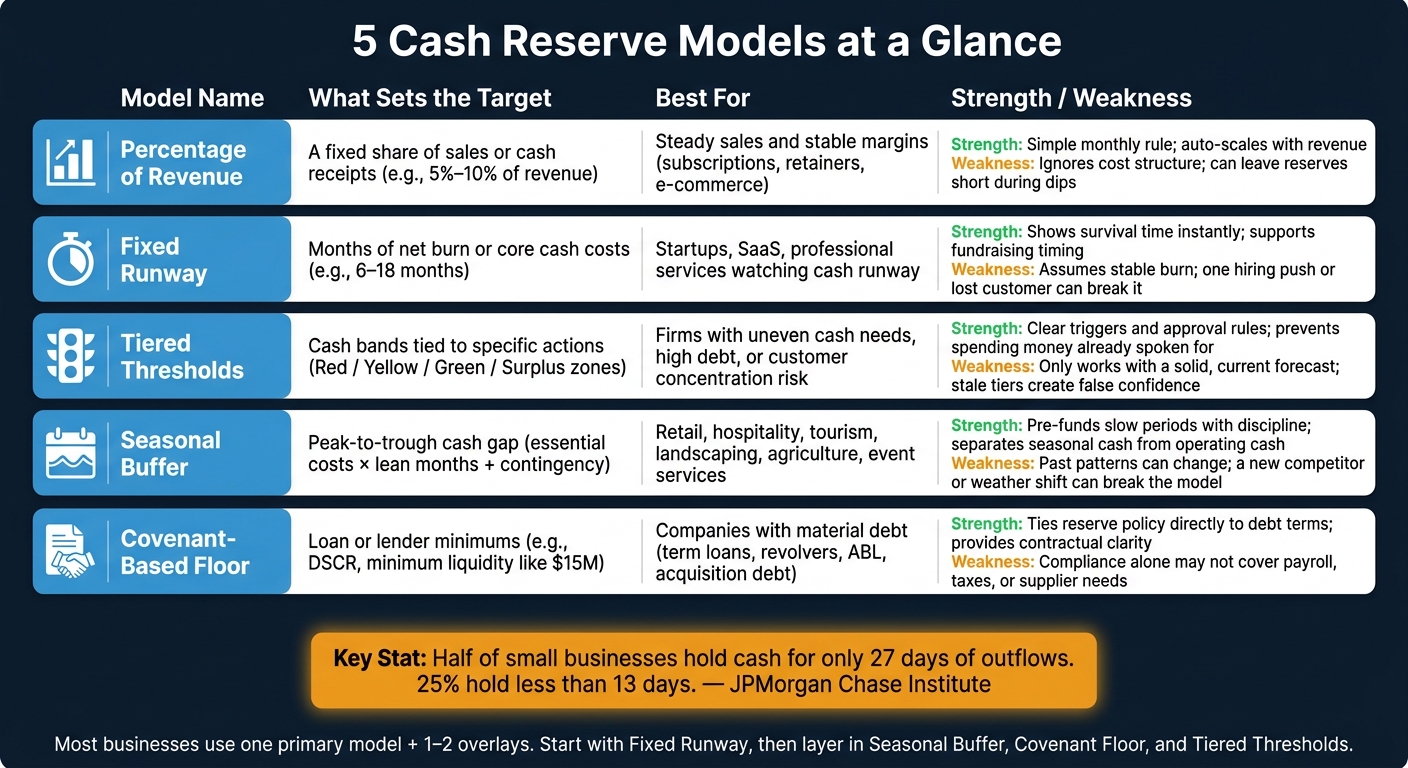
5 Cash Reserve Models: Quick Comparison Guide for Business Owners
| Model | What sets the target | Best for | Main strength | Main weakness |
|---|---|---|---|---|
| Percentage of revenue | A fixed share of sales or cash receipts | Steady sales and margins | Simple monthly rule | Ignores cost structure |
| Fixed runway | Months of net burn or core cash costs | Startups and firms watching cash runway | Shows survival time fast | Can miss sudden shifts in burn |
| Tiered thresholds | Cash bands tied to actions | Firms with uneven cash needs | Clear triggers and approvals | Depends on a solid forecast |
| Seasonal buffer | Peak-to-trough cash gap | Seasonal businesses | Pre-funds slow periods | Past patterns can change |
| Covenant-based | Loan or lender minimums | Firms with material debt | Keeps cash policy tied to debt terms | Compliance alone may not cover day-to-day needs |
The core message is simple: surplus cash is only the cash left after payroll, taxes, debt, and planned uses are covered. Everything else in the article helps you define that number with less guesswork.
These models differ in two big ways: how they set the reserve target and when they let you put extra cash to work. To compare them well, use four lenses: calculation basis, best-fit business profile, primary benefit, and key limitation.
Here’s the simple version:
No single model works for every business. In practice, most companies use one main model and add one or two overlays on top.
A JPMorgan Chase Institute study found that half of small businesses held cash for only 27 days of typical outflows, and 25% had fewer than 13 days.[2][3] That’s why reserve targets need to follow outflows and payment timing, not just revenue. With that baseline in mind, start with the model that lines up best with your cash-flow pattern.
Review the model monthly. Then update it after major shifts in pricing, hiring, margins, debt, or fundraising.
This model is simple: each month, you move a fixed share of revenue into a separate reserve account. The formula is straightforward: reserve contribution = eligible revenue × allocation percentage. So if a company brings in $100,000 in monthly revenue and uses a 5% rate, it transfers $5,000 to reserves. At 10%, that becomes $10,000. But that only works if the percentage gets you to a reserve balance that can cover essential expenses.[5]
The first call is deciding what counts as revenue for the formula. You can use gross revenue or, more practically, collected cash receipts. Collected cash receipts usually make more sense when customer payments come in unevenly, because the transfer is tied to money the business has already received. Pick the base once, define it clearly, and stick with it every month.
A common starting point is 5%–10% of revenue.[6] If your margins are thin or customers pay late, you may need a higher rate. A better gut check is the end target: reserves should eventually reach 10%–30% of annual revenue, with higher targets for businesses that deal with less predictable income.[4]
This works best for businesses with steady revenue and stable margins, like subscription software, retainer-based services, or e-commerce stores with consistent sales. It’s a weak stand-alone option for early-stage startups with uneven cash flow or for businesses that swing hard with the seasons.
This is a solid default when you want to route monthly surplus into reserves without rethinking the rule every cycle. The main upside is automatic scalability. When revenue goes up, contributions go up too, so the rule stays easy to run as the business grows.[5]
Revenue tells you how much came in. It does not tell you how much it costs to keep the business running. A company can post high revenue and still have little spare cash, while a smaller business with better margins may have more room to save.[5] The model can also leave reserves short during a revenue dip, even when fixed expenses don’t budge.
Test the percentage against a three-to-six-month essential-expense target.[1] It also helps to set a cap once the target is reached, plus a floor that restarts contributions after any withdrawal. That keeps the rule tied to reserve policy instead of monthly judgment calls.
Use this model when revenue is steady. If cash protection depends more on runway than on sales, the next model is a better fit.
While the percentage-of-revenue model ties contributions to sales, this model ties them to time. The idea is simple: fund operations for a set number of months, no matter what revenue does.
Move surplus cash into reserves until you hit the target runway. Then stop contributions. That makes this model a good fit when the business needs a clear survival window, not just a set savings rate.
The formula is straightforward:
Required reserve = target runway months × monthly net burn
Monthly net burn means cash spent to run the business minus cash collected. So if a company spends $250,000 per month and collects $150,000, net burn is $100,000. With a 9-month target, the reserve floor would be $900,000.
If the company has $1,200,000 in cash and highly liquid funds, don't treat all of that as surplus right away. First subtract known near-term outflows like taxes, insurance, and planned hiring.[7]
Set the target using cash activity, not accruals. If results bounce around, use a trailing three-month average. If hiring, debt, or renewals are about to shift burn, use a forward forecast instead.
A practical policy is to use whichever number is higher:
That helps keep the runway target grounded in what the business is doing now and where it's headed next.
This model tends to work best for businesses with steady recurring costs, like venture-backed startups, early-stage SaaS companies, and professional-services firms between contracts.
It's especially helpful when management needs to time a fundraising round or refinancing event, because the reserve balance maps straight to a decision window. High-burn startups often aim for 18–24 months, but the right target depends on revenue stability and access to capital.
When runway matters more than revenue share, the next model builds in thresholds that prompt action before reserves get too thin.
The biggest advantage here is clear runway planning. Management can look at the reserve balance, divide it by net burn, and know right away how much time is left.
That number supports direct decisions, such as:
It also creates an early warning signal. If actual runway falls below the target, that's the cue to act before cash gets tight.[8]
This model assumes burn and collections stay fairly steady. In practice, they often don't. A hiring push, a lost customer, a delayed receivable, or a tax bill can throw off a burn estimate fast.
Stress-test the target for lower revenue and higher costs. And for cash decisions, round runway down. If the math says 8.7 months, treat it as eight full months until timing risk and collection risk are modeled on their own.[9]
When burn is too unstable for one runway target to do the job, add threshold rules on top.
When a single runway target feels too rigid, cash bands give you more room to work with. The idea is simple: set cash thresholds in advance, then tie each one to a clear action. That way, when your cash position shifts, the response isn’t a scramble. It’s already mapped out.[11]
Start with two inputs:
From there, build four working bands and assign a specific response to each threshold.[11]
| Cash position | Zone | Primary action |
|---|---|---|
| Below the operating floor | Red | Freeze discretionary spending, accelerate collections |
| Between floor and reserve target | Yellow | Hold surplus; do not deploy |
| At or above reserve target | Green | Maintain liquidity; deploy only approved surplus |
| Above surplus threshold | Strategic surplus | Debt repayment, approved growth initiatives, or low-risk investments |
Set the operating floor based on near-term obligations. Then set the reserve target based on core outflows that keep the business running.
Coverage ratio = (unrestricted cash − near-term obligations) ÷ average monthly essential expenses[10]
Each zone should also spell out four things: the trigger, who decides (often a fractional CFO), what actions are allowed, and when the issue must be escalated.[11] That kind of clarity matters. If cash drops into the red zone, people shouldn’t be debating next steps in the moment.
This setup works well for businesses with uneven liquidity needs. That includes inventory-heavy companies, firms carrying a lot of debt, multi-entity groups, and businesses with customer concentration risk. In those cases, cash can move around more than expected, and the bands turn that movement into a set of plain decisions.
The main upside is adaptive control. It separates operating cash, reserve cash, and cash that can actually be put to work. In plain English: it helps prevent a business from spending money that looks available on paper but is already spoken for by near-term obligations.
This model only works if the forecast is solid and the thresholds stay current. If the tiers are based on stale burn rates, or if the forecast skips over customer concentration, capital expenditures, or debt service, the system can create false confidence. That’s where people get caught off guard.
Review the tiers at least quarterly, and revisit them sooner after big changes in revenue, hiring, financing, debt, or operating strategy.[10]
If cash needs swing with the seasons, add a seasonal buffer on top of the bands.
When cash moves with the calendar, thresholds by themselves won't do the job. Some businesses don't have a cash flow issue so much as a timing issue. In that case, build a seasonal reserve during your busy months and use it to get through the slow stretch.
The key here is simple: this buffer should sit on top of your current reserve policy, not replace it. It's a good fit when cash swings come more from seasonality than from one runway number.
Start with the peak-to-trough cash gap: essential monthly costs × lean months + known seasonal gaps + contingency margin.[12][16]
Then fund that buffer from peak-season surplus until you hit the target. Base the amount on when cash is actually collected during the low season, not on annual booked revenue.[13][15] That distinction matters. Booked revenue can look fine on paper while cash shows up too late to cover bills.
This works best for businesses with clear busy and slow periods, including:
The biggest upside is discipline. It separates cash meant for the slow season from cash that's free for day-to-day operations.[17][18]
Past seasonality is not a guarantee.[13][14] A new competitor, a bad weather stretch, or a change in how customers pay can throw off last year's pattern.
That's why it's smart to run a downside scenario and keep a minimum runway floor in place, so the buffer can still do its job if demand comes in below plan. And if your debt terms set a harder floor than seasonality does, layer those rules on top.
Use covenant floors as your reserve floor when debt agreements create the tightest limit on cash. In that setup, the agreement, not management preference, becomes the starting point for reserve policy.
Start with the lender’s definitions. For DSCR, use the formula stated in the agreement:
DSCR = Cash flow available for debt service ÷ Required principal and interest payments
Use the lender’s definitions and testing dates, not internal estimates.
Review every covenant that can limit access to cash, including minimum liquidity, fixed-charge coverage, leverage, and excess availability. If excess availability is tight, OCC guidance commonly requires 10% to 15% of the borrowing base to remain unused.[19] For example, Westrock Coffee Company reported a minimum-liquidity requirement of $15 million, measured on the last business day of each calendar month.[20]
Set the tightest covenant in a downside case as the floor. Then add a management cushion above it. Only cash above that internal target should be treated as discretionary surplus available for redeployment.
At that point, the next issue is simple: does the company’s debt load make this the main rule, or just a backup floor?
This model works best for companies with material debt, such as term loans, revolvers, asset-based lending, equipment financing, or acquisition debt. A lightly leveraged business with no restrictive financing agreements may do fine with a simpler model, though covenant floors can still serve as a second check.
The main upside is clarity. The agreement sets the minimum, and cash above your internal target can be used for growth, debt reduction, or distributions.
A covenant floor is a contractual minimum, not an operating target. A company can stay in compliance and still fall short on payroll, inventory, or tax needs.
Use it as one floor inside a broader reserve policy, not the whole policy.
Once you pick a reserve model, the next move is deciding how money gets into it.
Here’s the simple way to think about it: reserve models set the goal, while contribution methods set the rule. This is the step that moves surplus cash into reserves without choking day-to-day operations. The best method should fit the way cash shows up in your business.
Use the comparison below to line up the transfer rule with your cash pattern.
| Contribution method | Predictability | Margin sensitivity | Ease of administration | Collection risk |
|---|---|---|---|---|
| Percentage of revenue | High if sales are stable | Low | High | Moderate if based on collected cash; high if based on invoices |
| Percentage of profit | Low to medium | High | Medium | Moderate if profit is calculated from cash received |
| Fixed-dollar transfers | High | None | Very high | Risky when collections slow |
The main thing to watch is timing. If cash hits your account after the transfer date, the rule can backfire fast. That’s why, when collections lag, it’s smarter to base transfers on cash received, not invoices.
And one rule should stay firm: never make a scheduled transfer that drops operating cash below the floor.
Reserve target = monthly essential cash expenses × target runway months. Put simply, this is the cash you need to cover the costs that keep the business alive: core payroll, rent, utilities, insurance, taxes, debt service, and minimum inventory. The month ranges below help turn that formula into a planning target.
The right runway depends on your situation. Think of these ranges as guideposts, not hard rules.
| Planning range | Business stability | Revenue predictability | Outside funding dependence | Typical use |
|---|---|---|---|---|
| 3 months | Highly stable operations | Recurring or highly visible revenue | Low; reliable collections or readily available credit | Minimum operating cushion |
| 6 months | Moderately stable operations | Reasonably predictable but not guaranteed | Moderate; some reliance on credit, fundraising, or refinancing | A practical baseline for many small and midsize businesses |
| 12 months | Less stable, high-growth, or operationally fragile business | Variable, concentrated, or difficult to forecast | Meaningful; funding, major contracts, or refinancing may be needed | Businesses needing time to adjust costs, replace lost revenue, or raise capital |
| 18 months | High uncertainty or major operating risk | Unpredictable, seasonal, project-based, or early-stage revenue | High; substantial dependence on fundraising, lenders, or a major transaction | Businesses facing long sales cycles, turnaround periods, or extended funding timelines |
Here’s what that looks like in practice. If a business has $125,000 in monthly essential cash expenses, its reserve target would be:
As uncertainty goes up, the target should usually move toward the longer end.
One point matters a lot: base the math on cash collected, not invoices sent. A reserve target should reflect when money actually hits the bank, not revenue recorded on paper. If your revenue or expenses bounce around from month to month, use a rolling 3- or 6-month average so one odd month doesn’t distort the target.
You may also need a bigger reserve if costs are hard to cut fast, customers pay late, or your next financing event is still months away. The lower end makes sense only when revenue is very dependable, costs can be trimmed without much delay, and backup liquidity is actually available, not just something that looks good in a spreadsheet.
Before you identify surplus cash, you need to define what each dollar is there to protect. Start with the covenant floor. Then add an internal safety margin, an operating reserve target, a seasonal or event buffer, and only then look at deployable surplus.
That order matters. A reserve policy works better in layers than as one flat target.
| Reserve layer | Primary purpose | Typical permitted use |
|---|---|---|
| Lender covenant minimum | Contractual compliance | Only uses allowed by the agreement |
| Internal safety margin | Absorb forecast error and short-term stress | Emergency operating needs, delayed collections, unexpected costs |
| Operating reserve target | Fund operations through the target runway | Payroll, taxes, vendors, debt service, routine working capital |
| Seasonal or event buffer | Cover predictable troughs or known large outflows | Inventory build, annual premiums, tax payments |
| Deployable surplus | Allocate surplus after required liquidity is protected | Debt repayment, distributions, investments, acquisitions, capital expenditures |
Your internal operating minimum should sit above the covenant floor. Meeting the bare lender requirement may keep you compliant, but it doesn't necessarily protect payroll, tax payments, or supplier obligations.
The same layered setup can look very different depending on the model you use to set reserves.
| Model | Seasonality handling | Reserve volatility | Best fit |
|---|---|---|---|
| Percentage of revenue | Weak without seasonal adjustments | Moderate; moves with revenue | Stable businesses with predictable margins and collections |
| Fixed runway | Misses seasonal troughs | Lower, but sensitive to burn changes | Startups or companies with relatively consistent monthly burn |
| Tiered thresholds | Strong; thresholds can vary by month | Controlled through explicit triggers | Companies needing clear escalation rules and disciplined approvals |
| Seasonal buffer | Strongest; reserve peaks before known troughs | Higher during peak funding periods | Retail, distribution, construction, agriculture, travel, and other cyclical businesses |
| Covenant-based | Weak without month-by-month adjustments | Can appear stable while operating risk rises | Leveraged companies protecting lender minimums |
A simple way to think about it: the covenant floor is the starting line, not the finish line. From there, layer in seasonality and forecast-risk controls. That helps you separate three things clearly:
The five models don't compete with each other. They work best as layers, with each one doing a different job.
Use fixed runway as the starting point. Then use percentage-of-revenue transfers to build that reserve, tiered thresholds to decide what happens at each cash level, seasonal buffers to cover low periods, and covenant floors as the hard stop. In short: treat these models as stacked tools, not either-or choices.
Use the sequence below to turn those layers into one reserve policy.
For example, if a company has $180,000 in monthly net burn, a six-month runway target, a $900,000 covenant floor, and a recurring seasonal shortfall, it should set a $1.2 million management target before deploying any surplus.
Use percentage-of-revenue when collections are predictable. Use tiered thresholds when cash needs are tied to events. Use seasonal buffers when low periods are easy to forecast. Use covenant floors when loan terms set the tightest limit.
Apply the layers in this order:
The policy still needs approval limits, a review cadence, and exception rules.
Once the reserve floor is set, the next step is simple: figure out what cash you can actually use.
Start by splitting cash into three buckets. Restricted cash isn't available for day-to-day use because of legal, contract, regulatory, or lender limits. Internally earmarked cash is set aside for a planned use, like a tax payment, approved capex, or a hiring plan. You can reclassify it, but only through the documented approval process. Immediately available cash is the money that's free to use for normal operations or an approved emergency draw.
From there, build a plain-language liquidity bridge each period:
That bridge works best when it's paired with a 13-week rolling cash forecast updated every week. The forecast should show collections by receipt date, along with payroll, taxes, vendor payments, rent, debt service, capital expenditures, and hiring costs.[21][23] If there's a material draw, a missed collection, or an unplanned expense, reforecast right away. That way, the schedule stays tied to deployable cash, not revenue that exists only on paper.
After cash is classified, the next control is approval authority. Set draw approvals before anyone needs the money. Routine transfers, like a scheduled tax payment, can sit with the finance & accounting team or controller. Any draw that drops cash below the reserve floor should need approval from both the CFO and CEO. Large or strategic draws, such as covering the loss of a major customer, should go to the board or finance committee.[24]
Each request should spell out:
Replenishment rules matter just as much as withdrawal rules. After an emergency draw, a company might send 25% of monthly free cash flow back into the reserve until the balance is restored, with a six-month deadline. That distinction matters. A short-term timing draw can be refilled from the next collection cycle. A structural cash shortfall is a different animal and calls for a deeper operating fix.
Monthly reconciliation is what keeps the whole thing honest. Reconcile every reserve account to both the bank statement and the general ledger at least once a month. If the bank shows $500,000 across reserve accounts, but $75,000 is restricted and $125,000 is internally earmarked for taxes and payroll, then the immediately available reserve is $300,000 - not $500,000.[25]
There’s no one-size-fits-all reserve model. The right rule depends on how your cash moves: how steady revenue is, how much runway you need, whether the business is seasonal, and what your debt terms require.
Once you set the target, the next step is deciding what happens to cash above that level. A layered approach usually works best: keep a runway floor, a seasonal buffer, and a covenant floor. Then use only the cash that sits above the highest of those thresholds.
A written policy helps keep those calls steady instead of emotional. Spell out the target balance, the minimum floor, the trigger for refilling reserves, and what surplus cash can be used for. According to a 2025 Bluevine survey, 38.7% of U.S. small-business owners lacked enough cash to cover one month of operating expenses in an emergency [26]. Review that policy every quarter, and reset it when collections, margins, debt, or growth plans change.
More complex capital structures call for tighter modeling. If your business is growing fast, a fractional CFO or financial advisory team from Phoenix Strategy Group can help model scenarios, test covenant headroom, and connect reserve policy to capital allocation. The aim is simple: protect must-pay obligations while keeping extra cash available for high-value uses.
Match the reserve model to your cash drivers and risk profile.
Start with a target reserve based on burn and runway. Common benchmarks include:
From there, pick the model that fits how your risk shifts over time. Set clear rules for when you can draw from the reserve, when you need to review it, and how often targets should change.
It also helps to update reserve targets using three forecast views:
That way, your reserve plan isn't static. It moves with the business instead of lagging behind it.
Core cash costs are the recurring operating expenses you need to keep the business running, like payroll, rent, insurance, debt service, and must-have software subscriptions.
To estimate your core monthly burn, look at 12 months of cash flow and strip out seasonal swings in inventory, receivables, and payables. That gives you a steady baseline you can use to set emergency cash reserve targets.
Cash is surplus only after you split usable operating cash from restricted funds and still stay above your board-approved minimum reserve for the planning period, which is often a 13-week view.
In plain English: it’s the cash left after covering emergencies and your operating runway. That runway is usually 3–6 months of operating expenses, with extra cushion for seasonality and growth risk.