Published on
August 29, 2026


If your team spends days pulling approval logs, matching files, and rebuilding audit support, a blockchain audit trail can cut that work down. In plain terms, it creates a time-stamped record of approvals, status changes, and document checks that is hard to alter without leaving a trace.
Here’s the short version: I’d use this model where finance teams deal with high transaction volume, many approvers, repeat reconciliations, and audit pressure. In this article, the seven main use cases are:
A few points matter most:
What this means for you: if your team deals with journal approvals, payment release checks, vendor changes, or diligence file tracking, this type of recordkeeping can reduce email chasing and spreadsheet cleanup.
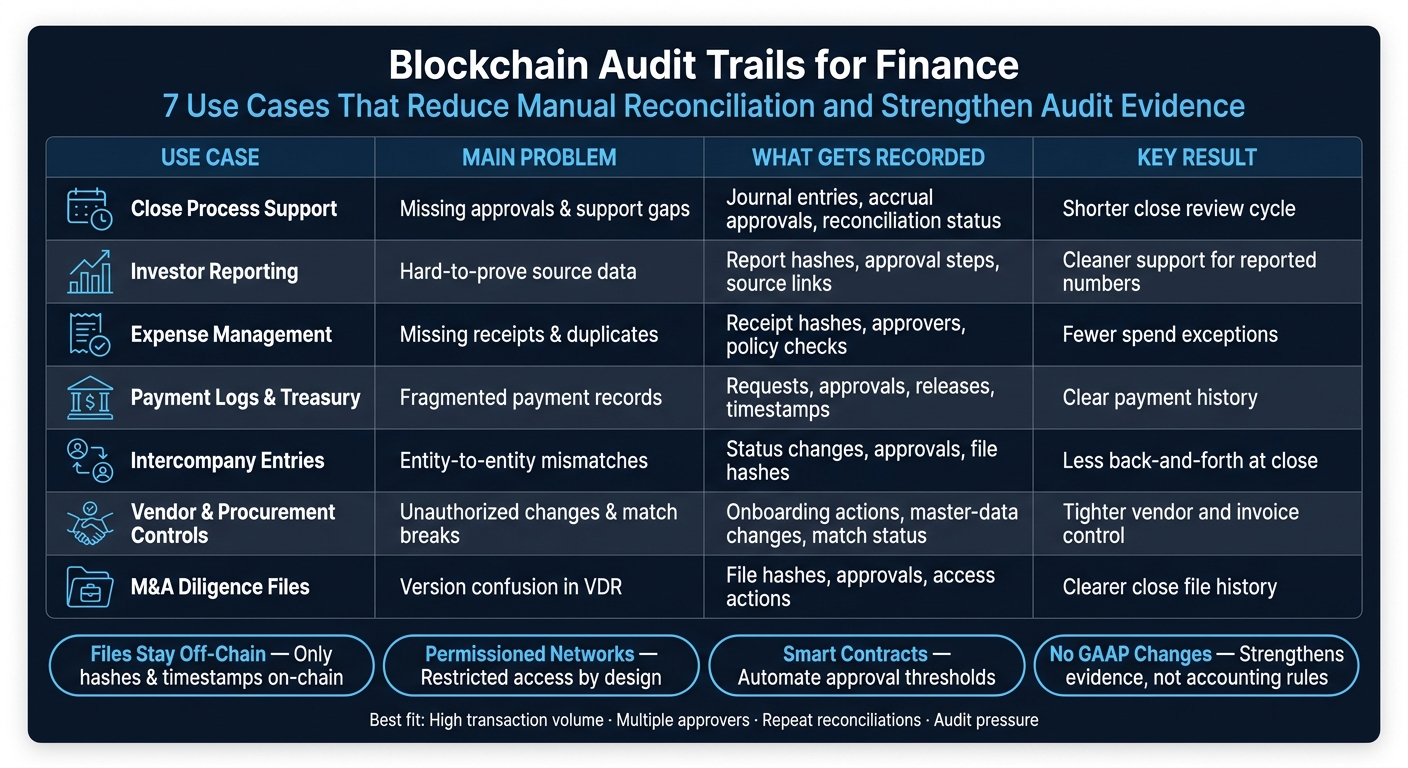
Blockchain Audit Trails vs. Traditional Finance Controls: 7 Use Cases
| Use Case | Main Problem | What the Audit Trail Records | Main Result |
|---|---|---|---|
| Close | Missing support and approval gaps | Journals, accrual approvals, reconciliation status | Shorter close review cycle |
| Investor reporting | Hard-to-prove source data | Report hashes, approval steps, source links | Cleaner support for reported numbers |
| Expenses | Missing receipts and duplicates | Receipt hashes, approvers, policy checks | Fewer spend exceptions |
| Treasury | Split payment records | Requests, approvals, releases, timestamps | Clear payment history |
| Intercompany | Entity-to-entity mismatches | Status changes, approvals, file hashes | Less back-and-forth at close |
| Procurement | Vendor changes and match breaks | Onboarding actions, master-data changes, match status | Tighter vendor and invoice control |
| M&A diligence | Version confusion in the VDR | File hashes, approvals, access actions | Clearer close file history |
One note before you read on: this article is not saying blockchain should replace your ERP, treasury platform, or virtual data rooms. I see it more as an audit layer that sits on top of the systems you already use.
These mechanics show why blockchain audit trails matter in finance. A blockchain audit trail brings together a few core parts to create a verifiable, tamper-evident record of financial activity [1].
Every transaction, approval, or document hash is stored as a cryptographically time-stamped record. Once it’s on the ledger, no single participant can rewrite or delete it on their own. The original record stays in place, with no silent edits in the background. That matters when multiple organizations need to trust the same process.
Most finance blockchain networks are permissioned, which means access is restricted by design. On top of that, role-based access controls (RBAC) define what each user can view and what actions they can take inside the network. In plain English, not everyone gets the same keys to the building. Together, these controls help support segregation of duties (SoD) and internal control requirements [1].
Smart contracts can automate approval rules for payments, journal entries, and vendor changes based on preset thresholds or multi-signature requirements. Instead of relying on back-and-forth emails or manual handoffs, the rules are built into the workflow itself. Smart contracts automate approval thresholds, and the ledger records each authorization step [1].
Invoices and contracts remain in your current storage systems, while the ledger stores only a cryptographic hash - basically, a file fingerprint. If someone changes the underlying document, the hash changes too. That gives auditors a simple way to check document integrity without exposing sensitive raw data on the chain [1].
Blockchain audit trails work best as a trust and audit layer inside your current stack, not as a replacement for it. In practice, teams connect the ledger to ERP and treasury workflows through APIs and identity connectors. That connection ties approvals and document hashes back to the general ledger, AP, AR, and subledgers. Once that control layer is in place, you start to see the payoff in close, reporting, spend, payments, and diligence workflows.
Month-end and quarter-end close tend to expose control gaps fast. Teams have to pull approvals, tie out balances, and gather support from different systems. That slows everything down and leaves room for mistakes.
In close, the record turns into an evidence trail for journals, accruals, and reconciliations. It tracks journal entries, accruals, and reconciliation status in one place, so finance and audit teams can check support without chasing email threads. Timing of approvals and ownership stay clear.
Auditors can trace approvals and supporting records without manually piecing evidence together from multiple systems.
A shared ledger sets one validation standard across entities. That helps catch mismatched states before they hold up the close. Fewer tie-outs, fewer mismatches, faster cutoff.
Smart contracts can block posting until the required sign-offs are logged, including entries above a set threshold. The ledger blocks the entry until approvals are complete. [1]
Those verified close records also feed the reporting workflow that follows.
The same verified close records also flow into investor reporting. And that reporting only works when the numbers are reconciled, approvals are clear, and source files stay unchanged across entities.
A blockchain audit trail makes the evidence path much easier to follow. It records approvals and key changes in a tamper-evident trail, so finance teams can show exactly where reported numbers came from. That matters most when investors need proof that a deck or dashboard matches the approved source data.
Sensitive reports stay off-chain. At approval, their hashes are recorded on-chain. That link ties transaction history, document integrity, approvals, and compliance checks back to the reporting package.
For funds and assets with split ownership, the audit trail also helps with ownership tracking and transfer rules. In plain English, it gives teams a clearer way to show who owns what and whether transfers followed the right process.
The result is a cleaner, faster way for investors and auditors to verify reported performance. It also cuts some of the cleanup work that usually shows up later in expense and payment workflows.
Expense workflows tend to break in familiar ways: missing receipts, duplicate submissions, policy exceptions, and GL reconciliation issues. A blockchain audit trail helps by logging approvals, status changes, and document hashes in one tamper-evident record. That gives auditors a clear path to trace spend without piecing together proof from several systems. For that reason, spend is a good fit for a permissioned, hash-based audit trail.
A practical setup keeps receipt images off-chain and stores only hashes plus approval metadata on-chain. That way, teams can check document integrity later without putting the files themselves on the ledger. Smart contracts can also build approval thresholds and compliance checks right into the workflow, which helps stop policy exceptions before posting.
Common expense gaps map to these controls [1]:
| Expense Management Gap | Blockchain Mitigation Strategy |
|---|---|
| Duplicate submissions | Shared transaction history prevents duplicate or altered entries. |
| Missing or altered receipts | On-chain hashes of off-chain documents provide proof of existence and integrity. |
| Policy exceptions | Smart contracts automate approval logic and threshold enforcement. |
| Reconciliation breaks | Shared ledger provides a single source of truth across spend systems and the GL. |
| Manual audit requests | Tamper-evident trails provide verifiable evidence of who changed what and when. |
That means less cleanup during close and faster audit support. The same trail can also feed payment logs and treasury controls.
Treasury teams often need to answer a simple question that turns messy fast: who approved a payment, and when?
A blockchain audit trail helps by recording payment requests, approvals, and releases in one shared, tamper-evident payment record. That gives treasury, accounting, and audit teams a single payment history they can all use with confidence. And when treasury activity moves across entities and counterparties, that shared record becomes even more useful.
A good rule here is to keep remittance details off-chain. Put only hashes, timestamps, and approval states on-chain. Smart contracts can then enforce multi-signature approvals, release conditions, and compliance checks for payments.
This matters most in cross-border payments, where no single party controls the full record. For treasury teams managing high-volume or cross-border payments, speed matters just as much as traceability. Permissioned networks can record payment finality fast enough for high-volume treasury operations, which makes them a practical fit for high-frequency workflows without giving up the audit trail.
| Treasury Gap | Blockchain Mitigation |
|---|---|
| Fragmented approval records | Permissioned ledger logs who authorized each payment, under what policy, and at what timestamp |
| Bank-to-ERP reconciliation breaks | Shared source of truth reduces manual matching across disconnected systems |
| Disputed payment status | On-chain state transitions eliminate disagreements on timing or approval status |
| Delayed close of payment batches | Tamper-evident trail covers the full payment lifecycle without manual evidence gathering |
That means less time spent rebuilding records for audits and fewer treasury exceptions. The same recordkeeping model also carries over to intercompany entries and transfer pricing support.
Intercompany reconciliation is one of the toughest parts of multi-entity finance. When records don’t match across entities, the month-end close drags on and teams get pulled into manual reviews. A blockchain audit trail helps by giving each entity access to the same permissioned record. That cuts down on disputes because everyone works from one agreed approval record. In plain English, the ledger becomes the single source of truth for matching, approval, and settlement.
A smart setup keeps sensitive data off-chain in ERP or consolidation systems. On-chain, you anchor status changes like Issued, Matched, and Settled, plus approval timestamps and document hashes. That way, auditors can check the full sequence without chasing records across multiple systems. The same trail can also support transfer pricing.
Transfer pricing documentation works well with this model too. Hashes of transfer pricing agreements, compliance attestations, and cross-border fund movement approvals can all be anchored on-chain. So when a reviewer asks for support, the evidence is already there - organized, verifiable, and built into the workflow instead of pulled together after the fact.
The point here is process integrity across entities, without handing control to one operator. A consortium model fits multi-entity structures well because each legal entity can run a node, while no single entity controls the record. Smart contracts can enforce approval thresholds and allocation rules, so intercompany entries post only when agreed criteria are met. That same approval logic can also extend to vendor onboarding and procurement controls.
| Intercompany Challenge | Blockchain Mitigation |
|---|---|
| Entities maintain conflicting versions of the same transaction | Shared ledger with common validation rules prevents disputed state |
| Manual reconciliation slows close | On-chain status transitions (Issued → Matched → Settled) are visible to all parties |
| Transfer pricing documentation is fragmented | Document hashes and approval timestamps anchored on-chain create a verifiable audit trail |
| Approval evidence is hard to reconstruct for auditors | Tamper-evident record of all approved actions reduces manual evidence assembly |
Duplicate vendors, off-book changes to payment details, and three-way match exceptions can turn reconciliation into a mess. The same control layer used in close and reporting can also support vendor onboarding and procurement. With a blockchain audit trail, you get one tamper-evident record for vendor onboarding, master-data updates, invoice matching, and payment release.
Keep W-9s and contracts off-chain. Put the hashes, timestamps, and approval states on-chain instead. That gives you proof of due diligence without exposing vendor data.
Once vendor records are anchored, the workflow can apply procurement rules on its own. Smart contracts can enforce approval thresholds and three-way match rules before any payment is released.
Auditors can trace each action - initiation, approval, and timestamp - without digging through email threads or spreadsheets.
| Vendor Control Gap | Blockchain Mitigation |
|---|---|
| Duplicate vendors or unauthorized master-data changes | Permissioned ledger restricts who can create or modify the vendor master |
| Unauthorized bank-detail changes | Tamper-evident log captures each change with a timestamp and who made the change |
| PO, invoice, and receipt mismatches handled manually | Smart contracts automate matching before payment release |
| Audit evidence scattered across ERP and email | On-chain approval trail provides a single, verifiable sequence for auditors |
The same tamper-evident record is also useful when diligence files move between buyers, sellers, and counsel. In plain English, M&A diligence is often a version-control mess. Files go missing, drafts clash, and approval status gets fuzzy. That can slow the close and spark arguments later.
A better setup is to keep sensitive files in the VDR while anchoring each file’s hash, timestamp, and approval state on-chain. That way, the approved version can be checked at close without putting the underlying documents on the ledger. In a VDR workflow, the ledger tracks the file fingerprint, approval state, and change history, but the documents themselves stay private.
Buyers, sellers, and counsel can each get role-based visibility. And every upload, review, approval, and modification is logged with identity and timestamp. That cuts out the usual version fights over which file was current or when someone signed off.
At close, auditors can follow the full diligence record without piecing it together from separate systems. For growth-stage companies getting ready for an exit, Phoenix Strategy Group can help organize diligence files and financial records for M&A support.
The table below sums up the main diligence risks and the control used to address each one.
| Diligence Risk | Blockchain Mitigation |
|---|---|
| Unauthorized document access or modification | Permissioned ledger logs every action with timestamp and user identity |
| Conflicting document versions between parties | Shared ledger provides a single verifiable record of version and approval status |
| Missing files or incomplete request-list responses | On-chain state transitions make gaps visible during diligence |
| Audit evidence scattered across disconnected systems | Immutable approval trail provides a verifiable sequence for auditors at close |
After the use-case breakdown above, these side-by-side tables make the trade-offs easier to see. The main idea is simple: they show where blockchain adds more control over evidence, approvals, version history, and audit support.
| Feature | Traditional Close Evidence | Blockchain-Based Close Evidence |
|---|---|---|
| Evidence Completeness | Manually assembled from disconnected systems | One shared ledger for approvals and evidence |
| Tamper Resistance | Vulnerable to unilateral database edits | Tamper-evident via consensus mechanism |
| Reconciliation Effort | High; requires comparing separate records | Low; single source of transactional truth |
| Version Control | Manual tracking of document versions | Immutable timestamps and on-chain hashes |
| Audit Defensibility | Requires proving what happened after the fact | Verifiable event sequence |
| Feature | Spreadsheet Reporting | Blockchain-Anchored Reporting |
|---|---|---|
| Evidence Completeness | Fragmented; relies on manual data entry | On-chain document hashes tied to report version |
| Tamper Resistance | Low; spreadsheets are easily altered | High; records are immutable once validated |
| Reconciliation Effort | Constant; requires manual verification | Minimal; parties verify against a common record |
| Version Control | Prone to disputed state and timing gaps | Immutable version history across parties |
| Audit Defensibility | High audit fatigue and manual assembly | Auditors trace the report through a durable record |
| Feature | Manual Expense Records | Blockchain-Anchored Expense Records |
|---|---|---|
| Evidence Completeness | Scattered across email, spreadsheets, and ERP | Approval metadata and document hashes in one trail |
| Tamper Resistance | Receipts and records can be altered after submission | On-chain hashes verify document integrity |
| Reconciliation Effort | High; duplicate and missing receipts require manual review | Low; shared ledger surfaces duplicates and gaps |
| Version Control | No reliable version history for receipts or approvals | Immutable approval sequence with timestamps |
| Audit Defensibility | Evidence must be reassembled from multiple sources | Verifiable trail of who approved what and when |
| Feature | Legacy Payment Logs | Blockchain-Linked Treasury Logs |
|---|---|---|
| Evidence Completeness | Fragmented across banks and ERPs | Shared transaction state across parties |
| Tamper Resistance | Dependent on individual bank security | Distributed ledger prevents unilateral changes |
| Reconciliation Effort | High due to different update timelines | Low; fast transaction finality reduces manual matching |
| Version Control | Manual exception handling for breaks | Real-time visibility into transaction status |
| Audit Defensibility | Requires reconstructing history from logs | Verifiable evidence of transaction approvals |
| Feature | Manual Intercompany Records | Blockchain-Anchored Intercompany Records |
|---|---|---|
| Evidence Completeness | Each entity holds its own version of the transaction | One shared ledger with common validation rules |
| Tamper Resistance | Entries can be altered in individual ERP systems | Tamper-evident record across all entities |
| Reconciliation Effort | High; mismatches require manual review at close | Low; on-chain status transitions visible to all parties |
| Version Control | Conflicting versions across entities | Immutable sequence of status changes and approvals |
| Audit Defensibility | Approval evidence must be reconstructed manually | Verifiable approval trail across entities |
| Feature | Traditional Vendor Controls | Blockchain-Anchored Vendor Controls |
|---|---|---|
| Evidence Completeness | Approval records scattered across ERP and email | On-chain approval trail for onboarding and changes |
| Tamper Resistance | Master-data changes can be made without a clear log | Permissioned ledger restricts and records every change |
| Reconciliation Effort | Manual three-way match and exception handling | Smart contracts automate matching before payment release |
| Version Control | No reliable history of vendor master-data changes | Immutable log of each change with timestamp and identity |
| Audit Defensibility | Evidence requires digging through email and ERP logs | Verifiable sequence of initiation, approval, and release |
| Feature | Conventional Virtual Data Room | Blockchain-Anchored Diligence |
|---|---|---|
| Evidence Completeness | Document-centric; lacks process proof | Hybrid: off-chain docs with on-chain hashes |
| Tamper Resistance | Relies on centralized access logs | Cryptographic proof of document integrity |
| Reconciliation Effort | Manual verification of document versions | Automated verification of file hashes |
| Version Control | Often leads to disputed version issues | Immutable sequence of document updates |
| Audit Defensibility | Hard to prove exact time of access or edit | Verifiable timestamps for every action |
Turning these use cases into a working system takes a few early control and architecture choices. The big decision is simple: how should the control layer fit into your current finance stack?
For most U.S. finance teams, permissioned networks are the practical default. Public chains offer more openness, but they can weaken confidentiality and access control.
A permissioned setup gives you tighter control over the things finance teams care about every day: who can validate transactions, who can view certain records, and how governance decisions are handled, often with guidance from fractional CFO services. That matters across close, payments, intercompany, and diligence workflows. It can also support low-latency finality for settlement and other control-heavy processes.
Once the network design is set, the next step is deciding what goes on-chain and what stays private. In most cases, a hybrid model makes the most sense.
Keep sensitive documents off-chain. Put hashes, timestamps, approval metadata, and status changes on-chain. This works well for expense receipts, vendor contracts, and M&A diligence files - basically, any record where confidentiality, retention, or residency rules come into play. It also keeps the ledger lean and helps align with retention and residency requirements.
Use API middleware to connect the ledger to your ERP, FP&A, and treasury systems. That way, approval events, status changes, and document hashes can move automatically between systems.
Your ERP, FP&A, and treasury tools don’t need to be replaced. They stay where they are. The blockchain layer adds a tamper-evident, verifiable evidence trail on top.
After data placement is sorted out, define how approvals and exceptions will be governed. Use smart contracts for approval thresholds and workflow rules that stay fairly stable. If the logic changes often, keep it off-chain.
Before launch, spell out a few things clearly:
These governance calls are much harder to bolt on later than a technical setting or system tweak.
The last step is making sure the evidence trail supports your audit process instead of trying to replace it. Blockchain can strengthen evidence, but it does not change GAAP requirements.
Financial statements, disclosures, and audit procedures still have to follow GAAP. What changes is the amount of manual work behind the scenes. Instead of piecing together approval sequences from disconnected records, auditors can follow a durable, time-stamped record directly. The ledger makes the evidence trail more defensible, but it does not change the accounting treatment of the transaction.
These seven use cases follow the same basic pattern: high-volume records, multiple approvals, repeated reconciliation, and higher audit risk. That’s exactly why the control layer matters.
What finance teams and auditors get from it is a tamper-evident record. In plain terms, they can check approvals and timing without having to piece together evidence from disconnected systems. That shifts the focus from a tech-first rollout to a process decision.
For U.S. finance teams, the smart move is to start small. Pick one audit-heavy process with a lot of friction, map the approval and documentation flow, and see whether a permissioned ledger cuts reconciliation time and improves control evidence. The payoff is pretty clear: faster verification, cleaner traceability, and fewer manual exceptions.
A blockchain audit trail is an immutable, tamper-evident record of transactions. Authorized parties can trace and verify it without depending on a single system to stay honest.
An ERP audit log is different. It’s usually a centralized record of user actions and data changes inside that ERP system. That makes it useful for investigations. But there’s a catch: it can be changed within the same environment unless it’s protected and matched consistently across systems.
Start with the finance process that drives the highest cost or causes the biggest delays, especially in areas where your data governance is already strong. That gives you a cleaner place to begin and makes it easier to spot what’s working.
Good early candidates usually share the same pain points:
If fraud is the main concern, pin down where the risk begins. Does it start during onboarding, or does it show up later in payments? That answer shapes where you focus first.
Before you build new blockchain architecture, make sure your core compliance policies and controls are already in place.
Finance teams should set limits based on severity instead of applying zero-tolerance rules across the board. That keeps attention on the issues that can do the most damage, without turning every minor exception into a fire drill.
For critical exceptions tied to financial reporting systems or protected health information, the target should be near-zero tolerance. Those cases need immediate investigation.
Also set firm outer limits. Allow no critical gaps beyond 30 days and no medium-severity gaps beyond 60 days unless there is documented risk acceptance.