Published on
July 21, 2026


If your company has about 20 to 30 employees, you likely need career pathing now. Without it, titles drift, promotions feel random, pay gets messy, and the CEO ends up approving too many people decisions.
I see the core point like this: career pathing gives you a clear system for roles, levels, pay bands, promotion rules, manager check-ins, training, and headcount planning. That matters because employee growth is tied to retention. In Randstad’s Workmonitor 2025, 42% of employees said they would think about leaving if career goals were not supported, and 31% said they had already left for that reason.
Here’s the article in plain English:
A few numbers stand out. Promotion increases often fall in the 8% to 15% range. A common compa-ratio target is 0.90 to 1.10. And LinkedIn data found 70% retention for employees promoted within three years, versus 45% for employees with no internal move.
This means career pathing is not just an HR project. It is a company system for growth, pay control, and retention.
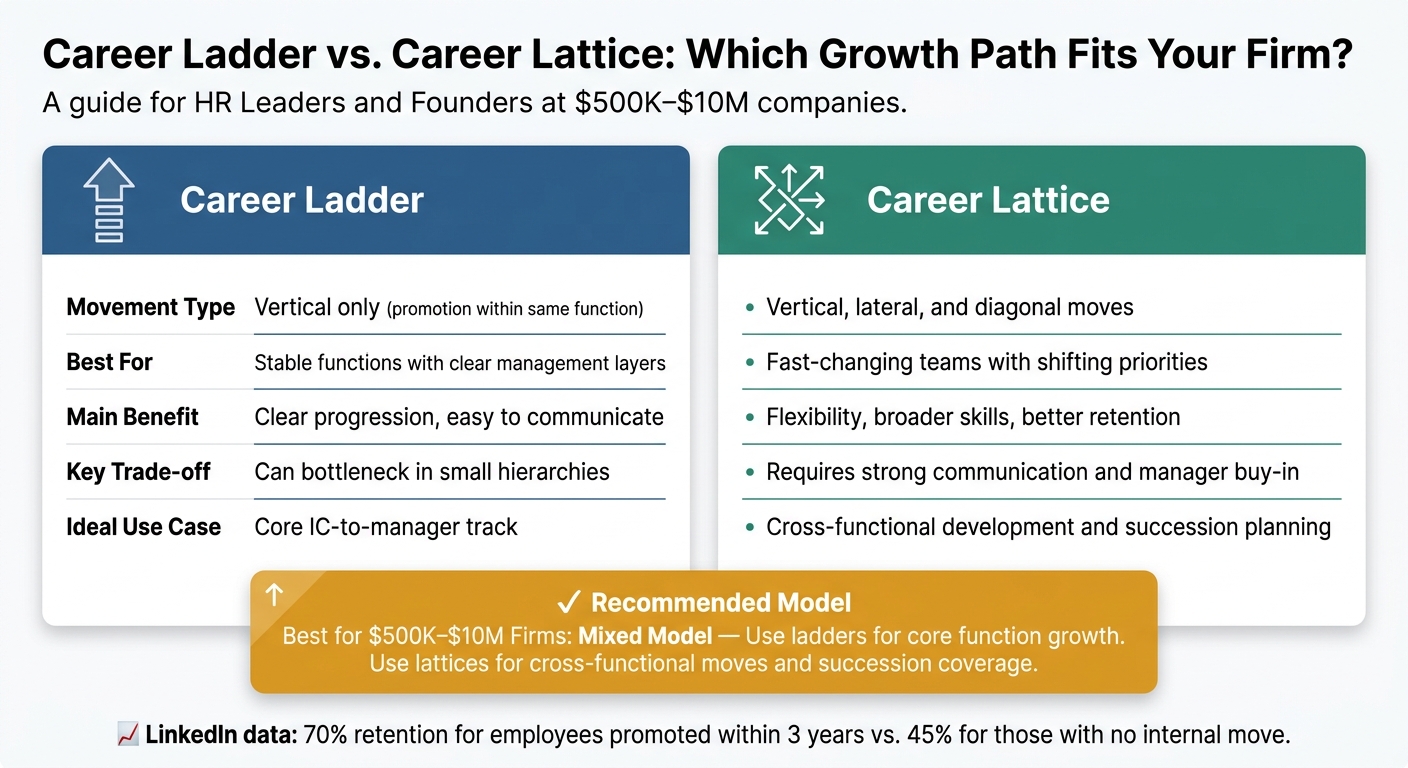
Career Ladder vs. Career Lattice: Which Path Fits Your Growing Firm?
Before you write job descriptions or set pay bands, get clear on how work is set up today. Start with a function-based org structure that matches the work your team is doing now and what the next 6–12 months will likely demand. Don't copy a chart from a much bigger company. That usually creates more mess, not less.
This step turns scattered titles and one-off promotions into a system people can actually use.
Begin by grouping work into job families such as sales, operations, finance, client service, and product or delivery. Depending on how your business runs, you may also need marketing, customer success, or engineering. The point is to build something usable, not something abstract.
One rule matters a lot here: separate roles from people. Define the role first. Then assign the person who owns it today, even if that person is also covering nearby work.
That overlap is normal. An early operations lead may also run client onboarding. A finance manager may handle both bookkeeping and reporting. No problem. What matters is writing down the core accountabilities, decision rights, and dependencies for each role so you can split work later without having to redraw the whole org.
Each role definition should include:
Once job families are mapped, build a simple, company-wide level framework and use it across every function. In most cases, four to six levels is enough.
A practical starting point looks like this:
| Level | Scope | Autonomy | People and Budget Responsibility |
|---|---|---|---|
| Associate | Defined tasks, close guidance | Low | None |
| Senior | Complex work, independent ownership | High | None |
| Team Lead | Coordinates work across others | High | None |
| Manager | Accountable for team outcomes and coaching | High | People and budget responsibility |
| Director | Owns a function, cross-functional decisions | Full | Function-level budget |
Levels should be tied to scope, impact, and complexity - not time served. A "Senior" role in sales should mean roughly the same thing as a "Senior" role in operations. If every team invents its own level system, promotion decisions get messy fast and become hard to explain [4].
Decision rights should also expand as levels move up. Individual contributors own their work. Managers own team outcomes. Directors own trade-offs across the function [3].
A career ladder moves someone upward within the same function - for example, Associate to Senior to Manager. That works well when a function is stable and the company needs more depth in a clear track.
But lean, growing firms don't always need another manager right away. And if upward movement is the only path, strong people can get stuck.
That's where a career lattice helps. A lattice allows lateral and diagonal moves. Picture a client service associate growing into a senior client service owner, then into a team lead or manager as the book of business grows. Or imagine that same person moving into operations or customer success because the company needs broader coverage, not another management layer [1][2].
Here's the difference in plain terms:
| Career Ladder | Career Lattice | |
|---|---|---|
| Movement type | Vertical (promotion within function) | Vertical, lateral, and diagonal |
| Best for | Stable functions with clear management layers | Fast-changing teams with shifting priorities |
| Main benefit | Clear progression, easy to communicate | Flexibility, broader skills, better retention |
| Key trade-off | Can bottleneck in small hierarchies | Requires strong communication and manager buy-in |
| Ideal use case | Core IC-to-manager track | Cross-functional development and succession planning |
For most firms in this revenue range, a mixed model makes the most sense. Use ladders for core growth inside a function. Use lattices for cross-functional moves and to cover gaps as needs shift.
There is one common risk with lattices: people can read a lateral move as a stall. That usually happens when the company treats management as the only path that matters, both in status and pay. A well-built framework is supposed to fix that pattern, not repeat it [2].
Next, connect these levels to pay bands and promotion rules so the framework shapes compensation.
Once your levels are set, connect them to pay rules and cash planning. That’s what turns a career framework into something managers can actually use.
Each level in your framework should have a salary band with a minimum, midpoint, and maximum. The midpoint is your market midpoint: the median pay for that role in your geography and industry. The minimum often lands around 80–90% of midpoint, and the maximum around 120–130%. In practice, band widths usually run 30% to 50% from minimum to maximum. Senior levels tend to need wider bands because experience and business impact can vary more.
Your pay philosophy should be a clear choice, not something you decide case by case. Paying at the 50th percentile helps keep costs predictable. Aiming for the 75th percentile can help bring in talent, but it also increases fixed cash burn. That matters a lot when your company is between $500K and $10M in revenue. Choose your approach and stick with it.[6][11]
Variable pay should move up with level and role type. Operations and support roles may have a 5–10% bonus target as a share of base pay. Senior roles and revenue-driving jobs - sales, business development, senior leadership - often sit at 10–20% or more, tied to measurable results like revenue booked, project margins, or EBITDA. To keep pay placement in check, track compensation against the band midpoint with a compa-ratio, which is pay divided by band midpoint. For most employees, a ratio between 0.90 and 1.10 is a solid target.[10]
Market data is only half the story. Internal equity matters just as much. If two people are at the same level and doing similar work, their pay should be in the same ballpark. Run an annual equity review so you can spot outliers and fix them before they turn into retention issues.[5]
After bands are in place, spell out what leads to a move up, a move across, or no level change at all. Promotions, lateral moves, and title changes are part of the operating rules for the framework. They’re not side topics.
A promotion to a higher level should require a few things:
Standard promotion increases usually fall in the 8–15% range, based on the size of the level jump and where the employee sits in their current band.[8][9] Then place the employee at the right point in the new band.
Lateral moves - same level, different function - should be treated as development and business coverage moves, not automatic pay events. Adjust pay only if the new role’s band is higher. If not, the gain is broader experience, new skills, and a stronger profile inside the company.[7][8]
Title changes without a real level change should be rare. Keep a tight handle on them. Require documented scope changes, HR and finance approval, and a clear update to the role’s job description. If someone is doing strong work, reward that with stretch assignments, one-time bonuses, or more scope - not title inflation that chips away at the framework.[7][8]
| Pay Progression Method | How It Works | Best Use in $500K–$10M Firms | Key Risk |
|---|---|---|---|
| Performance-based | Raises tied to measurable outcomes and results | Sales, client-facing, and revenue roles | Inconsistency if criteria are vague or manager calibration is weak |
| Skill-based | Pay increases when defined competencies are demonstrated | Engineering, finance, operations, and specialized roles | May not reflect business impact if skills aren't tied to value creation |
| Tenure-based | Raises follow time in role or at the company | Minimal use - cost-of-living adjustments only | Weakest link to performance; increases payroll without guaranteed value |
For most firms in this range, a performance-based core with skill-based elements for technical roles is the best default. Tenure-based increases, if you use them at all, should stay limited to modest cost-of-living adjustments, not become the main path for pay growth.
Promotions, new hires, and bonuses hit cash fast. So before you approve them, model them.
Build a headcount model that lists every role by level, band midpoint, planned hire date, and fully loaded cost. That means salary, taxes, benefits, and variable pay. If you model only base salary, you’ll understate your burn every time. Then plug those costs into your cash flow forecast and test at least three scenarios: a base case, a high-growth case, and a downside case where revenue comes in below plan.[14]
Promotion timing matters too. A cluster of promotions can change annual compensation costs in a big way, so those moves need to show up in the forecast before they happen. HR and finance should work from one shared model, not separate spreadsheets patched together every quarter. When hiring plans, promotion decisions, and cash forecasts sit in the same place, it gets much easier to make sound calls when liquidity tightens or growth runs ahead of plan.[12][13][14]
Once pay rules are clear, managers need a cadence to apply them the same way across the company.
Once levels and pay bands are in place, the next test is simple: do managers use them the same way?
That’s where many companies slip. A career framework can look solid on paper and still fall apart in day-to-day use if decisions depend on the founder’s gut, uneven manager habits, or a once-a-year review cycle. Career pathing only works when managers follow a simple rhythm and use the framework in the same way across the company.
Use three recurring cadences:
Each one should do a different job. Monthly check-ins focus on one skill and one on-the-job use case. Quarterly reviews look at progress against outcomes. Biannual career conversations confirm the target role, expected scope, and the evidence needed for promotion. This keeps growth criteria in view year-round instead of letting career decisions pile up during annual review season.[15][16][17]
Keep compensation reviews separate from career conversations. That split matters. When people talk about pay and growth in the same meeting, one topic tends to crowd out the other.
Frequency matters too. Engagement jumps when companies move from quarterly to monthly career conversations, with little extra gain beyond that point.[19] For a lean firm, monthly is the sweet spot.
That rhythm should lead to a written development plan for every key employee.
Use formal development plans for key employees: revenue owners, critical-function roles, and high-potential talent.
A strong individual development plan, or IDP, doesn’t need to be long. In most cases, one page is enough. It should cover the target role, current strengths, skill gaps, stretch assignments, training actions, milestones, and ownership. All of it should map to the employee’s target level.
Here’s what that looks like in practice. A Finance Manager candidate who is now a Senior Analyst might take on the monthly close for one business unit by month three, lead Q4 budget planning sessions with Sales and Marketing by month six, and prepare draft board packet metrics for review. The promotion decision would then come at the 9–15 month mark. That kind of detail makes progress much easier to judge and much easier to explain to leadership.
Managers can then use those plans to judge readiness against the same bar across the company.
In small companies, promotions often drift toward whoever is most visible or feels like the “right fit” to the founder. That’s a problem.
Managers should judge readiness based on the scope and decisions tied to each level - in other words, outcomes, scope handled, and decision quality - not tenure or personality.
Before a manager recommends a promotion, there should be proof of sustained performance, proof that the employee has handled next-level scope, and proof of sound independent decision-making. If that higher-level scope has not been tested yet, the right move is a stretch assignment, not a promotion.
To cut bias, require:
It also helps to track promotion patterns by demographic over time. That makes blind spots easier to spot before they turn into retention issues.[18]
| Cadence Type | Effort Required | Support Consistency | Best Fit for $500K–$10M Firms |
|---|---|---|---|
| Ad hoc only (no set schedule) | Low in theory; varies widely | Very low | Poor |
| Quarterly only | Moderate; one dedicated session per quarter | Low to moderate | Weak |
| Monthly check-ins + quarterly reviews + biannual career conversations | Moderate; recurring but lightweight | High | Strong - balances consistency with lean overhead |
Once managers can judge readiness the same way, the framework gets much easier to reinforce through training, systems, and board reporting.
Once managers use the framework the same way across the company, the next job is to keep it from drifting. That means turning decisions into training plans, system records, and board reporting.
Start with the role profiles you already have. For each level in a job family, list 8–12 core skills and spell out what beginner, proficient, and expert look like for each one. Then use the matrix to focus on the few gaps that matter for the next level up. The same matrix should also track progress over time, not just shape training at the start.
For lean firms, the best development tools are often the simplest ones:
Use 70-20-10 as a rough guide: 70% on the job, 20% from coaching, and 10% from formal training.[20][22][23] ATD data also shows that stretch assignments are still underused, with only 30% of employers using them.[21] That makes stretch work one of the clearest places to get better.
Formal learning still matters. But it should stay narrow and tied to an actual gap. A short online course on cash flow forecasting for a Finance Analyst, or a sales discovery workshop for an Account Executive, will do more than a giant training catalog that hardly anyone finishes. Every formal learning activity should link back to a skill gap in the matrix.
A $500,000–$10 million firm does not need enterprise software to manage career pathing. It needs data that is accurate, easy to access, and connected across five areas: a role library, promotion and lateral move history, development plan status, internal job openings, and compensation data tied to pay bands.
The role library is the anchor. Every promotion, lateral move, and development plan should point back to it. Compensation data should connect to role levels so managers can check pay band compliance without digging through spreadsheets. Development plan status - active, on track, behind, or complete - should be visible to both managers and leadership.
Career pathing falls apart when promotion and pay data sit in one place and forecasting lives somewhere else. Those numbers need to feed headcount planning, cash planning, and board reporting. The goal is one view of talent cost, capacity, and cash. Many firms use a fractional CFO or FP&A partner to connect HR and payroll data to FP&A models and board dashboards.
Boards need a small set of metrics that show whether internal mobility is working and where talent risk is building. These numbers should lead to action, not just fill a dashboard.
| Metric | What It Shows | How Leaders Should Use It |
|---|---|---|
| Internal promotion rate | Share of promotions awarded to existing employees | Tracks whether career pathing is producing real advancement |
| Lateral move rate | Share of moves that cross job families at the same level | Shows whether internal mobility is broadening bench depth |
| Succession coverage | Share of critical roles with at least one ready-now or ready-soon successor | Flags single points of failure before they become crises |
| Time-to-fill: internal vs. external | Days to fill a role from internal vs. external candidate pools | Reveals whether internal pipelines are faster and cheaper than outside hiring |
| Regrettable turnover | Share of voluntary departures the company would have preferred to prevent | Measures whether career pathing is actually retaining high performers and people in critical roles |
| Development plan completion | Share of active development plans with milestones on track or complete | Shows whether manager follow-through is consistent across the company |
LinkedIn analysis of 32 million profiles found that employees promoted within three years are more likely to stay: 70% retention, versus 62% for lateral movers and 45% for people with no internal move.[24][25][26] That gap is the board-level case for career pathing.
Review these metrics quarterly alongside financial KPIs. If internal promotion rate is low and regrettable turnover is climbing, the framework may exist on paper but it is not doing its job. If succession coverage is thin for two or three critical roles, call it out in the board packet before it turns into a hiring emergency.
Career pathing should move up the list as a company gets close to key growth milestones, especially around $2 million in revenue. That’s usually the point where the business starts moving away from relying on generalists and begins needing people in more specialized roles.
Putting those paths in place gives employees a clearer sense of where they can go next, which helps keep top talent on board. It can also reduce the team and day-to-day problems that often show up during fast growth.
Use objective data instead of gut instinct or manager recommendations alone. Look at more than one signal, including performance metrics and team contributions, to cut bias.
Set clear expectations for each role level. Then use structured scorecards and dashboards to keep decisions consistent, transparent, and tied to company strategy.
Start simple. Use Excel or Google Sheets to track headcount and compensation.
As the company grows, connect your HRIS to workforce planning or FP&A software. That way, HR and finance work from one source of truth instead of bouncing between mismatched files.
It also helps to use scorecards, documentation tools, pre-recorded video modules, and checklists. These tools make performance tracking, onboarding, and employee development more consistent and a lot easier to manage.