Published on
September 23, 2026


Cash runway is not “cash until $0.” It’s the time until you hit the lowest cash balance you can safely operate with. If you have $3,000,000 in cash but must keep $750,000 on hand, your usable runway is based on $2,250,000, not the full bank balance.
If I had to boil this down, I’d say this:
A simple formula like available cash ÷ monthly net burn is fine for a fast check. For example, $2,400,000 ÷ $300,000 = 8 months. But that shortcut can miss late customer payments, payroll timing, debt payments, hiring plans, and large purchases.
What works better is a cash forecast that shows when money comes in and when it goes out. That lets me see the low cash date, the lowest projected balance, and how long cash stays above the floor.
Here’s the short version of what matters most:
This piece is a guide to making runway easier to track, easier to test, and easier to act on before your options shrink.
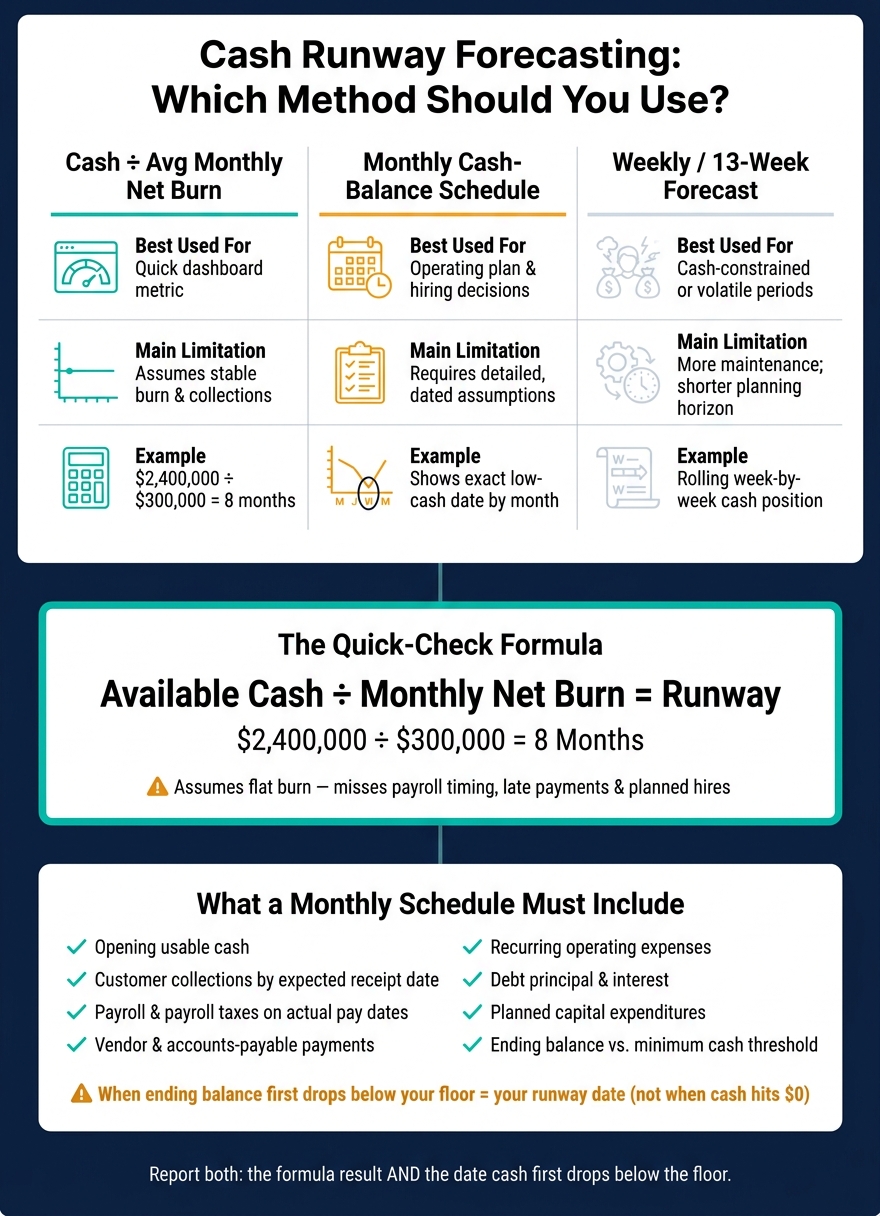
Cash Runway Forecasting Methods: Quick Formula vs. Monthly Schedule vs. 13-Week Forecast
To manage runway well, start with four clear definitions. Gross burn is your total monthly cash outflow. Net burn is cash out minus cash collected. Available cash is the unrestricted cash you can actually spend, not just the balance shown in your accounting system. And runway is the number of months until cash falls to your floor.[3][1][5]
The standard formula is simple:
Cash runway = available cash ÷ monthly net burn
If you have $2.4 million in available cash and $300,000 in monthly net burn, you have 8 months of runway.[3][1] It's a handy gut-check. But it also assumes burn stays flat.
That’s where things can go sideways. Planned hires, big purchases, and slow customer payments can pull your cash-out date forward.[4][6] Historical average burn has the same weakness: it tells you what already happened, not what’s about to happen. A forward-looking cash-balance forecast fixes that. It tracks when money actually moves, not when it gets invoiced or dropped into a budget.
Once the inputs are set, track them with a monthly cash-balance schedule. Each month starts with an opening cash balance, adds actual inflows, subtracts actual outflows, and gives you an ending balance that rolls into the next month.[9][10] Payroll lands on set days. Debt service comes due on set dates. A vendor invoice due June 30 might not get paid until July.
Those timing gaps are where companies get into trouble. Two months can show the same total inflows and outflows but lead to very different cash positions if payroll clears before a large customer payment hits.[2][4] A monthly average won’t show that. The schedule will.
For each month, the schedule should include:
When that ending balance first drops below your floor, that is your runway date, not the month when cash hits $0.[7][9]
Model planned hires from their actual start dates. Include salary, payroll taxes, benefits, and recruiting costs. For collections, use each major customer’s real payment behavior, not just the contract terms. If a customer tends to pay late, put that into the forecast. In plain English: use dated business drivers instead of broad assumptions so the schedule matches what will happen in your bank account.[4][6]
| Method | Best used for | Main limitation |
|---|---|---|
| Cash ÷ average monthly net burn | Quick dashboard metric | Assumes stable burn and collections |
| Monthly cash-balance schedule | Operating plan and hiring decisions | Requires detailed, dated assumptions |
| Weekly or 13-week forecast | Cash-constrained or volatile periods | More maintenance; shorter planning horizon |
Report both numbers to your leadership team: the runway from the formula and the date cash first drops below the floor in the schedule. Use the formula for a quick read. Use the schedule for the date that drives action.
The next step is setting a floor and testing what happens if collections slip or costs climb.
Once you know your runway date, the next step is setting a cash floor based on the bills you still have to pay if cash gets tight. Start with the obligations you simply can’t miss: payroll, payroll taxes, rent, insurance, debt principal and interest, critical software, and must-pay vendor bills. Payroll taxes should be modeled on their actual due dates because they are mandatory cash outflows, not optional expenses.[11]
A 3- to 6-month operating-expense floor is a starting point, not a hard rule.[14][15] Where you land depends on how your business behaves in the real world. If you have steady recurring revenue, strong gross margins, short collection cycles, low debt, and solid access to funding, you may be able to stay closer to the low end. If bookings swing a lot, a few customers make up a big share of revenue, accounts receivable takes a long time to collect, debt is heavy, or fundraising tends to drag on, you may need a bigger cushion.[12]
It helps to split cash into three layers. That way, the money that keeps the lights on doesn’t get mixed up with money for expansion or optional bets.
| Cash threshold | What it protects | Management response when reached |
|---|---|---|
| Operating minimum | Payroll, payroll taxes, rent, debt service, critical vendors, and other core obligations during a difficult period | Freeze nonessential spending and review payment timing |
| Management buffer | Forecast error, delayed collections, cost overruns, customer churn, and short-term volatility | Move to a tighter weekly forecast; slow hiring and discretionary programs; begin preparing financing or cost actions |
| Strategic liquidity | Acquisitions, major hiring plans, product investments, market expansion, or other optional initiatives | Release only when the operating minimum and management buffer remain protected; defer or re-stage the initiative if conditions weaken |
When you test your cash floor, don’t just apply a flat cut across the board. Tie each case to the drivers that actually move cash: bookings, sales conversion, customer churn, accounts-receivable days, payment terms, gross margin, hiring dates, compensation, contractor spend, debt payments, and discretionary spend.
For example, if your AR days moved between 38 and 67 over the last year, using 60 days in a downside case makes sense. Jumping to 90 days needs a clear reason, like a large customer at risk or a market shock. Otherwise, the case starts to feel made up instead of grounded in the business.
Build at least three linked scenarios, each with clear assumptions and preset actions.[13]
| Scenario | Key driver changes | Required action |
|---|---|---|
| Base | Bookings grow 8% monthly, churn is 2.0%, collections average 45 days, gross margin is 72%, approved hiring proceeds | Continue the operating plan; review monthly |
| Downside | Bookings 20% below plan, churn rises to 3.0%, collections extend to 60 days, gross margin falls to 68%, noncritical hiring paused | Freeze discretionary spending, tighten collections, and prepare financing options |
| Severe stress | Bookings 40% below plan, churn rises to 5.0%, collections extend to 90 days, gross margin falls to 60%, a major customer delays payment | Activate contingency actions, pursue committed liquidity, and renegotiate terms |
Swap out those sample figures for your own past ranges and contract facts.[13] Your model should show three things very clearly:
That matters more than looking at average monthly burn alone. Cash rarely moves in a smooth line. In many U.S. businesses, uneven cash flow and pressure from operating expenses are common problems, which is why collection timing and payment timing deserve just as much focus as top-line growth assumptions.[12]
These cases should tell you when to tighten spending and when to turn on funding options.
Once you have base, downside, and severe cases, the next step is keeping them up to date. How often you update should match two things: how close you are to the cash floor and how fast the business is moving.
Daily, if cash is tight or payment timing is shaky, review actual bank balances, cash available by account, large customer receipts, payroll or tax obligations, urgent vendor payments, and any unusual transaction. This is a cash check, not a full model rebuild. Weekly, update a rolling 13-week forecast with actual collections and payments, payroll changes, new commitments, forecast error, and the projected minimum cash date.[20][21][22] Monthly, refresh the full operating forecast and scenario inputs. And after any material event, update the forecast right away - don't wait for the next scheduled cycle.
As runway gets shorter, review more often. What starts as a monthly process can turn into a weekly one. Then, if pressure builds, it becomes daily.
| Review cadence | What to review | When to increase frequency |
|---|---|---|
| Daily | Bank balances, available credit, large receipts, payroll, taxes, urgent vendor payments, and unusual transactions | Volatility, financing uncertainty, uncertain collections, or proximity to the cash floor |
| Weekly | Rolling 13-week forecast, forecast error, collections, vendor timing, burn, hiring changes, and the projected minimum cash date | Downside runway is getting close to your fundraising lead time or forecast error is widening |
| Monthly | Full operating forecast and scenario inputs | Any material change that invalidates the monthly forecast |
| Event-driven | Revised forecast after any material customer, financing, hiring, legal, tax, or margin event | Update immediately - don't wait for the next scheduled cycle |
Give one person ownership of the weekly forecast and publish it on the same day every week. Consistency matters here. If numbers move around and nobody knows who owns the file, the forecast stops being useful.
A practical rule: investigate any variance greater than 10% or $5,000, whichever is smaller, and adjust that threshold to fit your company's size.[18]
When the projected minimum cash date shifts, the response shouldn't be improvised. It should already be mapped out. Set your thresholds in writing before you need them, name an owner, and spell out the response. The point is to use clear rules so everyone knows when to monitor, when to prepare, and when to act.
| Signal | Threshold or condition | Owner | Immediate action |
|---|---|---|---|
| Downside runway | Falls below fundraising lead time plus a safety buffer | CEO and CFO | Move to "prepare" or "act"; start financing outreach |
| Burn | Actual net burn exceeds plan for two consecutive reporting periods, or the monthly run rate is above budget | CFO and functional leads | Identify the variance, freeze or defer discretionary spend, and revise the forecast |
| Collections | A major invoice becomes overdue, promised payment dates slip, or expected collections move beyond the projected cash-floor date | CFO/controller and sales or customer-success lead | Escalate collection, obtain a dated payment commitment, and model the delay |
| Gross margin | Falls below plan enough to reduce projected runway | CFO and operations/revenue leads | Review delivery costs, revise hiring assumptions, and rerun downside cases |
| Hiring | Committed hires pull the minimum-cash date forward beyond the approved limit | CEO, CFO, and hiring manager | Rephase, pause, or condition hiring on revenue or financing milestones |
| Financing | Fundraising, debt renewal, or grant proceeds are delayed or uncertain | CEO and CFO | Remove proceeds from the base case and model the downside immediately |
Here's what that looks like in practice: if a company has 16 weeks of cash in its downside case but usually needs 20 weeks to raise and close financing, it should already be in the prepare category. It should not wait until the bank balance hits zero.[17][19] The whole point is to leave enough time to make a move.
Use these triggers to decide which backup funding option to activate next.
Once your triggers are set, tie each one to a funding source before the projected cash-floor date. Put this plan together while you still have room to negotiate.
Write down:
For each source, note the amount available, the first date you can use it, the owner, approvals needed, expected cost, and anything that could block access.
The most important line to spell out in writing is this: committed liquidity means cash or funding you can access under known terms. Potential liquidity means anything that is still uncertain or not closed. Keep potential liquidity out of the base case.[23][16][17]
Match each option to your operating minimum and management buffer, not to the day cash hits zero. The table below separates committed options from potential ones and shows what should trigger action.
| Liquidity source | Speed | Certainty | Cost / dilution | Activation trigger |
|---|---|---|---|---|
| Cash above the operating minimum | Immediate | Highest | None | Forecast approaches the operating minimum |
| Committed, undrawn revolving credit facility | Same day to several weeks | High if covenants are satisfied | Interest, fees, possible warrants | Downside case threatens the reserve floor |
| Spending and hiring cuts | Immediate to weeks | High for uncommitted spend | Opportunity cost or severance | Burn exceeds plan or a threshold is breached |
| Collections and working-capital actions | Days to weeks | Medium | Usually low; may require discounts | Receivables age beyond target or inflows weaken |
| Equity fundraising | Commonly 3–6 months, sometimes longer | Low–medium until closed | Dilution, legal costs, investor terms | Start preparation with substantial runway remaining[23][8] |
| Venture debt or new bank debt | Weeks to months | Medium after approval | Interest, fees, warrants, repayment | Only if repayment survives the downside case |
Here’s what this looks like in practice. Say a company has $9 million in usable cash, a $700,000 monthly base-case burn, and a $600,000 minimum reserve. That gives it about 12 months before it hits the floor. But if the downside case adds $150,000 in monthly costs - slower collections, delayed customer launches, extra hiring, or infrastructure spend - monthly burn jumps to $850,000. Now the reserve gets hit in under 10 months. If a 3- to 6-month raise starts taking longer than the runway you have left, you need to begin fundraising before the downside case shows up.[23][8]
Use these sources to decide what happens first when cash crosses a threshold.
Phoenix Strategy Group supports cash forecasting, FP&A, and fundraising preparation for growth-stage companies.
Runway management comes down to a few decisions made before the pressure hits. Build your cash forecast from actual cash flows, not a flat burn estimate. Set a minimum cash balance based on real obligations - payroll, taxes, debt service, and critical vendors - and treat it as a floor, not a target. Stress-test the model with downside assumptions tied to real business drivers. Update the forecast on a set cadence and act on leading signals, not lagging ones. Map backup funding sources now, with clear triggers, owners, and activation conditions for each.
The companies that handle cash pressure well usually do one thing early: they decide their thresholds, funding options, and next moves before they need them.
Usable cash is the money you can get to right away for day-to-day operations. To calculate it, add the ending balances in your operating, savings, and money market accounts. Then subtract any restricted cash that’s set aside for a specific purpose or otherwise off-limits.
This number is your baseline for tracking liquidity targets, like your minimum reserve or cash runway. Reconcile bank balances every week so the total shows actual cash movement, not just accounting entries.
Set your cash floor as a board-approved minimum reserve based on fixed operating costs. Use unrestricted cash only for this number.
A common benchmark is 3–6 months of fixed costs. If your business is seasonal or depends heavily on a small group of customers, aim for 6–12 months instead.
For runway, use a trailing 3–6 month average net burn. That gives you a steadier view than relying on one odd month.
If forecasts show cash dropping below the floor, treat that as an immediate trigger for cost controls and/or fundraising. In that situation, review runway weekly.
Most founders should start raising capital 9 to 12 months before they expect to hit their cash buffer floor.
Here’s why: fundraising often takes 3 to 6 months. And in plenty of cases, it can drag on longer than planned. So waiting until runway feels tight is a risky move.
A simple rule of thumb is 6 months of runway. Once you get there, it’s time to move.
If downside modeling shows your runway could drop below 6 to 9 months, start investor conversations early or bring in a fractional CFO before cash pressure gets worse.