Published on
August 21, 2026


If people do not hear one clear message, they make up their own. For growth teams, that usually means slower execution, more side questions, and lower trust during changes that touch roles, pay, tools, budgets, or reporting lines.
I’d sum up the article up this way: plan the message before you send it. That means I first map each audience, then prep managers 24–72 hours before launch, set a dated rollout plan, open question channels with a 1–2 business day reply target, and check understanding within 3–5 business days. Research cited in the article ties clear internal communication and employee involvement to better change support and change success.
Here’s the full checklist in plain English:
This is the core idea: say the same thing, in the right level of detail, to the right people, at the right time.
| Step | What I’d focus on | Timing |
|---|---|---|
| Audience map | Who needs what | Before drafting |
| Manager prep | Briefing + response sheet | 24–72 hours before launch |
| Rollout plan | Dates, channels, owners | Before send |
| Feedback | Questions and routing | Day 1 onward |
| Morale check | Survey + team signals | 3–5 business days |
| Review | Lessons learned | 2–4 weeks after launch |
If you’re dealing with a reorg, comp update, software rollout, budget reset, or leadership change, this checklist gives you a simple way to keep communication clear and keep teams moving.
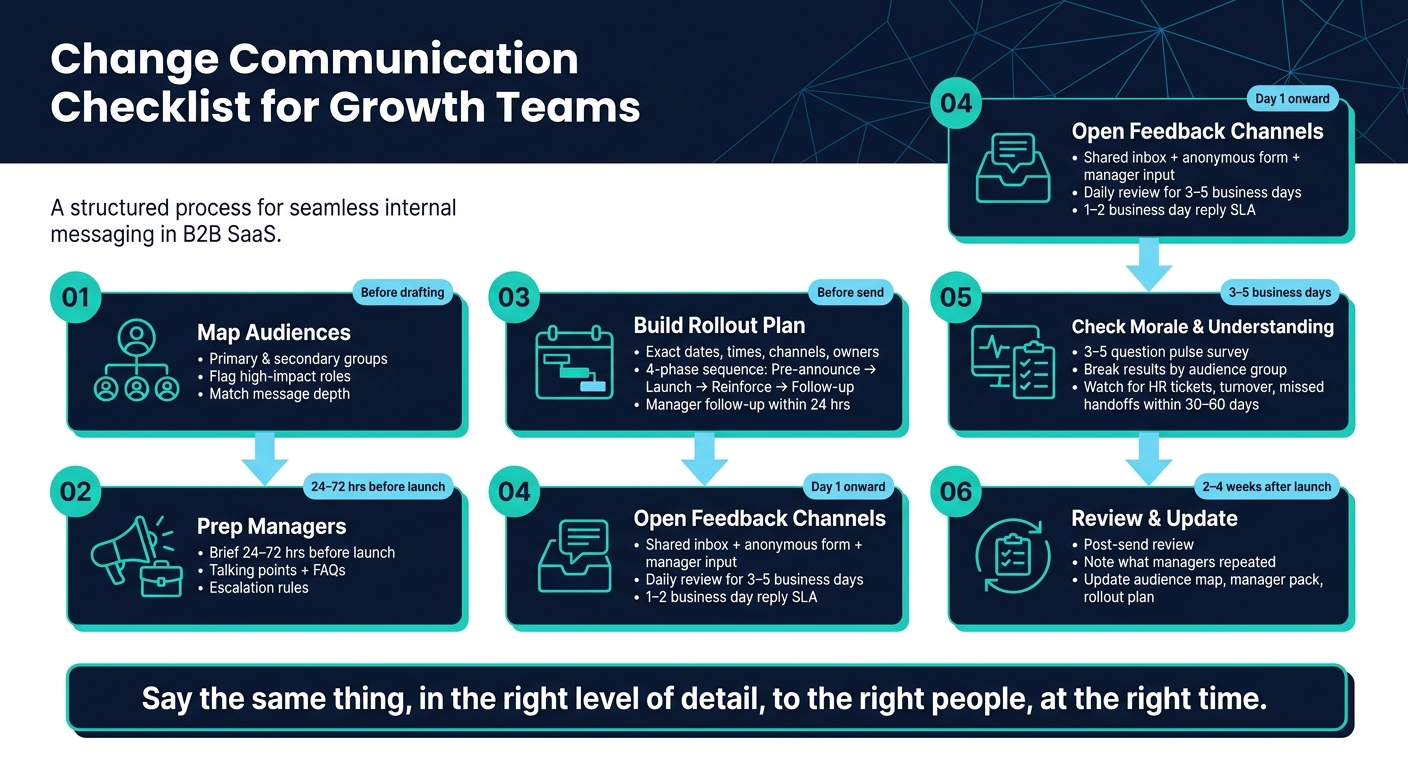
Change Communication Checklist: 6-Step Framework for Growth Teams
Map your audiences before you draft a single message. If you skip this step, one group gets too little detail while another gets buried in too much. Growth teams move fast, and audience mapping helps each group stay clear on what’s changing, when it’s changing, and why.
Primary audiences are the people most directly affected by the change. That usually means executives, department heads, frontline teams, and the people managers who oversee them.
Secondary audiences are affected more indirectly. This can include cross-functional partners like finance, RevOps, HR, and data teams. It can also include contractors, agencies, vendors, board members, and investors who need a clear view of scope, timing, or oversight.
Put every group into a simple spreadsheet. For each one, note:
That gives you a clear rollout order before you start writing.
A group is high-impact when the change affects their KPIs, workflows, tools, or reporting lines. Think about a sales team getting new pipeline definitions. Or a growth marketing team moving to a new attribution platform. These groups need more detail, earlier notice, and a manager who’s ready to answer questions.
People managers should be treated as their own audience, not just as message carriers. They need a manager-only briefing 24–72 hours before the wider rollout, along with talking points and escalation rules. That matters even more for teams spread across U.S. time zones, where questions may start coming in at different hours.
Every group needs the same five points spelled out:
What changes is the level of detail.
| Audience | Rationale depth | Key focus |
|---|---|---|
| Executives / board | Full - financials, risk, strategy | ARR impact, burn rate, scenario analysis |
| Department heads | Operational - process and resource changes | Cross-team dependencies, timelines |
| Frontline teams | Practical - what changes Monday morning | New steps, tools, updated metrics |
| Contractors / agencies | Summary - scope and SLA changes | Budget caps, volume targets, deliverables |
Use this map to decide message depth before drafting the core message set. If the change affects financial metrics, dashboards, or investor reporting, bring finance and data partners into the map early. That helps prevent conflicting numbers during funding rounds or board reviews.
Once the audiences are mapped, brief managers on the version each group will hear.
Start with managers, then roll things out to everyone else. Use your audience map to figure out which managers need the first briefing.
Schedule a manager briefing at least 24–48 hours before any company-wide announcement so managers do not hear the announcement at the same time as their teams. [1][2][3]
Set aside 60 minutes and give the meeting a clear agenda. Leadership should explain the why and the scope of the change. HR should walk through people impact and the process. Finance should cover any numbers that will be shared, like budget shifts, headcount plans, runway targets, or compensation changes.
It also helps to assign one owner to each message layer:
That way, managers have the context they need before anyone starts writing the message set.
After the briefing, send a written manager pack. Keep it short: two or three pages is enough.
Include a two- to three-sentence elevator pitch, the main talking points, and a one-page response sheet with direct answers to the questions employees are most likely to ask: job security, workload, metrics, and pay.
The part that matters most is the escalation matrix. Managers should know exactly what they can answer on their own and what needs to be handed off. Questions about pay changes above a set threshold, equity, immigration status, and any M&A speculation should go straight to HR, Finance, or Legal, not answered off the cuff.
Give managers a safe phrase for moments when they do not know the answer. The pattern is simple: acknowledge the question, avoid guessing, and promise a follow-up by a specific date.
The core message set is the single source of truth for the change. Every manager, every channel, and every audience tier should point back to it.
It should clearly answer:
For financially sensitive changes, Finance or FP&A must check the numbers before managers see them. Growth-stage firms working with advisors like Phoenix Strategy Group can use that relationship to line up internal and board-facing financial messaging. If numbers conflict during a funding round or board review, trust can drop fast.
Tag each item in the message set as confirmed, in progress, or out of scope for managers. That simple label helps managers avoid promising details that Finance or HR has not finished yet. It also keeps the response sheet honest.
With managers aligned and the message set locked, move to timeline and channel planning.
Once your message set is locked and managers are on the same page, map the rollout by date, channel, and owner. Think of the timeline like a project plan, not a vague outline. Every message should tie to a clear milestone: manager briefing, launch, team follow-up, and 30-day review.
Set an exact date, time, and time zone for each one. For example: Manager briefing - Tuesday, March 10, 2026, 10:00–10:45 a.m. PT. In the invite, include Eastern, Central, Mountain, and Pacific times so no one has to do the math.
A simple four-phase structure works well for most growth teams:
| Phase | Timing | Key milestone |
|---|---|---|
| Pre-announcement | 24–48 hours before launch | Executive, HR, finance, and key cross-functional alignment |
| Announcement | Launch day | All-hands or leadership session, followed by manager huddles within 24 hours |
| Reinforcement | First 1–2 weeks | Team follow-ups, FAQ updates, written recaps |
| Follow-up | Weekly for a month, then monthly | Progress check-ins, adoption review, feedback loop |
Before you lock the plan, check it against your sales, product, and finance calendars. If the rollout lands on top of a go-live date, a training window, or quarter-end close, you're asking for trouble. Lining it up with those milestones helps avoid conflicts and keeps the message tied to what people are dealing with right now.
Pick channels based on purpose, not routine. Use a live all-hands or town hall for the announcement. That gives leaders room to set the tone and handle Q&A in real time. Manager huddles within 24 hours then turn the company-wide message into team-level impact, like quota changes, budget shifts, or new deadlines.
Email and intranet posts work best as the official record people can come back to later. Slack or Teams channels are better for quick clarifications and small updates between formal touchpoints.
Try to keep each audience segment to three primary channels, with one owner per channel. If people have to hunt across too many places for the same update, the message gets noisy fast.
Repeat the core message in a few formats: the pre-announcement email, the live announcement, same-week manager huddles, a first-week recap, a two-week FAQ update, a 30-day progress report, and quarterly follow-ups. The main story should stay the same each time. What changes is the framing for the audience and the moment.
The biggest weak spot in most rollouts is the gap between the executive announcement and the manager follow-up. Close that gap by aiming for a manager-led follow-up within 24 hours of the all-hands. If changes are deadline-sensitive, use automated reminders in Jira or Asana and send targeted emails to owners before month-end or quarter-end close.
Next, use feedback channels and morale checks to confirm the rollout landed clearly.
Post-send follow-up should tell you whether the message actually landed, not just whether it got delivered.
Once the rollout begins, give people a fast way to ask questions or flag concerns. That usually means a dedicated inbox, an anonymous form, questions collected by managers in 1:1s and team meetings, and listening sessions before launch. Some issues - especially around compensation, equity, or job security - often show up ONLY through anonymous channels.
Put one executive in charge of pulling all of this together, usually the COO or Head of People. That person should use the same message owners to route answers fast. Review feedback every day for 3–5 business days, then 2–3 times per week as volume drops. It also helps to publish a 1–2 business day response SLA so people know what to expect.
Once questions start coming in, check whether people understood the message, not just whether they saw it. Within three to five business days, send a short pulse survey with three to five questions. Ask whether people know how the change affects their role over the next 90 days and where they should go with questions.
Break the results out by the same audience groups used in the rollout plan. That way, you can spot pockets of confusion that an overall average might hide.
Survey scores only tell part of the story. Watch for early signs like these:
After the first response window, turn what you learned into changes for the next rollout. Within two to four weeks after launch, run a structured review. Pull together feedback, manager notes, and operating signals like missed deadlines and execution errors. Then look for patterns by audience, level, and location.
Pay close attention to what managers had to repeat. If they kept filling in the same gaps, the original message likely missed something important.
Save the takeaways in a short lessons-learned note. Update your audience maps, tighten the manager briefing template, and change channel choices for next time. For restructuring, fundraising, or runway changes, Phoenix Strategy Group can help connect the review to financial and investor reporting. Then feed those findings back into the next audience map, manager pack, and timeline.
Change communication shouldn’t live only with HR or the communications team. Leaders need to be the face of the change. When people hear directly from leaders, trust tends to go up, anxiety comes down, and the message stays tied to the company’s goals.
That also means ownership has to be clear. Every task should have one person responsible for it, so nothing slips through the cracks.
For more complex situations, it helps to use a cross-functional team. That team can include leadership, legal, HR, IT, and communications, so decisions and messaging stay coordinated across the business.
If the details aren’t final, don’t go silent. Share what you know, say plainly what’s still being decided, and explain how those decisions are being made.
It also helps to spell out who’s involved and when employees should expect the next update. That kind of openness can cut down on rumors, ease anxiety, and reduce mistrust. Just as important, it shows leadership is paying attention and guiding the transition instead of leaving people in the dark.
Look at both data and feedback. Check pulse survey results, retention, productivity, and signs that teams are working together more smoothly to see if the change is landing well.
Then close the feedback loop. Gather honest input through suggestion boxes, focus groups, and regular check-ins. After that, show people how their input shaped decisions or changed the plan.