Published on
September 9, 2026


If you only map the task a buyer needs done, you miss half the buying decision. In JTBD, functional jobs explain what must work, while emotional jobs explain what must feel safe enough to approve, use, and renew.
Here’s the short version:
A simple example: a fractional CFO may need reports done by the 5th business day. But that same person also wants to feel sure the numbers will hold up in a board meeting. One need is about output. The other is about peace of mind.
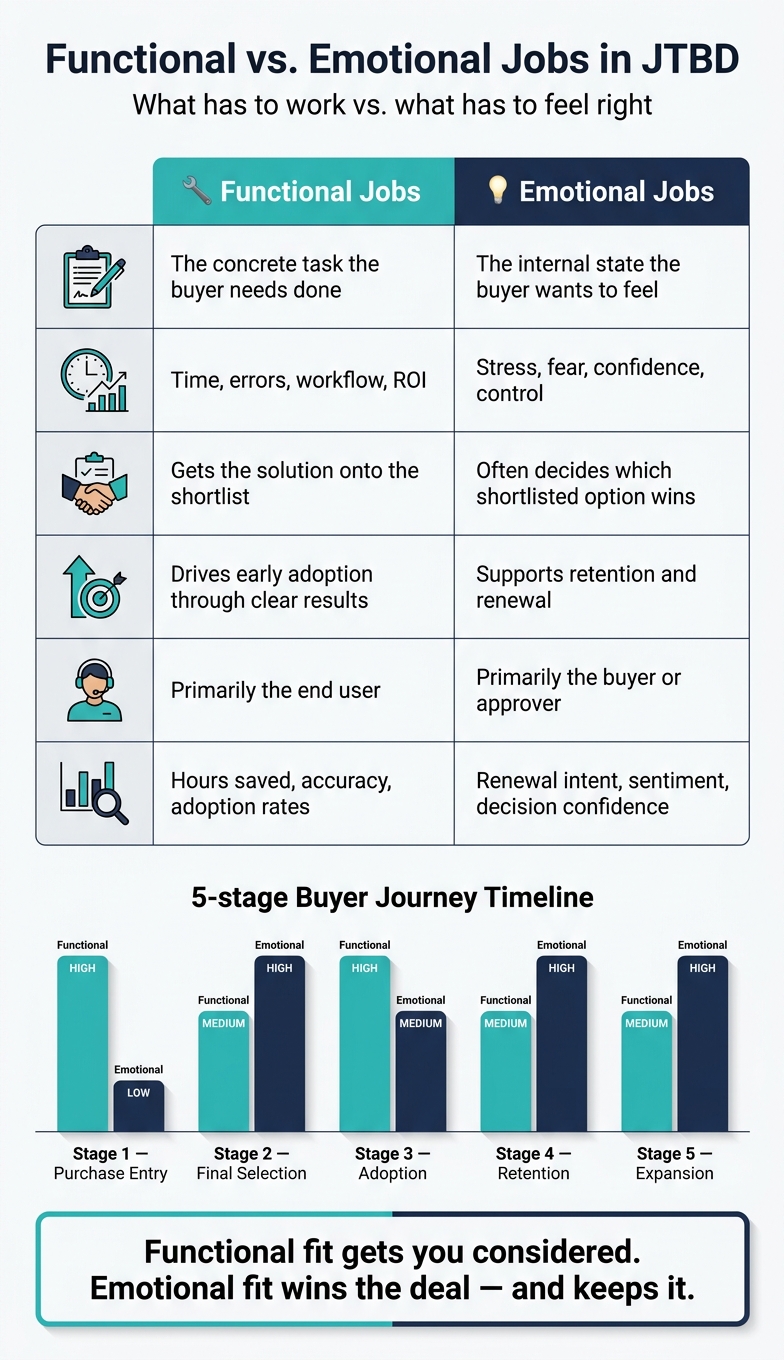
Functional vs Emotional Jobs in JTBD: Full Buyer Journey Breakdown
| Area | Functional Jobs | Emotional Jobs |
|---|---|---|
| What it means | The task the buyer needs done | The feeling the buyer wants |
| Common signals | Time, errors, workflow, ROI | Stress, fear, confidence, control |
| Role in buying | Gets a product on the list | Often decides the final pick |
| Role after sale | Starts usage through clear results | Supports stickiness and renewal |
| Main audience | Often the user | Often the buyer or approver |
| What to measure | Hours saved, accuracy, adoption | Renewal intent, sentiment, confidence |
Bottom line: when I look at JTBD the right way, I don’t just ask, “What does the customer need to do?” I also ask, “What does the customer need to feel?” That’s what keeps messaging, product choices, and growth work aligned.
JTBD splits buyer jobs into functional and emotional types. Each one affects a different part of the decision.
Functional jobs help a solution get considered. Emotional jobs often decide the winner.
That split matters. Buyers may start with a practical need, but the final choice often comes down to how a solution makes them feel about the outcome.
A functional job is the concrete task the buyer needs done: improve forecast accuracy, reduce reporting time, or streamline a workflow with fractional CFO services. These jobs show up in plain operating terms like time, accuracy, errors, and workflows.
Because functional jobs are specific, they’re usually easier to surface in interviews. Buyers can often describe them without much prompting.
If your product can’t credibly solve the practical task, it will have a hard time making the shortlist.
Emotional jobs describe the state the buyer wants: confident, in control, calm, or credible. These jobs rarely show up in formal documents, but they come through clearly in buyer conversations.
You’ll hear them when a buyer talks about wanting to trust the numbers, reduce anxiety, or appear credible to leadership.
When two solutions meet the same functional need, the one that reduces anxiety and builds confidence usually wins.
| Dimension | Functional Job | Emotional Job |
|---|---|---|
| Definition | Concrete task the buyer needs to complete | Internal state the buyer wants to feel |
| Interview signals | Time, accuracy, errors, workflows | Stress, fear, confidence, credibility |
| Role in decisions | Gets the solution onto the shortlist | Often decides which shortlisted option wins |
Next, look at how functional and emotional jobs affect choice and retention.
You can see this split most clearly when buyers move from a shortlist to final approval.
In growth-stage B2B, the choice often comes down to approval risk. Buyers need proof that the purchase will work. Just as important, they need to feel sure it won’t blow back on them if something goes wrong.
Functional fit gets a solution onto the shortlist. It shows that the product can do the job and deliver the outcome the buyer wants. But when two vendors check the same boxes, the last call usually comes down to something more human: which option feels safer to approve.
That’s where the emotional job steps in. It helps the buyer trust the provider and feel less career risk tied to the decision.
The same pattern shows up after the purchase.
Functional value drives early adoption. When a product does what it promised and does it well, users start building it into their daily workflow. Put simply, the practical payoff creates the habit.
Retention works a little differently. People stay when the product keeps delivering and the team lowers rollout risk over time. Buyers want reassurance. Users want results they can count on. That’s the emotional job in action: giving people confidence that the rollout will stick.
The table below shows how each job type shapes the buying journey.
| Stage | Functional Job Influence | Emotional Job Influence |
|---|---|---|
| Purchase Entry | Gets the solution considered based on measurable outcomes | Limited; buyers first screen for fit and ROI. |
| Final Selection | Validates that performance requirements are met | Determines the winner by reducing fear of a bad decision |
| Adoption | Drives usage when the product reliably delivers results with less manual work | Gives users the confidence to commit to a new workflow |
| Retention | Maintains a baseline of performance and error reduction | Keeps users loyal through ongoing support |
| Expansion | Proves functional value for new use cases or departments | Uses trust and proof of value to expand usage |
There’s one detail that matters a lot here: the buyer and the user often aren’t trying to get the same job done.
The buyer is often focused on approval risk, which is emotional. The user is usually trying to cut manual work, which is functional. If a solution only speaks to one side of that gap, it will have a hard time keeping both groups on board.
Use the same job split to guide both your messaging and your product roadmap.
JTBD messaging turns features into the job the buyer is trying to get done.
Feature-led messaging says: "Real-time dashboards with automated reporting." Job-based messaging says: "See your cash flow clearly enough to make weekly decisions with confidence."
That’s the shift. Instead of describing what the product has, you show what the buyer gets.
Functional messaging should lead with measurable outcomes. Emotional messaging should lead with reassurance, control, and confidence.
The same split that sharpens messaging should also shape what you build first.
Once you know which job a feature serves, prioritization gets much simpler.
Functional jobs should drive your core capabilities: workflow design, reporting outputs, and the metrics you use to prove value. If the buyer needs lower cost, better margins, or more predictable volume, the product should make those outcomes visible and measurable.
Emotional jobs should drive your trust-building layer: onboarding structure, progress visibility, support touchpoints, and small UI cues that show the rollout is working. This is where support touchpoints and visibility cues matter most, because they help users feel confident, not just informed.
| Dimension | Functional Job Focus | Emotional Job Focus |
|---|---|---|
| Messaging | Measurable outcomes, business impact, ROI | Reassurance, control, reduced professional risk |
| Onboarding | Speed to value, automation, workflow efficiency | Progress visibility, trust-building, confidence |
| Feature Prioritization | Core capabilities, workflow efficiency, reporting outputs | Progress visibility, support touchpoints, trust-building details |
| Support Design | Self-service, AI-driven technical resolution | Proactive, empathetic support that reduces user anxiety or frustration. |
| Success Metrics | Cost reduction, time saved, task completion rates | Retention, perceived control, decision confidence |
These choices should map directly to the metrics you track.
Functional jobs tell you what has to work. Emotional jobs tell you what has to feel right for a buyer to pick you, use your product, and keep paying for it. Put simply: functional jobs prove the value, while emotional jobs shape confidence.
A VP of Finance might need accurate, GAAP-compliant reports by the 5th business day. But before a board meeting, she also needs to feel sure the numbers will hold up. That’s the emotional job, and it often tips the final decision.
The same pattern shows up after the deal closes. Steady functional delivery - accurate outputs, faster closes, fewer errors - is the baseline, not the finish line. If buyers don’t feel in control, informed, or backed up, they can still churn even when the metrics look fine.
The practical test is pretty straightforward: track functional metrics like time-to-close, forecast accuracy, and hours saved alongside emotional signals such as renewal intent, buyer confidence, and qualitative feedback. One set shows you performance. The other shows you how safe and certain the buyer feels.
Teams that use both job types make better trade-offs, build features people care about, and keep customers who trust the relationship as much as the results. When you measure both performance and confidence, JTBD turns into a tool for growth, not just a research framework.
Interview customers one-on-one 30 to 90 days after purchase, when the experience is still fresh in their mind. That timing matters. Wait too long, and details get fuzzy. Talk too soon, and they may not have enough distance to explain what pushed them to buy.
Keep the conversation centered on what they did, not just what they think. Ask what was going on in their life or business at the time. Ask what problem they were trying to fix. Ask what other options they looked at before making a choice.
Use open-ended, neutral questions so you don’t steer their answers. Then dig a little deeper with why. That’s often where the good stuff shows up.
As you listen, pay close attention to emotion. Frustration, relief, and urgency can tell you as much as the facts do. And when customers describe their challenges, write down their exact words. Those phrases often become the clearest way to talk about the problem later.
In B2B, both buyer and user jobs matter because their motives are tightly connected.
Functional needs shape day-to-day use. But buying decisions aren’t based on function alone. Emotional and social factors matter too.
People often have to explain and defend their choice inside the company. So the product needs to do two things at once: deliver the core value users need, and help them feel safer, more sure of the decision, and better prepared to champion it across the organization.
Measure emotional jobs with qualitative research that shows how customers want to feel before, during, and after a task.
Talk to people one-on-one and pay close attention to the words they use. Frustration, urgency, and relief often show up in small phrases, and those phrases can tell you a lot about what matters to them.
Focus groups can help you get at the "why" behind behavior. They give people room to explain what they were trying to do, what got in the way, and what made the experience feel good or bad.
It also helps to dig into support tickets and sales notes. Those sources often reveal sentiment patterns you might miss elsewhere, especially when the same feelings keep popping up across different customer conversations.
This kind of research helps you spot emotional outcomes like confidence or status that shape product usage and loyalty.