Published on
August 12, 2026


If I were a founder reading this list, I’d focus on three things first: stage, check size, and business model. That one filter cuts through most of the noise fast.
This guide covers 19 clean energy investors across solar, wind, and storage. Some back seed-stage software, some fund Series A/B hardware, and some are built for first commercial deployments or utility-linked deals. A few patterns stand out right away:
I’d also keep one thing in mind: subsector alone is not enough. A solar software company and a solar hardware company often fit very different funds, even if both sell into the same market.
Quick Comparison
| Firm | Main Stage Fit | Check Size Signal | Best Match |
|---|---|---|---|
| Energy Transition Ventures | Early stage | Not public | Energy-transition startups with traction |
| Clean Energy Ventures | Seed, Series A | Not public | Clean energy with emissions impact |
| Congruent Ventures | Pre-seed to Series A | Not public | Early climate, solar, storage |
| Breakthrough Energy Ventures | Seed to Series D | $10 million to $550 million seen in deals | Deep tech, storage, hard science |
| Elemental Excelerator | First 2 commercial deployments | Non-dilutive | Field deployment |
| VoLo Earth Ventures | Seed, Series A | $10 million to $15 million Series A co-leads | Grid, supply chain, hard tech |
| SET Ventures | Early to growth | Not public | European energy tech scale-ups |
| Chrysalix Venture Capital | Series A, Series B | $2 million to $20 million | Hardware, industrial clean energy |
| Cycle Capital | Series A, Series B, growth | Not public | Grid, storage, batteries |
| Piva Capital | Series A, Series B | $5 million to $15 million | Deployment-stage industrial energy |
| Energy Impact Partners | Series A to C most often | $6 million to $198 million | Utility-linked energy transition |
| Energize Capital | Not public | Not public | Clean energy software |
| Prelude Ventures | Series A to C | $7.6 million to $130 million | Climate and solar |
| OGCI Climate Investments | Not public | Not public | Methane, CCUS, heavy industry |
| Lowercarbon Capital | Seed, Series A mainly | Seed: $2.7 million to $11 million; Series A: $6.5 million to $50 million | Climate with clear finance path |
| DCVC | Seed to Series B | Not public | AI, software, grid, storage tools |
| The Westly Group | Seed to mid-stage | Not public | Energy digitization |
| Ansa Capital | Series B, Series C | Not public | Growth-stage software platforms |
| 2150 | Early to growth | €5 million | Urban energy and buildings |
If I had to sum up the full article in one line, it would be this: the right VC is the one that fits your company today - not the one with the best-known name.
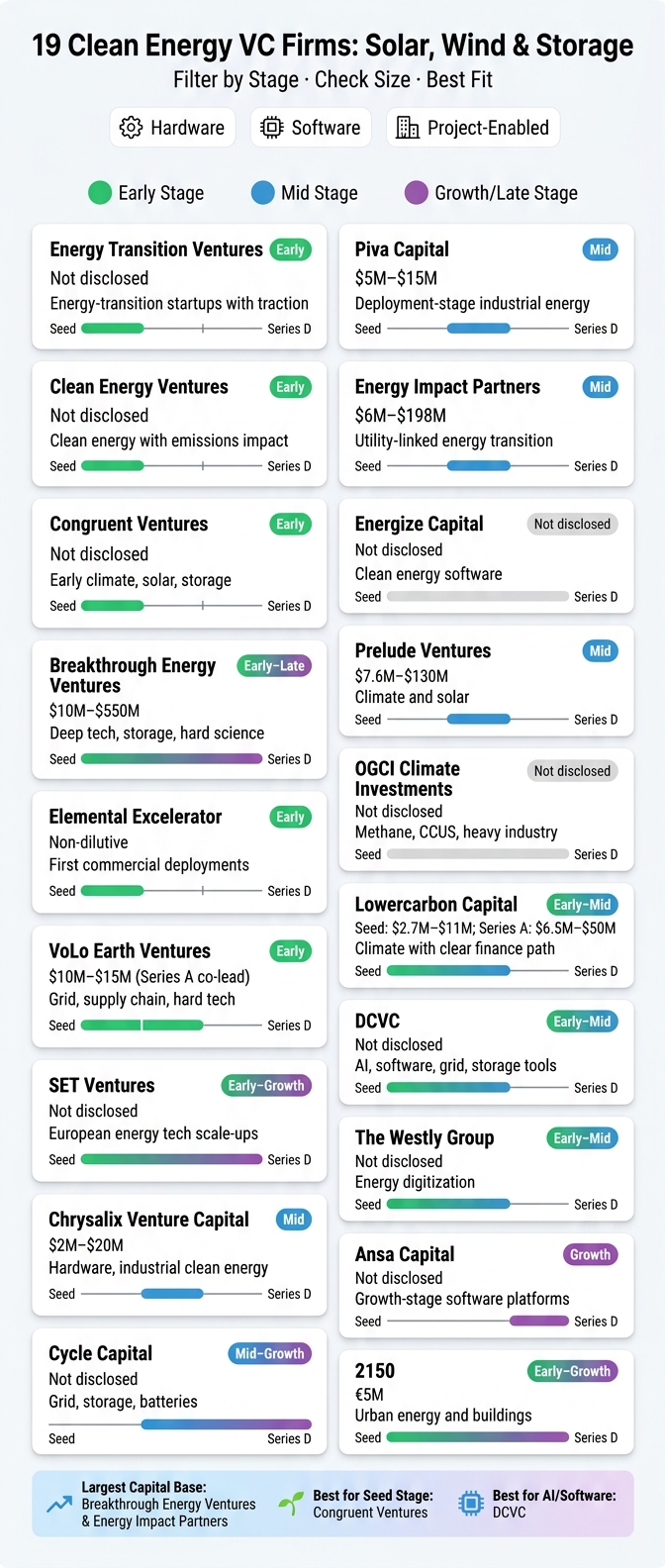
19 Clean Energy VC Firms: Stage, Check Size & Best Fit at a Glance
Each firm sits in the category - solar, wind, or storage - that best matches its main deal pattern. That said, most of these investors don’t stay in a single lane. Firms like Energy Impact Partners and SET Ventures back companies across the energy transition. The label here points to primary activity, not an only focus. [3]
So treat the subsector tag as a starting point, not the full story. Each profile below shows the fund’s actual stage, model, and check-size fit.
These three subsectors don’t work the same way, and that changes what investors want. Solar is more fragmented than wind or storage, so investor interest often comes down to the business model and the customer group a company serves. Wind and storage usually deal with longer permitting and build timelines than software-led clean energy models. On top of that, capital needs can swing from smaller venture checks to large project-finance facilities.
The business model split matters just as much as the subsector label. In each of the three categories, you’ll usually see three company types:
As you read the profiles below, keep those three filters in mind: subsector, business model, and capital needs.
Energy Transition Ventures (ETV) focuses on early-stage companies across the energy transition. So when you pitch them, traction tends to matter more than a fixed check size.
ETV does not publish a standard check size in public materials.
ETV backs early-stage companies, which means pilots and traction carry a lot of weight. In plain English: they want to see signs that the market is responding, not just a strong deck and big forecasts.
ETV leans toward energy-transition companies that can show commercial traction and a clear path to scale.
Lead with pilot results, traction, and unit economics. Put proof up front. If incentives play a role in the business, show that the model still works without them.
Compared with ETV, Clean Energy Ventures (CEV) has a tighter early-stage focus. The firm leans into Seed and Series A and backs climate tech companies that can drive large-scale emissions cuts.
CEV does not share a public standard check size.
CEV focuses on Seed and Series A.
The firm invests across the energy transition, with clear fit for startups tied to clean energy, electrification, and emissions reduction.
Before reaching out, founders should be ready to show measurable emissions impact. If you're building in solar, wind, or storage, that means spelling out the impact in plain terms and tying it to early traction.
So who fits best here? Founders with early proof and measurable climate impact. The bar is pretty straightforward: early proof, clear impact, and a clean energy use case.
Congruent Ventures invests in early-stage climate startups across North America, with a strong lean toward solar and a selective focus on storage. It also has one of the largest early-stage climate portfolios in the space. For this list, the firm lines up best with solar, while storage sits close behind. That makes Congruent a good match for founders who need early funding and want a climate-focused network around them.
There’s no public standard check size.
Congruent invests from formation capital, including pre-seed and seed, through Series A [3].
Its clean energy portfolio is strongest in solar and storage. One example is Form Energy, a long-duration storage company [4]. For founders, the bar is pretty clear: you need to show climate impact and venture-scale upside early.
Congruent looks for companies that can define a category [3] and pair venture-scale returns with measurable environmental impact. The firm also works closely with founders as they scale [3]. Its geographic focus is North America.
BEV sits at the deep-tech, larger-check end of clean energy venture capital. Breakthrough Energy Ventures (BEV) has built a portfolio of 83+ companies and has made at least 23 solar investments [3][5].
BEV doesn’t publish a set check size. Its recent deals show a pretty broad range, from a $10 million Seed round in Barocal to a $550 million Series C for Antora Energy [5].
BEV invests across the full startup path, from Seed through Series D [5]. It also runs a Fellows Program aimed at very early-stage technical ideas [5].
You can see that approach in how BEV groups its portfolio. The firm invests around five Grand Challenges: Electricity, Manufacturing, Agriculture, Transportation, and Buildings [3].
Within clean energy, BEV backs companies working on:
Representative portfolio companies include Form Energy, Antora Energy, and Planted Solar [4][5].
BEV tends to back deep-tech, hardware-heavy companies, often including university spin-outs [5]. That means founders usually need strong technical proof and a clear path to commercialization. That matters even more in long-cycle categories like fusion and multi-day storage, where the science may be strong but the road to market is longer and more demanding [5][4].

Elemental Excelerator isn't a standard VC fund, but it still earns a spot on this list. Why? Because it helps founders get past the pilot stage and into commercial deployment.
It's a nonprofit climate tech accelerator, not a fund built around plain equity checks. That makes it a strong fit for founders who need help getting projects deployed in the field, not just more capital on the cap table.
Elemental Excelerator provides non-dilutive funding for first-of-a-kind deployments.
It backs companies that are ready for their first two commercial deployments.
Its focus spans:
The thread running through all of it is simple: deployment-first climate solutions.
When reaching out, lead with pilot agreements, LOIs, and a clear commercialization timeline. Just as important, show evidence that the product has been validated in field conditions.[1][2]
If Elemental puts money into deployment, VoLo Earth puts money into the systems and supply chains that let that deployment grow. The firm focuses on the infrastructure behind solar, wind, and storage, with extra attention on grid software, industrial decarbonization, and critical materials. You can see that thesis in its approach: it invests early, goes deep on technical work, and stays close to manufacturing. [7]
VoLo Earth typically co-leads $10 million to $15 million Series A rounds. [7]
VoLo Earth focuses on Seed and Series A for hard-tech companies moving from prototype to production. [7]
Its portfolio goes after system bottlenecks, including grid orchestration and critical metals supply. Texture manages interconnection backlogs for renewable deployment. Nth Cycle is onshoring critical materials that support storage and clean-energy hardware. [7]
Founders should show standalone unit economics, signed customers, or de-risked manufacturing. It also helps to be ready for a nuts-and-bolts conversation about offtake, permitting, and supply chain exposure in concrete terms. [7]
SET Ventures leans away from hardware-heavy infrastructure plays and toward European energy-tech scale-ups. The firm is based in Amsterdam, was founded in 2007, and focuses on backing European energy-tech companies as they grow. [3]
SET Ventures does not publicly share a standard check size. [3]
SET invests from early stage through growth equity. Its sweet spot is scale-ups, and the team is known for active board participation. [3]
The portfolio is centered on smart energy, distributed energy, storage, and grid-scale tech. It also includes 18 solar investments. [3]
That setup tends to fit founders who can show that software, data, and hardware don't just sit side by side - they work as one system in the market.
This firm is a strong match for founders planning European market expansion. When you reach out, make the case in plain terms: show how your software or data layer improves the economics of your hardware. Also be ready for a hands-on investor relationship, including board seats. [3]
If the earlier funds leaned more toward energy software or deployment, Chrysalix sits closer to the hardware and manufacturing side. The firm backs energy and industrial hardware scale-ups, with a focus on Series A and Series B companies in the United States, Canada, and the Netherlands. As of May 2026, it had completed 21 energy-sector deals, which puts it among the top 50 most active VC funds investing in energy startups. [8]
Chrysalix usually joins rounds between $2 million and $20 million. If your raise falls outside that band, it may not be the right fit. [8]
The firm invests at the Series A and Series B stages. Founders should come prepared with traction, pilot results, or a clear plan for scaling. [8]
Chrysalix focuses on energy, manufacturing, and cleantech. It tends to be a stronger match for hardware-heavy companies in solar, wind, or storage. [8]
Reach out if your round is between $2 million and $20 million, your company is based in the U.S., Canada, or the Netherlands, and you can show technical validation along with early commercial proof. That puts you much closer to the kind of industrial clean energy company Chrysalix tends to back. [8]
Cycle Capital stays focused on the hardware and systems side of clean energy. The firm backs early- to growth-stage companies, with the strongest match in grid, storage, and battery infrastructure.
Cycle Capital does not publish a standard check size.
Cycle Capital invests mainly at Series A and Series B. It also has a separate growth fund for later-stage clean tech companies.
The firm focuses on:
If your company sits in storage, grid, or battery infrastructure, the fit is especially strong.
Cycle Capital is a better match for companies that are past proof of concept. That usually means you have pilots in market, early sales, or clear progress toward commercialization.
The strongest fit is for hardware and systems-level businesses in grid and storage.
Piva Capital invests in the shift across energy, industry, and materials. Its sweet spot is deployment-stage companies in industrial clean energy.
Piva usually writes initial checks between $5 million and $15 million.
The firm mainly invests at Series A and Series B. It may join Growth rounds from time to time, and it only rarely leads Seed.
For founders, the main filter here is stage fit. Piva tends to be a better match once the tech is out of the lab and heading into commercial deployment.
In plain English: if you're building clean-energy hardware or industrial tech and you've already validated the core product, Piva is much more likely to make sense than it would at the early idea stage.
After Piva’s deployment-stage industrial focus, EIP moves further upmarket into larger rounds tied to utilities. Energy Impact Partners (EIP) backs energy transition companies alongside utility and industrial partners. Founded in 2015, EIP has deployed more than $4.5 billion and manages over $2.5 billion. For founders building in storage and grid-facing markets, EIP stands out as one of the clearest utility-partnered options.
EIP joins rounds ranging from $6 million to $198 million across venture, growth, credit, and infrastructure.[8]
EIP is stage-agnostic, but it shows up most often in Series A, Series B, and Series C rounds.[8] As of May 2026, the firm had closed 25 relevant deals, which put it among the top 20 most active venture funds in the energy sector.[8] It also runs a dedicated European fund and focuses mainly on the U.S., Canada, and Germany.[3][8]
EIP’s portfolio covers both software-led businesses and hardware-heavy companies. Its main areas include energy storage, microgrids, grid security, and utilities management.[3]
Notable portfolio companies include:
Lead with utility-customer pull, partner validation, and clear unit economics. Have investor-ready financials in hand before you reach out.
Energize Capital invests in digital and software-led companies that improve the way clean energy assets get deployed and run. For founders in solar, wind, and storage, that usually makes Energize a better fit when your software helps with deployment, day-to-day operations, or grid integration.
Not publicly disclosed.
Not publicly disclosed.
Grid software, modernization, and operations software for clean energy assets.
When you reach out, lead with proof instead of vision alone. Show pilots, unit economics, and a clear plan for scale. In plain English: they’ll likely want to see that the product works, that customers find it worth paying for, and that growth won’t fall apart as demand picks up.
Founded in 2013 and based in San Francisco, Prelude Ventures backs early-stage climate startups. It doesn’t stick to energy alone, but its solar exposure puts it squarely on the radar for founders in this space. As of May 2026, the firm has made 19 investments in energy startups [8].
Prelude joins rounds ranging from $7.6 million to $130 million [8].
The firm focuses on early-stage companies, with deal activity spanning Series A through Series C [8].
Prelude invests across climate tech, and solar stands out as a clear area of focus. Its portfolio includes 17 solar investments [3].
If you’re building in clean energy, the big test is simple: can your company cut emissions at scale and deliver venture-style returns?
Prelude looks for category-defining companies with clear room to grow and measurable emissions impact. In your outreach, lead with the numbers that matter most:
That’s the stuff that helps the story land fast.
OGCI Climate Investments matters here because it funds emissions-cutting tech tied to the industrial energy transition. It’s a specialized investor backed by major oil and gas companies, with more than $1 billion under management. If you’re building climate infrastructure for heavy industry, this is a niche capital source worth knowing about.
Not publicly disclosed.
Not publicly disclosed.
The firm invests in methane detection and mitigation, carbon capture, utilization, and storage (CCUS), and industrial efficiency. In plain English, it’s a fit for startups working to cut emissions in oil, gas, and heavy industry.
That changes how founders should frame the pitch. Don’t lean on broad climate language. Lead with hard numbers, clear use cases, and where the product fits in day-to-day industrial operations.
Lead with:
This is the kind of investor that wants to see emissions cuts tied to commercial adoption. If the product saves money, reduces risk, or helps industrial buyers hit emissions targets, say that early.
Lowercarbon sits in the middle of two worlds: climate venture and capital-heavy energy deployment. The firm backs climate startups that can return venture-level outcomes, from emissions-focused software to energy tech that needs a lot more capital upfront.
Lowercarbon mainly invests at Seed and Series A [8].
| Stage | Typical Round Size |
|---|---|
| Seed | $2.7M – $11M |
| Series A | $6.5M – $50M |
As of May 2026, Lowercarbon had made 32 investments over the prior 12 months [8].
Lowercarbon had made 16 solar investments, and it also backs carbon removal and geothermal companies. These are capital-heavy climate businesses, but they also have clear paths to revenue [3][8]. Recent examples include Zanskar’s $115 million Series C+ and Cloover’s €1.04 billion Series A [9].
This mix tells you a lot about what founders should lead with. Climate impact matters, but it won’t stand on its own. You also need to show a financing plan that fits the company you’re building.
For hardware or project-heavy startups, spell out how the cap stack comes together. For software-led companies, tie the product straight to measurable emissions cuts [9]. Lowercarbon’s portfolio is also concentrated in the United States, the United Kingdom, and France [8].
After years of capital-heavy climate deals, DCVC puts the spotlight on software-led energy tools. The firm focuses on deep tech, with a sharp interest in AI and software built to solve energy problems.
Not publicly disclosed.
DCVC backs companies from Seed through Series B. As of May 2026, the firm had made 25 energy-relevant investments [8].
DCVC backs founders building AI models, software, and data-driven tools that help improve grid performance, storage systems, or asset output. This is not a fit for broad, catch-all energy startups. The focus is much tighter than that.
If you're reaching out to DCVC, lead with your data edge, model performance, and why your product is hard to copy. Show proof that the product works in practice, not just in theory. That means proprietary data, clear technical proof, and early customer traction matter a lot here.
Put simply, DCVC tends to fit founders with strong technical proof better than generalist energy startups.
The Westly Group is a strong match when clean energy intersects with digitization, operational software, or industrial systems. The firm invests in the digitization of energy, mobility, buildings, and manufacturing, with a geographic focus on North America and Europe [3].
Not publicly disclosed.
The firm backs seed to mid-stage companies [3].
Its portfolio is centered on energy digitization, smart buildings, and industrial systems. The firm has made 12 investments in the solar energy sector [3].
Founders building software or systems that improve energy, buildings, or industrial operations in North America or Europe are the best fit [3]. For solar, wind, or storage startups, the main question is simple: does the product help deployment, day-to-day operations, or asset performance?
Ansa Capital invests in growth-stage energy-transition companies. In plain terms, that means it looks for businesses that have moved past early proof and are now focused on scaling.
Ansa Capital has not publicly shared its usual check size.
The firm focuses on Series B and Series C companies with proven traction and a clear path to scale.
Ansa Capital backs software-led energy-transition platforms tied to:
This firm is a better match for Series B and Series C software and platform companies in clean energy. It’s not the right target for early pilot-stage startups or heavy hardware plays.
When reaching out, lead with traction, repeatable revenue, and expansion economics.
2150 is a European venture capital firm focused on better urban systems, including the energy infrastructure that helps cities run on clean energy. The firm backs companies working on the connected layers that keep cities moving: energy, buildings, infrastructure, and mobility.
It usually writes €5 million checks. Fund I closed at €270 million.
2150 invests from early to growth stage, with a focus on companies that are ready to deploy into urban markets.
Its main focus areas are:
2150 makes sense for founders building clean energy products that fit into urban systems, such as solar deployment, grid-edge infrastructure, or building-level energy management. Your pitch should lead with the city problem, show where you fit in the stack, and make the operational gain clear.
Next, compare 2150 with the other firms by stage, check size, and sector fit.
Use this table to compare the funds by stage, check size, and thesis at a glance.
It looks only at source-backed details for stage, check size, and fund thesis.
| Firm | Source-Backed Takeaway |
|---|---|
| Energy Transition Ventures | Early-stage energy-transition investor; traction matters more than a fixed check size. |
| Clean Energy Ventures | Seed to Series A; clean energy and emissions-reduction focus; no public check size. |
| Congruent Ventures | Seed and Series A focus; $300 million Continuity Fund for follow-on support [6]. |
| Breakthrough Energy Ventures | Seed through Series D; deep tech and gigaton-scale climate investing [6]. |
| Elemental Excelerator | Non-dilutive deployment capital for first commercial deployments. |
| VoLo Earth Ventures | Seed to Series A; hard-tech infrastructure and grid bottlenecks; $10 million–$15 million Series A co-leads. |
| SET Ventures | European energy-tech scale-up investor; early stage through growth. |
| Chrysalix Venture Capital | Series A/B hardware and industrial cleantech; $2 million–$20 million rounds. |
| Cycle Capital | Series A/B and growth fund; grid, storage, batteries, and efficiency. |
| Piva Capital | Series A/B deployment-stage industrial clean energy; $5 million–$15 million initial checks. |
| Energy Impact Partners | Venture, growth, and credit; over $4.5 billion in assets; 65+ utility partners [6]. |
| Energize Capital | Digital and software-led clean energy operations; stage and check size not public. |
| Prelude Ventures | Early to growth; hardware-tolerant [6]. |
| OGCI Climate Investments | Industrial emissions-cutting tech for methane, CCUS, and efficiency. |
| Lowercarbon Capital | Early to late; hardware-tolerant; more than $2.4 billion in assets [6]. |
| DCVC | Early to growth; AI/ML for climate and energy [6]. |
| The Westly Group | Seed to mid-stage digitization of energy, buildings, and industrial systems. |
| Ansa Capital | Series B/C software-led energy-transition platforms. |
| 2150 | Early to growth; €5 million checks; urban energy infrastructure and buildings. |
A few patterns jump off the page. Breakthrough Energy Ventures and Energy Impact Partners have the biggest capital base in this group. Lowercarbon Capital and Prelude Ventures stand out if you need a firm that can handle hardware-heavy companies. DCVC looks like the cleanest match for AI-driven energy tools. And if you're early, Congruent Ventures is the clearest seed-to-Series A player in the set.
Cold outreach often falls flat for a simple reason: the round, stage, or business model doesn't line up with the fund. Before you send a deck, filter each firm first.
Before you write a single line, make sure your round size and stage fit the fund's mandate. This sounds basic, but it's where a lot of outreach goes off the rails.
Multi-stage firms often divide capital by stage. That means you need to aim for the right fund and the right partner, not just the right logo on the website.
Once stage and check size line up, explain the business in the investor's language. The way you position the company matters just as much as the tech.
Give the model in one clear line, then connect it to the fund's thesis. Is the company best framed as hardware, software, or project-enablement? That call shapes how a fund prices risk and upside.
After the model is clear, bring proof. Lead with pilot results, commercial milestones, and unit economics.
For infrastructure-linked companies, things like signed PPAs, interconnection agreements, or ready-to-build status can remove a big risk flag early in the conversation. You also need to show that the unit economics still work under current policy conditions.
Next, package the numbers into investor-ready materials before outreach. Your model should be ready before you contact anyone.
If your finance stack isn't ready, Phoenix Strategy Group can help with bookkeeping, fractional CFO services, FP&A, data engineering, and fundraising support.
Start with fit: stage, check size, and business model. These firms vary on all three, and the wrong match can sink a good pitch.
Once stage and check size line up, look at whether the fund leans toward software, hardware, or project-enabled models. Your pitch should speak to how a given fund sees risk and return, not just what the tech does. [3]
Before you reach out, lead with pilots, unit economics, and financial readiness. Investors want proof that the product works, that customers will pay for it, and that the numbers stand up when someone digs in.
Use this list to narrow your targets before outreach.
Match the firm’s stage and traction requirements to where your startup is right now. Then spell out the unit economics investors are likely to back.
For early-stage companies, focus on funds that write checks at Seed–Series A once there’s clear market signal. That can look like signed enterprise contracts, paid pilots that convert, or strategic partnerships that show buyers are taking you seriously.
If you’re building in solar, wind, or storage, make the business model easy to underwrite. Put recurring revenue front and center. Show that the company still works after policy tailwinds fade. And be direct about exit paths, including M&A or IPO timing and fit.
Show strong balance-sheet discipline, clear financial health, and positive unit economics that still work without older tax-credit setups. Then build a detailed pitch deck that covers your business model, market opportunity, social impact, financial projections, team, and traction.
If your operation is more mature, come prepared with a QofE report that clearly separates project-EPC value from recurring O&M annuity revenue. That split matters because recurring revenue is a major driver of valuation.
Generally, no. Clean energy VCs don't need to be strictly software-only or hardware-only.
What matters more is stage, business model, revenue stability, and how tightly the offering is built into the customer's work. Tech-enabled, software-driven platforms may earn higher valuations, while more classic equipment businesses may trade at lower levels. So founders should focus on investor fit, not just the software vs. hardware label.