Published on
September 21, 2026

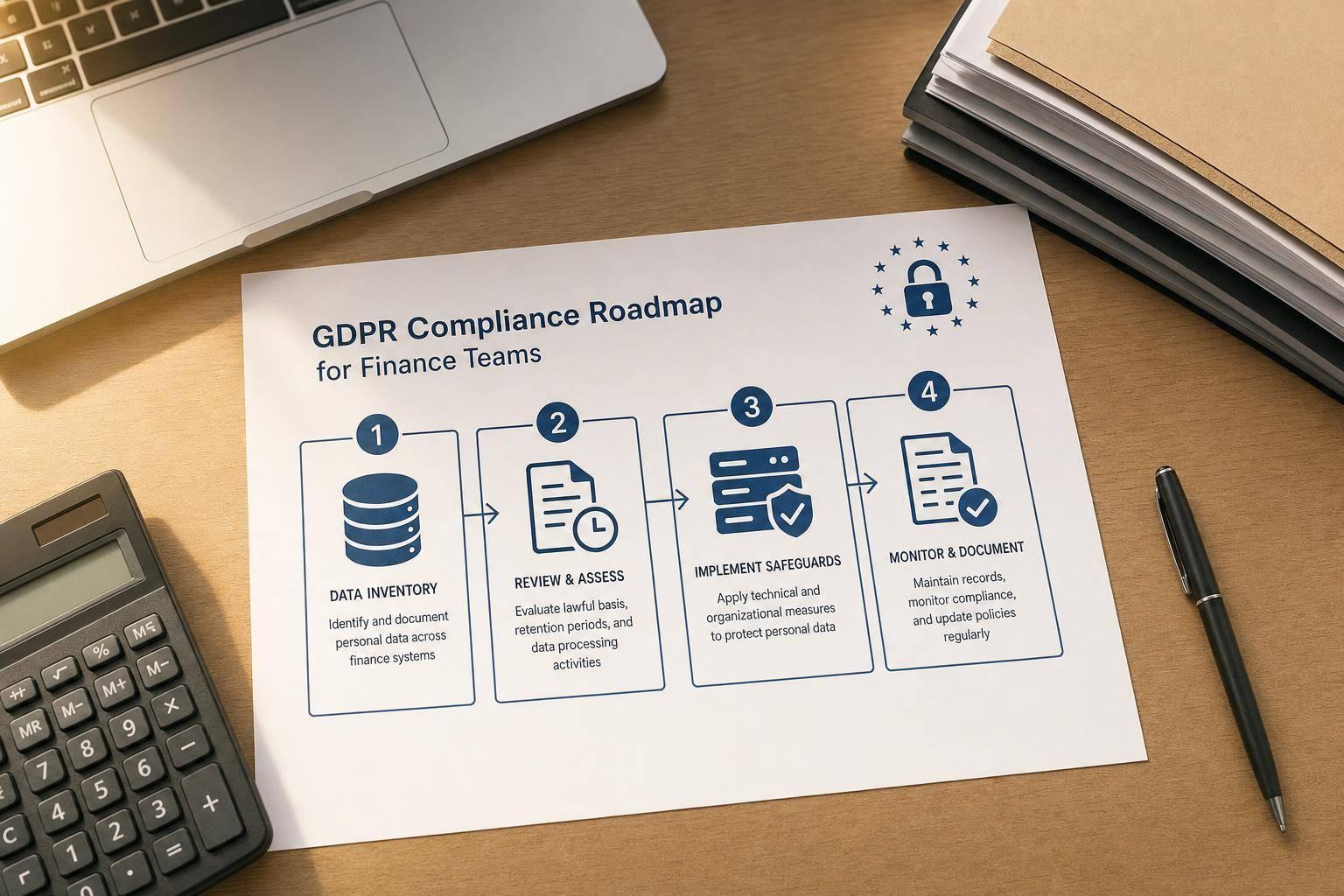
If your finance team touches EU personal data, GDPR applies faster than many U.S. companies expect. In this roadmap, I’d boil the job down to four moves: map your data, set rules inside daily finance work, check systems and vendors, and track proof that the process works.
Here’s the short version:
A few numbers make the risk plain. In 2025, the finance, insurance, and consulting sector saw 257 GDPR fines totaling €66.92 million. And Europe averaged 443 breach notifications per day that year. For a lean finance team, that means one thing: the best defense is clear ownership, clean records, and repeatable controls.
This roadmap is built for U.S.-based teams with lean headcount and covers bookkeeping, FP&A, and CFO workflows without changing how you close the books or report in U.S. dollars.
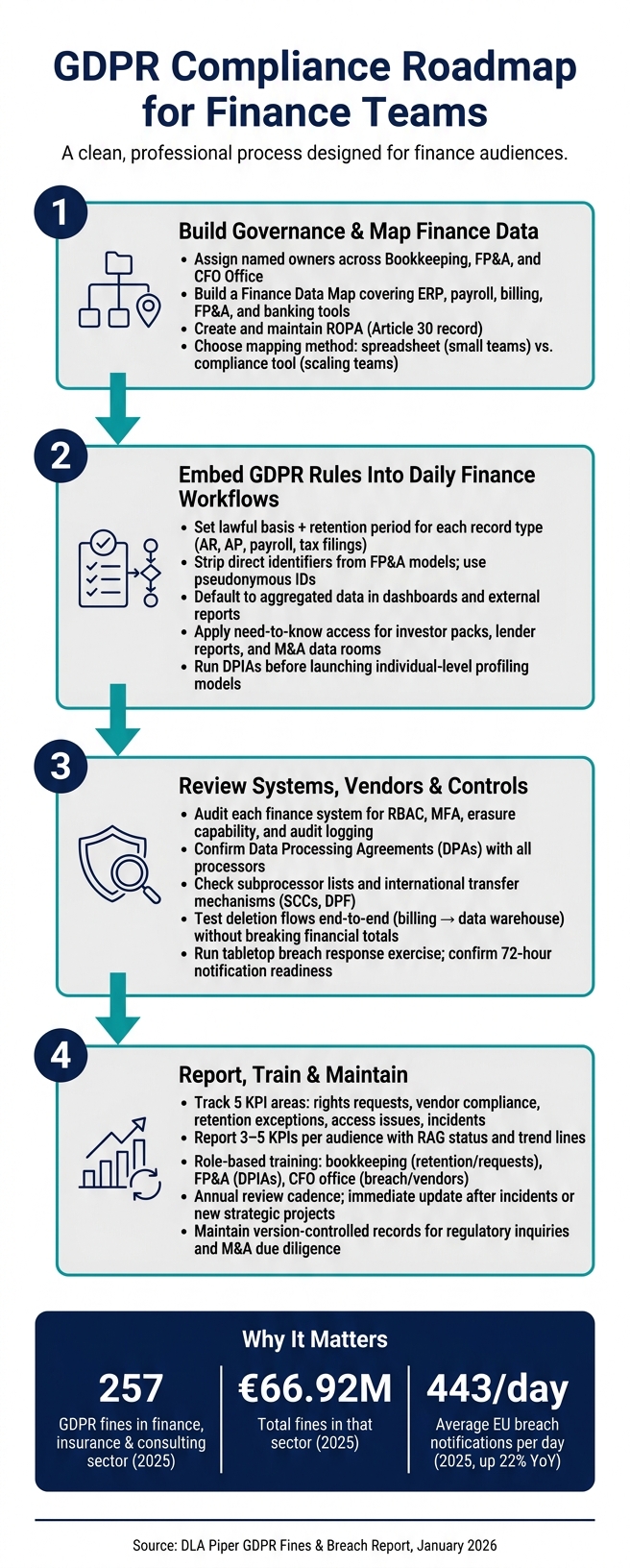
GDPR Compliance Roadmap for Finance Teams: 4-Step Framework
Start by turning the risk map into named ownership. Do that before you change policies or systems.
That means setting clear ownership across bookkeeping, FP&A, and the CFO office. In plain English: know what finance data you hold, how it moves, and who owns each processing activity.
Every finance team needs a named owner for each GDPR duty. If nobody owns the work, it tends to drift - especially when tools change or a data subject sends a request.
A simple RACI matrix for finance is a good place to start. System owners should update their entries whenever tools or workflows change. In a growth-stage company, ownership often looks like this:
| Responsibility | Typical Owner | Finance Function |
|---|---|---|
| ROPA updates | Financial Controller | Bookkeeping / Accounting |
| Retention rules | Head of Accounting | Bookkeeping |
| Vendor review | VP Finance or fractional CFO services | CFO Office |
| Rights request coordination | Finance privacy lead | Cross-functional |
| Breach escalation | Accounting Manager / FP&A Director | All finance functions |
The CFO office owns finance data strategy and sharing decisions. Bookkeeping and FP&A own day-to-day processing.
FP&A often works with data that was already collected under an existing lawful basis. So its main job is to check that any secondary use still matches the original purpose. It also needs to keep personal data out of models unless there’s a clear need for it.
Write this ownership into job descriptions and quarterly goals. If it lives only in a meeting note, it won’t hold up when the team gets busy.
Use the finance data map to build the ROPA required under GDPR Article 30. Keep that ROPA current. Regulators treat it as core evidence.
For each finance system - ERP, payroll platform, billing tool, FP&A software, or banking portal - capture:
One common mistake? Missing the personal data hiding in plain sight.
Personal data often sits in notes, attachments, and exports. It’s easy to miss because it doesn’t always show up in the formal inventory. Use sampling and workflow walkthroughs to spot that hidden data. Then add it to the map and remove fields you don’t need.
Once the map is done, use it to see which workflows need control changes.
The best method depends on two things: how messy your finance stack is and how fast the company is growing.
| Factor | Spreadsheet-Based Mapping | Dedicated Compliance Tool |
|---|---|---|
| Setup time | Hours to days; familiar to finance staff | Weeks; requires configuration and role setup |
| Maintenance effort | Manual updates; version control risk as systems change | Automated reminders and change tracking; requires licensing |
| Scalability | Works well for small stacks with limited EU data | Better suited as vendor count and data volume grow |
| Fit for fast-growing companies | Sufficient early on; becomes harder to maintain as systems multiply | Scales more cleanly; reduces manual coordination |
If you use a spreadsheet, keep it in a shared electronic format so the team can update it when systems, vendors, or workflows change.
The goal isn’t to pick the fanciest tool. It’s to pick the lightest one your team will actually keep up to date as finance systems grow.
Once your data map and ROPA are in place, the next job is simple in theory and harder in practice: turn them into day-to-day rules. GDPR controls should sit inside the finance workflow, not off to the side.
Start with bookkeeping. This is where lawful basis and retention decisions need to show up in routine processing, not in a policy that no one checks.
For core bookkeeping and tax recordkeeping, the main lawful basis is usually legal obligation. In day-to-day work like issuing invoices, handling accounts receivable and accounts payable, or paying vendors, contract may also apply. Each record type should be tagged in the process with its lawful basis, retention period, and deletion trigger.
Build a retention matrix for each category, including:
Typical retention periods are often 6 years for invoices and receipts from the end of the financial year, and 5–10 years for payroll records based on tax and pension rules.[2][3] Keep records only for as long as they are needed for accounting, tax, audit, and litigation duties. You should also define a legal-hold process so records are not deleted when they are needed for an active dispute, investigation, or audit. For other processing, document a legitimate interests assessment and keep it on file.[6][1]
FP&A is one of the easiest places for minimization to drift. Models tend to grow over time, and before long they start pulling in far more fields than the analysis needs.
Strip out direct identifiers from datasets used for forecasting, cohort analysis, or scenario planning. That includes names, personal email addresses, employee IDs that are not needed for the analysis, and Social Security Numbers.[4][7]
If individual-level tracking is needed, use pseudonymous IDs. Store the re-identification key separately, and still treat the dataset as personal data, because pseudonymized data remains personal data under GDPR.[7][8] For dashboards and external-facing reports, make aggregated data the default: revenue by segment, headcount by department, average salary bands. Move to individual-level detail only when there is a documented reason.
An FP&A data dictionary paired with a minimization checklist helps keep this under control. Every field in a planning model should have a one-line business justification.[4] If no one can explain why a field is there, it should come out.
If a model does individual-level profiling, run a DPIA before launch and again after material changes. A DPIA is not a one-and-done task.[5][7][9]
The same minimization rule applies when finance shares data outside the company. Investor updates, lender packages, fundraising data rooms, and M&A diligence all involve outside disclosure. The main control here is need-to-know access: each recipient should see only the minimum information required.[9]
Set role-based permissions in data rooms and log every disclosure with the recipient, date, dataset, and legal basis. Add watermarking and download controls. Investor updates and lender reports should default to aggregated financials, with individual-level data included only when required and documented.[9][1] For M&A diligence, make sure counterparty contracts include data protection clauses that cover purpose limitation, confidentiality, sub-processor controls, transfer safeguards, and deletion duties at the end of the engagement.
Rights requests also need a finance-specific response path. When a request reaches a financial record, document any lawful refusal to delete tax or accounting data, and mask fields that are not needed. Keep a ticket log for every request, including the date received, identity verification step, systems searched, decision made, and completion date. That log is your evidence if a regulator ever asks.[3][1]
Next, test whether your systems, vendors, and controls can carry out these rules the same way every time.
Once your workflows are mapped, the next job is simple in theory and tougher in practice: make sure the systems behind those workflows can actually enforce the rules.
A policy sitting in a shared folder doesn't do much on its own. If your tools, vendors, and incident process can't carry out that policy under normal day-to-day use, the gap will show up fast. This step is about pressure-testing what happens in the real world.
Start with a control checklist for each finance system that touches EU personal data. Use the systems already listed in your data map and ROPA as the review set. That usually includes your ERP, billing platform, payroll tool, treasury system, FP&A software, and data warehouse.
For each system, confirm four things:
RBAC should limit access based on job role. MFA should be required for privileged access and remote access. Use an authenticator app or hardware key, not SMS.
Erasure or anonymization needs to work in two cases: when a retention period ends and when a valid erasure request applies. Audit logs should show who changed what, when they changed it, and in which system.
It also helps to plug this review into work you're already doing. Tie it to quarterly access reviews and annual system audits so it doesn't become a one-off exercise that gets forgotten.
Any vendor that processes EU personal data on your behalf needs a Data Processing Agreement (DPA). That includes payment processors, banks, payroll providers, cloud ERP tools, and BI platforms.
The DPA should spell out:
Two areas need a close read.
First, check the subprocessor list and change notice terms. The DPA should name current subprocessors, such as cloud infrastructure providers and fraud tools. It should also require advance notice if that list changes, along with a right to object.
Second, review the international transfer terms. If a vendor stores or accesses data in the U.S. or outside the EU/EEA, the DPA should point to an approved transfer method, such as Standard Contractual Clauses (SCCs), Data Privacy Framework certification, or an equivalent method. It should also note any extra technical safeguards, like encryption.
Vendor review shouldn't stop at onboarding. Review vendor risk then, and do it again each year or when the contract comes up for renewal.
| Dimension | Basic vendor review | Structured recurring vendor risk program |
|---|---|---|
| Frequency | One-time at onboarding | Annual or tied to contract renewal |
| Scope | Legal terms only | Legal, security, transfer, and operational controls |
| Documentation | Minimal notes | Standardized templates and risk ratings |
| Monitoring | None ongoing | Tracks subprocessors, certifications, breach history |
| Finance integration | Isolated legal/IT check | Linked to vendor spend, budgeting, and financial controls |
Keep a processor register with the vendor name, purpose, data categories, processing location, transfer mechanism, and internal owner. That's the file you'll want when someone asks, Where does this data go? It's also what helps you respond to a rights request or audit question without a scramble.
This is where you move from review to proof. Run end-to-end tests across invoice, payroll, and analytics workflows.
Say you're testing deletion. You don't want to stop at the billing system and assume the rest will sort itself out. Confirm that removing a customer's personal data from billing also flows through to the data warehouse, and that it does so without breaking the financial totals underneath.
For breach response, run a tabletop exercise based on a realistic event. Use a payroll-system access incident as the scenario. Walk through detection, containment, internal escalation, and the call on whether regulatory notification is required.
The point is to confirm that you can meet GDPR's 72-hour notification window[10][11]. Just as important, make sure your DPAs require processors to alert you fast enough for that clock to be workable.
DLA Piper's January 2026 survey found an average of 443 breach notifications per day across Europe in 2025, up 22% from the prior year.[12] That's why rehearsed escalation paths matter. This isn't paperwork for its own sake.
Save the evidence as you go: screenshots, log exports, test results, approvals, and exception notes. You'll use that material in Step 4 for reporting and training updates. Feed those results into the reporting and training updates in Step 4.
Use the Step 3 test results to set how often you report, train, and review the program.
A practical finance privacy dashboard should cover five areas: open rights requests (count, average response time in days, and the percentage closed within the 30-day statutory window); vendor compliance (the percentage of finance vendors with current DPAs and the count of overdue reviews); retention exceptions (records kept past schedule, with documented justification); access control issues (unresolved inappropriate access or delayed deprovisioning); and incidents (count, severity, and hours from detection to containment).
Each metric should tie back to the finance function that owns it. Rights requests belong with bookkeeping, model risk sits with FP&A, and vendor and incident oversight belongs with the CFO office. For board-level reporting, keep it tight: 3–5 KPIs per audience, each with an owner, a baseline, a target, and a trend line across the last 3–4 quarters. Use Red/Amber/Green (RAG) status indicators so the picture is easy to scan. The CFO or finance privacy lead should also add a short note for any major shift. For example, retention exceptions may go up when new AML rules change record-keeping needs.
These KPIs should do more than sit in a report. They should trigger policy updates, training refreshes, and follow-up with the right owner.
Those metrics should feed the next control loop: policy updates and staff training.
GDPR's accountability principle (Article 5(2)) requires you to demonstrate compliance, not just achieve it.[15][17] In plain English, you need version-controlled records that you can produce during a regulatory inquiry, an audit, or M&A due diligence.
Once the metrics are set, assign them to the right finance owner and lock in the review cadence. The table below maps core finance processes to the documentation required, the primary owner, and how often each item should be reviewed.
| Finance Process | Key GDPR Documentation | Primary Owner | Typical Review Frequency |
|---|---|---|---|
| Bookkeeping & AR/AP | ROPA entries; retention schedule; ERP access policy; deletion procedures; vendor records; training logs | Financial Controller | Annual; update on any new processing, system change, or legal update |
| FP&A & Reporting | ROPA entries; data minimization guidelines; BI/data warehouse access policy; DPIAs for high-risk analytics; vendor records; training logs | FP&A Director | Annual; quarterly for high-change models; DPIA every 2 years or on material change |
| CFO Office & Treasury | ROPA for investor reporting and treasury; breach response procedures; vendor records; DPIAs for major initiatives; board privacy KPI definitions; training logs | CFO / VP Finance | Annual; immediate update after significant incidents or new strategic projects |
Training needs its own rhythm. Training logs and completion records are audit evidence.[18] Finance teams also need role-based training, not one generic session for everyone.
Annual refresh, 100% completion, and updated logs are the baseline.[13][14][16]
A finance-led GDPR program works as one continuous chain: map the data, control the workflows, review the systems, and report the results. None of these steps happens once and then disappears. Each one feeds the next, and the whole program needs to be revisited as the company adds systems, enters new markets, or brings on new vendors. A mature finance GDPR program should answer three questions fast: who owns the data, how long it is kept, and how breaches are handled.
Yes. GDPR applies to your U.S. finance team if you process personal data of people living in the European Union, even if your company has no physical presence in Europe.
GDPR follows the data, not your location. That means your team needs to meet the law’s rules for data protection, breach notification, and individual rights management when handling data tied to EU residents.
GDPR gives users the right to ask for their data to be erased. But in finance, that right doesn’t always mean records can be deleted on the spot.
Sometimes the law says you must keep them.
That often applies to records tied to AML compliance, tax reporting, and other financial rules. If a record falls under one of those rules, the finance team may need to keep it even after a deletion request comes in.
For example, some records, such as trading documents, order tickets, and client communications, may need to be kept for three to six years under SEC and FINRA rules.
When you deny a deletion request for this reason, spell it out clearly. Document the retention rule, note why the record must stay on file, and explain that the denial is based on a legal or regulatory duty rather than a choice by the company.
Keep a complete data inventory and Records of Processing Activities (RoPA) so you can find personal data fast across bookkeeping, FP&A, and CFO workflows within the one-month deadline.
That means knowing where data lives, who uses it, and how it moves through your finance stack. If a request comes in, you don’t want people digging through spreadsheets, inboxes, and old systems at the last minute.
Use automated workflows to retrieve, correct, or export data in a structured format. It saves time and cuts down on manual mistakes.
For erasure requests, document any legal retention exceptions, such as tax or AML requirements, and keep audit trails for every request. If you can’t delete something, you should be able to show why - clearly and in writing.