Published on
September 21, 2026


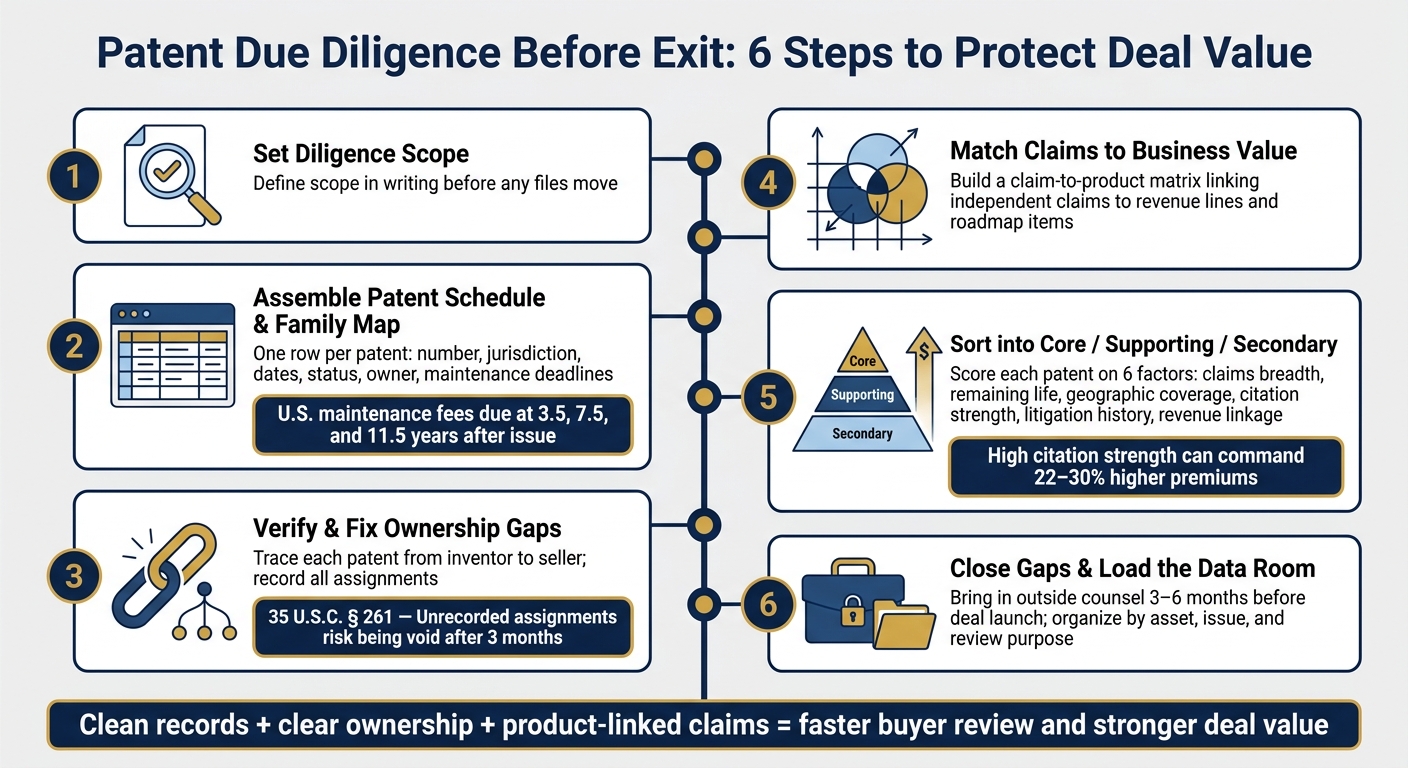
If your patent records are messy when a buyer starts diligence, your deal can slow down, get repriced, or pick up extra legal terms. In most exits, I’d focus on six things first: set the scope, build a clean patent list, fix title gaps, check claims against products and revenue, sort patents by deal importance, and load a clean data room before buyer review starts.
Here’s the short version:
A few points matter more than most. In the U.S., maintenance fees often come due at 3.5, 7.5, and 11.5 years after issue. And under 35 U.S.C. § 261, an unrecorded assignment can create risk if recording is delayed beyond 3 months. Those are the kinds of details buyers look for fast.
If I were preparing for an exit, I’d treat patent diligence as a value check, not a filing exercise, often collaborating with a fractional CFO to align IP strategy with exit valuation. Clean records, clear ownership, and product-linked claims usually make buyer review easier and cut down on back-and-forth.
Patent Due Diligence Checklist: 6 Steps to Exit-Ready IP
A complete patent package gives buyers what they need to review the portfolio without a string of follow-up emails. Use the diligence scope to pull these records into a buyer-ready set. If missing documents show up late in the deal - especially title gaps or unsigned inventor assignments - they can slow diligence or push the price down.[8][10][11]
The base of the package is a structured patent schedule: a spreadsheet or database export with one row for each patent or application. Each row should list the patent or application number, jurisdiction (such as USPTO or EPO), filing date (MM/DD/YYYY), priority date, issue date, expected expiration date, legal status (granted, pending, abandoned, or lapsed), and the current owner listed under the exact legal entity name. Add a column for upcoming maintenance fee deadlines too, so buyers can quickly see whether U.S. maintenance payments due at 3.5, 7.5, and 11.5 years are current.[13][6][7]
Next, build a family map that connects every continuation, divisional, continuation-in-part, PCT filing, and foreign counterpart to its parent priority application. Give each family its own ID - like F001 or F002 - and use that same ID across the schedule, the family map, and all filenames.
Stick to one file naming format across the package: FamilyID-Jurisdiction-Number-DocumentType-Date.pdf. For example: F001-US-10_123_456-IssuedPatent-09_15_2023.pdf. It sounds simple, but it saves a lot of back-and-forth. Buyer counsel can move through the files fast instead of pausing to figure out what belongs where.
Once the schedule is set, gather the backup documents in three separate groups.
Prosecution histories come first. For each family, collect the full prosecution record: the application, office actions, responses, claim amendments, interview summaries, restriction requirements, notices of allowance, and any RCEs or post-grant matters such as IPRs or reexaminations. Buyers review these records to see how the claims changed over time, whether key features were narrowed or disclaimed, and how much design-around risk may be in play.[4][6][2]
Chain-of-title documents matter just as much. Pull together inventor assignment agreements, any assignments between corporate entities, merger or restructuring records, employment IP agreements, and contractor IP agreements for every person who contributed to a patented invention. The assignment language should be in the present tense - "hereby assigns" - not just a future promise to assign. Also confirm that all assignments have been recorded with the USPTO and any other patent offices that apply. If transfers are missing or unrecorded, the deal can get delayed and the buyer may push for a lower price.[3][13][2][12]
Third-party rights and encumbrance documents come next. This set includes outbound licenses, inbound licenses, cross-licenses, options, covenants not to sue, security interests or liens listed in USPTO or UCC records, joint development agreements, and settlement agreements that limit enforcement. Organize them into clearly named subfolders so buyer counsel can review encumbrances without digging through a messy file dump:
Licenses_OutboundLicenses_InboundSecurity_InterestsJoint_OwnershipSettlementsWith the document package in place, the next move is to verify title and fix any ownership gaps. Keep the package lined up with the buyer's diligence checklist so the review can move straight into ownership and claim analysis.
Once the document package is together, the next job is to handle the two problems that most often drag out exit diligence: broken ownership chains and patent claims that don’t line up with what the company actually sells.
Trace each patent from the inventor to the current owner and fix any break in that chain before disclosure. The usual trouble spots are patents still recorded to founders, consultants, or inactive entities. If title gaps stay unresolved, they can block a transfer or lead to special indemnities that make the deal harder to close.
Start with the USPTO Patent Assignment Search. Work backward from the current recorded owner to the inventors, and check each link one by one. Then compare the public record with the package you already assembled. Under 35 U.S.C. § 261, an assignment that is not recorded within three months can be void against a later bona fide purchaser, so late or unrecorded transfers carry real legal risk.[20][19][9]
Also review liens and security interests that may still be sitting on the patents. If the patents were pledged as collateral in an earlier financing round, confirm that the release was recorded once the loan was paid off. For any gap, get a corrective or confirmatory assignment and record it before the data room opens. That upfront cleanup helps avoid delay and cuts down on price pressure.
Once title is clean, move straight to claim scope and business coverage.
After title is cleared, test each independent claim against the products and revenue it is supposed to protect. Independent claims set the broadest enforceable scope, so that’s where the review should start.[15][18][17] A simple claim-to-product matrix works well here. For each patent, note the independent claims, the product feature covered, the tied revenue line, and the type of coverage - whether the claim reaches the feature directly or only by implication.
That matrix helps split core patents from secondary assets fast. If a patent has no current link to product, revenue, or roadmap, mark it as secondary. Buyers pay the most attention to patents that support defensible product differentiation, licensing leverage, or blocking positions around current revenue.[15][14][16]
There’s another layer here that’s easy to miss: claims that were narrowed during prosecution. A patent can look broad on its face and still have less reach than expected. Limiting amendments and prosecution-history estoppel can shrink enforcement range in ways that aren’t obvious from the issued patent alone.[21][18] As you review, note the remaining term, any continuation coverage, and whether enforceability varies by market.
Once claims are mapped to products, the next step is to sort the portfolio by value and risk.
Rank the portfolio so buyers can quickly see which patents drive value, which back it up, and which sit on the edge. That kind of ranking helps buyers focus on the right assets first. It also shows the seller has already done the heavy lifting.
Use three tiers:
This ranking also sets the review order for outside counsel. Core patents get checked first. Lower-priority assets can be disclosed as such.
Score each patent against six factors:
| Ranking Criterion | What It Measures | Buyer-Facing Effect |
|---|---|---|
| Claims breadth | Legal scope of independent claims | Broader legal scope blocks more competitive entry |
| Remaining life | Years until expiration in key jurisdictions | Fewer than five years remaining scores lower [24][25] |
| Geographic coverage | Jurisdictions where rights are granted or pending | Coverage in priority jurisdictions such as the U.S., EU, China, and Japan drives higher priority |
| Citation strength | Forward citations, competitor references, and standards-setting use | High citation history can command 22–30% higher premiums [8] |
| Litigation/licensing history | Enforcement outcomes and license deals | Proven monetization supports higher valuation; unresolved challenges require risk allocation |
| Direct revenue linkage | Commercial exposure of covered products or features | Patents tied to core cash flows are the clearest driver of deal leverage |
A simple 1–5 scale for each factor gives you a total score that maps to the three tiers. Then have IP, product, R&D, and fractional CFO services or finance sign off on the final ranking. Core patents, supporting patents, and unresolved issues should each get their own tag or folder label, and those labels should carry into the data room.
Bring in outside patent counsel 3–6 months before the deal goes live. Their job is to test the portfolio ranking and spot legal gaps while there’s still time to fix them.
For core patents and key supporting patents, counsel should review prosecution histories, not just the issued patents. That’s where hidden trouble often sits: narrowing amendments, crowded prior-art fields, or estoppel that cuts down enforcement range. If gaps appear, the usual fix is a confirmatory or corrective assignment drafted and recorded with the USPTO before the data room opens. [19][1] Any lien or security interest left over from an earlier financing round also needs to be released if it hasn’t already been cleared.
Some problems won’t be fixed before signing. A pending third-party challenge, a non-assignable license, or a co-ownership issue can take time. In those cases, counsel needs to build the risk into the deal itself through specific IP reps and warranties, targeted indemnities with negotiated caps and survival periods, and escrow or holdback terms tied to the outcome of the open issue. [22][23] Put the issue on the table early and pair it with a proposed deal structure.
Package the ranked portfolio and unresolved issues into a buyer-ready data room next.
Once you’ve ranked the portfolio and logged the open issues, put everything into a buyer-ready data room. A clean room helps buyers find what they need fast. A messy one slows diligence before it even gets going.[31]
The simplest setup is to organize files by asset, issue, and review purpose. Put a master index spreadsheet at the center of it all. That index should map each patent family to its jurisdiction, status, expiration date, related products, and any encumbrances.[4][29] It also helps to use numbered folder prefixes so the order stays the same across platforms, like 01_Patent_Schedule, 02_Prosecution_Histories, and 03_Ownership_and_Assignments.[4][30]
| Folder Category | Required Documents | Review Purpose |
|---|---|---|
| Patent Schedule & Applications | Portfolio list by jurisdiction and status | Confirms portfolio scope and current legal status |
| Prosecution Histories | File wrappers and prosecution history | Assesses validity, claim scope, and amendment history |
| Ownership & Assignments | Assignments and IP agreements | Verifies chain of title from inventors to the selling entity |
| Licenses & Encumbrances | Licenses, liens, and use restrictions | Identifies restrictions on transfer or use |
| Litigation & Disputes | Disputes, post-grant matters, and settlements | Surfaces enforcement history and open legal risk |
| Maintenance Records | Fee receipts and deadline schedule | Confirms patents are current and helps avoid lapses |
| Commercial Relevance | Claim-to-product and revenue links | Connects the portfolio to business value for deal teams |
Before you open the room, set role-based access. Legal reviewers need ownership, licensing, and dispute files. Technical reviewers need claims, prosecution histories, and product mappings.[5][27][28] That way, people get what they need without exposing more than necessary.
Good file structure helps, but it won’t fix missing documents on its own. That’s where a live gap log comes in. Keep it next to the data room and use it to track every missing item, the patent family affected, the owner or team responsible, why the item is missing, the target completion date, and whether outside counsel or internal legal needs to handle it.[5][6] In plain English: it turns loose ends into assigned work.
Before buyers get access, do one last check. Make sure the schedule matches public records, assignments are recorded, maintenance is current, and every open issue is either resolved or logged.[5][1][26][27]
For complex exits, Phoenix Strategy Group can support M&A readiness and diligence coordination.
With the room set up and the gaps tracked, the last review is usually a short pass through ownership, maintenance, and disclosure.
The sellers who move through diligence fastest are usually the ones who started early. Each step in this guide builds on the last one. Define scope early, and you avoid document chaos later. Fix chain-of-title gaps before the data room opens, and you cut down on last-minute surprises. Map claims to business use, and buyers get a much clearer sense of what they’re buying.
It also helps to sort the portfolio into core, supporting, and secondary tiers. That keeps buyers focused on what matters most instead of treating every patent the same. Outside counsel can close legal gaps that internal teams can’t handle alone. Then a clean, indexed data room, role-based access, and a maintained gap log make life easier for every reviewer working through diligence.
Unrecorded patent assignments can create serious legal and financial risk during an exit. Under 35 U.S.C. § 261, an unrecorded assignment may be void against a later purchaser. In plain English, that can leave you with a broken chain of title and spark ownership concerns for buyers.
And that’s where deals can start to wobble.
If a buyer isn’t sure who owns the patent rights, the fallout can be expensive:
The fix is usually straightforward, even if it’s a bit of a paper chase. Secure retroactive assignments from the original creators, then record all transfers with the USPTO. If a contributor can’t be reached, Representations and Warranties insurance may help cover the gap.
Buyers care most about patents that protect the parts of a product that matter most: core features, main revenue drivers, and the edge that helps a company stand out.
They put more weight on patents that:
In plain English, a patent is worth more when it protects what the company actually sells, holds up in the markets that matter, and doesn’t come with legal loose ends.
Start patent due diligence years before a planned exit. In most cases, long-term prep starts 2 to 5 years in advance, and a formal chain-of-title audit should happen 18 to 24 months before exit.
When the deal starts taking shape, clean up IP records and confirm ownership 6 to 12 months before closing. Best case, you handle IP needs all along the way during development and each funding stage.