Published on
August 24, 2026


Many joint ventures fail because the partners do not line up on control, cash, IP, and exit. If I were reviewing a consortium JV today, I would focus on six things before signing: who can block decisions, who must fund the JV, what happens on default, how disputes get decided, who owns new IP, and how a member gets out.
The article’s core point is simple: a JV can help you win bigger work, but weak governance can trap cash, slow decisions, and turn a partner issue into a company-level problem. The piece points to failure rates of 40% to 70% and notes that 31% of large JVs end within five years. That is why I would not treat governance clauses like boilerplate.
Before I signed, I would make sure the agreement clearly covers:
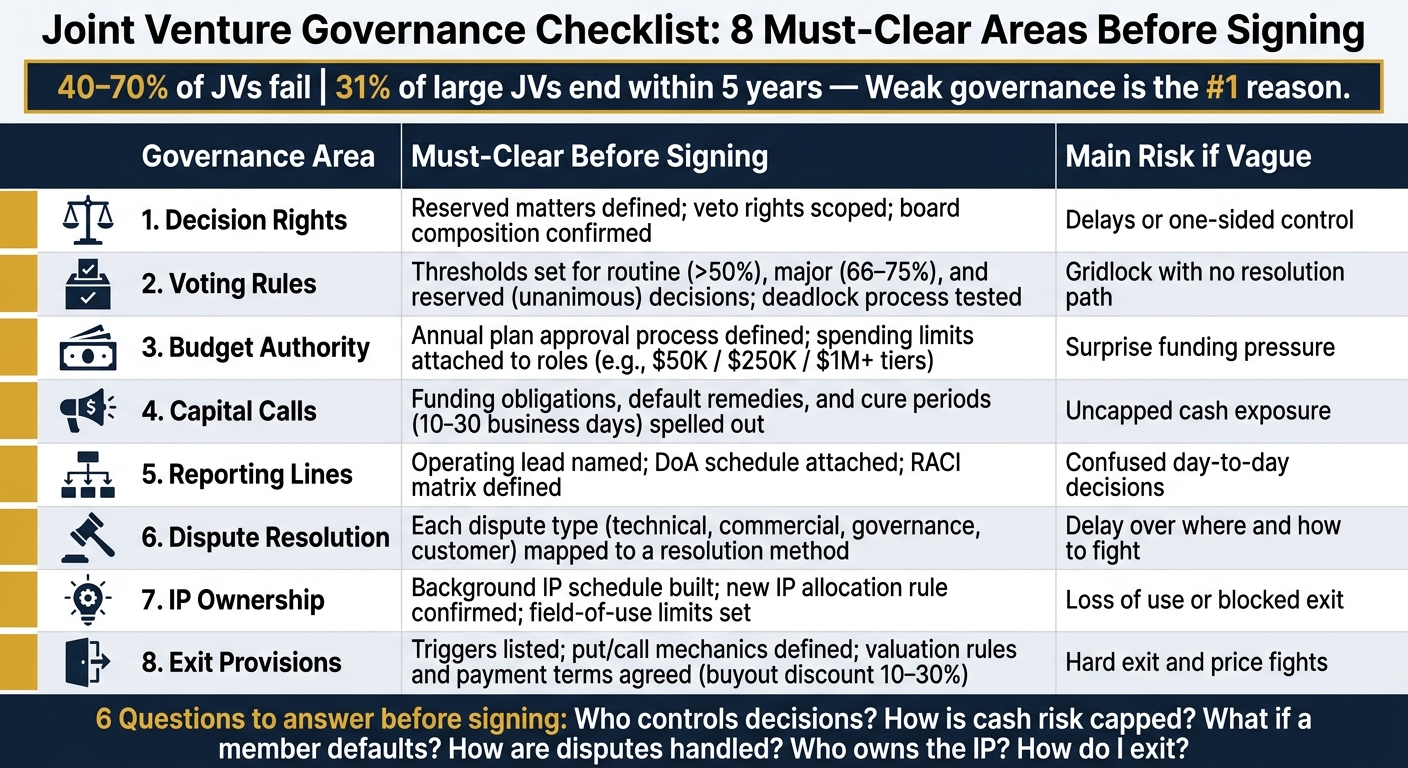
JV Governance Checklist: 8 Must-Clear Areas Before Signing
| Area | What I would confirm before signing | Main risk if vague |
|---|---|---|
| Control | Reserved matters, vetoes, board votes | Delays or one-sided control |
| Cash | Budget approval, capital call limits, default remedies | Surprise funding pressure |
| Management | Named lead, DoA, reporting lines | Confused day-to-day decisions |
| Disputes | Clear path by dispute type | Delay over where and how to fight |
| IP | Ownership, licenses, field limits, data rights | Loss of use or blocked exit |
| Exit | Triggers, valuation, payment terms | Hard exit and price fights |
If I could not answer those points in plain English after reading the draft, I would treat that as a red flag and fix it in writing before moving ahead.
Once each member's role is clear, the next issue is simple: who gets to approve, block, or push a decision upward. This is where many consortium JVs start to wobble. Before signing, go clause by clause.
Reserved matters draw the line between what management can do alone and what needs member sign-off. In a consortium JV, that list usually includes changes to the business plan, material capex, borrowing above a set threshold, issuing new equity, admitting a new member, approving major contracts, settling litigation, related-party transactions, and removing or appointing senior management.[5][7][9]
Get this list wrong, and problems show up fast. Too few reserved matters can leave partners exposed. Too many can bog the JV down and make normal execution feel like walking through mud.
A minority partner can also have more power here than many people expect. Even a 15% equity stake may be enough to block actions backed by the other 85% if veto rights apply.[10] If you're the minority, that's a strong shield. If you're not, it can be an expensive brake.
For each reserved matter, check:
Watch for vague words like material or significant with no hard threshold behind them. That kind of drafting is a common source of later fights.[5][7][13]
After you know which decisions need special approval, the next step is to see what that approval means in real terms. JVs use different voting models: ownership-percentage voting, one-member-one-vote, or a weighted setup. The agreement should spell out the formula and line it up with the JV's economics and board setup.[17][18]
In most cases, routine matters go by simple majority. Bigger strategic moves often need a supermajority. Fundamental changes usually call for unanimous consent.[12][16][17][18]
| Decision Type | Typical Threshold |
|---|---|
| Ordinary budgets, standard policies, routine contracts | Simple majority (>50%) |
| Annual plan approval, major financing, large vendor commitments | Supermajority (66%–75%) |
| Amending the JV agreement, changing business purpose, winding up | Unanimous consent |
| Issuing new equity without preemption protection | Unanimous consent |
Board composition matters just as much. Set the number of board seats, define quorum, and check whether minority members get affirmative approval rights on higher-risk issues.[15][17]
Then pressure-test the vacancy rules. If one board seat is empty, can the board still act? And if so, on which matters? If the agreement doesn't answer that cleanly, the quorum rule isn't finished.
As a rule of thumb, boards with 5 to 9 directors are usually workable for JV governance. Larger boards often slow decisions and make deadlock harder to sort out.[17]
Deadlock terms need an objective trigger. Don't rely on a fuzzy standard like "the parties disagree." A tighter clause links deadlock to something concrete: failure to approve a reserved matter after a set number of votes, repeated failure to meet quorum, or a budget still not approved after a stated date.[19][20][21]
That point matters more than it seems. A phrase like failure to approve a reserved matter sounds clear until a fight starts. Then the first argument becomes whether deadlock exists at all.
Once deadlock is triggered, the agreement should move through a fixed escalation path.[6][8][11][14]
1. Internal escalation
Senior executives or a named steering group try to resolve the issue within a set time window.
2. Mediation or expert determination
A neutral third party steps in. This tends to work well for valuation fights or technical disputes.
3. Binding mechanism
This could be arbitration, a chair's casting vote, or a buy-sell device such as a put/call or Russian roulette clause.
Buy-sell tools can force a result, but they come with real risk when one partner has much deeper pockets or better information than the other.[19][20][3] Before agreeing to one, check whether both sides have roughly equal financial firepower. If not, push for valuation formulas and financing contingencies that make the setup less one-sided. Courts in several jurisdictions often enforce well-drafted deadlock tools as valid commercial bargains when the contract wording is precise.[20][22]
Here's a simple test to run before signing:
If the parties disagree on the annual budget for 30 days, what happens next?
If the agreement doesn't give a clear answer, the deadlock clause needs more work.
Next, make sure those approval rules line up with budget authority and funding obligations.
Once decision rights are clear, the next stress point is money - who controls it, who can commit it, and what happens if a member doesn’t fund its share.
Require approval of the annual budget before the fiscal year starts. A sensible drafting target is to have management submit a draft plan 60–90 days before the start of the fiscal year, so members have time to review it, comment, and work through any issues.[27]
It also helps to decide, in writing, what happens if the parties can’t agree in time. A fallback budget can keep the JV running. In practice, that often means either rolling forward the prior year’s budget with a limited inflation adjustment or using a maintenance-only budget that limits new commitments until the full plan is approved.[27]
Spending limits are easier to use when they are tied to clear U.S. dollar amounts. For example:
For larger financial moves, the agreement should set a higher bar. Borrowing, guarantees, and credit facilities above $1,000,000 should require board or member approval, while projects above $5,000,000 should be reserved for supermajority or unanimous consent.[27] It also makes sense to set separate limits for capital spending outside the approved plan and tie thresholds to inflation or materiality tests so they still make sense over time.[27]
A capital call is a formal request for members to contribute more cash, usually based on their ownership percentages.[23] The agreement should answer four basic points: who can issue the call, how much notice is needed, when payment is due, and what happens if a member does not fund.[23]
In U.S. practice, 10–30 business days of notice is common. The notice should state the dollar amount, the purpose of the call, each member’s share, and the wire instructions.[23] Founders should be wary of open-ended capital call power and push for a cap on total extra contributions - for example, no new calls above 50% of initial committed capital without unanimous approval.[23]
Default remedies usually move in stages: first a cure period, then tougher sanctions if the default continues.[26] Common tools include penalty interest on the unpaid amount, suspension of voting rights, dilution if the non-defaulting members cover the shortfall, and, in the last stage, forced sale rights at a contractually defined price or formula.[1][24][25][26] Dilution matters for more than economics. It changes ownership percentages, voting power, and future profit allocations. That’s why cure periods and dilution mechanics should be proportionate and should not trip lender covenant issues by accident.[1][24][25][26]
Profit sharing should be just as clear. The agreement should spell out how cost overruns and savings are treated. Some JVs assign overruns to the party that caused them. Others split them pro rata. Gainshare mechanics, where operating partners keep part of the savings, can work well, but only if the terms are tight enough to avoid year-end fights over the math.[27]
Good financial reporting gives members an early warning before a capital call arrives or a budget problem gets worse. At a minimum, require monthly reporting on the income statement, balance sheet, cash flow, and budget-to-actual variance, along with written explanations for any line item that is off by more than 10% or $25,000.[27] Quarterly board packages should go further and cover project profitability, capex status, covenant compliance, and a forward-looking risk review.[27]
Rolling cash flow forecasts matter just as much as backward-looking reports. A 13-week cash flow forecast helps with near-term liquidity. A 12–24 month projection tied to the approved budget and capital call framework helps members see funding needs before they turn urgent.[27] It also helps to require a formal mid-year reforecast so the JV can adjust assumptions without reopening the full annual plan.[27]
Audit rights should also be clear. Require an annual independent audit with access to books and records, related-party transactions, capital account calculations, and support for management fees.[27][28] Records should be kept for at least three years after the final expenditure report, and longer if the law says so.[28]
Once funding and reporting rules are set, the next step is to define who runs day-to-day operations and how disputes move up the chain.
Pick the operating lead and spell out exactly what that person can do. If this part is fuzzy, even small decisions start to drag.
The JV agreement should name a specific role, such as the JV CEO, project director, or lead member, and attach a delegation of authority (DoA) schedule. That schedule should show transaction types, dollar limits, and the approval needed for each one. For instance, the JV CEO may be able to approve contracts up to $500,000 on their own, while anything above that goes to the board. Add a RACI matrix - Responsible, Accountable, Consulted, Informed - for core processes like hiring senior staff, approving subcontractors, managing quality control, and handling customer communications. Without that structure, teams tend to kick routine calls upstairs for no good reason. [34][35]
Each committee also needs clear guardrails: what it controls, how often it meets, and what must go into the minutes. Routine performance variances below 10% of budget should stay with management. Bigger gaps should go straight to committee review, along with a corrective action plan. [34][35]
If a member falls short on its duties, these operating rules should tie straight into the default provisions.
When a member doesn’t do what it promised, the governance setup should already say who steps in and what work can be shifted.
Call out default events in plain terms. That usually includes missed capital calls, failure to meet agreed milestones or workshare, confidentiality breaches, material regulatory violations, insolvency events, and unauthorized transfers of JV interests. Objective triggers matter here. A rule like failure to pay within a set number of days is much easier to run than vague performance language with no metric behind it. [30][12][33]
Cure periods should fit the problem. Missed payments or reporting failures may get a 10–15 day cure window. Performance failures that need new staffing or retooling may need 30–90 days. [30][33] If the cure period runs out and nothing is fixed, the non-defaulting members should get step-in rights. That means they can take over the defaulting member’s duties for the time being, charge those costs back to that member, and suspend that member’s voting rights on related issues.
If there are two uncured non-performance defaults within a 12-month period, the agreement may permit permanent reallocation of up to 50% of the defaulting member’s scope of work, along with a matching cut in its profit share. Before that becomes final, require an independent review. [31][32][33]
If the cure process fails, the agreement should direct the dispute into the right lane.
Set the first escalation step and the final forum for each kind of dispute before anyone is in a fight.
Here’s a practical map for the four dispute types that show up most often in a U.S. consortium JV:
| Dispute Type | First Step | Final Forum | Typical Timeframe | Founder Impact |
|---|---|---|---|---|
| Technical (e.g., design standards, specs) | JV technical committee | Independent expert determination | 30–60 days | Low cost, confidential, minimal disruption |
| Commercial (e.g., cost sharing, pricing) | Member executive escalation | Mediation → AAA arbitration in New York under New York law | 6–12 months | Medium-to-high cost; mediation preserves relationships |
| Governance (e.g., board deadlock, veto disputes) | Parent company CEO escalation | Expedited arbitration | 3–6 months | High strategic impact; focused and confidential |
| Customer-facing (e.g., delay penalties, warranty claims) | Customer contract provisions | Mediation → arbitration for internal allocation | Urgent; varies | High operational urgency; requires coordinated JV response |
The agreement should also line up governing law, venue, arbitral rules, language, and standing with the JV’s legal structure. This point gets missed more often than it should. In some consortium setups, a single member may not be allowed to start dispute proceedings on its own. Courts have found that only the JV entity - or all members acting together - can invoke those clauses. If the agreement states clearly who may start a case, you avoid that mess up front. [2][29]
Next, lock down IP, data, exit, and wind-down rights before signing.
After decision rights and dispute rules, the next step is to check who owns what the JV creates and how members can leave.
Separate background IP from new IP, and spell out who owns each one, who can use it, and under what terms.
IP is often the JV's most important asset, and it's also one of the hardest things to sort out when a venture ends. The agreement should draw a clear line between background IP - what each member brings into the deal - and new IP, sometimes called foreground IP, which the venture creates. If that line is blurry, ownership and usage rights can get messy fast.[39][41][43]
A common setup is simple: each member keeps its background IP and gives the JV a license to use it. New IP may then sit with the JV, be jointly owned, or belong to the member that created it, with licenses back to the other members.[41][42][44] Each option comes with tradeoffs:
| IP Ownership Model | Member Control | Monetization Flexibility | Exit Complexity |
|---|---|---|---|
| Background IP retained; JV gets limited license | High for the original owner | Owner can use IP outside the JV unless field-limited | Lower - JV rights end or continue as specified |
| New IP owned by JV | Collective via JV governance | Centralized; easier to license or sell as a bundle | Moderate to high; departing members rely on buyout terms |
| New IP owned by creating member with cross-licenses | Decentralized | High for each owner, but joint commercialization is harder to coordinate | High - multiple owners and cross-licenses complicate unwinding |
| Jointly owned new IP | Shared; key actions often need unanimous or supermajority approval. | Constrained unless the agreement allows specific licensing rights | High - valuation disputes and consent requirements can slow exits |
The agreement should also include an IP schedule. That schedule should list every piece of contributed background IP, identify the owner, and state whether it is being licensed or transferred to the JV. If it's licensed, the contract should say whether the license is exclusive or non-exclusive, whether sublicensing is allowed, and what limits apply to field of use, territory, and term.[41][44][46] It should also state who controls derivative works and whether improvements built on JV IP go back to the JV or stay with the member that made them.
Data rights need the same level of detail. Operational data created by the JV - like performance metrics, usage data, and sensor data - should be clearly assigned. In many consortia, that data is owned by the JV entity, while members get defined access rights. Data that a member brings in usually stays with that member and is licensed to the JV for specific uses. Post-termination access matters too. A departing member may still need historical data to review investment results or meet regulatory duties.
Next, check how those rights shift when someone withdraws or the venture ends.
The agreement should list clear, objective triggers for withdrawal or termination. Common triggers include material breach, insolvency, change of control of a member, project completion, persistent financial underperformance, and regulatory events.[4][37][48] Each trigger should connect to a stated exit process, with clear timelines and valuation rules. One common flashpoint is the right to keep using JV-developed IP. In many cases, jointly developed IP stays with the JV unless the parties agree to something else, and common termination triggers include milestone completion, breach, change in control, bankruptcy or insolvency, and put/call events.[48]
The exit tools you see most often are put/call rights, rights of first refusal, and drag-along/tag-along rights.[36][37][38] For each one, the agreement should say:
A defaulting member's buyout price is often discounted from fair market value, usually by 10–30%. A voluntary exit under a put right, by contrast, often uses an independent appraisal or a pre-agreed EBITDA multiple. If the remaining members don't have the cash for a lump-sum buyout, installment payments backed by secured obligations can help bridge that gap.
At wind-down, JV-owned IP is usually handled like any other JV asset unless the contract says otherwise.[39][47] Founders should confirm, in writing, what survives termination and what ends automatically. That includes licenses, confidentiality duties, and royalty streams. If a member will keep using trademarks, code, trade secrets, or data after exit, the contract needs an express post-termination license clause.[40][45]
Before signing, a founder should be able to answer six questions without pausing: Who controls key decisions? How is cash risk capped? What happens if a member defaults? How are disputes handled? Who owns the IP the JV creates? And how do I get out if the deal underperforms?
Before signing, check each item below and fix any gap in writing.
| Governance Area | Must-Clear Before Signing |
|---|---|
| Decision rights | Reserved matters defined; veto rights scoped; board composition confirmed |
| Voting rules | Thresholds set for routine, major, and reserved decisions; deadlock process tested |
| Budget authority | Annual plan approval process defined; spending limits attached to roles |
| Capital calls | Funding obligations, default remedies, and cure periods spelled out |
| Reporting lines | Operating lead named; reporting lines defined |
| Dispute resolution | Each dispute type mapped to a resolution method |
| IP ownership | Background IP schedule built; new IP allocation rule confirmed; field-of-use limits set |
| Exit provisions | Triggers listed; put/call mechanics defined; valuation rules and payment terms agreed |
First, founders need to agree on a shared vision and the venture’s main goals. Getting aligned on those big-picture points before digging into day-to-day or money matters can help cut down on confusion later.
Next, they should put a governance framework and communication plan in place. Early term sheets can also bring deal-breakers into the open and help everyone line up on major terms before formal contracts are signed.
Use governance design, not just veto power. Put a reserved matters list in place for big decisions that need unanimous consent, and leave day-to-day work to management.
It helps to bring in an independent board member as a tie-breaker. You should also spell out a clear, step-by-step dispute process and add deadlock clauses, like a shotgun clause, so disagreements lead to a decision instead of a stalled business.
Focus on three areas that tend to cause the most friction in a joint venture: performance rules, decision-making, and what happens if things go sideways.
For performance trigger/remedy provisions, spell out the metrics in plain terms. That usually means naming the KPIs, who measures them, how often they’re reviewed, and the exact timeline for fixing a miss. Don’t leave “underperformance” open to debate. Define the threshold, the cure period, and the consequence if the issue isn’t fixed. That consequence might be a step-in right, budget controls, loss of exclusivity, a forced review of management, or even an exit right. If money, delivery targets, service levels, or customer retention matter most, say so directly.
For governance, voting, and deadlock mechanics, set the rules before there’s tension. Identify which decisions can be made in the ordinary course and which fall under reserved matters. Reserved matters often include major spending, debt, hiring or firing senior leadership, changes to the business plan, new equity issuances, IP licensing, related-party deals, and a sale of the business. Then tie each category to a voting threshold: simple majority, supermajority, or unanimous approval. If the owners split 50/50, deadlock terms are a MUST. A good clause explains how a deadlock is declared, how long the parties must try to resolve it, and what happens next. Common tie-break tools include escalation to named executives, referral to an independent expert for narrow business issues, or a buy-sell process such as a shotgun clause or a call/put structure.
For breach, termination, and exit terms, be just as exact. List what counts as a material breach, the notice period, and the cure window. Then cover the events that can trigger termination or dissolution, such as insolvency, change of control, illegal conduct, loss of key licenses, repeated KPI failures, or long-running deadlock. The exit language should deal with the messy parts people often skip:
If one party brought in core IP, customer access, or regulated licenses, the agreement should say whether those rights end, continue for a transition period, or convert into a paid license after exit. The same goes for customer handoffs. If the venture shuts down, who services existing accounts, who collects receivables, and who handles support?
Add a clear dispute resolution ladder so there’s no scramble later. Keep it simple and step-based: first good-faith negotiation between business leads, then mediation within a set number of days, then binding arbitration if the dispute still isn’t resolved. Name the seat of arbitration, the rules, the number of arbitrators, the language, and whether either party can seek urgent court relief for things like misuse of IP, data issues, or nonpayment. That way, if a dispute hits, the path is already mapped out instead of being argued in the middle of the problem.